Tag Archives: Italian food

Italian Wedding Soup and Whole Wheat Spaghetti with Swiss Chard and Pecorino Cheese

Tonight I wanted to make something special for Sam after his fantastic first dance class. My four-year-old nephew and in-laws also joined us for dinner. Strangely, I’m more nervous cooking for kids than adults. Kids aren’t afraid to tell you they don’t like your food and are more than willing to go hungry if necessary to prove it. When I saw this recipe for tiny meatball-filled soup I figured the kids (even my chicken nuggets-loving nephew) would be amused enough to eat it, even if the adults weren’t as impressed. Luckily, both kids and adults enjoyed the soup. The whole wheat pasta with Swiss chard was also a hit. You can find these recipes and other kid-friendly fare at our new Family Favorites page at the top of the site.

Italian Wedding Soup
adapted from Giada’s Family Dinners by Giada De Laurentiis

Serves 6 to 8

for the meatballs:
1 small onion, grated
3 cloves garlic, minced
3 tablespoons chopped fresh flat-leaf parsley
1 egg
1 teaspoon salt
freshly ground black pepper
1/2 cup (50 g) grated Parmesan cheese
1/4 cup (25 g) plain dry breadcrumbs
1 lb (450 g) ground beef

for the soup:
8 cups (2 liters) low-sodium chicken broth
1 lb (450 g) escarole, coarsely chopped
2 eggs
1/2 cup (50 g) freshly grated Parmesan
salt and freshly ground black pepper

To make the meatballs, in a large bowl, stir together the onion, garlic, parsley, egg, salt and pepper. Using your hands, mix in the the cheese, breadcrumbs, and beef. Shape the meat mixture into 1‑inch-diameter meatballs (about 75). Place on a baking sheet or large plate.

To make the soup, bring the broth to a boil in a large pot over medium-high heat. Add the meatballs and escarole and simmer until the meatballs are cooked through and the escarole is tender, about 8 minutes. In a small bowl, whisk together the eggs and cheese. Stir the soup in a circular motion. Gradually drizzle the egg mixture into the moving broth for about 1 minute, stirring gently with a fork to form thin stands of egg. Season the soup to taste with salt and pepper. Ladle the soup into bowls and serve.

***

Whole Wheat Spaghetti with Swiss Chard and Pecorino Cheese
adapted from Giada’s Family Dinners by Giada De Laurentiis

Serves 6

3 tablespoons toasted walnuts or pine nuts
3 tablespoons olive oil
2 onions, thinly sliced
2 bunches Swiss chard, trimmed and chopped
3 garlic cloves, minced
1 x 14 oz (400 g) can diced tomatoes with juices
1/4 cup (60 ml) dry white wine
1/4 teaspoon dried crushed red pepper flakes
salt and freshly ground black pepper
12 oz (340 g) whole wheat spaghetti
1/2 cup (70 g) pitted Kalamata olives, coarsely chopped
3 tablespoons freshly grated Pecorino cheese

Preheat a small, heavy skillet over medium-low heat. Place the nuts in the hot skillet and stir them until they become golden brown and fragrant, about 5 minutes, taking care not to scorch them. Immediately place the toasted nuts in a separate bowl to cool and set aside.

Heat the oil in a large frying pan over medium-high heat. Add the onions and saute for about 8 minutes, until tender. Add the chard and saute for about 3 minutes, until it wilts. Add the garlic and saute for 1 minute, until fragrant. Stir in the tomatoes with their juices, wine, and red pepper flakes. Bring to a boil. Decrease the heat to medium-low, cover and simmer until the tomatoes begin to break down and the chard is very tender, stirring occasionally, about 5 minutes. Season the chard mixture to taste with salt and pepper.

Meanwhile, bring a large pot of salted water to a boil. Add the spaghetti and cook for about 10 minutes, stirring occasionally, until tender but still firm to the bite. Drain the spaghetti, add it to the chard mixture and toss to combine.

Transfer the pasta to a large bowl or platter. Sprinkle with the olives, cheese and nuts. Serve, passing extra cheese if desired.

Grilled Chicken with Gremolata, Slow Cooker Baked Potatoes, and Key Lime Coconut Cake

Sometimes I’ll try a new recipe and find myself shocked that it isn’t already part of my regular recipe rotation. You know the ones — quick, easy, cheap. This is one of those recipes. In the time it takes to preheat your grill, you can make a fabulously fresh-tasting paste of fresh herbs, lemon, and garlic to top the chicken. Serve the chicken with already cooked slow cooker baked potatoes (another I‑can’t-believe-how-easy-this-is preparation) and fresh steamed vegetables for a light but memorable dinner. If you have an extra half hour, you can whip up the equally quick, equally fabulous coconut cake. I knew it was a successful dessert when I noticed my usually sugar-avoiding mother-in-law sneaking slivers of it before dinner the following night.

Grilled Chicken with Gremolata
adapted from Giada’s Family Dinners by Giada De Laurentiis

Serves 4

1/4 cup (10 g) finely chopped fresh flat-leaf parsley
2 tablespoons extra virgin olive oil
1 1/2 tablespoons lemon zest
1 teaspoon finely chopped fresh oregano
1 teaspoon finely chopped fresh thyme
1 teaspoon finely chopped garlic
1 tablespoon olive oil
2 lb (900 g) skin-on, cut-up chicken (breasts, thighs, and/or legs)
salt and freshly ground black pepper

In a small bowl, combine the parsley, extra virgin olive oil, lemon zest, oregano, thyme, and garlic. Set the gremolata aside.

Preheat a charcoal or gas grill for medium heat. Rub the olive oil over both sides of the chicken. Season the chicken to taste with salt and pepper. Grill the chicken over medium heat until it’s just cooked through (10 to 15 minutes for breasts, 15 to 20 minutes for legs/thighs). Transfer the chicken to a platter. Immediately spoon the gremolata over the chicken and serve.

***

Slow Cooker Baked Potatoes

baking potatoes (as many as your slow cooker can hold)
aluminum foil

Wash the potatoes and prick them with a fork in a few places. Wrap each potato with aluminum foil. Place the wrapped potatoes in your slow cooker. Cover the slow cooker and cook the potatoes on low for 8 to 10 hours.

I gussied these up in the picture above by dicing the cooked potatoes, leaving the skins on, then topping them with melted butter, salt, pepper, and freshly chopped chives.

***

Key Lime Coconut Cake
adapted from Gourmet, March 2008

Serves 8

1 cup (90 g) sweetened flaked coconut
1/2 cup (110 g) unsalted butter, softened
1 1/4 cups (250 g) granulated sugar
1 tablespoon grated Key lime zest
2 extra-large eggs
1 3/4 cups (210 g) self-rising flour
3/4 cup (180 ml) whole milk
1/4 cup (60 ml) plus 1 tablespoon fresh Key lime juice, divided
1 1/4 cup (150 g) confectioner’s (icing) sugar
1 tablespoon rum (optional)

Preheat the oven to 350°F (180°C) with the rack in the middle. Generously butter a springform cake pan and line the bottom with a round of parchment paper.

Toast the coconut in a small baking pan in the oven, stirring once or twice, for 8 to 12 minutes, until it’s golden. Cool. Leave the oven on.

Beat together the butter, granulated sugar, and zest with an electric mixer until fluffy. Beat in the eggs 1 at a time. Stir together the flour and 1/2 cup coconut (reserve the remainder for the topping). Stir together the milk and 2 tablespoons lime juice. At low speed, mix the flour and milk mixtures into the egg mixture alternately in batches, beginning and ending with flour.

Spoon the batter into the prepared pan and smooth the top. Bake for 35 to 40 minutes, until golden and a wooden pick inserted into the center comes out clean. Cool the cake to warm, then turn out of the pan and remove the parchment paper.

Whisk together the confectioners sugar, the remaining 3 tablespoons lime juice, and rum (if using) and pour over the cake. Sprinkle with the remaining coconut.

Lemon and Pea Risotto with Parmesan Roasted Asparagus and Lemon Buttermilk Rhubarb Bundt Cake

To say my two-year-old son is a light eater is a bit of an understatement — he’s been known to go an entire weekend eating little more than a banana — but the night I made this risotto, he sat at the dinner table and practically chanted “more, more, more” in between mouthfuls and had a second helping.

As for the cake, I’d be hard pressed to think of a more perfect spring dessert than this. Light and lemony, it was still moist after three days — which is more than I can say for the overpriced “gourmet” cupcakes I bought in Dublin last week, which were so dry my children took only one bite and left the rest on the plate. My little boy might be a light eater, but he’s certainly a discerning one.

Lemon and Pea Risotto with Parmesan Roasted Asparagus
adapted from Nigella Bites by Nigella Lawson and Barefoot Contessa Family Style by Ina Garten

Serves 4

I love this lemon risotto on its own or as a springboard for adding in any number of other ingredients. Seafood is an obvious choice, and something like this roast fish wrapped in pancetta would be fantastic served alongside the risotto. I also like to serve it with grilled lemon chicken, or even leftovers from a slow roast chicken with vermouth.

These are the same flavors as in the gnocchi with peas, pancetta and lemon ricotta, so this is like a variation on that theme. If you wanted to make a little extra effort with the asparagus and aren’t concerned about the meal being vegetarian, you could omit the final sprinkle of Parmesan and wrap each stalk in a bit of Parma ham instead at the start, or perhaps simply crumble some cooked bacon or pancetta over the top of the dish for some extra flavor.

for the lemon and pea risotto:
4 tablespoons (60 g) unsalted butter
2 shallots or 1 small onion, finely chopped
1 rib celery, finely chopped
1 1/2 cups (300 g) risotto rice
1 cup (240 ml) white wine or extra-dry vermouth
approximately 1 quart (1 liter) vegetable stock
1 cup (140 g) fresh or frozen peas
zest and juice of 1/2 lemon
4 tablespoons grated Parmesan, plus extra for garnish
salt and freshly ground black pepper

for the Parmesan roasted asparagus:
1 bunch fresh asparagus
1 tablespoon good olive oil
salt and freshly ground black pepper
1/2 cup (50 g) freshly grated Parmesan

Preheat the oven to 400°F (200°C).

Heat the butter, shallots and celery in a wide, deep saucepan and cook to soften, about 5 minutes. Mix in the rice, stirring to give it a good coating of the butter. Allow it to cook for 1 or 2 minutes, until the grains of rice start to turn translucent. Add the white wine or vermouth and let it bubble away for a few minutes. Meanwhile, heat the stock in another saucepan and keep it at simmering point.

Once all the wine or vermouth has been absorbed into the rice, pour a ladleful of the stock into the rice and keep stirring until the stock is absorbed. Then add another ladleful and stir again. Continue doing this until the rice is al dente. You may not need all the stock; equally, you may need to add a bit more hot water. Don’t rush this process — allow the rice to fully absorb each ladleful of stock before adding the next one.

Meanwhile, once you’ve got the risotto going, snap off the woody ends of each asparagus stalk and discard. Lay the asparagus stalks in a single layer on a sheet pan and drizzle with olive oil, then sprinkle with salt and pepper. Roast for 15 to 20 minutes, until tender. Sprinkle with the Parmesan and return to the oven for 1 minute more, until the cheese has melted. Set aside and keep warm while you finish the risotto.

When you’ve added almost all the stock, test the rice — the risotto is ready when the rice is tender but still has a little bite. When the risotto is done, mix in the peas, lemon zest and juice and the grated Parmesan. Cook for a few more minutes, until the peas have thawed and are warmed through. Divide between 4 serving bowls or plates and top with the roasted asparagus stalks. Serve with more grated Parmesan if you wish, add seasoning to taste and serve immediately.

***

Lemon Buttermilk Rhubarb Bundt Cake
adapted from Rustic Fruit Desserts by Cory Schreiber and Julie Richardson

Serves 10 to 12

Ina Garten recommends having all your baking ingredients at room temperature, so I’ve modified the recipe slightly to add that instruction here. You really do need to have the butter softened, but if you forget to take the buttermilk and eggs out of the fridge beforehand, don’t worry about it.

for the cake: 
2 1/2 cups (300 g) plus 2 tablespoons all-purpose flour, divided
2 teaspoons baking powder
1 teaspoon salt
1 cup (225 g) unsalted butter, at room temperature
1 3/4 cups (350 g) sugar
zest of 1 lemon
3 eggs, at room temperature
1/2 teaspoon lemon extract (optional)
3/4 cup (180 ml) buttermilk, at room temperature
1 lb (450 g) rhubarb, trimmed and sliced very thin

for the lemon glaze: 
2 cups (240 g) sifted confectioners’ sugar (icing sugar), plus more if needed
juice of 1 lemon
1 tablespoon (15 g) unsalted butter, at room temperature

Preheat the oven to 350°F (180°C) and grease a 10-cup Bundt pan.

To make the cake, sift together the 2 1/2 cups (300 g) flour, baking powder and salt. Set aside. In a mixing bowl and using a hand-held mixer or a stand mixer with the paddle attachment, cream together the butter, sugar and lemon zest at medium-high speed for 3 to 5 minutes, until light and fluffy. Add the eggs one at a time, scraping down the bowl after each addition. Stir in the lemon extract, if using. Stir in the flour mixture in 3 additions, alternating with the buttermilk in 2 additions, beginning and ending with the flour mixture and scraping down the bowl occasionally. The batter will be very thick.

Toss the rhubarb with the 2 tablespoons of flour. Fold half the rhubarb into the batter and pour batter into the prepared pan. Sprinkle the remaining rhubarb on top.

Bake for 30 minutes, then rotate the pan and bake for an additional 30 minutes, or until the top of cake is firm and the center springs back when lightly touched. Cool the cake in its pan on a wire rack for 30 minutes before inverting and removing from the pan.

Meanwhile, to make the lemon glaze, whisk together the confectioners’ sugar, lemon juice and butter. The mixture should be thick. If it isn’t, add an additional 1 or 2 tablespoons confectioners’ sugar. Drizzle the glaze over the cake as soon as you remove the cake from the pan.

Covered with a cake cover or plastic wrap, the cake will keep at room temperature for 3 to 4 days.


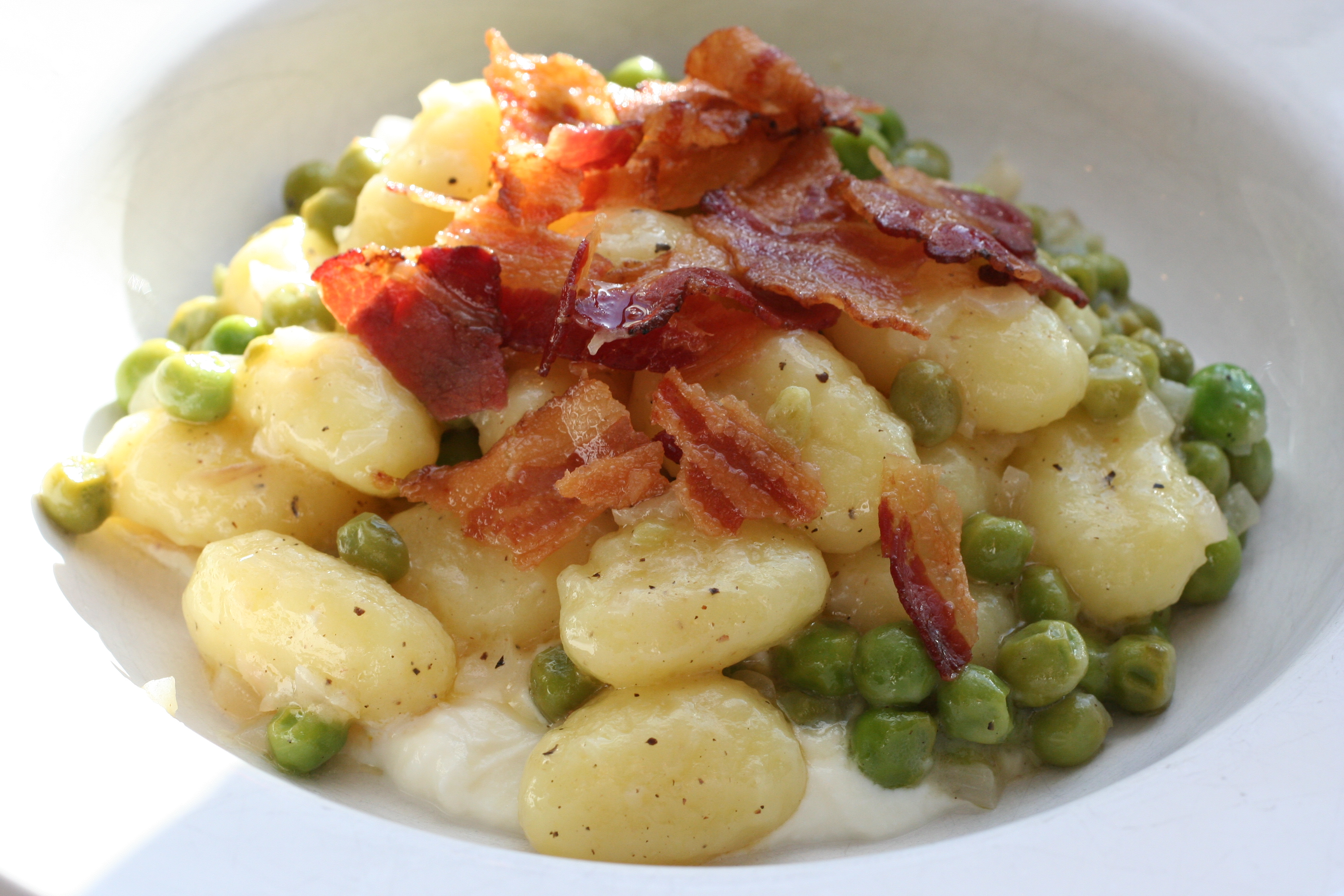
Gnocchi with Peas, Pancetta and Lemon Ricotta

I’ve been wanting to try my hand at making gnocchi for awhile now, but there’s only so far I’m only willing to go for a weeknight supper. I recently watched Tyler Florence making gnocchi on TV, and while it does look straightforward enough (not to mention something the kids would love to help with, since it looked like potato play dough), I cheated with a package of store-bought gnocchi but made the rest of his recipe, which comes together in less than half an hour.

This is an ideal dinner for this time of year. The potato gnocchi are still substantial and filling enough for spring evenings with a chill in the air, but the lemon brightens up the dish. Or if you’re having the kind of day where the last thing you want to face is cooking dinner, this requires minimal effort — the most taxing steps are chopping a shallot and zesting and juicing a lemon.

This was lovely just as it is, but I can see it being a springboard for other variations, perhaps with a cream and lemon sauce like the one in this lemon fusilli instead of the ricotta and pan sauce, with broad beans instead of the peas or with some finely chopped fresh basil or mint added in. A peppery arugula salad on the side would be perfect.

Gnocchi with Peas, Pancetta and Lemon Ricotta
adapted from Tyler Florence

Serves 4

If you quickly blanch the peas first it will help retain their green color, but honestly, could you be bothered? I’ll happily settle for dull green peas here if it makes for an easier life.

for the gnocchi:
1 lb 2 oz (500 g) store-bought gnocchi
4 oz (110 g) pancetta or prosciutto (or 6 slices bacon)
1 1/2 cups (200 g) frozen peas, thawed
1 large shallot, finely diced
2 tablespoons extra virgin olive oil
salt and freshly ground black pepper
2 tablespoons (30 g) butter
1/4 cup (25 g) freshly grated Parmesan

for the lemon ricotta:
2 cups (about 500 g, or 2 tubs) ricotta cheese
zest and juice of 1 lemon
salt

Preheat the oven to 350°F (180°C). (If using bacon instead of pancetta, preheat the oven to 400°F/200°C instead.) Bring a large pot of salted water to boil and cook the gnocchi according to the packet instructions (gnocchi usually only takes about 3 minutes to cook). Make sure you reserve about 1/2 cup (120 ml) of the cooking water for the sauce.

While the water is coming to a boil, place the strips of pancetta or bacon in 1 layer on a baking rack placed on top of a sheet pan. Cook for 8 to 10 minutes, until the pancetta is crispy. (If using bacon, this could take up to 15 or 20 minutes at the higher temperature, depending on how thick it is; cook until browned.) Drain on paper towels, then roughly chop into bite-sized pieces. Set aside.

Meanwhile, to make the lemon ricotta, place the ricotta in a mixing bowl and add the lemon zest and juice. Season with salt and set aside. (This could be done in advance and kept refrigerated.)

Heat the olive oil in a pan over a medium heat. Add the chopped shallots and gently saute for about 5 minutes, until fragrant and translucent. Add in the peas and toss gently to coat and heat through. Season with a little salt and pepper. Add the cooked gnocchi to the pan and gently toss. Add the reserved gnocchi water to the pan, then add the butter, sprinkle with the Parmesan and season again with salt and pepper.

To serve, spread a generous scoop of the lemon ricotta on the bottom of each plate. Ladle the gnocchi, peas and the pan sauce on top of the ricotta, then top with the crispy pancetta.

Polpette di Melanzane (Eggplant ‘Meatballs’) with Spaghetti and Tomato Sauce

I think most people by now have heard Michael Pollan’s famous advice: “Eat food. Not too much. Mostly plants.” One way of reaching this goal is to adopt the Meatless Monday approach. In a nutshell, it’s an international campaign to try to “reduce meat consumption 15% in order to improve personal health and the health of our planet.” Who can argue with that? I think the problem is that many people think vegetarian food is bland and boring — and let’s face it, some of it is. But if all vegetarian recipes tasted as outstanding as this one, I guarantee you wouldn’t even miss the meat in the dinner just once a week. My mom’s turkey meatball recipe is one of my all-time favorites, but I have to admit that I like this vegetarian version even better. They’re light, tender and have even more flavor than regular meatballs. And because they’re vegetarian, I didn’t feel at all guilty about sneaking a fourth polpette (I figured I’d work on that “not too much” part of the Pollan mantra some other time).

Polpette di Melanzane
adapted from Catherine Fulvio via the Good Food Channel; you can watch Catherine making these here and see just how easy it is

Serves 4 (makes 14 to 16 balls)

The original recipe calls for 2 teaspoons chopped mint and 1 teaspoon oregano, but I used basil and parsley simply because it’s what I had in my fridge. I used a modified version of Marcella Hazan’s tomato sauce here, but feel free to use your own favorite tomato sauce recipe or even a good-quality store-bought one. The polpette can be frozen, so you might even want to make a double batch. I certainly will the next time I cook this.

for the polpette:
2 large eggplants, cut in half
extra virgin olive oil
salt and freshly ground black pepper
4 large cloves garlic, finely chopped
2 cups (200 g) breadcrumbs
1 1/4 cups (125 g) freshly grated Parmesan or Pecorino cheese
2 egg yolks
1 tablespoon chopped basil
1 tablespoon chopped parsley
a pinch of grated nutmeg
1 lb (450 g) spaghetti, to serve

for the tomato sauce:
5 tablespoons (75 g) unsalted butter
3 cloves garlic, finely chopped
1 x 28 oz can (or 2 x 400 g cans) whole plum tomatoes, with their juices
1 medium yellow onion, peeled and cut in half
salt, to taste
6 basil leaves, chopped

To make the tomato sauce, melt the butter in a large saucepan. Add the garlic and sauté gently for 1 minute. Add the tomatoes along with their juices and the onion halves. Add a pinch or two of salt. Place over a medium heat and bring to a simmer, mashing up the tomatoes gently with the back of a wooden spoon. Cook, uncovered, at a very slow but steady simmer, adjusting the heat as necessary, for about 45 minutes, or until droplets of fat float free from the tomato and the sauce has reduced and thickened. Stir occasionally, continuing to mash any large pieces of tomato with the wooden spoon. Shortly before serving, stir in the chopped basil. Taste and add salt as needed. Discard the onion.

Meanwhile, to make the polpette, preheat the oven to 350°F (180°C). Rub the halved eggplants with olive oil and sprinkle with salt and pepper. Place them on a baking tray and roast for 25 to 30 minutes. Remove from the oven and leave to cool slightly.

Scoop out the flesh of the eggplants, place in a sieve and press gently to squeeze out the excess liquid. In a mixing bowl, mash the garlic and eggplant together, then stir in the breadcrumbs, Parmesan, egg yolks, basil, parsley and nutmeg. Add salt and pepper to taste.

Shape the eggplant mixture into golf ball-sized ‘meatballs’. Heat some olive oil in a pan and fry the balls in batches until golden, turning from time to time and taking care not to crowd the pan. Place on a paper towel to drain.

When the sauce is done, add the polpette and simmer gently for 10 to 15 minutes.

Meanwhile, cook the spaghetti in a large pot of boiling salted water. Drain well and serve with the polpette and tomato sauce.

Bacon, Leek and Camembert Risotto

If there’s one thing I’ve learned in the nine years that I’ve been in charge of organizing and hosting Christmas for my little family, it’s that Christmas is a lot of work. All the behind-the-scenes shopping, planning, decorating, wrapping, cleaning and cooking isn’t exactly the stuff of Norman Rockwell paintings, but someone (and we all know who) has to do it. It’s certainly made me appreciate how hard my own mother must have worked to make the holidays magical for me and my brother and sister when we were growing up. That’s why I love the Irish idea of Women’s Christmas (Nollaig na mBan) on January 6th, when women are meant to get the day off while the men do the housework, kind of like an extra Mother’s Day. What I can’t understand is why the idea isn’t spreading like wildfire. Who wouldn’t like a day off from housework, a girls’ night out and an extra present?

If Women’s Christmas was going to be celebrated in my own house (hint, hint Hubby), then this is the dinner I’d request to be made for me as one last calorific holiday indulgence (though I already made it on St. Stephen’s Day as a way to use up some of our leftover Christmas ham). Risotto is one of my go-to winter dishes, and this version is my absolute favorite. The leeks become meltingly soft and mild, the bacon adds its signature salty, smoky depth, and the Camembert in place of the usual Parmesan elevates the whole dish into something special. In fact, it’s the dinner I asked my husband to make me the day I came home from the hospital with our son. But don’t feel that you have to wait for a special occasion to make this. It would also be the perfect rib-sticking antidote to any long, dark, cold winter night.

Bacon, Leek and Camembert Risotto

Serves 4

If you can’t find or don’t care for Camembert, or if you want to make a less rich, more everyday kind of risotto, use 1/2 cup (50 g) of Parmesan instead. You can also use leftover ham instead of the bacon here, or for a vegetarian version, use mushrooms instead of the bacon.

4 tablespoons (60 g) unsalted butter
2 leeks, white parts only, sliced
1 1/2 cups (300 g) risotto rice (Arborio rice)
1 cup (240 ml) dry white wine or extra-dry Martini
2 pints (1 liter) good-quality vegetable or chicken stock
6 to 8 slices of bacon or pancetta, depending on how thickly cut the bacon is
8 oz (225 g) Camembert cheese
salt and freshly ground black pepper

Heat the butter in a wide, deep saucepan and add the leeks. Cook to soften, about 10 minutes. Mix in the rice, stirring to give it a good coating of the butter. Allow it to cook for a minute or two, until the grains of rice start to turn translucent. Add the white wine or Martini and let it bubble away for a few minutes. Meanwhile, heat the stock in another saucepan and keep it at simmering point.

Once all the wine or Martini has been absorbed into the rice, pour a ladleful of the stock into the rice and keep stirring until the stock is absorbed. Then add another ladleful and stir again. Continue doing this until the rice is al dente. You may not need all the stock; equally, you may need to add a bit more hot water. Don’t rush this process — allow the rice to fully absorb each ladleful of stock before adding the next one.

While the risotto is cooking, heat a separate frying pan and cook the bacon or pancetta until crisp. Drain on paper towels, then chop into bite-sized pieces. Set aside.

When you’ve added almost all the stock, test the rice — the risotto is ready when the rice is tender but still has a little bite. When the risotto is done, mix in the Camembert cheese and the bacon. Divide between 4 serving bowls or plates, add seasoning to taste and serve immediately.

Easy Pasta Supper with Marcella Hazan’s Tomato Sauce

I’ve eaten so much pasta in my life that my blood must be part durum wheat by now. My childhood memories of dinner are crowded with images of a big bowl of salad and a basket of garlic bread on the table and a pot of spaghetti on the stove, with a huge bucket of Kemp’s ice cream in the freezer for dessert. It’s no wonder, then, that pasta is still my go-to comfort food or the first thing I think of when I want a quick dinner. After two weeks of time-consuming holiday cooking, I’m in the mood these days for something effortless but still satisfying. This famous tomato sauce from Marcella Hazan fits the bill on both counts. The recipe couldn’t be easier — melt some butter, put a halved onion in the pan, pour in some canned tomatoes and let it all simmer for 45 minutes — but the result is an alchemical kind of magic. It’s the little black dress of pasta sauces — simple, sophisticated and versatile. You wouldn’t think it was possible for a humble can of tomatoes to be transformed into such a silky-smooth sauce so full of flavor, but don’t wait much longer to try this and see for yourself. Add in a baby leaf salad tossed with my favorite balsamic vinaigrette, a loaf of Parmesan garlic bread and a nice bottle of wine, and my favorite childhood dinner feels all grown up.

Marcella Hazan’s Tomato Sauce
adapted from Essentials of Classic Italian Cooking by Marcella Hazan

Makes enough sauce for about 1 lb (450 g) of pasta, or 4 servings

5 tablespoons (75 g) unsalted butter
1 medium yellow onion, peeled and cut in half
1 x 28 oz can (or 2 x 14 oz/400 g cans) whole plum tomatoes, with their juices
salt and freshly ground black pepper

To make the tomato sauce, melt the butter in a large pot (one that can also accommodate all the pasta later) over a medium heat, then add in onion halves and pour in the tomatoes with their juices. Season generously with salt and pepper. Bring the sauce to a simmer, mashing up the tomatoes gently with the back of a wooden spoon. Cook, uncovered, at a very slow but steady simmer, adjusting the heat as necessary, for about 45 minutes, or until droplets of fat float free from the tomato and the sauce has reduced and thickened. Stir occasionally, continuing to mash any large pieces of tomato with the wooden spoon. Taste for seasoning, then discard the onion when the sauce is ready. Add your cooked, drained pasta directly to the sauce in the pot and stir until all the pasta is coated.

***

Balsamic Vinaigrette
adapted from Epicurious, March 2003

Makes about 3/4 cup (180 ml)

3 tablespoons balsamic vinegar
1 tablespoon Dijon mustard
1 garlic clove, minced
1/2 cup (120 ml) olive oil
salt and freshly ground black pepper

In a screw-top jar, combine the vinegar, mustard, garlic and oil, shaking well to combine. Season with salt and pepper to taste.

Turkey Tetrazzini and Cranberry Buckle

This is one of my favorite ways to use up leftover Thanksgiving turkey. It’s an adaptation of Jamie Oliver’s chicken and mushroom pasta bake recipe (spaghetti tetrazzini), which he says is “really tacky but gorgeous.” It got me thinking about how foods or recipes are as subject to trends as anything else. Chef’s salad, cheese fondue, shrimp cocktail and deviled eggs have all had their day (though I still love shrimp cocktail and deviled eggs). But how could you go wrong with wine and cream? That will never go out of style as far as I’m concerned. What are some of your favorite tacky or untrendy foods?

Turkey Tetrazzini
adapted from Jamie’s Italy by Jamie Oliver

Serves 4

1 oz (20 g) dried porcini mushrooms
2 cloves garlic, finely sliced
12 oz (340 g) button mushrooms, cleaned and sliced
1 cup (240 ml) white wine
2 to 3 cups cooked shredded or diced turkey
1 lb (450 g) spaghetti
2 cups (480 ml) heavy cream
salt and freshly ground black pepper
2 cups (200 g) freshly grated Parmesan cheese
extra virgin olive oil

Preheat the oven to 400ºF (200ºC).

Put the porcini mushrooms in a bowl and pour over just enough boiling water to cover them (approx. 1/2 cup /120 ml). Put to one side to soak for a few minutes.

Strain the porcini, reserving the soaking water, and add them to a frying pan big enough to hold all the ingredients (including the pasta) with the garlic and fresh mushrooms. Add the wine and the strained porcini soaking water and turn the heat down. Add the turkey to the pan. Simmer gently until the wine has reduced a little.

Meanwhile, cook the spaghetti in plenty of boiling salted water according to the packet instructions and drain well. Add the cream to the pan of turkey, then bring to the boil and turn the heat off. Season well with salt and freshly ground black pepper. Add the drained spaghetti to the creamy turkey sauce and toss well. Add three-quarters of the Parmesan and stir well. Transfer to an ovenproof baking dish or nonstick pan, sprinkle with half the remaining cheese and bake in the oven until golden brown, bubbling and crisp. Divide between your plates, drizzle with extra virgin olive oil and sprinkle with the rest of the cheese before serving. (Alternatively, you could serve this right after adding the drained spaghetti and Parmesan to the creamy turkey sauce and skip putting it in the oven.)

***

cranberry buckle

Cranberry Buckle with Vanilla Crumb
adapted from Rustic Fruit Desserts by Cory Schreiber and Julie Richardson

You can keep the leftover vanilla crumb in the freezer for up to 3 months and either use it to make another cranberry buckle or as a fruit crisp topping (or you could just halve the amounts called for here for the crumb topping).

Serves 8 to 12

for the vanilla crumb (makes 2 cups):
1 cup (120 g) all-purpose flour
3/4 cup (150 g) sugar
1/4 cup (40 g) packed light brown sugar
1/2 cup (110 g) cold unsalted butter, cut into 1/4‑inch cubes
1 tablespoon vanilla extract

for the cranberry buckle:
1 3/4 cups (210 g) all-purpose flour
2 teaspoons baking powder
1/2 teaspoon fine sea salt
1/2 cup (110 g) unsalted butter, softened
3/4 cup (150 g) sugar
zest of 1 orange
2 eggs
1 tablespoon vanilla extract
1/2 cup (120 ml) sour cream
2 cups (8 oz/225 g) cranberries, fresh or frozen

Preheat the oven to 350°F (180°C). Butter a 9‑inch square baking pan.

To make the vanilla crumb, combine the flour, sugars, salt and butter in the bowl of a food processor or a stand mixer with the paddle attachment. Pulse or blend until the mixture resembles coarse breadcrumbs. Drizzle the vanilla over the mixture and either pulse or mix briefly to distribute the vanilla. Place the crumb mix in the freezer while you prepare the buckle.

To make the buckle, sift the flour, baking powder and salt together in a bowl. Set aside.

Using a hand-held mixer or a stand mixer with the paddle attachment, cream the butter, sugar and orange zest together on medium-high speed for about 5 minutes, until light and fluffy. Add the eggs one at a time, scraping down the sides of the bowl after each addition, then stir in the vanilla. Stir in the flour mixture in three additions, alternating with the sour cream in two additions, beginning and ending with the flour mixture and scraping down the sides of the bowl once or twice. Fold in half of the cranberries.

Spread the mixture in the prepared pan. Distribute the remaining cranberries over the cake and sprinkle the crumb topping over the cranberries.

Bake for 45 to 50 minutes, or until lightly golden and firm on top. Wrapped in cling film, this cake will keep at room temperature for 2 to 3 days.