Marinated Lamb Fillets with Chive Mash and Buttered Leeks

About six years ago, my husband and I treated ourselves to a weekend away in Temple House, a fabulous Georgian mansion on a 1,000-acre estate in County Sligo on the site of a 13th-century Knights Templar castle. Dinner is served at one huge mahogany dining table, where everyone sits together. Ingredients are grown on the estate, sourced locally or from specialist producers, and where possible are organic. We had meant to leave on Sunday, but the meal we had there on the Saturday night was so good that we decided to stay an extra night and leave at the crack of dawn on Monday to make the three-hour drive back east in time for work just so we could have another dinner there.

At one of the dinners, they served a side dish of delicate, delicious leeks that I’ve been trying to recreate ever since. I’ve tried roasting them and braising them, but it was never the dish I remembered. But when I came across this recipe for buttered leeks, I had a feeling I might be on to something. Much like this sauteed cabbage or these sauteed carrots, the secret is in the recipe’s simplicity — just leeks, butter, salt and pepper and a touch of cream at the end for a little luxury. I’m kicking myself for not thinking of it sooner.

This menu is uncomplicated enough to make on a weekday — the lamb cooks in less than 10 minutes, you can saute the leeks while the lamb is resting, and mashed potatoes are never difficult — but is also impressive enough for company. These lemon roast potatoes would be perfect to serve with the lamb instead of the chive mash.

Marinated Lamb Fillets
adapted from Real Food by Nigel Slater

Serves 4

Nigel Slater’s recipe calls for lamb fillets, but the marinade works well with just about any cut, even an entire leg of lamb. The original recipe calls for 2 teaspoons dried herbes de Provence, but I like the combination of fennel and rosemary, inspired by Catherine Fulvio.

4 large cloves garlic, peeled and crushed
2 tablespoons lemon juice
4 tablespoons extra virgin olive oil
1 teaspoon fennel seeds
freshly ground black pepper
2 x 9 oz (250 g) lamb fillets
3 rosemary sprigs

Put the garlic, lemon juice, olive oil, fennel seeds and some freshly ground black pepper in a large measuring jug and whisk together well, until thick (or shake to combine in a screw-top jar). Place the lamb fillets in a casserole dish and tuck the rosemary sprigs around the lamb. Pour the marinade over the lamb, over with cling film and leave in a cool place for at least 1 hour, but preferably overnight.

To cook the lamb, get a ridged grill pan really hot (or if you don’t have one, use the oven broiler) and open the windows or turn your extractor fan on, as this will smoke a lot. Also, you might have to cook the lamb in 2 batches, depending on the size of your pan. Place the lamb on the grill pan and press it down onto the pan with a palette knife or the back of a spatula. Leave for 3 or 4 minutes, until the underneath is golden and crusted. Turn the lamb over and continue cooking for a further 3 to 4 minutes. The inside should still be pink. Remove to a plate or chopping board, cover with foil and allow to rest for 10 minutes, then cut into slices and serve.

***

Chive Mash

2 lb (900 g) floury potatoes, such as Kerr’s Pink, Maris Piper or Yukon Gold
1/2 cup (120 ml) milk
4 oz (110 g) butter
1/2 bunch chives, finely chopped
salt and freshly ground black pepper

Peel the potatoes and slice them 1/4 inch thick. Put them in a large pot of generously salted water and bring to the boil. Simmer just until the potatoes are tender, then drain. Return the potatoes to the pot off the heat, cover with a clean tea towel and allow to sit for 5 minutes (this helps to dry out the potatoes, resulting in a fluffier mash). Meanwhile, while the potatoes are cooking, place the milk and butter in a saucepan over a medium heat, until the butter has melted. Mash the potatoes, then pour in the hot milk and butter mixture and the chopped chives and beat with a wooden spoon until the mash is fluffy and light. Taste for seasoning and serve piping hot.

***

Buttered Leeks
adapted from Greatfood.ie

Serves 4 to 6

4 tablespoons (60 g) butter
5 large leeks, white and pale green parts only, washed very well and sliced thinly on the diagonal
salt and freshly ground black pepper
2 tablespoons cream

Melt the butter in a large pan. Add the leeks, stir and season generously. Cover and cook over a gentle heat for about 15 minutes, stirring once or twice, until the leeks are tender. Add the cream just before serving.
Oven-roasted Sausage and Sweet Potato

If you live in Ireland and are at all interested in food, chances are you’ve heard of Donal Skehan, a rising star on the food scene. At only 23 years old, he’s already been blogging for three years at The Good Mood Food Blog and has published a cookbook. Television appearances include Ireland AM, the RTÉ Afternoon Show and Nationwide in Ireland and Market Kitchen in the UK, where he cooked his mojito chicken. In addition to his blog, he’s also a talented food photographer (he took many of the photos for his book) and writes for Irish Tatler magazine and The Cork News newspaper. Last month, he was in Paris cooking for 700 people at Veilleé Foodstock and returned to Ireland in time to scoop the Best Food/Drink Blog award at the Irish Blog Awards. But there’s more! Donal also sings in the pop band Industry, which has had two number-one singles since their debut in 2009, and was a finalist in the Eurovision song contest in 2008. The quote on the cover of Donal’s book from RTÉ says he’s Ireland’s answer to Jamie Oliver, but at the rate Donal’s going, Jamie Oliver should watch out — there’s some stiff competition snapping at his heels across the Irish Sea.

Photo credit: Jocasta Clarke, courtesy of Donal Skehan

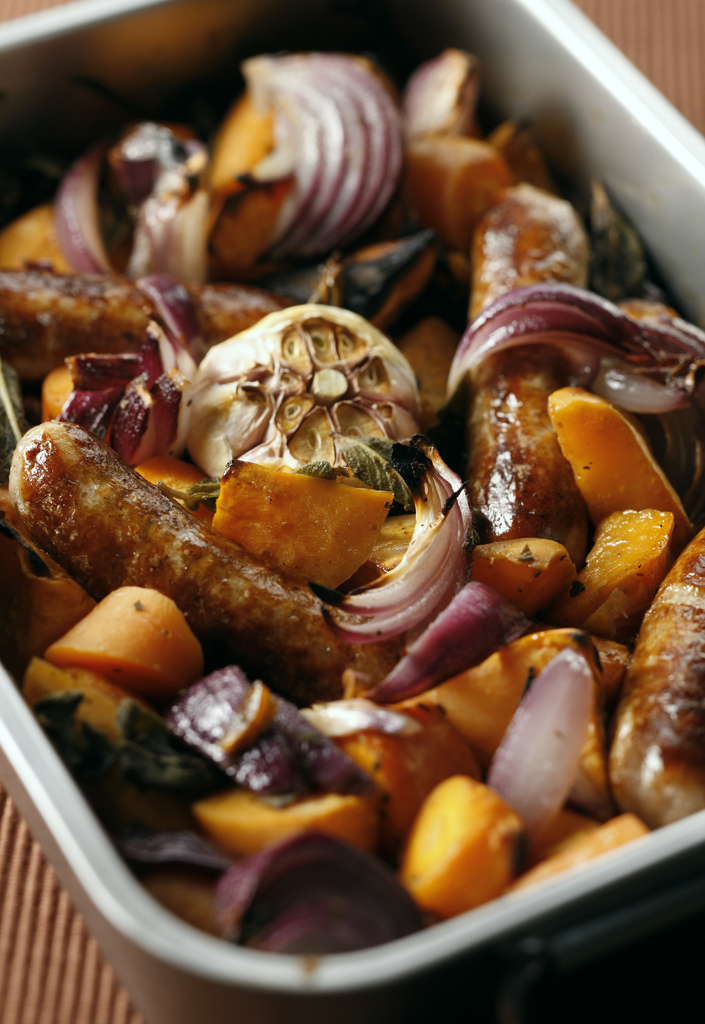
Oven-roasted Sausage and Sweet Potato
adapted from Good Mood Food by Donal Skehan*

Serves 4

Donal says this is a quick all-in-one dinner that can even be prepared ahead of time and then just banged into the oven, making it a perfect midweek supper. Donal’s original recipe calls for 3 fl oz (90 ml) red wine, but I used chicken stock simply because I tend not to have red wine in the house.

8 large, good-quality butcher sausages
4 sweet potatoes, chopped into chunks
2 large carrots, chopped into chunks
3 red onions, quartered
1 garlic bulb, top sliced off
1/2 cup (120 ml) chicken stock
1 tablespoon English mustard powder
1 tablespoon honey
2 teaspoons dried oregano
salt and freshly ground black pepper
a small handful of fresh sage leaves

Preheat the oven to 425°F (220°C). Arrange the sausages in a roasting tin or casserole dish with the sweet potatoes, carrots, red onions and garlic, making sure not to overload the tin. In a measuring jug or bowl, mix together the chicken stock, mustard powder, honey and oregano. Pour the stock mixture over the sausages and vegetables, tossing to make sure everything is coated with the stock. Season with salt (adjust according to how salty your stock is) and pepper and toss again. Scatter over the sage leaves. Roast in the oven for 45 to 55 minutes. Serve straight from the roasting tin, making sure to spoon over any remaining juices.

*Our thanks to Donal for permission to use his recipe and for his generous use of the photo from his cookbook.

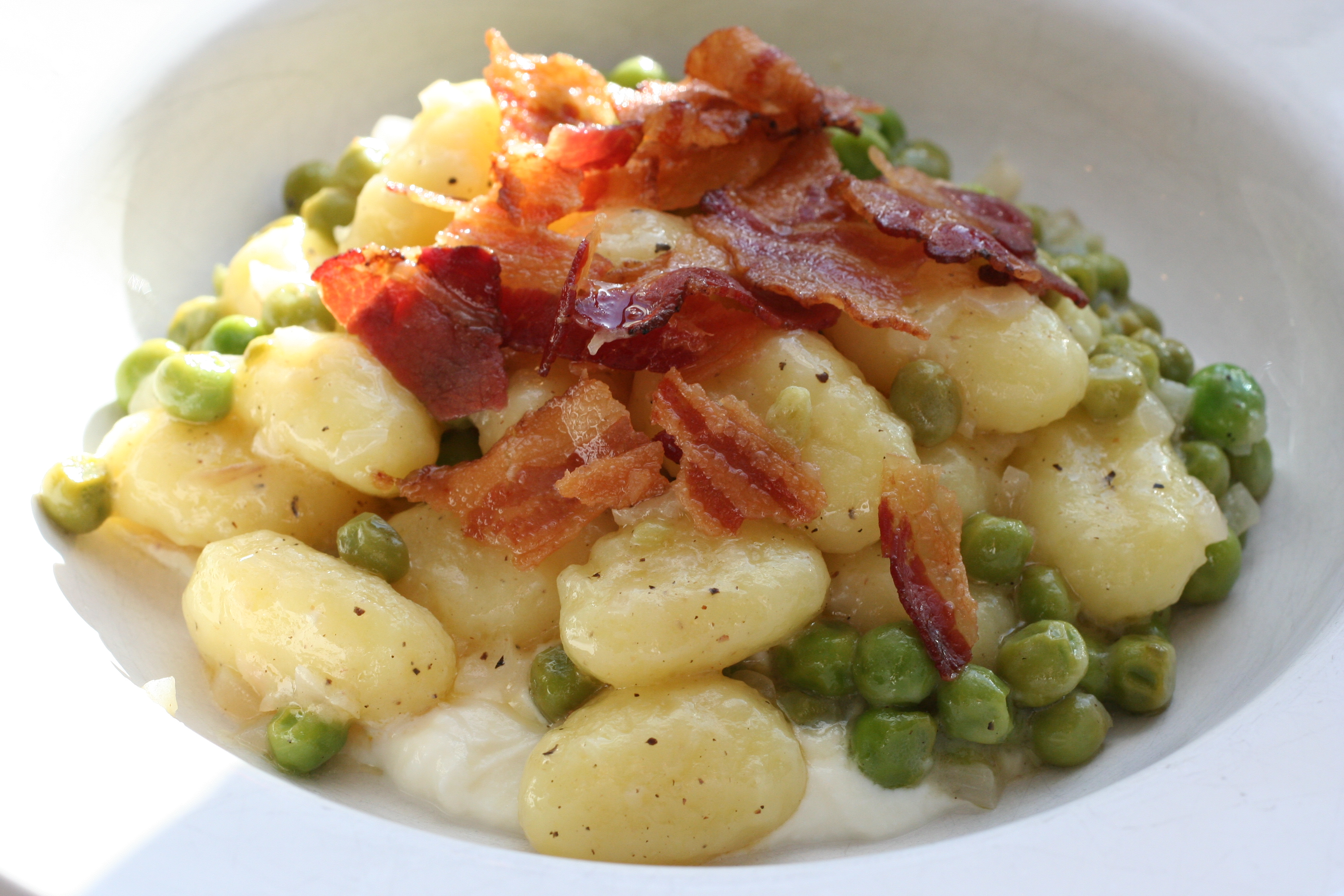
Gnocchi with Peas, Pancetta and Lemon Ricotta

I’ve been wanting to try my hand at making gnocchi for awhile now, but there’s only so far I’m only willing to go for a weeknight supper. I recently watched Tyler Florence making gnocchi on TV, and while it does look straightforward enough (not to mention something the kids would love to help with, since it looked like potato play dough), I cheated with a package of store-bought gnocchi but made the rest of his recipe, which comes together in less than half an hour.

This is an ideal dinner for this time of year. The potato gnocchi are still substantial and filling enough for spring evenings with a chill in the air, but the lemon brightens up the dish. Or if you’re having the kind of day where the last thing you want to face is cooking dinner, this requires minimal effort — the most taxing steps are chopping a shallot and zesting and juicing a lemon.

This was lovely just as it is, but I can see it being a springboard for other variations, perhaps with a cream and lemon sauce like the one in this lemon fusilli instead of the ricotta and pan sauce, with broad beans instead of the peas or with some finely chopped fresh basil or mint added in. A peppery arugula salad on the side would be perfect.

Gnocchi with Peas, Pancetta and Lemon Ricotta
adapted from Tyler Florence

Serves 4

If you quickly blanch the peas first it will help retain their green color, but honestly, could you be bothered? I’ll happily settle for dull green peas here if it makes for an easier life.

for the gnocchi:
1 lb 2 oz (500 g) store-bought gnocchi
4 oz (110 g) pancetta or prosciutto (or 6 slices bacon)
1 1/2 cups (200 g) frozen peas, thawed
1 large shallot, finely diced
2 tablespoons extra virgin olive oil
salt and freshly ground black pepper
2 tablespoons (30 g) butter
1/4 cup (25 g) freshly grated Parmesan

for the lemon ricotta:
2 cups (about 500 g, or 2 tubs) ricotta cheese
zest and juice of 1 lemon
salt

Preheat the oven to 350°F (180°C). (If using bacon instead of pancetta, preheat the oven to 400°F/200°C instead.) Bring a large pot of salted water to boil and cook the gnocchi according to the packet instructions (gnocchi usually only takes about 3 minutes to cook). Make sure you reserve about 1/2 cup (120 ml) of the cooking water for the sauce.

While the water is coming to a boil, place the strips of pancetta or bacon in 1 layer on a baking rack placed on top of a sheet pan. Cook for 8 to 10 minutes, until the pancetta is crispy. (If using bacon, this could take up to 15 or 20 minutes at the higher temperature, depending on how thick it is; cook until browned.) Drain on paper towels, then roughly chop into bite-sized pieces. Set aside.

Meanwhile, to make the lemon ricotta, place the ricotta in a mixing bowl and add the lemon zest and juice. Season with salt and set aside. (This could be done in advance and kept refrigerated.)

Heat the olive oil in a pan over a medium heat. Add the chopped shallots and gently saute for about 5 minutes, until fragrant and translucent. Add in the peas and toss gently to coat and heat through. Season with a little salt and pepper. Add the cooked gnocchi to the pan and gently toss. Add the reserved gnocchi water to the pan, then add the butter, sprinkle with the Parmesan and season again with salt and pepper.

To serve, spread a generous scoop of the lemon ricotta on the bottom of each plate. Ladle the gnocchi, peas and the pan sauce on top of the ricotta, then top with the crispy pancetta.

Roast Loin of Pork with Fennel and Sauteed Cabbage

For someone who loves to cook, I know it’s surprising to admit that I only cooked a pork tenderloin for the first time this past winter. I put it down to the fact that growing up, our family only ever ate the most basic cuts of meat — lots of boneless, skinless chicken breasts and minced beef, with an occasional pork chop or rump roast. But ever since Kelly wrote about how pork tenderloin is one of her favorite meats to cook and makes for a quick weeknight dinner, I’ve had it in the back of my head to (finally) try it myself.

The first time I cooked a tenderloin, I wasn’t even sure my husband had got the right cut from the butcher when he came home with it, since it didn’t look like the photo in my cookbook (turns out the fat hadn’t been trimmed or the loin tied, like the recipe stated). The second time I cooked one I made this recipe, but even though I remembered to ask the butcher to tie the tenderloin, I forgot to ask him to trim the fat. And what a mistake that was, since it meant the garlicky mustard topping was slathered over the fat instead of directly on the meat, which was a terrible waste (though we still scraped as much as we could off the fat and ate it anyway). But third time’s the charm, and I finally got it right.

I can’t recommend the sauteed cabbage highly enough — I stood at the stove picking at the buttery, salty shreds of cabbage straight from the pan while the pork was resting — but if you want to skip it, then the pork with fennel is an easy roast version of a one-pot dinner. If you can’t find fennel or don’t care for its anise flavor, just leave it out; the dish will still be delicious with just the onions, carrots and potatoes.

Roast Loin of Pork with Fennel
adapted from Barefoot Contessa Parties! by Ina Garten

Serves 6

2 cloves garlic, minced
salt and freshly ground black pepper, plus 1 tablespoon kosher salt
1 tablespoon fresh thyme leaves (or 1 teaspoon dried thyme)
1/4 cup (60 ml) Dijon mustard
1 x 3 lb (1.4 kg) boneless pork loin, trimmed of fat and tied (ask your butcher to do this for you)
3 small fennel bulbs, tops removed
8 carrots, peeled and thickly sliced diagonally
12 baby potatoes, halved or quartered, depending on size
2 large yellow onions, thickly sliced
4 tablespoons olive oil

Preheat the oven to 425°F (220°C).

With a mortar and pestle, or in a food processor fitted with a steel blade, grind together the garlic, 1 tablespoon salt, and thyme leaves. Add the mustard. Spread the mixture over the pork and allow it to sit at room temperature for at least 30 minutes.

Meanwhile, cut the fennel bulbs in thick wedges, cutting through the core. Place the fennel, carrots, potatoes, and onions in a large roasting tin or casserole dish and toss evenly with the olive oil, salt and pepper to taste. Cook for 30 minutes. Add the pork loin to the tin and continue to cook for another 30 to 50 minutes, or until a meat thermometer inserted into the middle of the pork reads exactly 138°F (59°C). Remove the meat from the pan and return the vegetables to the oven to keep cooking, if necessary. Cover the meat with aluminum foil and allow it to rest for 15 minutes. Remove the strings from the meat and slice it thickly. Arrange the meat and vegetables on a platter. Sprinkle with salt and freshly ground pepper to taste. Serve warm.

***

Sauteed Cabbage
adapted from Barefoot Contessa Parties! by Ina Garten

Serves 6

1 small head white cabbage, including outer green leaves (about 2.5 lb/1.1 kg)
2 tablespoons unsalted butter
1 1/2 teaspoons kosher salt
1/2 teaspoon freshly ground black pepper

Cut the cabbage in half and, with the cut-side down, slice it as thinly as possible around the core, as though you were making coleslaw. (Or you could cut the cabbage with the slicing attachment of your food processor.) Discard the core.

Melt the butter in a large saute pan or heavy-bottomed pot over medium-high heat. Add the cabbage, salt, and pepper and saute for 10 to 15 minutes, stirring occasionally, until the cabbage is tender and begins to brown. Season to taste and serve warm.

Mark Bittman’s Basic Meatloaf with Roasted Parnsips and Raspberry Buttermilk Cake

Meatloaf reminds me of falling in love with my husband. Romantic, isn’t it? I can clearly remember the moment I sheepishly admitted to him that I love meatloaf, and could we please have it for dinner. The aged paperback cookbook containing 101 recipes for ground beef that sat on Reuben’s shelf for as long as I can remember also brings back good, and hilarious, memories of our early cooking days together. I think half of those 101 recipes were meatloaf recipes. I remember paying special attention to these recipes, thinking they would make an ideal meal for us impoverished college students — except for the odd and numerous ingredients listed in most of the recipes. Do people still put anchovies, olives, Cheese Whiz or tomato soup in their meatloaf? Eventually, Reuben and I gave up on meatloaf recipes and developed our own odd list of ingredients to make a decent one. This week, in a fit of open-mindedness, and perhaps in subconscious recognition of our 14-year dating anniversary, I decided to try out another meatloaf recipe. And as with every other recipe in Mark Bittman’s How To Cook Everything, I was thrilled with the results.

Basic Meatloaf

adapted from How To Cook Everything: Simple Recipes for Great Food by Mark Bittman

Serves 6 to 8

fresh breadcrumbs made from 1 or 2 slices of good-quality white bread
2 lb (900 g) ground beef (you can also use veal, lamb, and/or pork combined with beef)
1 egg, lightly beaten
1 clove garlic, minced
1 small onion, minced
1 small carrot, peeled and minced
1/2 cup (50 g) freshly grated Parmesan cheese
1/4 cup (10 g) minced fresh parsley
1/2 teaspoon minced fresh thyme
salt and freshly ground black pepper

Preheat the oven to 350°F (180°C).

Mix together all of the ingredients. Shape the meat into a loaf in a baking pan (free-form meatloaf baked in a larger baking pan will be less greasy than meatloaf baked in a loaf pan). Bake for 50 to 60 minutes, basting occasionally with the rendered pan juices. When done, the meatloaf will be lightly browned and firm, and an instant-read thermometer inserted into the center of the loaf will read 160°F (70°C).

***

Roasted Parsnips

Serves 4 to 6

1 1/2 lb (680 g) parsnips, peeled
4 tablespoons olive oil
1 clove garlic, minced
3 sprigs fresh thyme
salt and freshly ground black pepper

Preheat the oven to 375°F (190°C).

Cut the parsnips into 2‑inch-long pieces, halving or quartering large parts of the parsnips so that each piece is about 1/2 inch thick. Toss the parsnips with the olive oil, garlic, thyme, salt and pepper. Spread the parsnips onto a large baking sheet in a single layer. Roast for about 45 minutes, until the parsnips are tender, turning once or twice to prevent scorching. Remove the thyme sprigs before serving.

Raspberry Buttermilk Cake
adapted from Smitten Kitchen

Makes 1 x 9‑inch cake

1 cup (120 grams) all-purpose flour
1/2 teaspoon baking powder
1/2 teaspoon baking soda
1/4 teaspoon salt
1/2 stick (60 g) unsalted butter, softened
2/3 cup (150 g) plus 1 1/2 tablespoons sugar, divided
1/2 teaspoon pure vanilla extract
1/2 teaspoon finely grated lemon zest (optional)
1 large egg
1/2 cup (120 ml) well-shaken buttermilk
1 cup raspberries (about 5 oz/140 g)

Preheat the oven to 400°F (200°C) with a rack in the middle. Butter and flour a 9‑inch round cake pan.

Sift or whisk together the flour, baking powder, baking soda, and salt and set aside. In a larger bowl, beat the butter and 2/3 cup (150 g) sugar with an electric mixer at medium-high speed until pale and fluffy, about 2 minutes, then beat in the vanilla and zest, if using. Add the egg and beat well.

At low speed, mix in the flour mixture in 3 batches, alternating with the buttermilk, beginning and ending with flour. Mix until just combined. Spoon the batter into the prepared cake pan, smoothing the top. Scatter raspberries evenly over the top and sprinkle with the remaining 1 1/2 tablespoons sugar.

Bake for 20 to 25 minutes, until the cake is golden brown and a tester inserted into center comes out clean. Cool in the pan for 10 minutes, then turn out onto a rack and cool until it’s just warm, 10 to 15 minutes more. Invert onto a plate.

Tandoori Chicken with Bombay Potatoes

I’ve hated ghost stories, horror movies and all things even remotely scary since I was nine years old and read a book of ghost stories from my school library, so I’m at a loss to explain why I thought it was a good idea to start swapping first- and second-hand ghost stories when I was having lunch with a friend a week ago. That was all fine and good on a sunny Saturday afternoon, sitting in her bright, cozy kitchen in the County Kildare countryside with a glass of wine, but a few nights later, up in the middle of the night with my little boy, all our stories were running through my head and I was scaring myself silly.

But I’d do it all over again just to have this lunch that she made (not to mention her warm Bakewell tart with fresh raspberries, but that’s a recipe for another day). The fact that I made it myself for my family just one week after having it for our girls’ lunch will also tell you something about how good it is. My four-year-old daughter liked it so much on Saturday that she was disappointed when I served up something else on Sunday and said she wanted this again. Lucky for her, there were leftovers that I’d been planning on having for lunch yesterday, but I let her have them for dinner last night instead. Such are the sacrifices we make for our children — including getting up in the dark to soothe them back to sleep when you’ve turned into a scaredy cat again and just want to pull the covers over your head.

Don’t let the long list of ingredients put you off, it’s just a bunch of spices, and the marinade takes all of 5 minutes to put together. As an alternative to the raita, you could make a mango salsa by combining 1 large mango, peeled and chopped, 1 red chili, deseeded and chopped, the juice of 1 lime and 1 tablespoon chopped mint.

This tandoori chicken is very similar to Kelly’s chicken tikka masala, the main difference being that this version has more spices and doesn’t have a sauce, which makes it even faster and easier to cook as a weeknight dinner. I served it with the pan-roasted curried cauliflower and peas from that menu, as well as Kelly’s cucumber raita, which I added a large handful of chopped fresh mint to. I cooked the curried cauliflower in a separate pan, but next time I’ll try increasing the amount of spices for the Bombay potatoes and just cooking all the vegetables together in one pot instead.

Tandoori Chicken with Bombay Potatoes
adapted from The Eden Cookbook by Eleanor Walsh and Michael Durkin

Serves 6

for the tandoori chicken:
1 tablespoon paprika
1/2 teaspoon garam masala
1/2 teaspoon chili powder
1/2 teaspoon ground cumin
1/2 teaspoon salt
1/2 teaspoon turmeric
2 tablespoons lemon juice
2 tablespoons sunflower oil
2 tablespoons natural yogurt
2 tablespoons cream
1 tablespoon tomato puree
3 cloves garlic, crushed
1 teaspoon fresh ginger, peeled and grated
6 boneless, skinless chicken breasts

for the Bombay potatoes:
2 1/4 lb (1 kg) potatoes, peeled and cubed
1 tablespoon sunflower oil
2 onions, finely chopped
1 tablespoon tomato puree
1 tablespoon curry powder
salt and freshly ground black pepper
3/4 cup (180 ml) vegetable or chicken stock
a few handfuls of baby spinach (about 4 oz/110 g)

cucumber raita or mango salsa (see above), to serve

Combine all the marinade ingredients (except the chicken) in a medium-sized bowl. Add in the chicken, making sure all the pieces are coated with the marinade. Cover the bowl with cling film and marinate the chicken breasts overnight in the fridge.

To cook, preheat the oven to 400°F (200°C).

Place the potatoes in a saucepan with cold water, bring to the boil and drain immediately.

Meanwhile, heat a frying pan with 2 tablespoons sunflower oil. Seal the chicken breasts for 2 or 3 minutes per side, then transfer to a baking tray or casserole dish and cook in the preheated oven for 25 minutes.

In another saucepan, heat 1 tablespoon sunflower oil over a medium heat and fry the onions for 10 minutes, until translucent. Add the tomato puree, curry powder and salt and pepper. Cook for 1 minute, stirring with a wooden spoon. Add the parboiled potatoes and stock. Cover and cook for 10 minutes, until the potatoes are tender. Add the baby spinach just before serving, stirring until the spinach just wilts.

Serve the chicken on top of the potatoes and spinach, garnished with a dollop of cucumber raita.

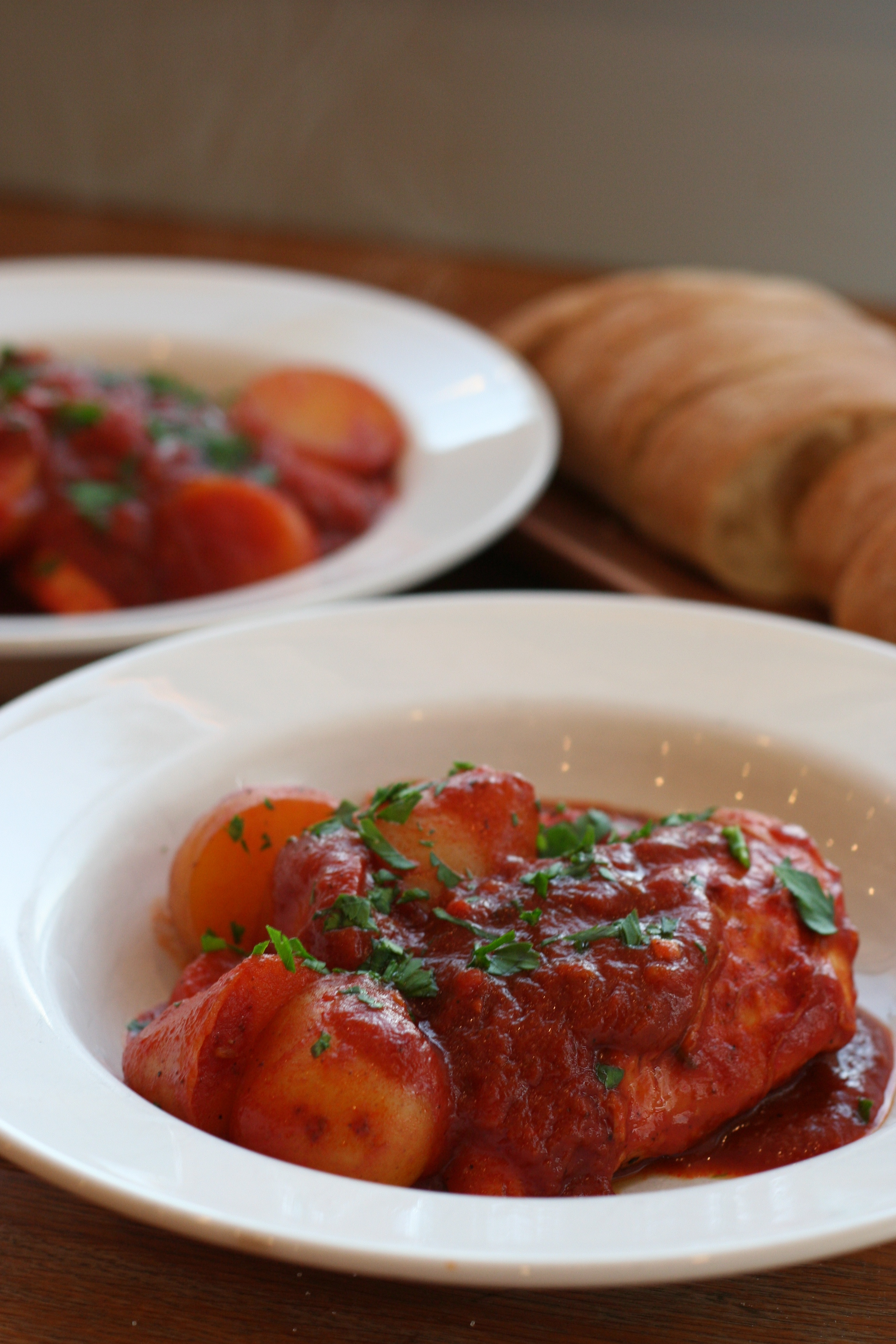
Chicken Bouillabaisse

One-pot dinners are so popular that entire cookbooks are dedicated to them. The renowned Ballymaloe Cookery School in Ireland even offers a one-day course on them. Their appeal is obvious — they tend to be easy to cook, only using one pot means there’s less washing up to do, you can let them simmer away while you get on with other things, and they’re ideal for cooking for a crowd. This chicken bouillabaisse is straightforward enough to make as a weeknight meal, yet impressive enough to serve for company. The bright fennel flavors in this stew make for a nice change, especially as we’re coming into spring and cravings for heavy foods are waning. I also love the lurid red sauce, which you’ll want to mop up with plenty of crusty bread. As one-pot wonders go, this is one of my favorites (plus it’s always more fun to cook something with a French name).

Chicken Bouillabaisse
adapted from Barefoot Contessa Back to Basics by Ina Garten

Serves 4 to 6

I’ve adapted this quite a bit from the original, most notably by adding in onions, fennel and carrots and cooking it on the stovetop instead of in the oven. It’s traditional to serve bouillabaisse with a dollop of rouille and Ina Garten has a recipe for one here, though truth be told I usually skip it. You could make a cheat’s version by adding 1 tablespoon freshly squeezed lemon juice, 1/2 teaspoon saffron and 1/4 teaspoon crushed red pepper flakes to 1 cup (240 ml) good store-bought mayonnaise. I’ve listed the Pernod as optional because there’s no need to go out and buy a whole bottle just for 3 tablespoons, and the dish is perfectly delicious without it.

5 large chicken breasts (or a combination of breasts and thighs), either left whole or cut into bite-sized pieces
salt and freshly ground black pepper
1 tablespoon minced fresh rosemary leaves
2 tablespoons extra virgin olive oil
2 large onions, roughly chopped
1 fennel bulb, roughly chopped
3 or 4 carrots, cut into 1‑inch pieces on the diagonal
4 large cloves garlic, finely chopped
1 teaspoon saffron
1 teaspoon whole fennel seeds
11 oz (300 g) tomato puree
2 cups (480 ml) good-quality chicken stock
1 cup (240 ml) dry white wine
3 tablespoons Pernod (optional)
1 lb (450 g) baby potatoes, halved
handful of fresh parsley, chopped, to garnish
crusty bread, to serve

Pat the chicken dry with paper towels and season it generously with salt, pepper, and the rosemary. Heat the olive oil over a medium heat in a large pot and brown the chicken in batches (don’t crowd the pot) until nicely browned all over, about 5 to 7 minutes per batch. Transfer the browned chicken to a plate and set aside.

Lower the heat to medium-low and the onion, fennel and carrots. Saute for 10 minutes, until the onions have softened. Add the garlic and saute for 1 minute more. Add the saffron, fennel seeds, tomato puree, chicken stock, white wine, Pernod, 2 teaspoons salt, and 1 teaspoon of pepper to the pot. Stir and scrape up any browned bits on the bottom. Add the browned chicken and their juices back to the pot, along with the baby potatoes.

Cover the pot and simmer for 45 to 55 minutes, until the potatoes are tender (but not falling apart) and the chicken is done. Check the seasoning, then add a dash of Pernod or a splash of white wine at the end if you think it could use a little alcohol edge. Serve hot in shallow bowls with big dollops of rouille (if using), some chopped fresh parsley sprinkled over and plenty of crusty bread to mop up the sauce.

Polpette di Melanzane (Eggplant ‘Meatballs’) with Spaghetti and Tomato Sauce

I think most people by now have heard Michael Pollan’s famous advice: “Eat food. Not too much. Mostly plants.” One way of reaching this goal is to adopt the Meatless Monday approach. In a nutshell, it’s an international campaign to try to “reduce meat consumption 15% in order to improve personal health and the health of our planet.” Who can argue with that? I think the problem is that many people think vegetarian food is bland and boring — and let’s face it, some of it is. But if all vegetarian recipes tasted as outstanding as this one, I guarantee you wouldn’t even miss the meat in the dinner just once a week. My mom’s turkey meatball recipe is one of my all-time favorites, but I have to admit that I like this vegetarian version even better. They’re light, tender and have even more flavor than regular meatballs. And because they’re vegetarian, I didn’t feel at all guilty about sneaking a fourth polpette (I figured I’d work on that “not too much” part of the Pollan mantra some other time).

Polpette di Melanzane
adapted from Catherine Fulvio via the Good Food Channel; you can watch Catherine making these here and see just how easy it is

Serves 4 (makes 14 to 16 balls)

The original recipe calls for 2 teaspoons chopped mint and 1 teaspoon oregano, but I used basil and parsley simply because it’s what I had in my fridge. I used a modified version of Marcella Hazan’s tomato sauce here, but feel free to use your own favorite tomato sauce recipe or even a good-quality store-bought one. The polpette can be frozen, so you might even want to make a double batch. I certainly will the next time I cook this.

for the polpette:
2 large eggplants, cut in half
extra virgin olive oil
salt and freshly ground black pepper
4 large cloves garlic, finely chopped
2 cups (200 g) breadcrumbs
1 1/4 cups (125 g) freshly grated Parmesan or Pecorino cheese
2 egg yolks
1 tablespoon chopped basil
1 tablespoon chopped parsley
a pinch of grated nutmeg
1 lb (450 g) spaghetti, to serve

for the tomato sauce:
5 tablespoons (75 g) unsalted butter
3 cloves garlic, finely chopped
1 x 28 oz can (or 2 x 400 g cans) whole plum tomatoes, with their juices
1 medium yellow onion, peeled and cut in half
salt, to taste
6 basil leaves, chopped

To make the tomato sauce, melt the butter in a large saucepan. Add the garlic and sauté gently for 1 minute. Add the tomatoes along with their juices and the onion halves. Add a pinch or two of salt. Place over a medium heat and bring to a simmer, mashing up the tomatoes gently with the back of a wooden spoon. Cook, uncovered, at a very slow but steady simmer, adjusting the heat as necessary, for about 45 minutes, or until droplets of fat float free from the tomato and the sauce has reduced and thickened. Stir occasionally, continuing to mash any large pieces of tomato with the wooden spoon. Shortly before serving, stir in the chopped basil. Taste and add salt as needed. Discard the onion.

Meanwhile, to make the polpette, preheat the oven to 350°F (180°C). Rub the halved eggplants with olive oil and sprinkle with salt and pepper. Place them on a baking tray and roast for 25 to 30 minutes. Remove from the oven and leave to cool slightly.

Scoop out the flesh of the eggplants, place in a sieve and press gently to squeeze out the excess liquid. In a mixing bowl, mash the garlic and eggplant together, then stir in the breadcrumbs, Parmesan, egg yolks, basil, parsley and nutmeg. Add salt and pepper to taste.

Shape the eggplant mixture into golf ball-sized ‘meatballs’. Heat some olive oil in a pan and fry the balls in batches until golden, turning from time to time and taking care not to crowd the pan. Place on a paper towel to drain.

When the sauce is done, add the polpette and simmer gently for 10 to 15 minutes.

Meanwhile, cook the spaghetti in a large pot of boiling salted water. Drain well and serve with the polpette and tomato sauce.

A Cooking Blog