Tag Archives: One-pot wonders

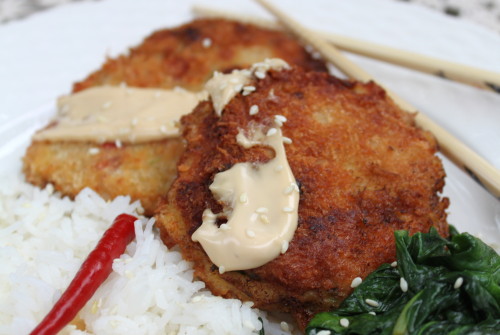
Crunchy Pork Kimchi Burgers

Last year I succumbed to a telemarketer begging me to buy a magazine subscription in support of a well-known charity. I’d like to tell you it was because I care deeply for the organization or felt pity for the poor saleswoman, but honestly, I just missed receiving a magazine with my name on it every month. After years of being a loyal subscriber to Gourmet (my idealistic college days), then Cooking Light (I put on weight working an office job in my early twenties) and, most recently, Cook’s Illustrated (the serious cooking began), I let the subscriptions expire four years ago when my first-born arrived. But no longer. My magazine days are here again. Unfortunately, I regretted last year’s selection of Food & Wine magazine. Besides this fantastic pork burger recipe and one other interesting salmon preparation, I didn’t find much inspiration in the magazine. Maybe I don’t drink enough wine to appreciate it. So, dear readers, tell me what periodical to order next. What cooking magazines do you love?
Crunchy Pork Kimchi Burgers
adapted from Food & Wine, May 2012

I used the last few precious tablespoons of my sister-in-law’s homemade kimchi for this recipe. Because the kimchi has a bit of kick to it, I made some of the burgers without the kimchi for the kids. Both versions tasted good but the kimchi really made the burger memorable.

Serves 4

1 tablespoon grated fresh ginger
1 large garlic clove, minced or grated
2 scallions, minced
1 lb (450 g) ground pork
3/4 cup (170 g) finely chopped kimchi
Kosher salt
All-purpose flour, for dusting
2 large eggs, beaten
1 1/2 cup (100 g) panko (Japanese bread crumbs), lightly crushed
Vegetable oil, for frying
12 oz (340 g) baby spinach
1/4 cup (60 ml) mayonnaise
1/2 teaspoon toasted sesame oil
1 tablespoon light soy sauce
Toasted sesame seeds, for garnish
Steamed rice

In a bowl, combine the ginger, garlic, scallions, pork and kimchi with 1 teaspoon of salt. Form the mixture into eight patties, about 1/2 inch thick. Dust the patties with flour and refrigerate for 10 minutes while you prep the other ingredients.

Put the eggs and panko in 2 shallow bowls. Dip the patties in the egg and then in the panko, pressing to help the crumbs adhere.

In a large skillet, heat 1/4 inch of vegetable oil. Depending on the size of your skillet, you will probably need to cook the patties in 2 batches. Add as many patties to the hot skillet as will fit and fry over moderate heat, turning, until golden and cooked through, 5 to 6 minutes. Drain on paper towels.

Pour off all but 1 tablespoon of the oil in the skillet. Add the spinach in batches, season with salt and cook over high heat until wilted, about 1 minute.

In a bowl, mix the mayonnaise, sesame oil and soy sauce. Mound the spinach on plates and top with the burgers. Top with the sauce and sprinkle with sesame seeds. Serve with steamed rice
Oven Baked Chicken Focaccia Sandwich

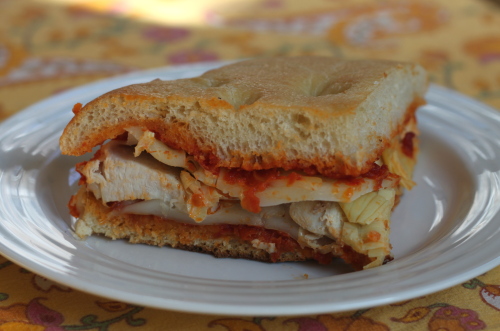
My grandma’s neighbor is a baker and gives her leftover bread, which she sometimes passes down to me (lucky me!). This week I received two loaves of focaccia and decided to use one of them for a sandwich experiment. Not only was I looking for that perfect, toasted, crispy, savory bite, oozing with a little cheese, I wanted to see how much food I could clear out of my cupboard at the same time. I formulated and tested the following hypothesis: 1 jar of sun-dried tomato spread bought on sale a year ago + leftover chicken + excellent piece of goat’s milk mozzarella = hopefully something good enough to serve a guest. Luckily for my friend Denise who served as my test subject, the experiment succeeded. My high school chemistry teacher, or at least my home ec teacher, would be proud.

Oven Baked Chicken Focaccia Sandwich

A note for our American readers, this is a great way to use up your leftover Thanksgiving turkey, especially the white meat which tends to be a little bland for my taste.

Serves 4

1 loaf focaccia bread
7 oz (200 g) prepared sun-dried tomato spread or pesto
1/2 lb (225 g) boneless, skinless chicken or turkey breast, cooked and sliced
1/2 lb (225 g) mozzarella, sliced or shredded
4 oz artichoke hearts, roughly chopped

Preheat the oven to 400°F (200°C). Carefully cut the loaf of focaccia in half horizontally. Spread one half of  the sun-dried tomato spread or pesto onto the cut side of each piece of bread.

On the bottom (spread side up) of the soon-to-be sandwich layer half the cheese. Next, cover the cheese with the cooked chicken, seasoning the chicken to taste with salt and pepper. Sprinkle the artichoke pieces around the chicken then add a final layer of mozzarella. Top the sandwich with the other bread half, spread side down and push the sandwich together lightly.

Wrap the sandwich in aluminum foil and place it on a baking sheet. Bake the sandwich for 20 minutes or until the cheese just begins to melt and the bread is golden and toasty. Cut the sandwich into 4 wedges before serving.

Bacon and Butterbean Chowder

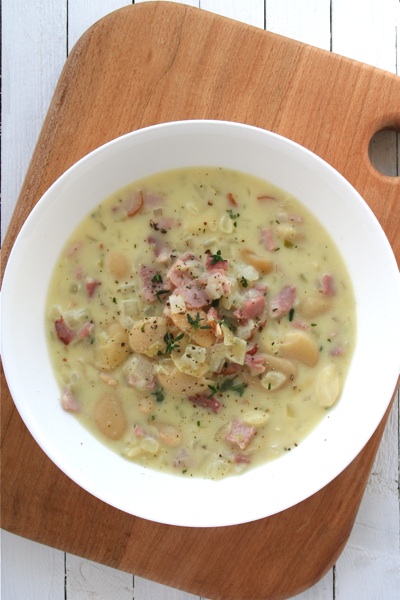
A couple weeks ago I was at The Tannery in County Waterford having lunch with a few other bloggers and food writers to celebrate the launch of the Cook with Avonmore site, which features Tannery chef Paul Flynn as their first guest chef. On the menu that day there was a choice of crab crème brûlée or this bacon and butterbean chowder as a starter. I went for the crab not only because it’s The Tannery’s signature dish, but because I knew I had the recipe for the chowder in my press pack. What I didn’t know, though, was what a fantastic recipe it is. From just a few ordinary ingredients, this soup is more than the sum of its parts.

Paul Flynn says, “A chowder for me is something that’s really rich and comforting. It’s something that you eat in front of the fire or just after a lovely long walk and you’re cold and you want something hot and heart-warming to eat.” Serve this with some good crusty bread, a nice cheese and a glass of red wine — either with or without the long walk beforehand — and I’m willing to bet it will be one of the nicest meals you’ll make this autumn.

Bacon and Butterbean Chowder
adapted from Paul Flynn via cookwithavonmore.ie

Serves 2 as a main course or 4 as a starter

Paul Flynn says that “when you use beautiful ingredients like butter and cream, you’ve got to realize that if you put just enough in, it gives you that lovely, luxurious richness that you’re looking for, and that will really comfort you on a cold night”, but you can use a little less cream if you don’t want the chowder to be quite as rich. You can also use a handful of fresh parsley instead of thyme.

knob of butter
olive oil
1 large onion, finely chopped
pinch of salt
1 garlic clove, finely chopped
6 pieces of smoked bacon or dry cure streaky bacon, finely diced
1 tablespoon flour
2 teaspoons chopped fresh thyme leaves, plus extra to garnish (or 1/2 teaspoon dried thyme)
1 teaspoon Dijon mustard
freshly ground black pepper
2 cups (500 ml) chicken stock
1 x 14 oz (400 g) can of butterbeans, rinsed
1/2 cup (125 ml) cream
crusty bread, to serve

Melt the butter in a pot over a medium heat along with a splash of olive oil so the butter doesn’t burn. Add the onion and a pinch of salt to prevent the onion from colouring. As Paul Flynn says, “The real key to this is that what you do inside this pot with the onions will provide you with the whole base flavour for the soup. If you rush this, it’s not going to be right.” So turn the heat down a little to medium-low, put the lid on and “let the magic happen”. Cook the onion for about 10 minutes, until it’s translucent. Raise the heat back to medium, add in the garlic and cook for 1 minute more, then add in the bacon and cook for about 5 minutes (though note that the bacon won’t go crispy because of the juice from the onions). Sprinkle the flour over the onions and bacon and give it all a stir, then allow it to cook for 2 minutes. Add in the thyme and mustard and a generous grinding of black pepper, then pour in the stock. Bring to the boil, then reduce the heat to a simmer and add in the butterbeans. Continue to simmer the soup for a few minutes, until the beans are warmed through, then stir through the cream. Taste the soup and adjust the seasoning if you think it needs more salt, though be careful because the bacon and stock are already salty. Ladle the soup into bowls, garnish with some of the reserved thyme leaves and serve with crusty bread.

Scallop, Chorizo and Artichoke Paella

I’d like to think that if blogs had been around when Kelly and I went to high school and college together, we might have turned out like Cara Eisenpress and Phoebe Lapine, blogging our way through our first boyfriends, first jobs and first dinner parties as we learned how to cook along the way. We might have set up a blog like their popular Big Girls, Small Kitchen, landed ourselves a book deal and had the Barefoot Contessa write the foreword to it. If only, right? But failing all that, I wish someone had given me a cookbook like theirs, In the Small Kitchen, when I moved into my first apartment and started cooking for myself and my friends. It would have been a hell of a lot better than 1,001 Vegetarian Recipes.

The book is aimed at the twenty-something crowd just finding their feet in the kitchen, with chapters like ‘Cooking for One’, ‘Potlucking’, ‘Cocktail Parties’, ‘Dating and Food’ and ‘One Year Closer to Thirty’, but there’s plenty here to inspire complete beginners and more well-seasoned cooks alike. Also bookmarked to try are Provencal baked chicken, chipotle hummus, black bean dip, coconut peanut sauce, spiked lemonade and pumpkin cake with chai cream. With graduation season upon us, In the Small Kitchen would make the perfect gift for students heading off to college or moving out into their own place, or for any new cook who’s just starting to learn their way around the kitchen.

Scallop, Chorizo and Artichoke Paella
adapted from In the Small Kitchen by Cara Eisenpress and Phoebe Lapine

Serves 8

I made a special trip to the fishmonger to get scallops, only to be told that they didn’t have any because of the recent bad weather (typical!). After some quick thinking, I decided to substitute 1 lb (450 g) of prawns instead. I simply skipped the first step and added the prawns into the paella at the very end of the cooking time, letting the heat of the rice quickly cook them right before serving. This dish reminded me of one of our family favorites, oven-baked risotto with sausages and tomato, and was just as much of a hit with the kids.

2 to 3 tablespoons olive oil
1 lb (450 g) scallops
1 lb (450 g) chorizo, cut diagonally into 1 1/2‑inch pieces
1 large onion, diced
4 cloves garlic, minced
8 to 10 scallions, white and green parts chopped separately
2 cups (360 g) Arborio rice
1/2 cup (125 ml) dry white wine or vermouth
1 x 15 oz (400 g) can of crushed tomatoes
1 x 9 oz (250 g) package frozen artichoke hearts, or jarred or canned artichoke hearts (rinsed and drained if using jarred or canned)
2 teaspoons smoked paprika
1 teaspoon salt
3 to 4 cups chicken stock
lemon wedges, for garnish

In a large cast iron skillet or a Dutch oven, heat 2 tablespoons of the olive oil over a medium-high heat until the oil is shiny and just about to smoke. While the oil is heating, quickly pat the scallops dry and remove and discard the tough side muscles. Sear the scallops in batches in the hot oil until browned and crusty on both sides, about 2 minutes per side. [Check out this post from The BA Daily blog about how to perfectly sear scallops.]

Transfer the scallops to a plate. Add the chorizo to the skillet and brown it, turning on all sides, for 2 to 5 minutes. Remove the chorizo with a slotted spoon and set aside.

Reduce the heat to medium and saute the onion in the remaining oil until translucent, scraping up any drippings in the skillet. Add the garlic and the white part of the chopped scallions and cook for another 2 minutes. Add the rice and stir to coat it in the onion mixture, allowing it to get covered in the oil and begin to toast, which should take about 3 minutes. Add the wine and cook for 2 to 3 minutes, until the liquid has reduced by nearly half. Use your spoon or spatula to help deglaze the pan and lift up any caramelized bits.

Stir in the tomatoes and their juices, artichokes, paprika and salt. Return the chorizo to the skillet and add enough stock to submerge the rice mixture. Bring the liquid to a boil, then reduce the heat to medium-low and simmer for 25 to 30 minutes, until the rice is cooked through, all the liquid has been absorbed and the rice is beginning to become crusty around the edges.

Using the back of your spoon, make indents in the top of the rice and arrange the scallops in them. Pour the scallop juices over the skillet and cook until all the liquid has been absorbed. Garnish with the chopped scallion greens and lemon wedges. Serve warm, straight from the skillet.

Chicken and Bacon Pot with Oatmeal Freezer Cookies

I’m usually not a fan of boneless, skinless chicken breasts. In comparison to chicken thighs, I find chicken breasts too easy to dry out and dull in flavor, reserved only for dishes with lots of other “wow” ingredients. Maybe it’s the bacon in this dish or the top-quality chicken that I used, but this one-dish chicken recipe proved me wrong. The sauce is savory and satiny, the meat moist and tender, and it all meshes perfectly on top of basmati rice. My kids both asked for thirds and I hid the leftovers for myself. 

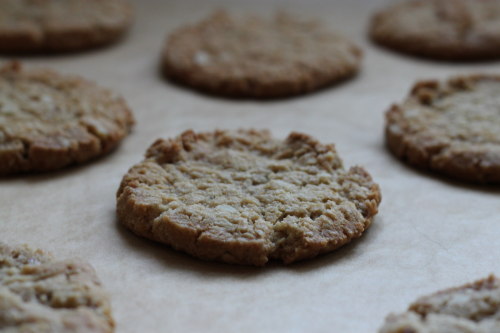
I took advantage of my already hot oven and put in a batch of oatmeal freezer cookies before we sat down to eat. Despite the fact that it’s May, it’s damp and gray here in Wisconsin — but good weather for baking cookies. Freezer cookies are ideal desserts for busy people. You can make the dough days, weeks, even months in advance, then store it in your freezer until you need it. On the day you want to bake the cookies, simply thaw the dough in the fridge, slice, and bake it. Hot cookies fresh from the oven in minutes!

Chicken and Bacon Pot
adapted from Easy Everyday: Simple Recipes for No-fuss Food

Serves 4

High-quality chicken is essential for chicken breast-based recipes like this one. I used chicken shipped to me from Springer Mountain Farms, which prides itself on their 100% natural, vegetarian-fed and humanely raised (certified by the American Humane Association) chicken.

1 tablespoon olive oil
8 oz (225 g) bacon, diced
8 oz (225 g) white, button mushrooms
4 boneless, skinless chicken breast fillets
1 garlic clove, crushed
2 shallots or 1 small onion, diced
1/3 cup (40 g) flour
2 cups (500 ml) chicken broth or stock
2/3 cup (150 ml) white wine
1 bay leaf
a handful of fresh parsley, chopped
sea salt and freshly ground black pepper
basmati rice, to serve

Preheat the oven to 350°F (180°C). Heat the olive oil in a casserole dish, add the bacon and mushrooms, and cook over medium heat until golden. Transfer the bacon and mushrooms to a plate.

Put the chicken breasts in the casserole and quickly brown on both sides. Set the chicken aside with the bacon.

Saute the garlic and shallots (or onion) over a low heat in the same pan for about 5 minutes. Add the flour and mix well. Stirring constantly, cook the flour mixture about 1 minute, until well blended and nutty smelling, being careful not to burn the flour. Remove the pan from the heat, slowly pour in the stock and wine, and stir or whisk until smooth. Return the pan to the heat and bring to a boil, stirring constantly for another 2 to 3 minutes, or until the sauce slightly thickens. Mix in the bacon and mushrooms, then add the chicken, bay leaf, and seasoning. Cover and cook in the oven for 30 minutes. Add the parsley just before serving with rice.

***

Grandma Dot’s Oatmeal Freezer Cookies
adapted from cooks.com

Makes about 2 dozen cookies

I freeze this dough in smallish logs, just enough to make about 8 cookies. By freezing smaller portions, the dough thaws more quickly. And because I only bake a few cookies at a time, they are always fresh.

1/2 cup (100 g) shortening
1/2 cup (85 g) brown sugar
1/2 cup (100 g) sugar
1 egg
1 teaspoon vanilla
3/4 cup (90 g) flour
1/2 teaspoon salt
1/2 teaspoon baking soda
1 1/2 cups (120 g) rolled oats
1/4 cup (25 g) finely chopped pecans or walnuts

Preheat the oven to 350°F (180°C). Cream the shortening and sugars. Beat in the egg and vanilla.

In a separate bowl, stir together the flour, salt, baking soda, oats and nuts. Add the flour mixture to the creamed mixture until just blended.

Shape the dough into 2‑inch rolls, like refrigerator cookie dough at the grocery store, on waxed paper. Roll up and twist the ends together. Chill until firm (at least 2 hours) or freeze for later use (place logs in a plastic bag before freezing). When ready to bake the cookies, thaw the dough (only if frozen), then cut into 3/4‑inch slices. Place on an ungreased cookie sheet with at least 1 inch separating the cookies. Bake at 350°F (180°C) for approximately 10 minutes.

Pot Roasted French Tarragon Chicken (Poulet à l’Estragon)

The Cookbook Club is one of those simple but brilliant ideas, the kind where you wonder why no one thought of it before now. The brainchild of Elaine Walsh, The Cookbook Club is a monthly event that features an Irish chef talking about his or her latest cookbook over a three-course dinner at Ely CHQ, where all the food is made from the cookbook being featured that night. It’s the best book signing you’ll ever go to.

The dinners started in September, but the first one I went to was last month, when the legendary Darina Allen of the Ballymaloe Cookery School was the featured author talking about her latest book, the award-winning Forgotten Skills of Cooking. What’s more, Elaine arranged a special pre-dinner meeting with Darina just for a few food bloggers. Never mind that it was during the same manic week as Inishfood — how could I pass up such a chance?

But on the day of the dinner, when faced with the thought of meeting the grande dame of Irish cooking with her trademark red glasses, I got nervous. What on earth would I say to someone so highly regarded? What clever question could I possibly ask? I needn’t have worried. As soon as we all sat down with a glass of wine, Darina hit the ground running, talking about everything from the early days at Ballymaloe, how she started the farmers’ market movement in Ireland, learning how to use her iPad on her recent trip to Sri Lanka to casually mentioning cooking for Bill Clinton. Meanwhile, myself and the three other bloggers (Aoife and fellow expats Sharon and Tim) just sat and listened, enthralled. Still reeling, the bloggers all sat down to dinner together, where I had salt cod croquettes, pork osso bucco and carrageen moss pudding with poached rhubarb. (You can find the recipe for the salt cod here as well as Darina’s own recount of the evening.)

While Darina’s book features lots of recipes for things like homemade pasta, preserves, dandelion wine or even instructions on how to build your own cold smoker, there are also plenty of everyday recipes, such as this French bistro classic, poulet à l’Estragon. Darina says that casserole roasting is an almost forgotten skill that releases plenty of delicious juice while the chicken cooks in the moist, steamy atmosphere of a covered casserole. It also couldn’t be easier — 10 minutes of active cooking time yields the best chicken I’ve had in a long time. The Telegraph calls poulet à l’Estragon “possibly the best chicken recipe in the world”, and after standing over the pot greedily slurping up the sauce with a spoon, I’d have to agree.

Pot Roasted French Tarragon Chicken (Poulet à l’Estragon)
adapted from Forgotten Skills of Cooking by Darina Allen

Serves 4 to 6

Because this is such a moist method of cooking, it’s a good method to use if you’re dealing with a bird you know is a little tough or past its prime. Darina also notes that some chickens yield less juice than others, so if you find that you need more sauce, just add some chicken stock to the cream. She says this is also delicious without any cream, just the chicken juices, stock and fresh herbs. Try to find French tarragon for this recipe, as opposed to the more common Russian variety.

Serve the chicken with mashed potatoes or boiled new potatoes — something, anything you can pour the amazing sauce over — and a vegetable such as sauteed carrots or green beans with lemon.

1 x 4 1/2 lb (2 kg) chicken
salt and freshly ground black pepper
2 tablespoons chopped fresh French tarragon, plus a few extra sprigs
2 tablespoons (30 g) butter, softened
1 tablespoon flour
1/2 cup (125 ml) cream
1/2 cup (125 ml) chicken stock (optional; see note above)

You will also need a casserole dish large enough to hold the chicken

Preheat the oven to 350°F (180°C).

Season the cavity of the chicken with salt and freshly ground black pepper and stuff a sprig of tarragon inside. Mix 1 tablespoon of the chopped tarragon with two-thirds of the butter and set aside. Smear the rest of the butter over the breast of the chicken. Place the chicken breast side down in a casserole (aka Dutch oven) and let it brown over a gentle heat for about 5 minutes. Turn the chicken breast side up in the casserole and smear the tarragon butter over the breast and legs. Season generously with salt and pepper. Cover the casserole and cook in the oven for 1 1/4 to 1 1/2 hours, or until the juices run clear when you pierce the flesh between the breast and thigh. Remove the chicken to a carving dish and allow it to rest for 10 to 15 minutes before carving.

Place the pot with the juices over a medium heat. Add the remaining tablespoon of chopped tarragon to the juices in the pot. Add in 1 tablespoon of flour and whisk until smooth, then add in the cream. Bring to the boil and whisk until the sauce thickens slightly. Taste and adjust the seasoning. Serve the chicken with the sauce spooned over.

Chicken and Noodles Baked in Cream Sauce

Every family has its own set of favorite meals and often its owns way of labeling them. Case in point, when my husband asks for “Thomas Jefferson’s chicken” what he really wants is gratin de volaille pavillon, a fancy name for the best chicken and noodles you’ll ever eat. We found this dish in college, pulled from The New York Times More 60-Minute Gourmet, which introduces the recipe by noting that this variation of chicken in cream sauce was “much admired by Thomas Jefferson.” Not sure how this culinary tidbit made it to modern times, but it stuck with us.
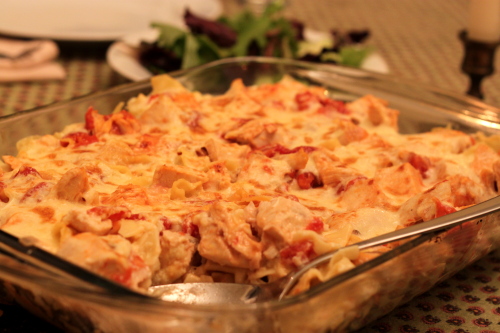
Though this preparation is not as easy as your average condensed soup-based casserole, the extra effort it requires is soon forgotten as you bite into the delicately sauced poached chicken and tender, buttery, tomato flecked noodles. It’s easy to see why it may have been a favorite of one of America’s founding fathers.

Gratin de Volaille Pavillon (Chicken and Noodles Baked in Cream Sauce)
adapted from The New York Times More 60-Minute Gourmet by Pierre Franey

Serves 6

2 cooked whole chicken breasts (see recipe for poaching chicken below, highly recommended)
12 oz (340 g) medium width egg noodles
5 tablespoons (75 g) butter, divided
3 tablespoons flour
2 cups (500 ml) chicken broth (use the broth from the poached chicken if possible)
1/2 cup (125 ml) heavy cream
salt and freshly ground black pepper
2 tablespoons shallots, finely chopped
1 ripe tomato, chopped (or 1 cup canned diced tomatoes, drained)
1 egg, lightly beaten
2 tablespoons freshly grated Parmesan cheese

Remove the chicken from the bones. Discard the skin and bones and cut the meat into 1 or 2 inch cubes. There should be about 3 cups.

Cook the noodles according to the package directions. Do not overcook. Drain the noodles. Return them to the pot and add 1 tablespoon of butter. Toss gently.

Meanwhile, melt 2 tablespoons (30 g) of butter in a saucepan and add the flour, stirring with a wire whisk. When blended, add the chicken broth, stirring rapidly. When the sauce is thickened and smooth, simmer for about 5 minutes. Add the cream and let it simmer briefly. Season to taste with salt and pepper. Set aside.

Melt 2 tablespoons (30 g) of butter in another saucepan and add the shallots. Cook briefly, stirring, then add the tomatoes and cook down for about 3 minutes. Add the chicken and salt and pepper to taste. Add 1 cup (250 ml) of the cream sauce and stir gently; set aside.

To the remaining cream sauce, add the egg. Bring to a boil stirring rapidly with a whisk. Do not overcook. Remove from the heat.

Butter a 13 x 9 inch baking pan with the remaining tablespoon (15 g) of butter. Add the noodles, and smooth them over. Spoon the chicken and sauce mixture over the noodles. Cover with the cream and egg sauce, smoothing it over. Sprinkle on the cheese. Place the dish under the broiler and cook until nicely browned and bubbling on top.

Poached Chicken

2 whole, bone-in, skin-on chicken breasts
2 cups (500 ml) water
1 cup (250 ml) dry white wine
1 small white onion, sliced
1 bay leaf
3 sprigs parsley
1 carrot, chopped
1 teaspoon salt
1/8 teaspoon pepper

Combine all the ingredients in a saucepan and bring to a boil. Cover and simmer gently for about 10 minutes. Uncover and set aside. Let the chicken cool in its own broth.

Spicy Bacon Cowboy Chili and Snowball Cookies

I think there has been more snow in the past 12 months in Ireland than in the previous 11 years I’ve been living here put together. We were hit with a record-breaking cold snap and snowfall two weeks ago that saw school canceled for six days and had us stranded in our house in the countryside on a hill. My husband, raised in Michigan, where they get buried under lake effect snow, braved our road at the start of the snow days to get us stocked up on groceries and coal and turf for the fire. A big pot of warming chili sounded like just the thing to see us through a couple nights. My friend Clare tipped me off to this recipe, and if I wasn’t sold already by the bacon in the title, the beer clinched it. Serve with honey buttermilk cornbread or bacon corn muffins, and you’ve got a filling winter meal.

Things you’ll never find me without though, snow or no snow, are flour, butter and sugar, so it seemed fitting to make snowball cookies to pass the time one afternoon with the kids. These are my favorite childhood Christmas cookie, and even if I have the tree up and all the presents bought, it only really feels like Christmas to me when I make a batch of these. For years I used my mom’s recipe, but these days I use Bon Appétit’s tip to add some ground cinnamon to the powdered sugar you roll the cookies in, and it makes all the difference. Growing up, we called these butterballs, but now I know they’re also called snowball cookies, Mexican wedding cakes and Russian tea cakes. No matter what you call them, it wouldn’t be Christmas for me without them.

Spicy Bacon Cowboy Chili
adapted from White on Rice

Serves 4 to 6

Using the leftovers on the second day, I mixed some of the chili with passata to tone down the flavors enough to pass it off as a Bolognese sauce to my kids, who gobbled it up when served with pasta. Todd and Diane suggest serving this as chili cheese fries, and I don’t know anyone who would turn up their noses at that combination.

olive oil
1 large onion, diced
1 or 2 red chilies, finely diced
salt
4 cloves garlic, finely diced
2 lb (1 kg) ground beef
6 strips (300 g) bacon, diced
1 x 14 oz (400 g) can of kidney beans, black beans or pinto beans
1 cup (250 ml) barbecue sauce
2 tablespoons paprika
2 tablespoons brown sugar
2 teaspoons cayenne pepper (optional if you don’t want it too spicy)
2 teaspoons chili powder
2 teaspoons ground cumin
1 teaspoon freshly ground black pepper
1 x 12 oz (350 ml) beer
grated cheddar cheese, sour cream, diced scallions, tortilla chips, etc., to serve

Heat a splash of olive oil in a large pot over a medium-high heat. Add the onion, chilies and a pinch of salt (to stop the onions from browning) and cook for 10 minutes, or until the onions have softened. Add the garlic and cook for 1 minute more. Add the ground beef and bacon and cook until it’s nearly cooked through and browned, stirring occasionally.

Add the remaining ingredients and stir to combine. Bring to a simmer, then lower the heat to keep at a gentle simmer. Cook for 30 minutes to 1 hour – the longer you cook it, the more the flavors will develop – adding more beer or water if the chili starts to look too dry. Serve the chili warm with toppings of your choice.

***

Snowball Cookies
adapted from Bon Appétit, May 2003

Makes about 4 dozen

These cookies can be prepared 2 days ahead. Store airtight at room temperature and reserve the remaining cinnamon sugar.

1 cup (225 g) butter, at room temperature
2 cups (240 g) powdered (icing) sugar, divided
2 teaspoons vanilla extract
2 cups (240 g) flour
1 cup (100 g) pecans or walnuts, toasted and coarsely ground
1/8 teaspoon ground cinnamon

Using an electric mixer, beat the butter in a large bowl until light and fluffy. Add 1/2 cup (60 g) of the powdered sugar and the vanilla and beat until well blended. Beat in the flour, then nuts. Divide the dough in half and form each half into ball. Wrap separately in cling film and chill until cold, about 30 minutes.

Preheat the oven to 180°C (350°F). Whisk the remaining powdered sugar and cinnamon in a shallow bowl or pie dish to blend. Set the cinnamon sugar aside.

Working with half of chilled dough, roll 1 scant tablespoon of dough between your palms into balls. Arrange the balls on a large baking sheet, spacing them 1/2 inch apart. Bake for about 18 minutes, until the cookies are golden brown on the bottom and just pale golden on top. Cool the cookies for 5 minutes on the baking sheet, then gently toss or roll the warm cookies in cinnamon sugar to coat them completely. Transfer the coated cookies to a wire rack and allow to cool completely. Repeat this procedure with the remaining half of the dough. Sift any remaining cinnamon sugar over the cookies and serve.