All posts by Kelly

Fish with Edamame Pesto and Cookies-and-Cream Ice Cream Cake

In what I suspect will become a birthday tradition, Sam once again asked for “chocolate cake with whipped cream” for his birthday party this year. Although my holiday schedule wasn’t quite as hectic as Kristin’s, between December 1st, 2010 and January 1st, 2011, I had already celebrated eight days of Chanukah, my husband’s birthday, my birthday, Christmas, and New Year’s.  Exhausted from the festivities, I was tempted to remake last year’s icebox cake and spare myself the time it would take to find a new recipe to fit Sam’s party criteria. But I just couldn’t brush off the request that easily. It’s not Sam’s fault he was born the first week in January and that his birthday, like mine, tends to be sucked up and forgotten amidst the winter holiday hustle and bustle. I luckily found another great make-ahead cake covered in whipped cream, chocolate, and–as an added  bonus–sprinkles.  Despite its less than perfect appearance (to be blamed on a final layer of too warm hot fudge sauce), this cake was a real crowd-pleaser.

The birthday dinner itself was a lighter affair. Sam is a huge fan of Japanese food, especially edamame, so this edamame-based pesto caught my eye while I browsed cookbooks for a cake recipe. The pesto tasted amazing dolloped on a piece of sauteed cod, and nearly as good spread on a cracker later that night as a bedtime snack. I rounded out dinner with simple steamed veggies and cooked quinoa.
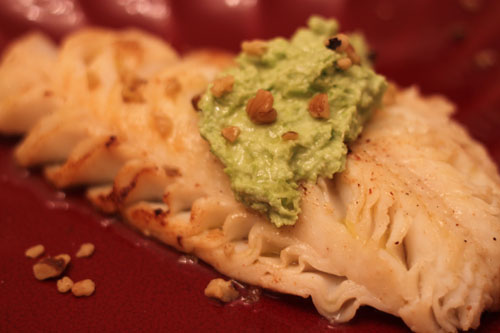
Fish with Edamame Pesto
adapted from Mark Bittman’s Kitchen Express: 404 inspired seasonal dishes you can make in 20 minutes or less

serves 3

1 bag frozen edamame (in pods)
olive oil
1 clove garlic, grated
juice of half a lemon
handful of grated Parmesan cheese
salt and pepper, to taste
1 lb (450 g) cod or other fish fillet(s)
2 tablespoons butter or olive oil
chopped walnuts, for garnish

Blanch the frozen edamame in boiling salted water for 3–5 minutes until tender. Drain and rinse the edamame under cold water. Shell the soybeans and place them in a blender or food processor with a few tablespoons of olive oil (or more, as needed) to get a nice puree. Add the garlic, lemon juice, and Parmesan and blend until smooth. Season the puree to taste with salt and pepper.

Season the fish fillet with salt and pepper. Cook the fillet(s) in the butter or olive oil over medium heat about 4 minutes per side or until golden and cooked through. Serve the fish with a spoonful of the pesto and garnish with chopped walnuts.

***

Cookies-and-Cream Ice Cream Cake
adapted from Bon Appetit, June 2000

serves 12

1 x 16-oz (45o‑g) pound cake, thawed if frozen
1/2 gallon (about 1 kg) cookies-and-cream ice cream, slightly softened

12 oz (340 g) hot fudge sauce (purchased or homemade)
6 oz (170 g) semisweet chocolate chips
1/4 (60 ml) cup water
10 Oreo cookies, coarsely chopped

1 cup (240 ml) chilled whipping cream
2 tablespoons sugar
candy sprinkles

Cut the cake into 1/3‑inch-thick slices. Halve each slice diagonally, forming triangles. Cover the bottom of a 9‑inch-diameter springform pan with the cake by arranging some triangles, points facing in, around the edge of pan. Fill in the center with more triangles; then cut additional pieces to fill in any spaces. Spread half of the ice cream over the cake. Freeze until firm, about 1 hour.

Stir the fudge sauce, chocolate chips and 1/4 cup water in a heavy medium saucepan over medium-low heat until melted and smooth. Cool to just barely lukewarm. Spread half of the fudge sauce over the ice cream. Sprinkle with the cookies. Top with enough remaining cake slices to cover. Spread the remaining ice cream over. Freeze 1 hour.

Stir the remaining fudge sauce over medium-low heat until barely lukewarm. Pour the sauce over the ice cream, spreading to the edge. Freeze at least 6 hours or overnight.

To serve, let cake sit in fridge about 15 minutes to slightly thaw. While the cake thaws, beat the cream and sugar in a medium bowl to stiff peaks. Run a knife around the pan sides to loosen the cake. Release the pan sides. Spread the whipped cream around the side of the cake and, if desired, pipe a border of whipped cream around the top edge of the cake. Scatter sprinkles or other small candies atop the cake.

Brisket with Portobello Mushrooms and Dried Cranberries with Latkes

Happy Chanukah! We are in the midst of our celebrations and enjoying them even more than in years past.  Sam is old enough to help light the menorah and Anabelle can unwrap her own presents. She can also express her opinions. The matching sweater and hat set garnered a loud “no” (as she threw it off back at me) while chocolate covered raisins won an immediate smile. Chanukah is a relatively new holiday for me as I was brought up Christian.  Reuben was raised Jewish. Being the open-minded, holiday-loving couple that we are, Reuben and I celebrate both holidays. Unlike the fast and frenzied Christmas rush, I find the eight nights of Chanukah more relaxed and laid back and can’t see ever giving up the tradition.

My mother-in-law asked me to make the main course for our big Chanukah dinner this year. I decided to try out this simple braised brisket recipe, which turned out to be the best brisket I’ve ever made. The dish is perfect for entertaining, even if you aren’t celebrating Chanukah. You can spend more time with guests since you don’t need to do much with the meat once it’s braising in the oven. You can even make it the day before. If you can’t find brisket, I bet this recipe would taste amazing with short ribs or chuck roast, though the cooking time might be shorter. Along with the brisket recipe, I’m posting my mother-in-law’s latke recipe. If you’ve never had latkes, they’re like potato pancakes, only better. I have no idea why we only eat them once a year.

Brisket with Portobello Mushrooms and Dried Cranberries
adapted from Bon Appétit, December 1998

serves 8

1 cup (240 ml) dry red wine
1 cup (240 ml) broth (turkey, beef or chicken)
3/4 cup (180 ml) cranberry juice cocktail (100% juice recommended)
1/4 cup (30 g) all purpose flour
1 large onion, sliced
4 garlic cloves, chopped
1 sprig fresh rosemary
1 x 4‑lb (1.8‑kg) trimmed flat-cut brisket
12 ounces (340 g) baby portobello (crimini) mushrooms , sliced
4 oz (110 g) dried cranberries

Preheat the oven to 300°F (150°C). Whisk the wine, broth, cranberry juice and flour to blend in medium bowl; pour the mixture into a dutch oven or roasting pan large enough for the brisket to lay flat in. Mix in the onion, garlic and rosemary. Sprinkle the brisket on all sides with salt and pepper. Place the brisket, fat side up, in the pan. Spoon some of the wine mixture over it. Cover the pan with its lid or, if using a roasting pan, tightly with heavy-duty aluminum foil.

Bake the brisket until very tender, basting with pan juices every hour, about 3 1/2 hours. Let the brisket cool in the sauce for 1 hour. Discard the rosemary stem. Transfer the brisket to cutting board; cool 1 hour at room temperature. Thinly slice the brisket across the grain. Arrange the slices in the pan with the sauce, overlapping slices slightly. The brisket can be prepared 2 days ahead. Cover and refrigerate.

Preheat the oven to 350°F (180°C). Gently stir the mushrooms and cranberries into the sauce around the brisket. Cover the pan and bake until the mushrooms are tender and the brisket is heated through, about 30 minutes (40 minutes if the brisket has been refrigerated).

Transfer the sliced brisket and sauce to a platter and serve.

***

Years ago, my mother-in-law wrote this latke recipe on a piece of Queens Botanical Garden note paper and sent it to Reuben and me. She correctly assumed I had no idea how to make them. The recipe has moved with us to a least four different residences, acquiring more oil splatters each year. I’ve added more instructional detail for those who have not witnessed latke-making in person.

Latkes
from my mother-in-law

serves 6

2 lbs (900 g) potatoes
1 onion
juice of 1/2 lemon [Note: I sometimes omit this]
2 tablespoons of flour or matzo meal
1 egg, slightly beaten
salt and pepper, to taste
peanut, canola, or vegetable oil, for frying
sour cream and applesauce, to serve

Using a food processor or hand held grater, grate the potatoes and onion into a large bowl. Squeeze the lomn juice on the mixture so the potatoes don’t turn black. Let the mixture stand 30 minutes, covered, then drain the liquid out.

Mix the flour, egg, salt, and pepper into the grated potatoes and onion. Heat oil (enough to generously cover the bottom of the pan by about a centimeter) in a large cast iron skillet over medium-high heat. With a large spoon [or by hand if you have done this at least 20 years], place a pancake-size pile of the mixture into the hot oil and press lightly. Three latkes will usually fit into the pan. Fry the latkes in hot oil about 4 minutes on each side until brown and crisp. Drain the latkes on paper towels or paper grocery bags. Serve hot with sour cream and/or applesauce.

Tortellini in Broth with Spinach

Inevitably after most holiday meals, I find myself walking to my car with a plastic grocery bag of slightly gooey, unattractive, and lukewarm bag of bones and meat scraps. Perhaps no one else wants to carry home such an odd parcel, or perhaps everyone knows of my frugality. Whatever the reason, I’m happy to turn the humble carcass into a hearty broth at home. If you browse through the recipes on this site, you’ll find that both Kristin and I use broth frequently. Although I’ve found a good store-bought brand (Swanson’s Organic Chicken Broth), nothing beats homemade.  It’s really cheap and easy to make.

For this year’s turkey broth I threw the leftover bones (with scraps attached) into a large stock pot and poured in water to cover. I roughly chopped and added one onion, one carrot, one celery stalk, and a handful of fresh parsley. For added zip, I threw in a pinch of dried thyme, a bay leaf, and about a tablespoon of salt. After bringing it to a boil, I let the liquid barely simmer for about three hours, strained it, and poured it into quart jars. After a night in the fridge, you can skim off any fat that rises to the top and pour the broth into whatever size container you wish. It will keep in the fridge for a few days and frozen for several months. I like to freeze it in muffin tins, then put the small broth-circles into larger storage bags, perfect for adding to sauces and stir-frys. I didn’t freeze all my broth this year, instead sacrificing a quart for this quick and kid-friendly meal. For extra cuteness, serve in bunny bowls as pictured below.

Tortellini in Broth with Spinach

Serves 4 as main course, 6 as first course

14 oz (400 g) dried tortellini
1 quart (1 liter) chicken or turkey broth
12 oz (340 g) fresh baby spinach
grated Parmesan cheese, to serve

Cook the tortellini according to the package directions. Drain the tortellini and set it aside.

While the pasta cooks, bring the broth to a simmer. Depending on the broth you are using, you may need to add salt or pepper to taste.

After the tortellini is cooked, add the spinach to the broth and cook for about 2 minutes, stirring gently, until the spinach is wilted. To serve, divide the broth, spinach, and tortellini between bowls. Top each bowl with grated Parmesan, if desired.

Pan-roasted Pork Chops with Cranberries and Swiss Chard

I am ashamed to admit that despite living in a state where cranberries are the state fruit and number one produce export, I’ve never cooked with fresh cranberries.  Because I’m not a fan of cranberry sauce, a Thanksgiving staple here in the United States, I generally tend to ignore the bags of cranberries piled high in the produce section each November. But this year, the tiny ruby red berries looked too attractive to bypass, so on a whim I bought a single humble bag and vowed to try out some new recipes.

After a successful batch of cranberry applesauce, I tried this pork chop recipe out on my brother, Michael, for his birthday dinner. Normally I don’t test drive new recipes on dinner guests, especially on their birthdays, but Michael, bless his heart, never leaves a morsel on his plate, can be talked into second and third helpings, and always thanks me “for the best dinner” even if it wasn’t my best, or even close. Lucky for Michael and the rest of us, the pork chop cranberry experiment was successful. The sauce is complex and savory, balanced nicely with the garlicky Swiss chard and the simply roasted chop. I served the dish with salad and quinoa pilaf but a crusty baguette and glass of red wine would be just as good.

Pan-roasted Pork Chops with Cranberries and Red Swiss Chard
adapted from Gourmet, November 2001

Serves 4

for the Swiss chard:
2 medium shallots, minced
1 tablespoon minced garlic
2 tablespoons unsalted butter
1 lb (450 g) red Swiss chard, stems and center ribs cut out and chopped together, leaves coarsely chopped separately

for the pork chops:
4 x 1 1/4‑inch-thick rib pork chops
1 1/2 tablespoons extra virgin olive oil

for the sauce:
2 medium shallots, minced
1/2 cup (120 ml) dry red wine
5 oz (150 g) fresh or thawed frozen cranberries
3/4 cup (180 ml) chicken stock or broth
3 tablespoons packed light brown sugar
1 1/2 teaspoons chopped fresh thyme or 1/2 teaspoon dried, crumbled
2 tablespoons (30 g) unsalted butter

Preheat the oven to 400°F (200°C).

To prepare the Swiss chard, cook the shallots and garlic in butter in an ovenproof 12-inch heavy skillet over a moderate heat, stirring, until golden, about 5 minutes. Add the chard stems and center ribs and cook, covered, stirring occasionally, until crisp-tender, 3 to 4 minutes. Add the chard leaves and cook, uncovered, stirring occasionally, until tender, 6 to 7 minutes. Season the chard with salt and pepper, then transfer it to a bowl, cover the bowl with a lid or foil (to keep the chard warm), and wipe out the skillet.

Pat the pork chops dry and season them with salt and pepper. Heat 1 1/2 tablespoons of oil in the skillet over a moderately high heat until hot but not smoking, then brown the chops, about 3 minutes per side. Transfer the skillet to the oven and roast the chops until an instant-read thermometer inserted horizontally 2 inches into the meat registers 155°F, 7 to 9 minutes. Transfer the chops with tongs to a platter, leaving the fat in the skillet, and cover the chops loosely with foil to keep warm.

Make the sauce by sauteing the shallots in the fat remaining in the skillet over a moderately high heat, stirring, until golden, about 5 minutes. Add the wine and deglaze by boiling over a high heat, scraping up any brown bits, until reduced by half. Add the cranberries and stock and simmer, stirring occasionally, until the cranberries begin to burst, about 2 minutes. Stir in the brown sugar and thyme and simmer, stirring, until the berries are collapsed, about 3 more minutes. Remove the sauce from the heat and stir in the butter until incorporated, then season with salt and pepper.

To assemble the dish, divide the chard among 4 plates and top with the chops, then spoon the sauce over.

Couscous Paella with Shrimp

Don’t you love finding a recipe that’s tasty, easy, quick, and healthy? Here’s one I just discovered. This recipe is also an excellent choice for anyone looking to serve the wild Gulf of Mexico shrimp that are finally back in stores (ahem, thank you BP for the forced hiatus). One word of caution — make sure you have enough dinner guests at the table for this dish. Couscous doesn’t reheat particularly well and you won’t want a bite of it to go to waste.

Couscous Paella with Shrimp
adapted from Family Circle as posted on Food Network

Serves 6

1 tablespoon olive oil
1 medium onion, chopped
3 cloves garlic, chopped
2 bell peppers (green, yellow, and/or red), cut into 1/2‑inch dice
1 teaspoon salt
1/2 teaspoon black pepper
1/2 teaspoon dried thyme
1/2 teaspoon red pepper flakes
1/2 teaspoon ground turmeric
1 can (14 oz/400 ml) chicken broth
1 cup (240 ml) water
10 oz (280 g) frozen peas, thawed
1 1/2 lb (680 g) large shrimp, shelled and cleaned
10 oz (280 g) couscous (plain or whole wheat)

Heat the oil in a large heavy-bottomed pot that has a lid. Add the onion, garlic and peppers and cook until the peppers are tender, about 8 minutes. Add the salt, black pepper, thyme, pepper flakes and turmeric and cook for 1 minute. Add the broth, water, peas and shrimp. Simmer, covered, for 2 minutes.

Remove the pan from the heat. Stir in the couscous and cover. Let stand for 5 minutes, then remove the cover, fluff the couscous with a fork, and serve immediately.

Tuscan-style White Beans with Sausages and Peppers

My kids are crazy about beans. They’d eat them for breakfast, lunch and dinner, which is fine by me. You can’t cook many things that are healthier, easier or quicker than a can of beans. While canned beans are great, cooking dried beans is much cheaper and tastes better, too. And then there’s the BPA issue to think about. So I’m trying to use dried beans instead of canned and, in the process, finding some great recipes. This white bean recipe may be my favorite so far. Don’t be afraid by the amount of sage, it’s actually quite subtle tasting when cooked low and slow. If you have leftovers, try pureeing them with some olive oil and Parmesan cheese to make a spread perfect for crackers. I combined this batch with sausages and peppers as per Mark Bittman’s suggestion. The last-minute side of plain quinoa was a surprisingly perfect match with the beans.

A quick comment about beans, generally. I usually cook my beans in a slow cooker but the stove top works just as well. Don’t be afraid to add salt to the beans during cooking. I add a good teaspoon per pound (450 g) of beans after the beans are just tender, about halfway through cooking. Contrary to popular belief, salt doesn’t prevent the bean from cooking properly and results in a much better-tasting bean. And if you’re making a pot of beans, you may as well make a double batch. Once cooked, beans will keep in the fridge for several days or in the freezer several months, ready for pasta with chickpeas, eight-layer veggie burritos, or hummus at the drop of a hat.

Tuscan-style White Beans
adapted from How To Cook Everything: Simple Recipes for Great Food by Mark Bittman

Makes 8 servings

1 lb (450 g) dried white beans (cannellini, navy, Great Northern, etc.), washed and picked over
30 fresh sage leaves or 1 heaping tablespoon dried sage
salt and freshly ground black pepper
2 teaspoons minced or grated garlic
3 tablespoons extra virgin olive oil

Place the beans in a pot with water to cover by about 1 inch. Turn the heat to high and bring to a boil. Add the sage. Reduce the heat, cover loosely and simmer, stirring occasionally, until the beans begin to soften. Add about 1 teaspoon of salt and some pepper. Continue to cook until the beans are very tender, adding additional water if the beans dry out. Depending on the size and freshness of the bean, this will usually take 1 to 2 hours. Drain the cooking liquid if necessary, then gently stir in the garlic and olive oil. Season to taste with salt and pepper and serve hot, warm, or even cold.

***

Sausages with Peppers

Serves 6

1 tablespoon olive oil
6 hot and/or mild Italian sausages
2 bell peppers (one green and one red, yellow, or orange), sliced into thin strips

In a large skillet, heat the olive oil over a medium heat. Add the sausages and cook for 10 minutes, turning the sausages halfway through the cooking time. Add the pepper strips and cook until the peppers are soft and the sausages are fully cooked, stirring frequently, about 10 more minutes. If the sausages take on too much color early in the cooking process, lower the heat or cover the skillet with a lid for a few minutes.

Mustard Crusted Tofu with Sweet Potatoes and Kale

Earlier this month our family went vegetarian for a week. My husband and I have been wanting to try on vegetarianism for awhile and when our friends mentioned their interest, we made a pact to go meat-free together. To sweeten the deal, we agreed to have each other over for dinner during the week. As you can probably figure out by my posts, we tend to eat (and enjoy) meat a few times per week. But honestly, except for a momentary craving for a turkey sandwich, I didn’t miss meat at all. Eliminating meat from our menu gave me the chance to make some of my favorite vegetarian dishes, vegetarian chili on quinoa and fettuccine alfredo, for example, and was good motivation to find some new meatless menus. I tried out this tofu recipe because it sounded different and, more importantly, quick. I never thought to combine mustard and tofu but it somehow works. The sweet potatoes and kale provide an earthy, sweet note to balance the tangy tofu.

Mustard Crusted Tofu with Sweet Potatoes and Kale
adapted from Bon Appetit, September 2007

Serves 3

1 x 14-oz (400‑g) package firm tofu
1/4 cup (60 ml) whole grain Dijon mustard
4 tablespoons vegetable oil, divided
1/2 medium onion, sliced
1 tablespoon minced peeled fresh ginger
1 bunch kale, stem cut from each leaf, leaves thinly sliced crosswise
1 red-skinned sweet potato (yam), peeled, halved lengthwise, thinly sliced crosswise
2 tablespoons fresh lime juice
soy sauce or tamari, to taste
cooked rice, to serve

Cut the tofu in half lengthwise and place the pieces, side by side, on a clean dishtowel or several pieces of folded paper towels. Fold dish towel (or paper towels) over the tofu. Place the covered tofu in a dish, cover, and let it sit overnight in the fridge. The towels should draw out a considerable amount of moisture from the tofu. If you forget to do this the night before your meal, simply place a large pan or other heavy plate on top of the tofu and let it sit for at least half an hour to press out excess moisture.

Cut the pressed tofu into eight pieces, cubed as in the picture, or in 1/2‑inch-thick slices. Spread the top and bottom sides of each piece with the mustard.

Heat 2 tablespoons of oil in a large nonstick skillet over medium-high heat. Add the onion and ginger; sauté 3 minutes. Add the sweet potato and saute another 5 minutes. Add the kale and lime juice then cover, reduce the heat to low, and cook until the potato is tender and the kale is wilted, about 12 more minutes.

Meanwhile, heat the remaining 2 tablespoons oil in another large nonstick skillet over medium heat. Add the tofu; cover and cook until heated through and crisp, about 2 minutes per side (some mustard seeds may fall off of the tofu).

Arrange the kale and sweet potato mixture on a plate. Place the tofu pieces atop the vegetables. Serve with soy sauce or tamari and rice, if desired.

Layered Taco Salad and Rocky Road Bark

I’ve made this layered taco salad a few times, each time planning to post the recipe because it’s so easy to make and pretty to look at once assembled. Unfortunately, it’s so tasty I’m never able to resist immediately sitting down to dish up a plate, ruining the picture-perfect ensemble of beef, beans, cheese, avocados and lettuce, so you’ll have to use your imagination on this one. If it helps, think of  your favorite nachos, then imagine them with better, fresher ingredients on a bed of tangy lime-dressed lettuce.

For those in need of a picture, I give you dessert — rocky road bark. Sam is a huge fan of marshmallows but I try to limit his intake. This inevitably leads to opened bags of marshmallows growing stale in my cupboard. This recipe took care of a handful of them and provided a few days of bite-sized after-dinner treats that the whole family enjoyed.

Layered Taco Salad
adapted from Gourmet, August 2003

Serves 4

for the dressing:
juice of 1 lime
3 tablespoons chopped fresh cilantro
1/2 teaspoon sugar
1 teaspoon chili powder
1/4 teaspoon ground cumin
1/2 teaspoon salt
1/4 teaspoon black pepper
1/4 cup (60 ml) olive oil

for the beef:
1 medium onion, chopped
2 garlic cloves, finely chopped
1 jalapeno or serrano chiles (including seeds), finely chopped
2 teaspoons chili powder
2 teaspoons ground cumin
2 tablespoons olive oil
1 lb (450 g) ground chuck
6 oz (175 ml) tomato sauce
1/2 teaspoon salt
1/4 teaspoon black pepper

for the salad:
1 firm-ripe California avocado
1 large head romaine lettuce, thinly sliced
1 tomato, chopped
1/4 lb (110 g) coarsely grated sharp Cheddar
1 x 15 oz (425 g) can black beans, drained and rinsed
1 x 6 oz (170 g) can sliced pitted black olives, drained
tortilla chips, to serve

To make the dressing, whisk together the lime juice, cilantro, sugar, chili powder, cumin, salt, and pepper, then add the oil in a stream, whisking until emulsified.

To cook the beef, cook the onion, garlic, chile, chili powder, and cumin in the oil in a 12-inch heavy skillet over a moderate heat, stirring occasionally, until the onion is well softened, about 6 minutes. Add the beef and cook, stirring occasionally and breaking up lumps, until the meat is no longer pink, about 5 minutes, then spoon off any excess fat from the skillet. Add the tomato sauce, salt, and pepper to the beef and cook, stirring, until slightly thickened, about 3 minutes. Remove from the heat.

To assemble the salad, peel and pit the avocado, then cut into 1/2‑inch pieces. Spread the lettuce over the bottom of a shallow 4‑quart dish or other large shallow bowl (for example, a large pasta serving bowl). Drizzle the dressing over the salad and toss lightly. Spoon the beef mixture evenly over the lettuce and continue making layers with tomatoes, cheese, beans, avocado, and olives.

***

Rocky Road Bark
adapted from Cook’s Country

Makes 16 pieces

5 or 6 whole graham crackers
6 tablespoons (90 g) unsalted butter
1/4 cup (40 g) packed light brown sugar
1/2 teaspoon salt
4 oz (110 g) semisweet or bittersweet chocolate, chopped
3/4 cup (40 g) mini marshmallows
1/2 cup (50 g) chopped pecans, walnuts or sliced almonds

Preheat the oven to 375°F (190°C). Line an 8‑inch-square baking pan with heavy-duty aluminum foil, making sure the foil is tucked into all corners and at least 1 inch of foil overhangs the top of the pan on the sides. This will create a type of handle, which you’ll use later to pull out the bark. In a single layer, line the bottom of the pan with graham crackers, breaking them if needed so that they fit tightly.

Combine the butter, brown sugar, and salt in a small saucepan and cook over low heat, stirring constantly, until the butter is melted and the sugar is dissolved. Scrape the mixture onto the graham crackers and smooth so that the mixture covers the crackers completely. Bake until the caramel is bubbling, about 8 minutes.

Remove the pan from the oven, sprinkle with the chocolate pieces, and return the pan to the oven to soften the chocolate, about 2 minutes. Remove the pan from the oven and use a spatula to gently smooth the chocolate into an even layer.

Sprinkle the marshmallows and then the nuts over the chocolate, pressing lightly with your fingertips so the marshmallows and nuts adhere to the chocolate. Cool the pan on a wire rack for 30 minutes, then freeze until the chocolate hardens, 30 minutes.

Grabbing the overhang, lift the foil from the pan onto a cutting board. Using a sharp chef’s knife, cut the bark into 2‑inch squares. Store any leftovers in an airtight container for up to 1 week in the refrigerator.