Pasta Fagiole, Sausages with Peppers, and Assorted Antipasti

I love having people over for dinner. I love planning a menu around their tastes and dietary restrictions. I love shopping for high-end special occasion ingredients and flowers for the table. I love seeing how many place settings I can squeeze onto my dining table. I love the rush of preparing a big meal while trying to keep my kitchen intact. But mostly, I love sharing good food and good conversation with friends and family. There are few things that please me more than a home-cooked dinner and lively, loud conversation (usually after a few bottles of wine have been opened), except maybe the hush that sometimes falls over my guests if I’ve made something particularly good and they have no time to speak between mouthfuls.

This week my husband Reuben’s lovely grandmother, Ellie, visited Milwaukee. I invited her, Reuben’s parents, my grandparents, my parents, and my sister to join us for dinner. Since I had to prepare enough food for 10 adults with two small children underfoot, my menu was simple. Most items could be prepared in advance, during the kids’ nap time. Note that I doubled the soup and sausages recipes below to serve 10 adults. And in case you were worrying that I let my guests go home without dessert, I also served the blueberry crumb bars Kristin posted three weeks ago.

Pasta Fagiole
from an unknown magazine card that’s been in my recipe box for as long as I remember. My apologies to whatever source I took it from years ago.

Serves 4

2 tablespoons extra-virgin olive oil
1 garlic clove, minced
4 cups (1 liter) chicken broth (Swanson Organic Chicken Broth recommended)
1 x 14 oz (400 g) can stewed tomatoes, with Italian seasoning (note: if seasoned tomatoes aren’t available, use regular stewed tomatoes and add 1/2 teaspoon dried oregano and 1/2 teaspoon dried basil)
1 x 19 oz (540 g) can cannellini or great northern beans, rinsed well and drained
6 oz (170 g) tubetti or ditalini pasta
3 tablespoons chopped fresh basil
2 tablespoons freshly grated Parmesan

Heat 1 tablespoon of oil in a large saucepan over a moderate heat until hot but not smoking, then cook the garlic, stirring until fragrant, about 30 seconds. Stir in the broth and tomatoes with their juices and bring to a boil, breaking up the tomatoes with a fork.

Add the beans, pasta, 2 tablespoons basil, and Parmesan and boil, stirring frequently, until the pasta is al dente. Let stand for 5 minutes before serving. (Pasta will continue to absorb liquid.) Stir in the remaining basil and black pepper to taste. Drizzle with the remaining olive oil and serve immediately.

***

Sausages with Peppers

Serves 6

1 tablespoon olive oil
6 hot and/or mild Italian sausages
2 bell peppers (one green and one red, yellow, or orange), sliced into thin strips

In a large skillet, heat 1 tablespoon olive oil over a medium heat. Add the sausages and cook for 10 minutes, turning the sausages halfway through the cooking time. Add the pepper strips and cook until the peppers are soft and the sausages are fully cooked, stirring frequently, about 10 more minutes. If the sausages take on too much color early in the cooking process, lower the heat or cover the skillet with a lid for a few minutes. Serve with a crusty baguette or good Italian bread.

***

Assorted Antipasti

Antipasti refers to the traditional first course in an Italian meal. Cheeses, cured meats, marinated vegetables and salads are typical. Antipasti selections are also perfect for picnics. For my dinner, I served the following (all at room temperature):

cheeses (one soft, one semi-soft, one hard, one goat’s cheese, and fresh mozzarella balls)
olives (I love the bitter taste of black, oil-cured olives, but you can use any type)
1 jar of sun-dried tomatoes in olive oil, julienned
marinated hearts of palm and artichokes (see recipe below)
2 baguettes, one plain and one seeded, sliced

Marinated Hearts of Palm and Artichoke

Drain and rinse 1 can of hearts of palm and 1 can of quartered artichoke hearts. Mix with 1 clove garlic, grated, 1 tablespoon red wine vinegar, 3 tablespoons olive oil, and a pinch of red pepper flakes. Let sit for at least 1 hour before serving.

Ceviche Salad with Avocado, Cilantro and Green Chile, Black Beans, and Rice

My husband and I were browsing Time’s fascinating photo essay, What the World Eats, Part 1 and Part 2 yesterday. The differences in food costs, food variety, and presence of packaged foods is remarkable. In many parts of the world, dried legumes and grains are the backbone of daily eating, yet unfortunately, here in America, these items are rarely prepared by your average middle-class family.

If you become a regular visitor to our website, you will see that I frequently serve beans and rice. Not only are these items a complete protein when eaten together, containing all necessary amino acids, but they also serve as a very economical base to a meal; rice and beans for a family of four costs about $2.00. I also love that I can put the rice and beans on to cook before I leave for work (rice in our programmable rice cooker and beans in a slow cooker). With the addition of a few fresh, chopped vegetables or other accompaniments, dinner can be on the table in a matter of minutes. This menu takes a bit longer, as the ceviche must marinate for at least 1 hour, but it is a good example of what you can do with rice and beans as a starting point.

Ceviche, rice, and beans

Ceviche Salad with Avocado, Cilantro and Green Chile
adapted from Mexican Everyday by Rick Bayless

Serves 4

3/4 lb (340 g) raw shrimp
1/2 lb (225 g) raw squid, cleaned, with tentacles separated and “body” cut into 1/4‑inch rings
1 cup (240 ml) freshly squeezed lime juice
2 garlic cloves
1 cup (about 30 g) loosely packed cilantro, roughly chopped, plus extra for garnish
1 jalapeno, minced
1 teaspoon salt
1 avocado, flesh scooped from the skin, and cut into 1/4‑inch cubes
1 cucumber, peeled, seeded and cut into medium dice
1 head Boston/butterhead lettuce or 8 large leaves red or green leaf lettuce
2 green onions, sliced diagonally

Simmer the shrimp in boiling well-salted water until just cooked, about 2 minutes. Drain, then chill. Repeat with squid, simmering 20 to 30 minutes, until tender, then draining. Peel and chop the shrimp into 1/2‑inch pieces.

Put lime juice, garlic, cilantro, jalapeno and salt into a food processor and blend till smooth. Pour over the seafood in a bowl. Leave to marinate in the fridge for 1 to 4 hours, depending on your taste. When done, pour off half the marinade. Add the avocado, cucumber and salt, if needed. Divide the lettuce among 4 plates. Scoop a portion of the ceviche into the center of each arrangement. Garnish with cilantro and green onions.

***

Slow Cooker Black Beans

1 lb (450 g) dried black beans
1 onion, diced
2 cloves garlic, minced
1 teaspoon good-quality chili powder
1/2 teaspoon dried red pepper flakes
1 teaspoon ground cumin
1 teaspoon dried epazote or oregano
6 cups (1.5 l) water
salt

Combine the first 8 ingredients in a slow cooker. Cook on low for 7 to 8 hours, until the beans are tender. Season to taste with salt (usually about 1 teaspoon).

Crusty Chicken Thighs with Mushroom Sauce, Pan-roasted Pattypan Squash, and Boiled Red Potatoes

Pattypan squash are a special summertime treat. Because they can be a bit pricey, I only cook them when our CSA, Rare Earth Farm, delivers them. This week we were fortunate to get a small bag of them. Pan roasting brings out the sweetness. I also like the look of the rich caramel color of the roasting process on the bright yellow of the skin. The chicken in this menu is quick and delicious. As stated in the recipe, a nonstick skillet should be used. I try not to use nonstick cookware (too many chemicals), but this is one recipe where the nonstick is needed. I tried to use a Le Creuset pan and most of the delectable crust stuck to the bottom of it. We still ate it but it certainly could have been prettier.

Preparing the boiled red potatoes is pretty self-explanatory: boil red potatoes in water until just tender (cooking time will vary depending on size of the potato; mine took about 20 minutes). I recommend boiling the potatoes in very salty water both for taste and texture reasons. The water should be as salty as the sea.

IMG_6212

Crusty Chicken Thighs with Mushroom Sauce
adapted from More Fast Food My Way by Jacques Pepin

Serves 4

4 large bone-in, skin-on chicken thighs
3/4 teaspoon salt
3/4 teaspoon freshly ground black pepper
1 small onion
2 to 3 large cloves garlic
12 oz (340 g) crimini (baby bella) or white mushrooms
1/3 cup (70 ml) chicken broth or dry white wine
6 to 8 chives, for garnish (optional)

Preheat the oven to 150°F (65°C), or your oven’s lowest temperature.

Place the chicken thighs skin side down on a cutting board. Use a sharp paring knife to trim away any excess skin and fat at the edges. Cut a slit about 1/2 inch deep into the flesh on either side of the thighbone to help the meat cook faster.

Use 1/2 teaspoon each of the salt and pepper to season the thighs all over. Arrange them skin side down in one layer in a nonstick skillet with a tight-fitting lid, then place the skillet over a high heat. When the thighs start to sizzle, reduce the heat to medium, cover tightly and cook for 16 to 18 minutes, checking occasionally to make sure they are browning properly. If the chicken seems to be cooking too fast after 10 minutes or so, reduce the heat to low. The skin of the chicken should be very crisp and brown. Transfer the thighs skin side up to the platter and place in the oven, along with the stack of dinner plates.

While the chicken is cooking, cut the onion into 1/4‑inch dice to yield 1 cup. Coarsely chop the garlic to yield 1 1/2 tablespoons. Wash and trim the mushrooms, wipe them dry and cut them into 1/2‑inch dice.

Discard all but 2 tablespoons of fat from the skillet in which you cooked the chicken. Add the onion, garlic and mushrooms, stirring to combine; cook over a high heat, stirring frequently, for about 5 minutes, until the vegetables begin to wilt. Sprinkle the remaining 1/4 teaspoon salt and 1/4 teaspoon pepper over the mixture, then add the broth and any liquid that has accumulated around the thighs on the platter. Cook over a high heat for about 1 minute to reduce the liquid.

To serve, place a thigh in the middle of each plate and top with 1/4 of sauce.  Sprinkle with chives to garnish, if desired.

***

Pan-roasted Pattypan Squash

olive oil
about 1 lb (450 g) pattypan squash, whole if small, or cut in half if large
salt and pepper

Pour enough olive oil into the bottom of a medium skillet to just cover it. Heat over a medium heat. Add the squash and cook, turning squash every 2 to 3 minutes until just tender, about 15 minutes total. Make sure the squash is browned on as many sides as possible for optimal flavor. If the squash browns too quickly or starts to scorch, reduce the heat to medium-low or cover for a few minutes with a lid. Before serving, season with salt and pepper to taste.

Spaghetti with Fresh Tomato Sauce and Chocolate Pavlova with Strawberries

One of my favorite things to do when I visit my mom is to sit down with a cup of coffee and flip through her stash of magazines. I never buy them myself, so it’s a treat to have so many to look through at one time, and she always has half a dozen cooking ones lying around (some of which invariably find their way into my suitcase … sorry Mom!). If I remember correctly, I first came across this recipe in one of her Martha Stewart magazines about 10 years ago, and it was the first time I’d ever heard of peeling tomatoes. It quickly became a favorite summertime staple, one that we look forward to having as soon as good tomatoes are available. If I had to pick just one dish that sums up summertime to me, this would be it.

Still looking for more ways to use up tomatoes? Try Chicken Cacciatore, Tomato and Goat’s Cheese Tart, Ravioli and Tomato Salad, Oven-roasted Ratatouille or Spaghetti with Roast Cherry Tomatoes, Chili and Basil.

Spaghetti with Fresh Tomato Sauce

Serves 4

3 lb (1.4 kg) ripe tomatoes
1 tablespoon olive oil
2 cloves garlic, finely chopped
1 bunch fresh basil, chopped
1 teaspoon sugar (optional)
salt and freshly ground black pepper
1 lb (450 g) spaghetti (or angel hair or linguine)
freshly grated Parmesan, to serve

First, skin the tomatoes. To do this, cut a shallow X in the bottom of each tomato with a sharp knife, then pour boiling water over them and leave until the skin around the X starts to curl away, about 1 to 2 minutes. Drain and allow to cool, then slip off their skins. Cut into quarters or roughly chop them — it doesn’t matter too much since they’ll break up during the cooking anyway. If you want,  you can deseed the tomatoes to make a thicker, more concentrated sauce, but I rarely bother and just let it simmer for longer instead.

Heat the oil in a large frying pan or stockpot (one that is big enough to hold all the tomatoes). Saute the garlic for 1 minute, taking care not to let it burn or it will ruin the flavor of the sauce. Add the tomatoes, basil and the teaspoon of sugar. Season well with salt and pepper. Bring to the boil, then reduce the heat and simmer, uncovered, for 30 minutes, until the sauce has thickened, stirring now and then. You could serve the sauce now, or let it continue simmering until it has reduced even further — I always let it bubble away for at least 1 hour, and preferably 90 minutes.

Put a pot of water on to boil and cook the pasta according to the packet instructions. Divide the pasta between 4 bowls and spoon the tomato sauce over. Top with freshly grated Parmesan and serve. This is fantastic with a simple green salad and garlic bread.

***

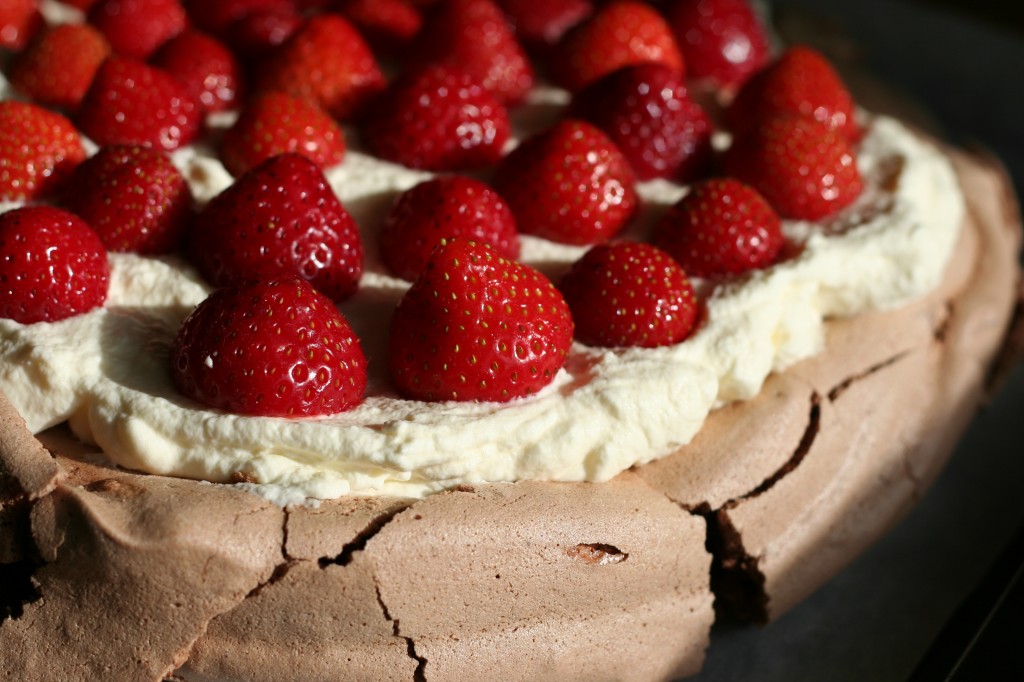
chocolate pavlova with strawberries

Chocolate Pavlova with Strawberries
adapted from Forever Summer by Nigella Lawson

Serves 8 to 10

for the chocolate meringue base:
6 egg whites
1 1/2 cups (300 g) caster sugar
3 tablespoons cocoa powder, sieved
1 teaspoon balsamic or red wine vinegar
1/4 cup (50 g) dark chocolate, finely chopped

for the topping:
2 cups (480 ml) cream
1 lb (450 g) strawberries or raspberries
2–3 tablespoons coarsely grated dark chocolate

Preheat the oven to 350°F (180°C). Line a baking tray with baking parchment and draw a circle approximately 9 inches (23 cm) in diameter onto the paper with a pencil (or just trace around a dinner plate). Just make sure the circle doesn’t go too close to the edge of the baking sheet, because the pavlova will spread a bit during cooking. Flip the paper over so that the penciled-in circle is facing down onto the sheet (so that the pavlova doesn’t come into direct contact with the pencil lead).

Beat the egg whites in a spotlessly clean and perfectly dry bowl until satiny peaks form, then beat in the sugar a spoonful at a time until the meringue is stiff and shiny. Sprinkle over the cocoa, vinegar and chopped chocolate. Gently fold everything until the cocoa is thoroughly mixed in.

Mound the mixture onto the circle you’ve drawn onto the baking parchment, smoothing the sides and top. Place in the oven, then immediately turn the temperature down to 300°F (150°C) and cook for about 1 to 1 1/4 hours. When it’s ready it should look crisp around the edges and on the sides and be dry on top, but when you prod the centre you should feel the promise of squidginess beneath your fingers. Turn off the oven and open the door slightly, and let the chocolate meringue disc cool completely (or you could even leave it in the oven overnight).

When you’re ready to serve, invert the cooled pavlova onto a big, flat-bottomed plate. Whisk the cream till thick but still soft and pile it on top of the meringue, then scatter over the fruit. Coarsely grate the chocolate so you get curls rather than rubble, as you don’t want the berries’ luscious colour and form to be obscured, and sprinkle haphazardly over the top, letting some fall, as it will, on the plate’s rim.

Oven-roasted Ratatouille with (or without) Sausages

I saw recipes for ratatouille for years and always flipped right by them in my cookbooks. A stew of nothing but vegetables sounded bland and boring to me — and this from someone who was a vegetarian for a time. It was only when I came across this recipe for Italian sausages and ratatouille that I was tempted to finally give it a try. I couldn’t believe how good it was, and kicked myself for not making it sooner. It’s the kind of dish that’s definitely more than the sum of its parts. While the sausages do impart an extra depth of flavor to it — especially if you get high-quality butcher sausages like pepper and herb, or my favorite, the Guinness sausages my local butcher makes — I’ve since made this just as often without them, and it’s equally as good. It’s the perfect dinner for late summer, when all these vegetables are readily available. I always make this on the day I get my delivery of organic fruit and veg, when everything is fresh and perfect.

There are so many versions of this classic dish out there. Most call for fresh tomatoes, as does this one, but to be honest, I just use canned tomatoes 99% of the time. Some use fennel, green peppers, wine or balsamic vinegar. Some use basil, marjoram, parsley or herbes de Provence. Almost all of them sauté the vegetables in batches in separate pans (I roast them because it’s easier). In other words, pretty much anything goes — use what you have or what you like and you can’t go too far wrong.

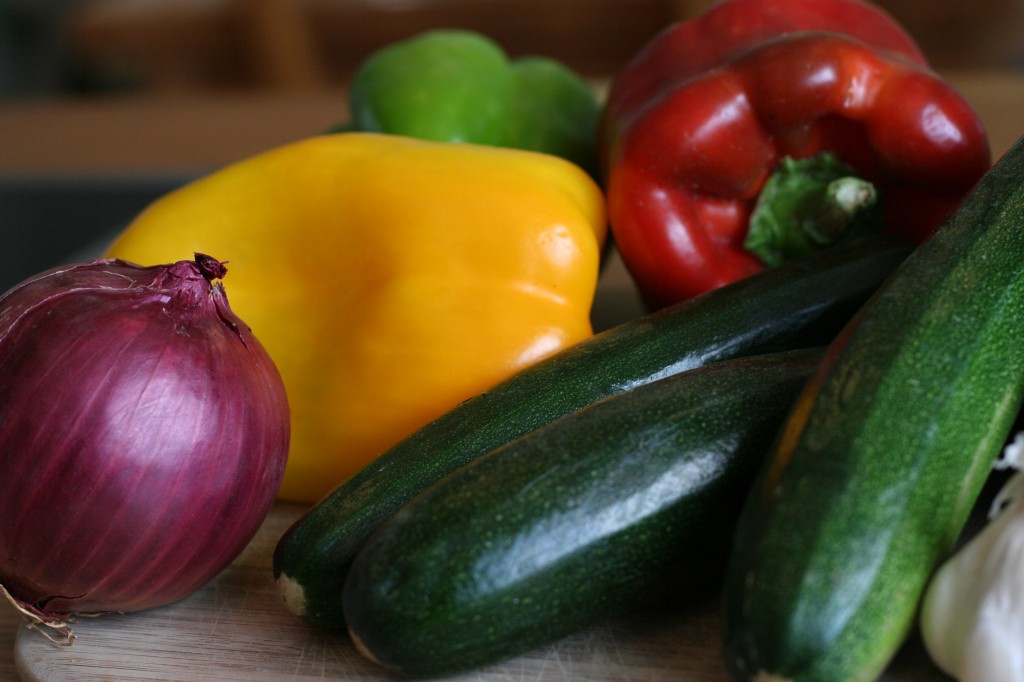
vegetables destined for ratatouille

Still looking for more ways to use up tomatoes? Try Chicken Cacciatore, Tomato and Goat’s Cheese Tart, Ravioli and Tomato Salad, Spaghetti with Fresh Tomato Sauce or Spaghetti with Roast Cherry Tomatoes, Chili and Basil.

Oven-roasted Ratatouille with (or without) Sausages

Serves 6

4 medium zucchini, chopped into bite-sized pieces
3 small eggplants, chopped into bite-sized pieces
3 red or white onions, chopped into bite-sized pieces
2 red peppers, deseeded and chopped into bite-sized pieces
2 yellow peppers, deseeded and chopped into bite-sized pieces
olive oil
salt and freshly ground black pepper
3 cloves garlic, chopped
2 x 14 oz (400 g) cans of chopped tomatoes
a few sprigs of fresh thyme (if you have it), chopped
2 sprigs of fresh rosemary, chopped
12 good-quality butcher sausages (allow 2 sausages per person)

Preheat the oven to 400°F (200°C).

Place the chopped zucchini, eggplants, onions and peppers on 2 baking sheets. Drizzle with olive oil and season well with salt and freshly ground black pepper. Toss the vegetables with your hands to ensure they’re all coated with the oil. Roast the vegetables in the oven for about 30 minutes, until they have blackened slightly, taking care not to let anything burn.

About 10 minutes before the vegetables are done roasting, heat 1 tablespoon of olive oil in a large pot (big enough to eventually hold all the vegetables, tomatoes and sausages, if you’re using them) over a medium heat. Add the garlic and cook for 1 minute, taking care not to let it burn. Add the tomatoes, chopped herbs and salt and freshly ground pepper and ring to the boil. Reduce the heat and simmer, uncovered, while the vegetables finish roasting.

Once the vegetables are done, add them to the pot with the tomatoes and stir to combine. Nestle the sausages into the vegetables and sauce, making sure they are immersed in the sauce as much as possible. Cover the pot halfway and continue to simmer on a medium-low, stirring occasionally so that nothing burns on the bottom, for about 30 minutes, until the sausages are cooked through and the flavours have blended together. Season to taste. Serve with crusty bread, or spooned on top of pasta as a sauce.

Zucchini Carbonara and Peach and Blueberry Sour Cream Cobbler

It turns out I’m not the only one around these parts with a weakness for American bacon. We’re having our house repainted at the moment, and today the painter was working inside to do the window frames. He spent 15 years living in America and only moved back about five years ago, and was chatting with us in the kitchen as I started to fry up the pancetta for this dish. “That’s not streaky bacon, is it?” he asked, streaky bacon being somewhat closer to American bacon than rashers, but still too thick cut to get as crispy as I like it to be. So he got the whole story of how much I’d missed bacon and then finding the pancetta at the grocery store. He told me how his oldest daughter prefers American bacon too, and how he’d have to get her some now that he knew about it. He was also eying up this cobbler as I made it and dropping hints about how good it looked, so he was pretty pleased when he was still around when it came out of the oven and I gave him some to have with his coffee.

It’s true that carbonara isn’t for the calorie-conscious, but even so, once you break it down per serving, there’s “only” one or two tablespoons of cream, one egg yolk, a couple tablespoons of cheese and a few slices of pancetta per serving, so for being a decadent dish, it’s not all that bad, though certainly not something you’d want to have every day. But as for the cobbler, there’s only two tablespoons of sugar in the entire dessert, making it the kind of treat I don’t at all mind giving my kids.

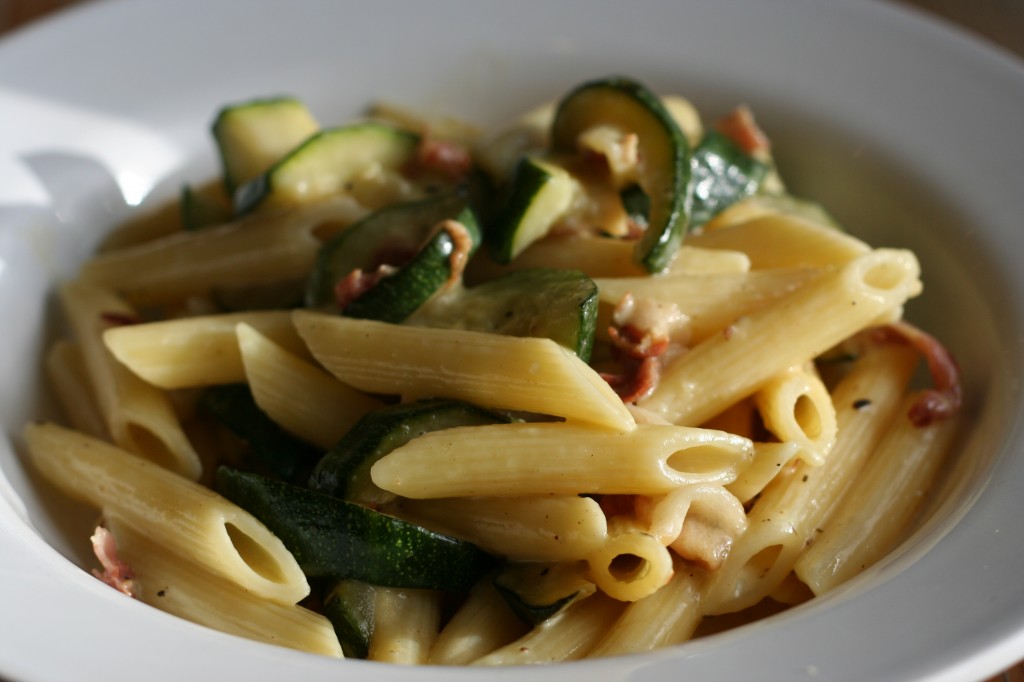
zucchini carbonara

Zucchini Carbonara
adapted from Jamie at Home by Jamie Oliver

Serves 4

6 medium green and yellow courgettes
1 lb (450 g) penne
4 large free-range or organic egg yolks
1/2 cup (120 ml) heavy cream
2 good handfuls of freshly grated Parmesan cheese
salt and freshly ground black pepper
olive oil
12 thick slices of pancetta or smoked streaky bacon, cut into chunky lardoons
a small bunch of fresh thyme, leaves picked and chopped (or 1/2 teaspoon dried)

Put a large pan of salted water on to boil. Halve and then quarter any larger courgettes lengthways. Cut out and discard any fluffy middle bits, and slice the courgettes at an angle into pieces roughly the same size and shape as the penne. Smaller courgettes can simply be sliced finely. When the water boils, add the penne to the pan and cook according to the packet instructions.

To make the carbonara sauce, put the egg yolks into a bowl, add the cream and half the Parmesan, and mix together with a fork. Season lightly and put to one side.

Heat a very large frying pan (one that will be able to hold all the sauce plus the pasta later on), add a good splash of olive oil and fry the pancetta or bacon until dark brown and crisp. Remove with a slotted spoon and to a plate lined with a paper towel to drain. Drain off all but 1 tablespoon or so of the bacon fat.

Add the courgette slices and 2 big pinches of black pepper, not just to season but to give it a bit of a kick. Sprinkle in the thyme leaves, give everything a stir, so the courgettes become coated with all the lovely bacon-flavoured oil, and fry until they start to turn lightly golden and have softened slightly. Crumble or chop the bacon and add it back to the pan.

It’s very important to get this next bit right or your carbonara could end up ruined. You need to work quickly. When the pasta is cooked, drain it, reserving a ladleful or two of the cooking water. Immediately toss the pasta in the pan with the courgettes and bacon, then remove from the heat and add a ladleful of the reserved cooking water and your creamy sauce. Stir together quickly. (No more cooking now, otherwise you’ll scramble the eggs.)

While you’re tossing the pasta and sauce, sprinkle in the rest of the Parmesan and a little more of the cooking water if needed, to give you a silky, shiny sauce. Taste quickly for seasoning. Serve and eat immediately, as the sauce can become thick and stodgy if left too long.

***

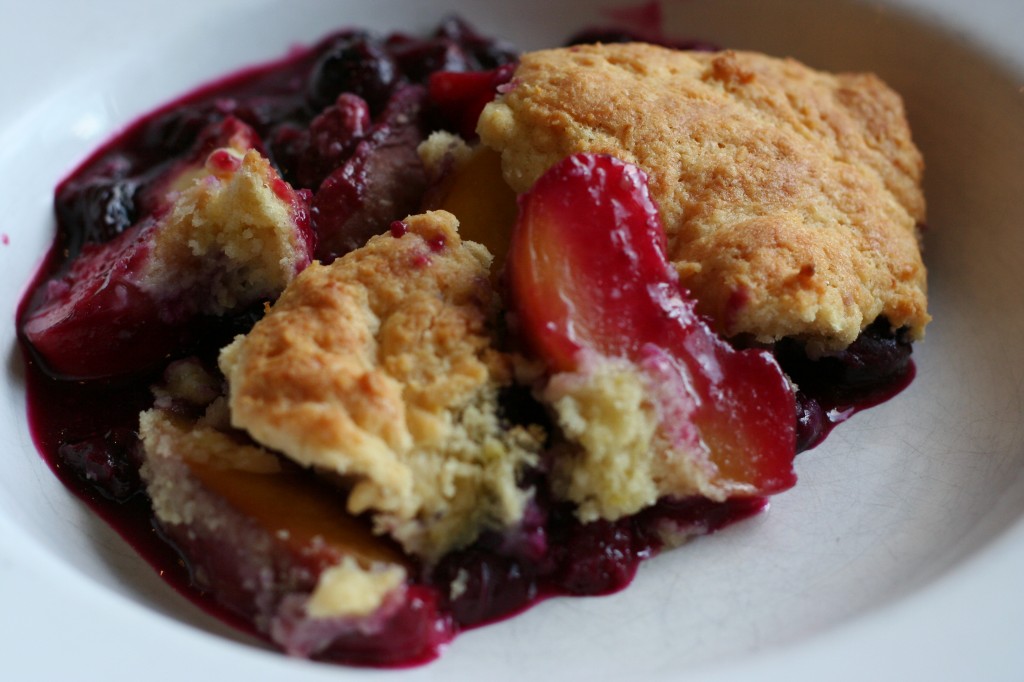
peach and blueberry sour cream cobbler

Peach and Blueberry Sour Cream Cobbler
adapted from The Kitchen Diaries by Nigel Slater

Serves 4

4 ripe peaches, sliced
about 3 cups (400 g) blueberries
juice of 1 lemon
1 tablespoon sugar
1 tablespoon flour

for the crust:
1 1/3 cups (150 g) flour
pinch of salt
2 teaspoons baking powder
1 heaped tablespoon sugar, plus extra for sprinkling
zest of 1 lemon
6 tablespoons (90 g) butter
1/2 cup (140 ml) sour cream
ice cream, cream or custard, to serve

Preheat the oven to 400°F (200°C).

For the cobbler crust, put the flour, salt, baking powder, sugar, lemon zest and butter in a food processor and blitz for a few seconds, until the mixture resembles breadcrumbs. Tip into a bowl and set aside.

Put the sliced peaches and blueberries into an ovenproof dish. Toss them with the lemon juice, sugar and flour.

Mix the sour cream into the crumb mixture to make a soft dough. Break off walnut-sized pieces and flatten them lightly. Lay them on top of the fruit. Sprinkle the rounds of dough with sugar, then bake for 25 minutes, till the cobbler is golden and the fruit is bubbling. Serve with ice cream, a drizzle of cream or some warm custard.

Ravioli and Tomato Salad and Honey Vanilla Poached Apricots

One of the quintessential smells of summer for me is a bunch of fresh basil — I’m sure I’m not alone in this. When I had gardens in the Midwest, it grew so quickly that I often couldn’t use it all fast enough. In Ireland, though, it’s so cool in the summer that it won’t grow outside at all, which means you either have to be content with whatever you can fit on your windowsill or grow it in a greenhouse or polytunnel. That’s been a huge disappointment for me, since having a nonstop supply of basil throughout the summer was one of the things I’d been looking forward to when we started our garden three years ago. I also couldn’t wait to grow tomatoes, but after losing all of our plants during the past two summers due to record-breaking rain, we didn’t even bother planting any this year (and good thing too, seeing as how this July was the wettest for 50 years). It’s just another thing that will have to wait until we get a tunnel, hopefully next year. In the meantime, I begrudgingly buy meager packets of fresh herbs, instead of the heaps I’d hoped to be growing myself. But for anyone with basil to spare, and tomatoes too (lucky you!), this recipe is for you.

IMG_8810

Still looking for more ways to use up tomatoes? Try Chicken Cacciatore, Tomato and Goat’s Cheese Tart, Oven-roasted Ratatouille, Spaghetti with Fresh Tomato Sauce or Spaghetti with Roast Cherry Tomatoes, Chili and Basil.

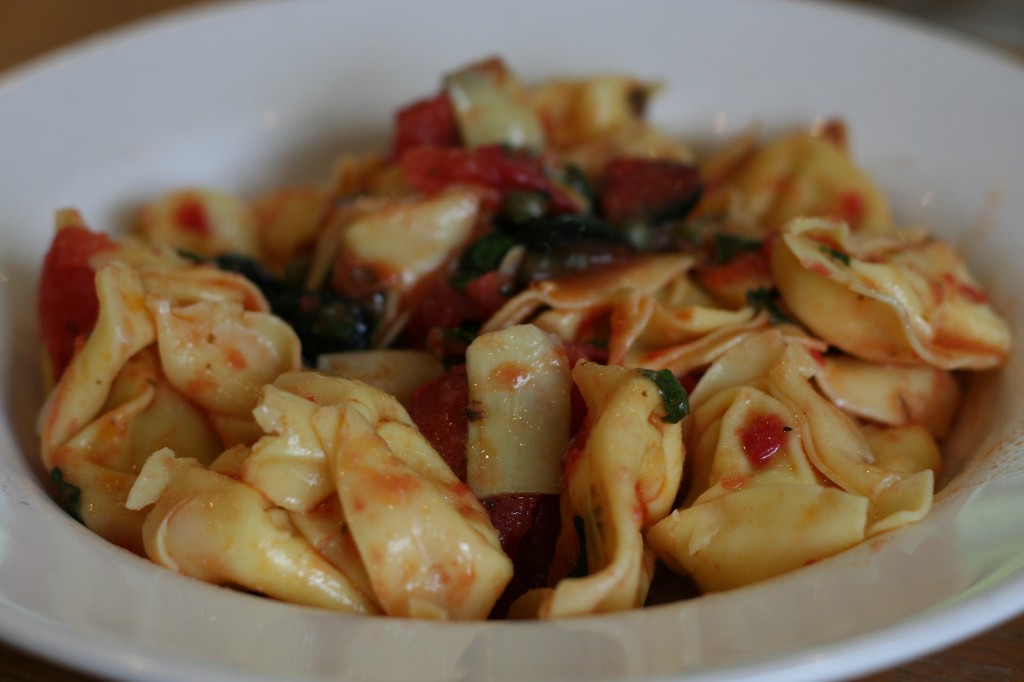
Ravioli and Tomato Salad with Masses of Basil
from Vegetarian Cooking for Everyone by Deborah Madison

Serves 4 to 6

This will be even better if you can make it ahead of time, giving the flavors plenty of time to blend together. It would be perfect for a picnic.

1 lb (450 g) cheese ravioli or tortellini
2 lb (900 g) ripe tomatoes
1 x 6‑oz (170‑g) jar artichoke hearts, drained and halved (optional)
1 bunch basil, leaves torn into pieces
1/2 cup (90 g) olives, pitted and halved
3 tablespoons capers, rinsed
1/4 cup (60 ml) extra virgin olive oil
salt and freshly ground black pepper
red wine vinegar

Bring a large pot of water to boil for the ravioli. Meanwhile, skin the tomatoes. (To do this, cut a shallow X in the bottom of each tomato with a sharp knife, then pour boiling water over them and leave until the skin around the X starts to curl away, about 1 to 2 minutes. Drain and allow to cool, then slip off their skins.) Deseed them and chop them into large pieces. Put the tomatoes and artichokes in a large bowl along with the basil, olives, capers, and oil.

Once the water is boiling, add the ravioli or tortellini and cook according to the package instructions, then drain well. Add the pasta to the tomato mixture in the bowl and toss gently with a rubber spatula. Taste for salt, season with pepper and sprinkle with vinegar to taste. Serve warm or at room temperature.

***

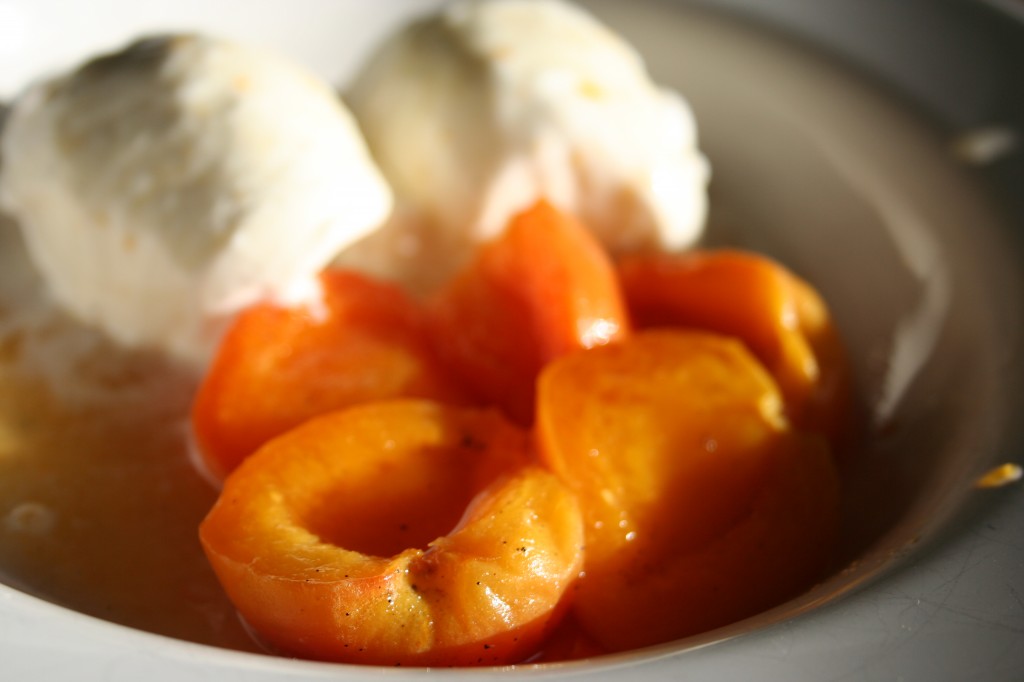
honey vanilla poached apricots

Honey Vanilla Poached Apricots
from Gourmet, June 1996

Serves 2

1 cup (240 ml) water
3 tablespoons honey
3 tablespoons sugar
1/2 vanilla bean, halved lengthwise
3/4 lb (340 g) fresh apricots (about 9 or 10 apricots), halved lengthwise and pitted
vanilla ice cream, to serve

In a 1 1/2‑quart saucepan, simmer the water, honey, sugar, and vanilla bean, covered, for 5 minutes. Add the apricots and simmer, covered, until just tender but not falling apart, 2 to 5 minutes (mine were done after 2 minutes), depending on how ripe the fruit is.

Transfer the apricots with a slotted spoon to a bowl and boil the syrup until it has reduced to about 1/2 cup (120 ml). Pour the syrup over the apricots and chill for 25 minutes. Serve with vanilla ice cream, with the syrup spooned over.

Mexican Rice Supper with Chorizo, Zucchini and Corn

You can learn a lot from reading cookbooks. By that I don’t mean just reading the recipes, but the surrounding text as well, where some good tips can be hidden. It was from Nigella Lawson’s How to Eat that I learned the great trick of substituting vermouth when a recipe calls for white wine, for the simple reason that if I open a bottle of wine to add some to whatever I’m cooking, the rest of it is going to be drunk that night. That’s not necessarily a problem, except that I like to cook with wine and that can get expensive, whereas you just need a splash of vermouth for the same effect and one bottle will last for a couple months.

Another invaluable trick is one I learned from Rick Balyess’s Mexican Kitchen: deflaming onions. I’ve never been a fan of raw onions, finding them to be too overpowering in most dishes, but deflaming them takes a lot of the bite out of them. All you do is prepare the onion as your recipe says to, then toss the cut-up onion into a strainer and rinse well under cold water. I do this all the time now.

This is a great one-dish dinner on its own, though Rick Bayless suggests pairing it with some dressed greens (try the Tangy Avocado Dressing) or a spinach salad, warm tortillas, and perhaps a small bowl of beans for, as he says, “a supper to savor.” If you’re really in the spirit of the summer season, use the kernels from 1 ear of fresh corn here.

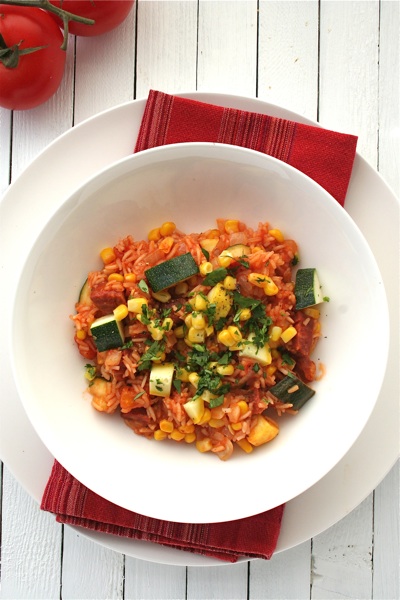
Mexican Rice Supper with Chorizo, Zucchini and Corn
adapted from Rick Bayless’s Mexican Kitchen by Rick Bayless

Serves 4

If you have your own favorite salsa recipe, then by all means use that instead here. If you don’t want to bother making your own salsa, just substitute 2 cups (480 ml) of a good store-bought one. This dish can be made a day ahead, though the zucchini will suffer a bit in the reheating.

for the salsa:
2 medium round tomatoes or 4 to 6 plum tomatoes, chopped into 1/4‑inch dice
1 or 2 red chilies (or 3 to 5 fresh Serrano chilies), deseeded and finely chopped
1 large garlic clove, finely chopped
3 tablespoons chopped cilantro, plus extra to garnish
1 small onion, finely chopped

for the rice:
1 cup (225 g) chorizo sausage, casing removed
1 cup (180 g) rice, preferably medium grain
3/4 cup (175 ml) chicken, beef or vegetable stock (or water)
salt and freshly ground black pepper
2 small zucchini, cut into 1/2‑inch dice
1 cup (200 g) corn

To make the salsa, mix together the tomatoes, chillies, garlic and cilantro. Place the chopped onion into a strainer, rinse under cold water, shake off the excess and add to the mixture.

To make the rice, break up the chorizo into a medium heavy-bottomed saucepan (it will need to be big enough to accommodate all the ingredients) and set over a medium heat. Stir regularly, breaking up any lumps, until the chorizo is thoroughly cooked, about 10 minutes. Remove it with a slotted spoon, then pour off all but 1 tablespoon or so of the fat. Add the rice to the pan, return to the heat and stir regularly until the rice is lightly browned, about 7 minutes. Add the salsa, raise the heat to medium-high and cook, stirring every once in a while, until very thick and reduced, about 7 minutes.

While the mixture cooks, bring the stock (or water) to a boil in a small saucepan. Add to the rice mixture, stir once, scrape down any rice kernels clinging to the side of the pan, cover and cook over a medium-low heat for 10 minutes.

Add the cooked chorizo, zucchini and corn, re-cover and cook 5 minutes longer. Uncover and bite into a grain of rice: it should be nearly cooked through. If the rice is ready, turn off the heat, cover, and let stand for 5 to 10 minutes longer to complete the cooking. If the rice seems far from done, continue cooking for 5 minutes or so, retest, then turn off the heat and let stand for a few more minutes.

Divide into 4 warmed bowls, sprinkle with the extra cilantro, and serve.

A Cooking Blog