Category Archives: 30-minute meals

Linguine with Chili, Crab and Watercress and Eton Mess

There are two events that mark the start of summer for me — the first day I see a van on the side of the road selling Wexford strawberries or when I cook something from Nigella Lawson’s Forever Summer cookbook.

Once I dust off that cookbook, this linguine is invariably the first thing I make from it, since I’ve made it so often that the book now falls open naturally to this well-thumbed, cooking-splattered page. As for Eton mess, it was invented at Eton College in England in the 1930s and is now traditionally served there today, on June 4th, but we don’t stand on such ceremony in my family — we eat this as soon as Irish strawberries hit the shops and roadside stands, then make it more often than I care to admit all through the summer (certainly more than can be good for us). I’m lucky in that you can buy meringues in practically any grocery store in Ireland, which is what makes it so easy to whip together, but if you want to try making meringues yourself, this is the perfect recipe to have as a back-up plan. Because you crush the meringues anyway, it doesn’t matter one bit if they look pretty beforehand. And I’m willing to bet that once you try this, you’ll be getting plenty of practice honing your meringue-making skills by making this irresistible summer dessert (far too) often.

Linguine with Chili, Crab and Watercress
adapted from Forever Summer by Nigella Lawson

Serves 4

By all means use fresh crab if you can, but canned works just fine. The original recipe calls for watercress, but arugula (rocket) or even spinach would work too.

1 lb 2 oz (500 g) linguine or spaghetti
2 cloves garlic, peeled
1 scant tablespoon Maldon sea salt (or 1 teaspoon regular sea salt)
1 large red chili
about 11 oz (310 g) crab meat
1/2 cup (120 ml) extra virgin olive oil
juice and zest of 1 lemon
a handful of fresh parsley, chopped
a handful of watercress, leaves only, roughly torn

Bring a large pot of salted water to boil and cook the pasta according to the packet instructions.

Meanwhile, in a pestle and mortar, mash the peeled garlic cloves with the salt, so that it makes a smooth paste. Add the chopped and seeded chili and crush again until you have a red-tinged mixture.

Put the crab meat in a large bowl, breaking it up gently with a fork. Pour the oil, lemon zest and juice into another bowl or measuring jug and whisk together. Scoop in the garlic and salt paste, then whisk everything together. When the pasta is finished cooking, drain, then add to the crab mixture and pour the dressing over, tossing well to combine. Add in the parsley and watercress, toss again and serve.

***

Eton Mess

Serves 4

For a grown-up boozy twist, marinate the strawberries in a generous splash of orange liqueur (like Cointreau or Grand Marnier) for 30 minutes before stirring them into the whipped cream (you could also try creme de cassis, Framboise, grappa, kirsch, or even a little orange juice and vodka). If you can’t find meringues in the store or you want to make your own, try Delia Smith’s recipe, who also has a great step-by-step tutorial on how to make them here.

You can make Eton mess with strawberries, bananas or any summer fruit, though strawberries are considered to be traditional.

Pureeing the strawberries makes this dessert more attractive and heightens the strawberry flavor, but you could be lazy and skip this step (I often do) — simply chop all the strawberries and fold them in with the cream and meringues and it will still be delicious.

1 lb (450 g) fresh strawberries, hulled
1 tablespoon confectioners’ (icing) sugar
1 tablespoon granulated or caster sugar (optional)
1 1/2 cups (360 ml) cream
4 store-bought meringue nests

Cut the strawberries into halves or quarters, depending on their size (you want them to be bite sized). Place about one-third of the berries and the confectioners’ (icing) sugar in a food processor or blender and process until just pureed (or you can mash them with a potato masher or fork). Place the remaining strawberries in a bowl and sprinkle with the granulated or caster sugar only if you think the berries need a little boost to bring out their natural sweetness (or add some liqueur instead; see above). Set aside to macerate while you whip the cream.

Whip the cream just until soft peaks form. Break up the meringues into bite-sized pieces and add them to the whipped cream, along with the chopped strawberries, reserving a few for decoration. Gently fold in all but a few tablespoons of the puree, marbling it throughout the cream mixture. Spoon into individual serving dishes and drizzle with the remaining puree and reserved strawberries. Serve immediately.

Pork Chops with Tomatillo and Green Apple Sauce and Couscous

With only a few weeks left until summer officially arrives in the US, I’ve thrown myself into spring cleaning. The kitchen is my most used, most tidied, but least organized part of my house. It’s hard to thoroughly clean out a room that always seems to have someone in it. In an attempt to use up my food odds and ends so I could wipe down shelves, I took a stab at this admittedly strange-sounding pork chop recipe. I’ll admit that I probably wouldn’t have tried the dish if I didn’t need to use up two aging green apples, a can of tomatillos bought on clearance, a frozen chipotle pepper and a package of pork chops. But necessity is the mother of invention, and in this case, genius. The sweetness of the green apple lends just the right amount of zing to the spice of the chipotle and sour of the tomatillos. It’s pretty enough to serve your mother and unique enough to make for your foodie friends.

To liven up the Israeli couscous, I cooked the couscous according to the package directions, making sure to toast it before adding the liquid. Once cooked, stir in a few tablespoons of minced fresh parsley, a generous drizzle of olive oil, and a handful of grated Parmesan cheese. Don’t forget to season to taste with salt and pepper. I used an Israeli couscous, lentil and quinoa blend, but plain Israeli couscous tastes just as good.

Pork Chops with Tomatillo and Green Apple Sauce
adapted from Gourmet, June 2004

Serves 4 to 6

for the pork chops:
2 tablespoons ground coriander
2 tablespoons ground cumin
2 tablespoons kosher salt
1 tablespoon black pepper
4 tablespoons olive oil
6 x 1‑inch-thick loin pork chops

for the tomatillo and green apple sauce:
12 oz (340 g) canned, whole tomatillos (or 1/2 lb/225 g fresh tomatillos)
2 Granny Smith apples
1/2 cup (10 g) loosely packed fresh cilantro sprigs
1 garlic clove, minced
1 teaspoon ground cumin
2 tablespoons fresh lime juice
1/4 cup (60 ml) water or apple juice
1 tablespoon mild honey
1 minced canned chipotle chile in adobo

Stir together the coriander, cumin, salt, and pepper in a small bowl, then add the oil and stir until combined well. Rub the spice mixture all over the chops. Let the chops marinate while making the sauce.

If using fresh tomatillos, remove the husks and rinse the tomatillos. Boil the tomatillos in water, uncovered, until the tomatillos are just soft, 8 to 10 minutes. Drain and cool for 15 minutes.

Peel and core the apples and cut into 1/4‑inch dice.

Purée the canned (or cooked) tomatillos with the remaining sauce ingredients except the apples in a food processor. Transfer to a bowl and stir in the apples.

Heat a heavy cast iron skillet or ridged grill pan. Lightly oil the surface of the pan, then sear the pork chops over a moderately high heat, turning over once, until well browned and cooked through, about 5 to 6 minutes on each side. Alternatively, you can grill the pork chops over medium heat until done, about 15 minutes total, depending on the thickness of the chop. Serve with the sauce spooned on top.

Pasta with Bacon, Peas and Cream

The trouble with being a two-year-old who still doesn’t talk much is that your older sister takes liberties when translating for you. When I asked my little boy what he wanted for dinner for his birthday last week, my daughter piped up and proclaimed that he wanted “that pasta with the peas and white sauce” — what is, in fact, one of her favorite dinners. But since I knew he loves it too, I went along with it. This comes from the “Kiddiefeast” chapter in Nigella Lawson’s Feast cookbook, and while it’s a winner with kids, grown-ups love it too (bacon and cream — what’s not to love?). It’s certainly not a dish for every day, what with all that cream, but it’s one of my favorite comfort food recipes.

Pasta with Bacon, Peas and Cream
adapted from Feast: Food to Celebrate Life by Nigella Lawson

Serves 4

In her book The Dinner Lady, Jeanette Orrey makes a version of this where instead of the cream and Parmesan, you could add 10 oz (280 g) grated cheddar cheese and 1/3 cup (80 ml) milk to the drained pasta at the end, stirring until the cheese has melted. If I have some leftover ham, I almost always wind up making this and using the ham instead of bacon.

14 oz (400 g) farfalle (bow ties) or other short pasta
1 1/2 cups (200 g) frozen peas
1/2 lb (225 g) bacon, diced (or use leftover diced ham)
1 1/4 cups (300 ml) heavy cream
1/2 cup (50 g) freshly grated Parmesan, plus extra to serve
salt and freshly ground black pepper

Cook the pasta according to the packet instructions in plenty of boiling salted water. After 5 minutes, add the peas to the pasta to cook them together in the one pot.

Meanwhile, fry the bacon in a separate pan until crispy. Remove from the pan with a slotted spoon and drain on paper towels. Set aside.

When the pasta is cooked, drain along with the peas. Put the pot back on the heat with the bacon, cream and Parmesan. Stir well and warm it through. Add the drained pasta and peas back to the pan and toss everything together. Season to taste and serve with extra Parmesan grated on top.

Grilled Chicken with Gremolata, Slow Cooker Baked Potatoes, and Key Lime Coconut Cake

Sometimes I’ll try a new recipe and find myself shocked that it isn’t already part of my regular recipe rotation. You know the ones — quick, easy, cheap. This is one of those recipes. In the time it takes to preheat your grill, you can make a fabulously fresh-tasting paste of fresh herbs, lemon, and garlic to top the chicken. Serve the chicken with already cooked slow cooker baked potatoes (another I‑can’t-believe-how-easy-this-is preparation) and fresh steamed vegetables for a light but memorable dinner. If you have an extra half hour, you can whip up the equally quick, equally fabulous coconut cake. I knew it was a successful dessert when I noticed my usually sugar-avoiding mother-in-law sneaking slivers of it before dinner the following night.

Grilled Chicken with Gremolata
adapted from Giada’s Family Dinners by Giada De Laurentiis

Serves 4

1/4 cup (10 g) finely chopped fresh flat-leaf parsley
2 tablespoons extra virgin olive oil
1 1/2 tablespoons lemon zest
1 teaspoon finely chopped fresh oregano
1 teaspoon finely chopped fresh thyme
1 teaspoon finely chopped garlic
1 tablespoon olive oil
2 lb (900 g) skin-on, cut-up chicken (breasts, thighs, and/or legs)
salt and freshly ground black pepper

In a small bowl, combine the parsley, extra virgin olive oil, lemon zest, oregano, thyme, and garlic. Set the gremolata aside.

Preheat a charcoal or gas grill for medium heat. Rub the olive oil over both sides of the chicken. Season the chicken to taste with salt and pepper. Grill the chicken over medium heat until it’s just cooked through (10 to 15 minutes for breasts, 15 to 20 minutes for legs/thighs). Transfer the chicken to a platter. Immediately spoon the gremolata over the chicken and serve.

***

Slow Cooker Baked Potatoes

baking potatoes (as many as your slow cooker can hold)
aluminum foil

Wash the potatoes and prick them with a fork in a few places. Wrap each potato with aluminum foil. Place the wrapped potatoes in your slow cooker. Cover the slow cooker and cook the potatoes on low for 8 to 10 hours.

I gussied these up in the picture above by dicing the cooked potatoes, leaving the skins on, then topping them with melted butter, salt, pepper, and freshly chopped chives.

***

Key Lime Coconut Cake
adapted from Gourmet, March 2008

Serves 8

1 cup (90 g) sweetened flaked coconut
1/2 cup (110 g) unsalted butter, softened
1 1/4 cups (250 g) granulated sugar
1 tablespoon grated Key lime zest
2 extra-large eggs
1 3/4 cups (210 g) self-rising flour
3/4 cup (180 ml) whole milk
1/4 cup (60 ml) plus 1 tablespoon fresh Key lime juice, divided
1 1/4 cup (150 g) confectioner’s (icing) sugar
1 tablespoon rum (optional)

Preheat the oven to 350°F (180°C) with the rack in the middle. Generously butter a springform cake pan and line the bottom with a round of parchment paper.

Toast the coconut in a small baking pan in the oven, stirring once or twice, for 8 to 12 minutes, until it’s golden. Cool. Leave the oven on.

Beat together the butter, granulated sugar, and zest with an electric mixer until fluffy. Beat in the eggs 1 at a time. Stir together the flour and 1/2 cup coconut (reserve the remainder for the topping). Stir together the milk and 2 tablespoons lime juice. At low speed, mix the flour and milk mixtures into the egg mixture alternately in batches, beginning and ending with flour.

Spoon the batter into the prepared pan and smooth the top. Bake for 35 to 40 minutes, until golden and a wooden pick inserted into the center comes out clean. Cool the cake to warm, then turn out of the pan and remove the parchment paper.

Whisk together the confectioners sugar, the remaining 3 tablespoons lime juice, and rum (if using) and pour over the cake. Sprinkle with the remaining coconut.

Easy Sole Meunière with Parmesan Roasted Asparagus and Herbed New Potatoes

Sole meunière had its five minutes of fame last year when the movie Julie and Julia was released, which renewed interest in Julia Child. The story did the rounds of how it was Julia’s first (and ultimately life-changing) meal in France, which she described as “a morsel of perfection.” Who am I to disagree? It’s simple and delicious, a true classic.

This is an all-Ina menu from three different cookbooks, and everything comes together to make an elegant and easy springtime dinner that’s ready in half an hour. In the “Easy French” episode of her TV show, Ina Garten suggests serving the sole with a French apple tart, which would elevate this menu into something nice enough for company.

Note that this sole recipe serves 2 while the asparagus and potatoes serve 6, so adjust the recipes according to how many people you’re serving. You could also try green beans dressed with lemon and olive oil or lemon roast potatoes instead of the roasted asparagus and herbed new potatoes.

Easy Sole Meunière
adapted from Barefoot Contessa Back to Basics by Ina Garten

Serves 2

When I make this recipe, I add a little olive oil along with the butter to stop it from burning.

1/2 cup (60 g) all-purpose flour
salt and freshly ground black pepper
4 x 4 oz (110 g) fresh sole fillets
6 tablespoons (90 g) unsalted butter
1 teaspoon grated lemon zest
6 tablespoons freshly squeezed lemon juice (3 lemons)
1 tablespoon minced fresh parsley

Preheat the oven to 200°F (100ºC). Have 2 heat-proof dinner plates ready.

Combine the flour, 2 teaspoons salt, and 1 teaspoon pepper in a large shallow plate. Pat the sole fillets dry with paper towels and sprinkle one side with salt.

Heat 3 tablespoons (45 g) of butter in a large (12-inch) saute pan over medium heat until it starts to brown (add a little olive oil as well if you’re worried about the butter burning). Dredge 2 sole fillets in the seasoned flour on both sides and place them in the hot butter. Lower the heat to medium-low and cook for 2 minutes. Turn carefully with a metal spatula and cook for 2 minutes on the other side. While the second side cooks, add 1/2 teaspoon of lemon zest and 3 tablespoons of lemon juice to the pan. Carefully put the fish fillets on the ovenproof plates and pour the sauce over them. Keep the cooked fillets warm in the oven while you repeat the process with the remaining 2 fillets. When they’re done, add the cooked fillets to the plates in the oven. Sprinkle with the parsley, salt, and pepper and serve immediately.

***

Parmesan Roasted Asparagus
adapted from Barefoot Contessa Family Style by Ina Garten

Serves 6

2 1/2 lb (1.1 kg) fresh asparagus (about 30 large spears)
2 tablespoons good-quality olive oil
1/2 teaspoon kosher salt
1/4 teaspoon freshly ground black pepper
1/2 cup (50 g) freshly grated Parmesan
2 lemons cut into wedges, for serving

Preheat the oven to 400°F (200°C).

Snap off the woody ends of the asparagus stalks and discard. Lay the stalks in a single layer on a sheet pan and drizzle with olive oil. Sprinkle with salt and pepper. Roast for 15 to 20 minutes, until tender. Sprinkle with the Parmesan and return to the oven for 1 minute more. Serve with lemon wedges.

***

Herbed New Potatoes
adapted from Barefoot in Paris by Ina Garten

Serves 6

4 tablespoons (60 g) unsalted butter
2 1/2 lb (1.1 kg) baby or new potatoes, scrubbed but not peeled
2 teaspoons kosher salt
1/2 teaspoon freshly ground black pepper
3 tablespoons chopped mixed fresh green herbs, such as parsley, chives, and dill

Melt the butter in a Dutch oven or large heavy-bottomed pot. Add the whole potatoes, salt and pepper and toss well. Cover the pot tightly and cook over a low heat for 15 to 30 minutes, until the potatoes are just tender when tested with a small knife. From time to time, shake the pot without removing the lid to prevent the bottom potatoes from burning. Turn off the heat and allow the potatoes to steam for another 5 minutes. Don’t overcook! Toss with the herbs and serve hot.

Caramel Salmon with Cucumber and Snow Pea Salad

Is there anyone more stereotypically Australian than Bill Granger? He’s blond, buff, lives by the beach in Sydney and knows his way around a barbecue. He also isn’t afraid of loud shirts and white pants and throws in an occasional wink to the camera. He’s my new favorite TV chef and this is my new favorite salmon. It’s the kind of recipe that’s so good I won’t want to make salmon any other way from now on. Try it and you’ll see why. (And head’s up for all you cookbook addicts — Bill Granger’s most recent book, Every Day, is on sale online at the Book Depository for €10.32 (about $13.50), with free worldwide shipping. Just don’t tell my husband, who bought it for me as a surprise last week and paid twice as much.)

Caramel Salmon
adapted from Every Day by Bill Granger

Serves 4

This is Bill Granger’s take on a traditional Vietnamese caramel dish.

1 tablespoon vegetable oil
2 lb (900 g) salmon, deboned and cut into large cubes
1 red onion, sliced
3 cloves garlic, sliced
3 tablespoons dark soy sauce
1/2 cup (100 g) brown sugar
3 tablespoons fish sauce (nam pla)
freshly ground black pepper
1 tablespoon lime juice
steamed rice, to serve
a handful of fresh cilantro, chopped, to serve
3 or 4 scallions, chopped, to serve
1 red chili, deseeded and finely chopped, to serve
lime wedges, to serve

Heat the oil in a large frying pan over a high heat. Add the salmon in 2 batches and cook each batch for a couple of minutes until lightly browned. Turn over and cook the other side for 1 minute, then remove from the pan.

Reduce the heat to medium and add a little extra oil to the pan, if needed. Add the onion and garlic and cook for 3 minutes, stirring occasionally. Stir in the soy sauce, sugar and fish sauce. Return the salmon to the pan and cook for 1 minute, or until the sauce is rich, dark and syrupy. Sprinkle liberally with black pepper and stir through the lime juice. Serve on top of steamed rice with a little sauce drizzled over. Sprinkle over some chopped cilantro, scallions and red chili and place lime wedges on the side.

***

Cucumber and Snow Pea Salad
adapted from Every Day by Bill Granger

Serves 4

If you like this salad, you might also like to try Bill Granger’s sugar snap and bok choy salad, which is very similar to this one.

1 cucumber, thickly sliced
5 oz (140 g) snow peas (mangetout), trimmed, blanched and halved diagonally
2 teaspoons lime juice
pinch of sugar
1 tablespoon olive oil

Put the cucumber and snow peas in a large bowl. Whisk together the lime juice, sugar and oil until the sugar dissolves (or shake to combine in a screw-top jar). Pour over the cucumber and snow peas and toss well. Serve immediately.

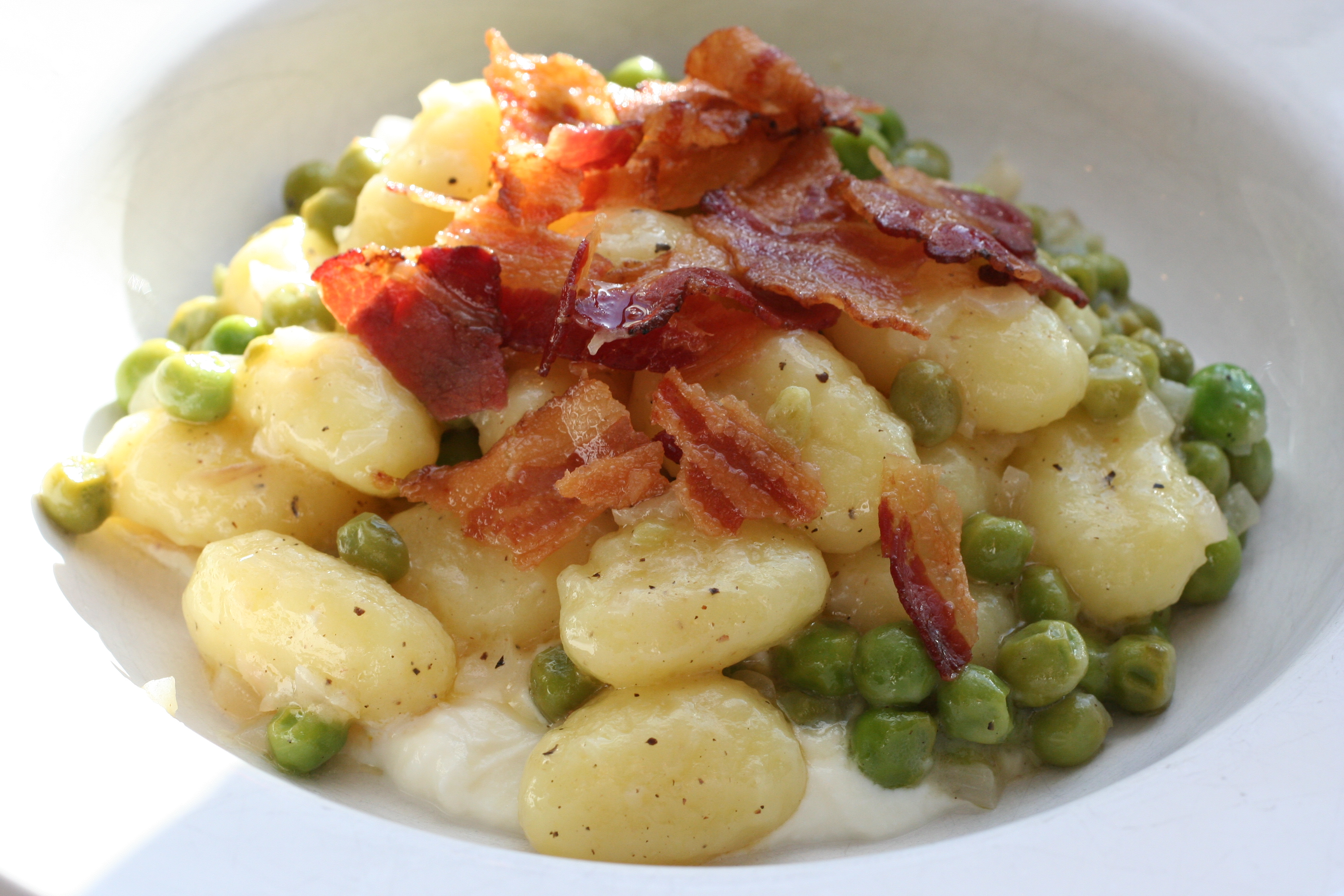
Gnocchi with Peas, Pancetta and Lemon Ricotta

I’ve been wanting to try my hand at making gnocchi for awhile now, but there’s only so far I’m only willing to go for a weeknight supper. I recently watched Tyler Florence making gnocchi on TV, and while it does look straightforward enough (not to mention something the kids would love to help with, since it looked like potato play dough), I cheated with a package of store-bought gnocchi but made the rest of his recipe, which comes together in less than half an hour.

This is an ideal dinner for this time of year. The potato gnocchi are still substantial and filling enough for spring evenings with a chill in the air, but the lemon brightens up the dish. Or if you’re having the kind of day where the last thing you want to face is cooking dinner, this requires minimal effort — the most taxing steps are chopping a shallot and zesting and juicing a lemon.

This was lovely just as it is, but I can see it being a springboard for other variations, perhaps with a cream and lemon sauce like the one in this lemon fusilli instead of the ricotta and pan sauce, with broad beans instead of the peas or with some finely chopped fresh basil or mint added in. A peppery arugula salad on the side would be perfect.

Gnocchi with Peas, Pancetta and Lemon Ricotta
adapted from Tyler Florence

Serves 4

If you quickly blanch the peas first it will help retain their green color, but honestly, could you be bothered? I’ll happily settle for dull green peas here if it makes for an easier life.

for the gnocchi:
1 lb 2 oz (500 g) store-bought gnocchi
4 oz (110 g) pancetta or prosciutto (or 6 slices bacon)
1 1/2 cups (200 g) frozen peas, thawed
1 large shallot, finely diced
2 tablespoons extra virgin olive oil
salt and freshly ground black pepper
2 tablespoons (30 g) butter
1/4 cup (25 g) freshly grated Parmesan

for the lemon ricotta:
2 cups (about 500 g, or 2 tubs) ricotta cheese
zest and juice of 1 lemon
salt

Preheat the oven to 350°F (180°C). (If using bacon instead of pancetta, preheat the oven to 400°F/200°C instead.) Bring a large pot of salted water to boil and cook the gnocchi according to the packet instructions (gnocchi usually only takes about 3 minutes to cook). Make sure you reserve about 1/2 cup (120 ml) of the cooking water for the sauce.

While the water is coming to a boil, place the strips of pancetta or bacon in 1 layer on a baking rack placed on top of a sheet pan. Cook for 8 to 10 minutes, until the pancetta is crispy. (If using bacon, this could take up to 15 or 20 minutes at the higher temperature, depending on how thick it is; cook until browned.) Drain on paper towels, then roughly chop into bite-sized pieces. Set aside.

Meanwhile, to make the lemon ricotta, place the ricotta in a mixing bowl and add the lemon zest and juice. Season with salt and set aside. (This could be done in advance and kept refrigerated.)

Heat the olive oil in a pan over a medium heat. Add the chopped shallots and gently saute for about 5 minutes, until fragrant and translucent. Add in the peas and toss gently to coat and heat through. Season with a little salt and pepper. Add the cooked gnocchi to the pan and gently toss. Add the reserved gnocchi water to the pan, then add the butter, sprinkle with the Parmesan and season again with salt and pepper.

To serve, spread a generous scoop of the lemon ricotta on the bottom of each plate. Ladle the gnocchi, peas and the pan sauce on top of the ricotta, then top with the crispy pancetta.

Tandoori Chicken with Bombay Potatoes

I’ve hated ghost stories, horror movies and all things even remotely scary since I was nine years old and read a book of ghost stories from my school library, so I’m at a loss to explain why I thought it was a good idea to start swapping first- and second-hand ghost stories when I was having lunch with a friend a week ago. That was all fine and good on a sunny Saturday afternoon, sitting in her bright, cozy kitchen in the County Kildare countryside with a glass of wine, but a few nights later, up in the middle of the night with my little boy, all our stories were running through my head and I was scaring myself silly.

But I’d do it all over again just to have this lunch that she made (not to mention her warm Bakewell tart with fresh raspberries, but that’s a recipe for another day). The fact that I made it myself for my family just one week after having it for our girls’ lunch will also tell you something about how good it is. My four-year-old daughter liked it so much on Saturday that she was disappointed when I served up something else on Sunday and said she wanted this again. Lucky for her, there were leftovers that I’d been planning on having for lunch yesterday, but I let her have them for dinner last night instead. Such are the sacrifices we make for our children — including getting up in the dark to soothe them back to sleep when you’ve turned into a scaredy cat again and just want to pull the covers over your head.

Don’t let the long list of ingredients put you off, it’s just a bunch of spices, and the marinade takes all of 5 minutes to put together. As an alternative to the raita, you could make a mango salsa by combining 1 large mango, peeled and chopped, 1 red chili, deseeded and chopped, the juice of 1 lime and 1 tablespoon chopped mint.

This tandoori chicken is very similar to Kelly’s chicken tikka masala, the main difference being that this version has more spices and doesn’t have a sauce, which makes it even faster and easier to cook as a weeknight dinner. I served it with the pan-roasted curried cauliflower and peas from that menu, as well as Kelly’s cucumber raita, which I added a large handful of chopped fresh mint to. I cooked the curried cauliflower in a separate pan, but next time I’ll try increasing the amount of spices for the Bombay potatoes and just cooking all the vegetables together in one pot instead.

Tandoori Chicken with Bombay Potatoes
adapted from The Eden Cookbook by Eleanor Walsh and Michael Durkin

Serves 6

for the tandoori chicken:
1 tablespoon paprika
1/2 teaspoon garam masala
1/2 teaspoon chili powder
1/2 teaspoon ground cumin
1/2 teaspoon salt
1/2 teaspoon turmeric
2 tablespoons lemon juice
2 tablespoons sunflower oil
2 tablespoons natural yogurt
2 tablespoons cream
1 tablespoon tomato puree
3 cloves garlic, crushed
1 teaspoon fresh ginger, peeled and grated
6 boneless, skinless chicken breasts

for the Bombay potatoes:
2 1/4 lb (1 kg) potatoes, peeled and cubed
1 tablespoon sunflower oil
2 onions, finely chopped
1 tablespoon tomato puree
1 tablespoon curry powder
salt and freshly ground black pepper
3/4 cup (180 ml) vegetable or chicken stock
a few handfuls of baby spinach (about 4 oz/110 g)

cucumber raita or mango salsa (see above), to serve

Combine all the marinade ingredients (except the chicken) in a medium-sized bowl. Add in the chicken, making sure all the pieces are coated with the marinade. Cover the bowl with cling film and marinate the chicken breasts overnight in the fridge.

To cook, preheat the oven to 400°F (200°C).

Place the potatoes in a saucepan with cold water, bring to the boil and drain immediately.

Meanwhile, heat a frying pan with 2 tablespoons sunflower oil. Seal the chicken breasts for 2 or 3 minutes per side, then transfer to a baking tray or casserole dish and cook in the preheated oven for 25 minutes.

In another saucepan, heat 1 tablespoon sunflower oil over a medium heat and fry the onions for 10 minutes, until translucent. Add the tomato puree, curry powder and salt and pepper. Cook for 1 minute, stirring with a wooden spoon. Add the parboiled potatoes and stock. Cover and cook for 10 minutes, until the potatoes are tender. Add the baby spinach just before serving, stirring until the spinach just wilts.

Serve the chicken on top of the potatoes and spinach, garnished with a dollop of cucumber raita.