All posts by Kelly

Nigella Lawson’s Clementine Cake

I wasn’t planning to post this week (birthdays, holidays, children, my excuses could go on forever), but this cake is so quick, easy, and different, I had to share. In case any of you need a holiday dessert you can make the ahead of time, this is the cake for you. It’s texture and flavor become more complex on day two, though eating it warm out of the oven might be delicious also. This cake alone might save my sanity this season. I made it last weekend for lunch with my cousin. It’s not too sweet so I’m taking another one to work for my birthday breakfast treat tomorrow. And then I’ll make it again on Friday night to serve with Christmas dinner on Saturday. Speaking of which, I’m cutting this post short  so I can get back to figuring out the logistics of seating thirteen people for dinner at a table that only holds twelve. Happy holidays everyone!
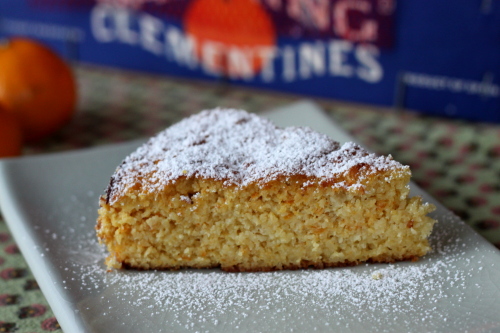
Clementine Cake
adapted from Nigella Lawson

Serves 8

Like many of Nigella Lawson’s cakes, this one seems an incredibly bad idea as you stir it together. Seriously, who would think to boil whole clementines, mash them peel and all, and throw them into a cake that doesn’t even have flour? It works though, and your whole house will smell wonderfully of citrus as it bakes.

4 to 5 clementines (about 13 oz / 370 g total weight)
6 eggs
1 cup plus 2 tablespoons (225 g) sugar
2 1/3 cups (250 g) ground almonds
1 heaping teaspoon baking powder
Powdered (confectioner’s) sugar, for dusting

Put the clementines in a pot with cold water to cover, bring to the boil, and cook for 2 hours. [Check the pan regularly to ensure it doesn’t dry out.] Drain the clementines and, when cool, cut each clementine in half and remove the seeds. Then finely chop the skins, pith, and fruit in the processor (or by hand, of course).

Preheat the oven to 375°F (190°C). Butter and line an 8‑inch springform pan with parchment paper.

Beat the eggs. Add the sugar, almonds, and baking powder. Mix well, adding the chopped clementines. I don’t like using the processor for this, and frankly, you can’t balk at a little light stirring.

Pour the cake mixture into the prepared pan and bake for 1 hour, when a skewer will come out clean; you’ll probably have to cover the cake with foil after about 40 minutes to stop the top from burning. Remove from the oven and leave to cool, in the pan on a rack. When the cake is cold, you can take it out of the pan.
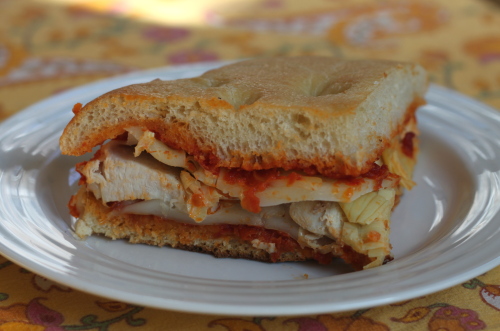
 

Oven Baked Chicken Focaccia Sandwich

My grandma’s neighbor is a baker and gives her leftover bread, which she sometimes passes down to me (lucky me!). This week I received two loaves of focaccia and decided to use one of them for a sandwich experiment. Not only was I looking for that perfect, toasted, crispy, savory bite, oozing with a little cheese, I wanted to see how much food I could clear out of my cupboard at the same time. I formulated and tested the following hypothesis: 1 jar of sun-dried tomato spread bought on sale a year ago + leftover chicken + excellent piece of goat’s milk mozzarella = hopefully something good enough to serve a guest. Luckily for my friend Denise who served as my test subject, the experiment succeeded. My high school chemistry teacher, or at least my home ec teacher, would be proud.

Oven Baked Chicken Focaccia Sandwich

A note for our American readers, this is a great way to use up your leftover Thanksgiving turkey, especially the white meat which tends to be a little bland for my taste.

Serves 4

1 loaf focaccia bread
7 oz (200 g) prepared sun-dried tomato spread or pesto
1/2 lb (225 g) boneless, skinless chicken or turkey breast, cooked and sliced
1/2 lb (225 g) mozzarella, sliced or shredded
4 oz artichoke hearts, roughly chopped

Preheat the oven to 400°F (200°C). Carefully cut the loaf of focaccia in half horizontally. Spread one half of  the sun-dried tomato spread or pesto onto the cut side of each piece of bread.

On the bottom (spread side up) of the soon-to-be sandwich layer half the cheese. Next, cover the cheese with the cooked chicken, seasoning the chicken to taste with salt and pepper. Sprinkle the artichoke pieces around the chicken then add a final layer of mozzarella. Top the sandwich with the other bread half, spread side down and push the sandwich together lightly.

Wrap the sandwich in aluminum foil and place it on a baking sheet. Bake the sandwich for 20 minutes or until the cheese just begins to melt and the bread is golden and toasty. Cut the sandwich into 4 wedges before serving.

Spaghetti with Red Pepper-Toasted Almond Pesto

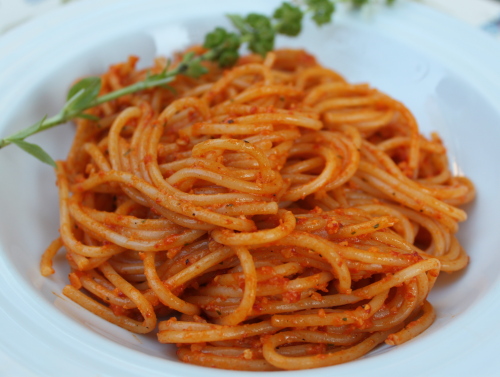
I pore over cookbooks in my 30s the way I once devoured fashion magazines in my teens. The pictures aren’t usually as interesting but the content is much more useful. Not that I don’t appreciate knowing when leopard print is in and heavy eyeliner is out, but style changes so much that it’s hard to keep up with. I prefer to spend my time thinking of something fabulous to cook than fabulous to wear. Luckily, I’m not alone. Much to my delight, I’ve noticed that most of my friends have food magazines or cookbooks stashed around the house. I found this recipe while hanging out with Leah (you may remember her rigatoni with pork and lemon ragu or tzatziki chicken with couscous and hummus). Maybe it’s because she also has a food blog, or maybe she was too nice to make fun of me, but she didn’t bat an eye when I asked her for pen and paper and transcribed this pantry staple-based recipe over a glass of beer. I guess this is adulthood.

Spaghetti with Red Pepper-Toasted Almond Pesto
adapted from The Best Simple Recipes by the editors of America’s Test Kitchen
Serves 4

My fridge is never without a bag of Trader Joe’s toasted, sliced almonds. They are perfect for throwing into a bowl of oatmeal, on top of brownies, or in a pasta dish like this one. The few extra cents I pay to buy them pre-toasted saves me toasting and cooling time (not to mention the aggravation of an extra pan to wash).

1 lb (450 g) spaghetti
1 cup (150 g) drained jarred roasted red peppers, patted dry (about 2 peppers)
1/3 cup (30 g) grated Parmesan cheese
1/4 cup (25 g) sliced or slivered almonds, toasted
1/4 cup (10 g) fresh basil
1 garlic clove, skin removed and quartered
1 teaspoon lemon juice
7 tablespoons extra virgin olive oil
sea salt and freshly ground black pepper

Cook the spaghetti al dente in a large pot of boiling, salted water according to package directions.

While the pasta cooks, process the red peppers, cheese, almonds, basil, garlic, and lemon juice in a food processor until smooth. With the motor running, slowly add the olive oil until it is incorporated. Season the pesto well with salt and pepper.

Drain the spaghetti, reserving 1/2 cup (125 ml) of cooking water. Return the spaghetti to the pot. Add the pesto to the spaghetti and toss to combine, adding reserved pasta water as needed. Season with salt and pepper and serve with additional grated Parmesan, if desired.

Cheddar Chicken Salad and Farro with Cucumber

There are a million ways to make chicken salad, but my mom’s recipe makes a knock-your-socks-off, can’t-go-wrong sandwich, especially when served on a buttery croissant. It’s perfect to take to baby showers, wedding showers, work lunches, picnic lunches, or any other place where you aren’t sure how picky the eaters are going to be. Everyone enjoys it. Pair it with this fresh and fabulously textured farro salad or, if you don’t feel like babysitting a pot of simmering farro or wheat berries but want an equally healthy and tasty side dish, try some roasted chickpea snacks. The Good Bean sent me a few complimentary packets of their pre-packaged version and we all loved them, especially my husband. I plan to pack them in lunches and throw them in my purse for snack emergencies.

Cheddar Chicken Salad

Makes a dozen cocktail sandwiches (or 6 full-size sandwiches)

3 cooked chicken breast halves (boneless, skinless), diced
1/2 cup (125 ml) mayonnaise or Miracle Whip
4 oz (100 g) chopped pitted black olives
1/2 cup (50 g) shredded cheddar cheese
1/2 green bell pepper, chopped fine
1/2 small onion, chopped fine
small croissants or cocktail rolls (about 1 dozen)

Gently mix all the ingredients together except the rolls (obviously). Fill the rolls and serve. If not serving immediately, chill the salad for up to 24 hours or filled rolls for up to 2 hours in the fridge, covered.

***

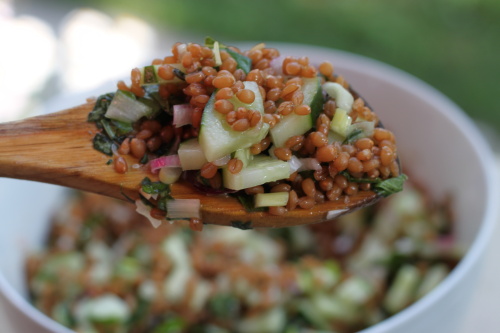
Farro with Cucumber
adapted from Molto Gusto: Easy Italian Cooking by Mario Batali

Serves 6

As much as I love this recipe and Molto Gusto: Easy Italian Cooking, the cookbook it came from (currently on its third renewal from my local library), it doesn’t taste great as leftovers. Try to eat it within 24 hours of preparing it unless you like seriously chewy grains.

8 oz (225 g) farro or wheat berries, picked over and rinsed
1 lb (450 g) cucumbers, cut into 1/4‑inch dice
1 medium red onion, cut into 1/4‑inch dice
1 red finger chile or serrano chile, cut into tiny dice
1/3 cup (10 g) packed fresh basil leaves, thinly sliced (chiffonade)
1/2 cup (125 ml) red wine vinaigrette (below)
Maldon or other flaky sea salt

Combine the farro and water to cover by 2 inches in a large saucepan and bring to a simmer, skimming off the foam. Reduce the heat to a bare simmer and cook until the farro is just tender, about 25 minutes if using pearled farro, about 1 1/2 hours if using wholegrain farro (or wheat berries).

Drain the farro and transfer to a large bowl. Add the cucumbers, onion, chile and basil, mixing well. Add the vinaigrette, tossing well. Season well with salt and serve, or let stand at room temperature for 1 hour to bring out the flavors.

Red Wine Vinaigrette

Makes 1 cup (250 ml)

1/2 cup (125 ml) extra virgin olive oil
1/4 cup (60 ml) good-quality red wine vinegar
1/4 cup (60 ml) sparkling water

Whisk the oil, vinegar and water together in a small bowl, or shake the ingredients together in a small, lidded jar, until well incorporated. The vinaigrette can be refrigerated for up to 5 days.

Summer Corn Chowder

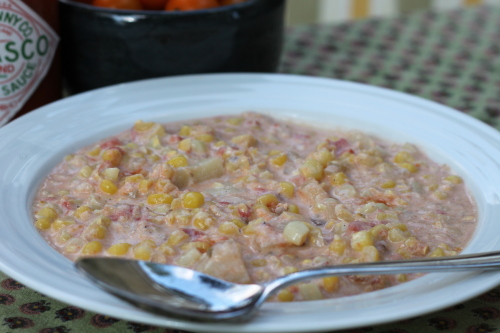
Though I’m a city dweller, I see my fair share of corn at the end of summer. A half hour drive north, south, or west of Milwaukee (Lake Michigan borders our eastern coast) will lead you into corn country. At this time of year, the fields are just turning from gold to green or are being turned under in preparation for next year’s crop. Grocery stores, farmers markets, tiny hand built produce stands, and even the backs of pick up trucks offer plenty of corn for sale. Our CSA delivered a dozen ears for the second week in a row. Though the corn was past its prime, I salvaged the slightly starchy ears in this chowder. I am not usually a fan of corn chowder, having experienced one too many mediocre, pasty bowls of the stuff but this version is vastly better than any other I’ve eaten, helped out by the addition of tomatoes and hot peppers–also abundant right now. And since I’m on the topic of corn, I may as well mention one of my favorite documentaries in recent years, King Corn. If you ever wondered how, what, and why America grows mass quantities of corn, check it out.

Summer Corn Chowder
adapted from Food52

Though I rarely follow recipes that call for peeling tomatoes, this time the effort was worth it. The diced tomatoes nearly melt into the soup, turning it an appealing shade of pink. To peel tomatoes, simply score each tomato on the bottom with a small “x” then submerge them into a pot of boiling water. After a minute or two, gently remove the tomatoes from the boiling water and place them in a bowl of ice water. After a quick soak in the ice bath, you’ll be able to easily peel of the skins.

Serves 6

8 medium ears of corn
6 strips of bacon, cut into 1/2‑inch pieces
1 onion, diced small
1 medium poblano or other hot pepper, seeded and finely chopped
1 jalapeno, seeded and finely chopped (optional, I omitted this ingredient to keep the chowder kid friendly)
1 celery rib, finely chopped
1 lb (450 g) red potatoes, peeled and cubed into 1/2 in. pieces
3 medium tomatoes, peeled, seeded and finely chopped
1 teaspoon salt
1/4 teaspoon ground allspice
1/4 teaspoon sugar
1 small bay leaf
2 cups (500 ml) light cream (half and half), at room temperature
1 cup (250 ml) milk
freshly ground black pepper, to taste
Tabasco hot sauce, to serve

Working over a bowl, cut the corn kernels from the cobs at about half their depth. Then, using the back of the knife, scrape the cobs over the bowl to release all the “milk”; set aside.

In a large dutch oven, fry the bacon over moderately high heat, stirring occasionally, until crisp, about 10 minutes. Transfer the bacon to paper towels to drain. Crumble and reserve.

Discard all but 3 tablespoons of the bacon drippings from the pan. Add the onion and cook over moderate heat until golden, 4 to 5 minutes. Add the poblano and jalepeno peppers and celery and cook until slightly softened, about 5 minutes more. Add the potatoes, tomatoes, salt, allspice, sugar, bay leaf and the reserved corn kernels with their “milk” and stir well. Cook over moderate heat until mixture begins to sizzle.

Reduce the heat to low. Cover and cook, stirring occasionally, until the potatoes are tender, about 45 minutes. Stir in the cream, milk and bacon and bring just to a boil. Remove from heat and season with black pepper to taste. Ladle the chowder into bowls and serve with a good loaf of bread and a few drops of Tabasco.

End-of-Summer Squash Sauté with Three Bean Salad

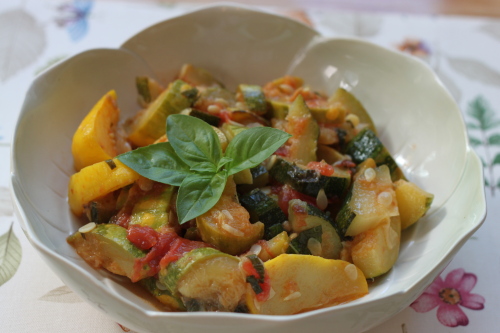
I love cooking at this time of the year. Vegetables and fruits are bountiful and at peak tastiness. It’s not too hot to use the stove top. And a week’s vacation at the end of August left me feeling (relatively) stress free at home and work. Not wanting to add any unnecessary work to my day, the dishes below provided a quick, tasty, and healthy meal and they take full advantage of the overabundant squash and beans from your or your neighbor’s backyard garden. This menu is light. If you want something more substantial for dinner or if you are cooking for guests, pick up a rotisserie chicken at the supermarket, cook up a little pasta to serve with the squash saute, or splurge on a trip to Kopp’s or your favorite ice cream store after dinner. What better way to celebrate the last few, long, warm nights of summer.

End-of-summer squash saute

End-of-Summer Squash Sauté

serves 4

2 or 3 medium summer squash (about 1 1/2 lbs / 680 g)
3 tablespoons olive oil
1 teaspoon kosher salt
1/2 teaspoon freshly ground black pepper
1/2 teaspoon garlic powder
1 large or 2 small tomatoes, peeled and coarsely chopped
3 tablespoons chopped fresh basil
freshly grated Parmesan cheese, for serving (optional)

Cut the squash in half lengthwise (or if the squash is very thick, cut it into quarters lengthwise), then dice into 1/2‑inch-thick pieces.

In a large saute pan with a lid, heat the olive oil over a medium-high heat until hot but not smoking. Add the squash and saute, stirring occasionally, for about 5 minutes, until it just begins to brown. Sprinkle the salt, pepper and garlic powder over the squash, then stir in the tomatoes. Cover and cook, stirring every few minutes, for 10 to 15 minutes longer, until the squash and tomato just begin to break down.

Remove the lid and continue to cook until your desired sauciness level. Stir in the basil and serve with grated Parmesan cheese, if desired. This dish tastes great over cooked pasta or rice or as a side dish.

***

Three Bean Salad
adapted from Molto Gusto: Easy Italian Cooking by Mario Batali

serves 6

1 tablespoon salt
1 lb (450 g) green beans [Note: smaller is better]
1 x 15 oz (425 g) can chickpeas, rinsed and drained
1 x 15 oz (425 g) white kidney beans (cannellini) or red kidney beans
1/4 cup (10 g) coarsely chopped fresh mint
1/2 cup (120 ml) Red Wine Vinaigrette (recipe below)
Maldon or other flaky sea salt and freshly ground black pepper

Bring four quarts of water to a boil in a large pot and add 1 tablespoon salt. Add the beans and blanch them until crisp-tender, about 3 minutes. Drain the beans in a colander and cool under cold running water; drain well.

Combine the green beans, chickpeas and kidney beans in a large bowl. Add the mint and toss. Add half the vinaigrette and toss gently again. Season with salt and pepper. Serve or, if possible, let stand at room temperature for 1 to 2 hours to bring out the flavors. Serve the salad with the remaining vinaigrette on the side.


Red Wine Vinaigrette

Makes 1 cup (250 ml)

1/4 cup (60 ml) good-quality red wine vinegar
1/4 cup (60 ml) sparkling water
1/2 cup (125 ml) extra virgin olive oil

Whisk the vinegar, water and olive oil together in a small bowl, or shake the ingredients together in a small, lidded jar, until well incorporated. The vinaigrette can be refrigerated for up to 5 days.

Old South Jelly Roll Cake (and my favorite canning recipes)

As odd as this is to admit, I’ve developed an addiction to canning. It all started quite innocently with a batch of strawberry lemonade concentrate a couple years ago. Then last year Kristin helped me put up a batch of garlic dill pickles. Now I’ve worked my way up to pickled peppers, spicy dilly beans, green tomato relish, and, finally this year, jam. Strawberry jam, though not the easiest thing I’ve ever cooked, may be one of the best things to come off my stove top. Even the extra emergency trip to the store to buy more Sure Jell (Anabelle had hidden mine in the microwave) didn’t bother me after tasting the final product.

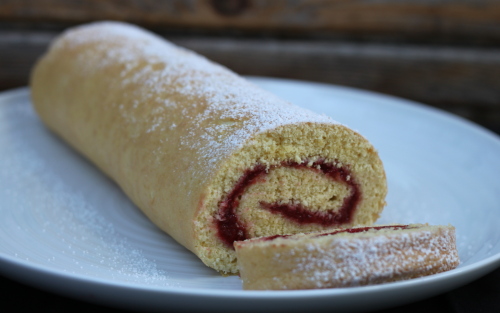
But what can you do with such a treasure? Surely it could not live up to its potential merely spread on wheat toast. Leave it to Sam to come up with a solution — a jelly roll. How a four-year-old even knows about this old-fashioned dessert is beyond me, but I’m glad he does. The light sponge cake highlights the sweet, ruby red jam beautifully, a tasty and lovely looking treat, perfect for a picnic.

Old South Jelly Roll Cake
From Paula Deen, Food Network

4 eggs, separated
3/4 cup (150 g) sugar
1 tablespoon vanilla
3/4 cup (75 g) cake flour, sifted
3/4 teaspoon baking powder
1/4 teaspoon salt
1 cup (250 ml) jam, stirred well
confectioners’ sugar (a.k.a. icing sugar), for dusting, sifted
whipped cream, to serve (optional)

Preheat the oven to 400°F (200°C).

In a small bowl, beat the egg whites until stiff but not dry and set aside. In another bowl, beat the egg yolks until light. Gradually add the sugar and vanilla, and mix well. Sift together the flour, baking powder, and salt. Add the sifted flour mixture to the egg yolk mixture. Fold the egg whites into the egg mixture and pour the batter into a 15 x 10 x 1‑inch jelly roll (Swiss roll) pan lined with waxed paper. Bake for 8 to 10 minutes, or until the cake is golden.

Loosen the edges of cake and invert the cake onto a dish towel dusted with confectioners’ sugar. Gently and slowly peel the wax paper off the cake. Trim 1/4 inch of hard crust off each long side of the jelly roll cake. Begin with the narrow side and roll the cake and towel up together. Cool the cake on a rack, seam side down, for 10 to 15 minutes.

Once the cake has cooled, gently unroll and spread the cake with jam and re-roll. Sprinkle with confectioners’ sugar. Serve with whipped cream, if desired.

Salmon with Lentils and Mustard-Herb Butter

You may have noticed that Kristin and I cook salmon pretty regularly. Not only is salmon healthy, loaded with omega‑3 and other good stuff, but it’s easy to prepare and hard to mess up. Unlike some more delicate varieties of fish, salmon can take a few minutes of overcooking. It’s also less “fishy” tasting than most other seafood, so most kids won’t turn up their noses at it. This recipe is one of my family’s most recent favorites. It’s fancy enough to serve for guests, but a breeze to throw together, especially if you make the compound butter and lentils the night before. Steamed artichokes make an excellent side dish, especially if served with a bit of melted butter and lemon juice for dipping.

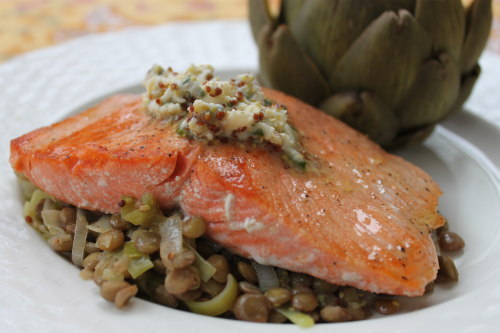
The picture doesn’t quite do this dish justice. I snapped the photo quickly before I called the kids to dinner. By the time everyone was seated, their sippy cups filled, and our napkins unfolded, the butter had melted beautifully, leaving the salmon with a lovely layer of herbs and mustard seeds.

Salmon with Lentils and Mustard Butter

Salmon with Lentils and Mustard-Herb Butter (Saumon aux Lentilles)
adapted from Gourmet, March 2008

For mustard-herb butter:
5 tablespoons unsalted butter, softened
1 tablespoon chopped chives
1 teaspoon chopped tarragon [I substituted 1/2 teaspoon dried tarragon]
2 teaspoons grainy mustard
2 teaspoons fresh lemon juice

For lentils:
1 cup French green lentils
4 cups water
2 medium leeks (white and pale green parts only)
1 tablespoon unsalted butter
1/2 to 1 tablespoon fresh lemon juice

For salmon:
4 (6‑ounce) pieces skinless salmon fillet
2 tablespoons unsalted butter

Make the mustard-herb butter:
Stir together all the ingredients with 1/4 teaspoon each of salt and pepper. [The mustard-herb butter can be made 1 day ahead and chilled, covered. Soften at room temperature before using (1 hour).]

Cook the lentils:
Bring the lentils, water, and 3/4 teaspoon salt to a boil in a heavy medium saucepan, then reduce heat and simmer, uncovered, until the lentils are just tender, 20 to 25 minutes. Remove from heat and let stand 5 minutes. Reserve 1/2 cup cooking liquid, then drain lentils. [The lentils can be cooked (but not drained) 1 day ahead and chilled in cooking liquid, covered (once cool).]

While the lentils cook, chop the leeks, then wash them. Cook the leeks in the butter in a heavy medium skillet over medium-low heat, stirring occasionally, until softened, 6 to 8 minutes.

Add the lentils with the reserved cooking liquid to the leeks along with 3 tablespoons mustard-herb butter and cook, stirring, until the lentils are heated through and the butter is melted. Add the lemon juice and salt and pepper to taste. Remove from heat and keep warm, covered.

Sauté the salmon while the leeks cook:
Pat the salmon dry and sprinkle with 1/2 teaspoon salt and 1/4 teaspoon pepper (total).

Heat the butter in a large nonstick skillet over medium-high heat until foam subsides, then sauté the salmon, turning once, until golden and just cooked through, 6 to 8 minutes total.

Serve the salmon, topped with the remaining mustard-herb butter, over lentils.