Tag Archives: Soups and stews

Roasted Potato Leek Soup with Irish Soda Bread

How does Ina Garten do it? She can take any recipe and somehow make it 10 times better than any other version. What’s her secret? Maybe it’s that she often roasts vegetables to bring out their natural sweetness, and she’s not afraid of butter or cream either — and lots of it. I’ve been making a potato leek soup from The New Vegetarian Epicure as my standby recipe for years, but no longer (sorry, Anna Thomas). As for the soda bread, the Avoca Café recipe here is the only one I’ve ever made. It’s so easy and foolproof — flour, baking soda, sugar, salt and buttermilk — that I doubt even the Barefoot Contessa could improve on it.

Roasted Potato Leek Soup
adapted from Barefoot Contessa Back to Basics by Ina Garten

Serves 6 to 8

Don’t worry if you can’t find any arugula (rocket), the soup would still be good without it.

2 lb (900 g) Yukon Gold potatoes, peeled and cut into 3/4‑inch chunks (or substitute any waxy or red-skinned potato)
4 leeks, white and light green parts chopped and cleaned well
1/4 cup (60 ml) good-quality olive oil
salt and freshly ground black pepper
3 cups (50 g) baby arugula, lightly packed
1/2 cup (120 ml) dry white wine, plus extra for serving
6 to 7 cups (1.4 to 1.7 liters) chicken stock (or use vegetable stock for a vegetarian version)
3/4 cup (180 ml) heavy cream
1 cup (225 g) crème fraîche
1/4 cup (25 g) freshly grated Parmesan, plus extra for garnish

Preheat the oven to 400°F (200°C).

Combine the potatoes and leeks on a sheet pan in a single layer. Add the olive oil, 1 teaspoon salt, and 1/2 teaspoon pepper and toss to coat the vegetables evenly. Roast for 40 to 45 minutes, turning them with a spatula a few times during cooking, until very tender. Add the arugula and toss to combine. Roast for 4 to 5 more minutes, until the arugula is wilted. Remove the pan from the oven and place over 2 burners. Stir in the wine and 1 cup (240 ml) of the stock and cook over a low heat, scraping up any crispy roasted bits sticking to the pan.

In batches, transfer the roasted vegetables to a food processor fitted with the steel blade, adding the pan liquid and about 5 cups (1.2 liters) of the stock to make a puree. Pour the puree into a large pot or Dutch oven. Continue to puree the vegetables in batches until they’re all done and combined in the large pot. Add enough of the remaining 1 to 2 cups (240 to 480 ml) of stock to make a thick soup. Add the cream, crème fraîche, 2 teaspoons salt, and 1 teaspoon pepper and check the seasonings.

When ready to serve, reheat the soup gently and whisk in 2 tablespoons white wine and 1/4 cup (25 g) of Parmesan. Serve hot with an extra grating of Parmesan.

***

Irish Soda Bread
adapted from Avoca Café Cookbook

Makes 1 loaf

This is the easiest bread to make, and it cooks in only half an hour. Don’t worry about its lumpy appearance — it’s meant to look that way. It’s fabulous with hearty, wintry soups, but the leftovers are equally as good for breakfast the next morning, lightly toasted and spread with jam and butter.

3 3/4 cups (450 g) plain flour
1 level teaspoon baking soda
1 teaspoon sugar
1/2 teaspoon salt
1 3/4 cups (400 ml) buttermilk

Preheat the oven to 450?F (230°C). Grease a loaf tin very well.

Mix all the dry ingredients together in a large bowl. Gradually mix in the buttermilk to make a moist dough. Place in the greased loaf tin and bake in the preheated oven for 30 minutes, until the loaf sounds hollow when turned out of the tin and tapped underneath. Place on a wire rack to cool.

Carrot and Cilantro Soup with Brown Bread and Plum Oat Slices

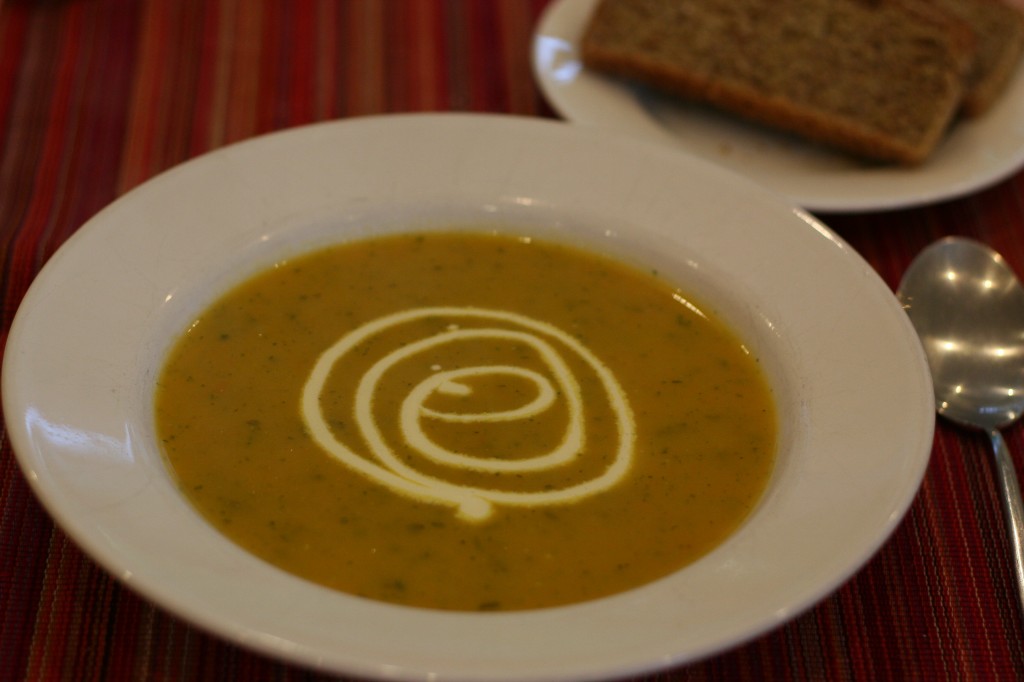
Back in the days before I used to cook, we would often buy a carton of Avonmore ready-made carrot and coriander soup. I can’t think why now, seeing how easy this is to make. Pair the soup with a good-quality brown bread from the bakery along with a dessert that Delia Smith says is so easy even children can make it, and you have a quick midweek meal.

carrot and cilantro soup

Carrot and Cilantro Soup

Serves 4 to 6

2 tablespoons olive oil
1 white onion, roughly chopped
1 1/2 lb (680 g) carrots, peeled and roughly chopped
1 large potato, peeled and roughly chopped
4 to 6 cups (1 to 1.4 liters) vegetable stock
1 bunch cilantro
salt and freshly ground black pepper
cream, to garnish (optional)

Heat the olive oil in a large stockpot on a low to medium heat. Add the onions and sweat them, covered, for 10 minutes, until soft but not browned. Add the carrots and potatoes to the pot, give everything a good stir to coat in the oil, and sweat for another 10 minutes. Add 4 cups (1 liter) of the vegetable stock and bring to a boil. Lower the heat to a summer and cook until all the vegetables are soft, about 15 minutes. Take the pot off the heat.

Add the cilantro to the soup, including the stems. Puree the soup in a blender or food processor or with a hand-held immersion blender, until smooth. Add the soup back to the pot, reheat it and season to taste. Add more stock if you think the soup is too thick (I wound up using 5 cups (1.2 liters) of stock). Add a swirl of cream to each portion of soup and serve.

***

Plum and Cinnamon Oat Slices
adapted from How to Cook: Book Two by Delia Smith

Makes 15 bars

1 lb (450 g) plums, halved and cut into thin slices
1 rounded teaspoon ground cinnamon
2 cups (160 g) porridge oats
1 3/4 cups (280 g) plain wholemeal flour
1 level teaspoon salt
1 cup (225 g) butter
3/4 cup (120 g) light brown sugar

You will also need a nonstick baking tin measuring 10 x 6 inches and 1 inch deep, lightly greased.

Preheat the oven to 400°F (200°C).

Place the plum slices in a bowl and toss them around with the cinnamon. In a separate bowl, mix the flour, oats and salt together. Melt the butter and sugar in a small saucepan over a fairly gentle heat, stirring from time to time until the butter has melted. Mix the melted butter and sugar with the oat mixture, starting with a wooden spoon but finishing off with your hands so you end up with a lump of dough. Now halve the dough and press one half of the mixture into the baking tin, pressing it firmly all over the base with your hands like a wall-to-wall carpet. Next scatter the plums evenly over the surface, then top with the remaining oat mixture, again pressing down firmly.
Place the tin on the centre shelf of the oven and bake for 25 to 30 minutes, or a bit longer if you like the top really crispy. Remove the tin from the oven and allow to cool for about 10 minutes before marking into 15 squares – to do this, make 2 cuts lengthways, then 4 cuts widthways, and don’t worry if they’re not all even. Unless you want to serve these warm, leave them to cool completely in the tin.

Curried Pork Stew with Potatoes

I felt especially domestic yesterday as I whipped up my butternut squash lasagna and made this curried pork stew at the same time. The stew came together in a flash. There is minimal prep time; the vegetables are roughly cut and you use a curry paste instead of mincing and measuring a long list of the usual curry ingredients. I’ve minced plenty of garlic, seeded countless chiles, and pounded enough lemongrass in my lifetime to really appreciate this shortcut. After letting the cooked stew cool, I refrigerated it in the same pan I cooked it in. Dinner tonight was as easy as reheating the stew and baking some store-bought naan.

We buy our curry paste for about $.89 a can at nearby Asian Mart. As the name suggests, this store supplies Asian and Asian-inspired ingredients and cooking tools. It’s fun to shop there because you never know what you’ll find. I’ve walked out with a wide variety of items you just can’t find anywhere else, like a 20-pound mortar and pestle, an economy pack of chopsticks, long beans, and tamarind paste, to name a few. The owners are delightful and it’s fun to see what chefs from Milwaukee’s ethnic restaurants pick up as they shop alongside you.

Curried Pork Stew with Potatoes 

adapted from Whole Foods Market

Serves 6

1 tablespoon olive oil
12 oz (340 g) boneless pork sirloin chops, cut into 1‑inch cubes
salt and freshly ground black pepper
1 red onion, roughly chopped
1 1/2 cups (360 ml) chicken broth
1 cup (240 ml) coconut milk
3 tablespoons green curry paste, or to taste (3 tablespoons makes a very spicy curry)
1 lb (450 g) red potatoes, cut into 1‑inch chunks
1 lb (450 g) carrots or parsnips, cut into 1‑inch chunks

Heat the oil in a large pot over a medium-high heat. Season the cubed pork with salt and pepper. Cook until deep golden brown. Add the onions and about 2 tablespoons water to loosen the browned bits in the bottom of the pot and cook, scraping the bottom of the pan, until the onions are just softened, about 3 minutes. Add the broth, coconut milk and curry paste and bring to a boil. Cover and simmer for 30 minutes. Add the potatoes and carrots and simmer for 10 minutes, then uncover and simmer until the vegetables are tender and the stew is thickened, about 30 minutes. Season to taste with salt and pepper and serve with naan or rice (or both).

Curried Parsnip and Apple Soup with Parsnip, Parmesan and Sage Bread

Smugglers Creek Inn in County Donegal is one of my favorite places to eat in Ireland. You can’t beat it in terms of location and atmosphere — dating back to 1845, this restaurant, pub and B&B is perched on a cliff overlooking Rossnowlagh beach and Donegal Bay, with the Bluestack Mountains in the distance. If you’re really lucky, you can nab one of the chairs in front of the open fire in the pub and settle in to have a pint before dinner. The restaurant specializes in seafood, but I still remember the curried parsnip and apple soup Matt ordered the first time we went there. I probably played it safe and ordered seafood chowder, thinking a parsnip and apple soup sounded odd, not to mention a curried one at that. But it was outstanding, and I’ve been making it myself at home ever since. Paired with this bread, it’s one of our favorite fall dinners, and is always one of the first soups I make once the weather turns cool.

Curried Parsnip and Apple Soup

Serves 4

4 tablespoons (60 g) butter
1 onion, chopped
1 teaspoon fresh root ginger, chopped (optional)
1 heaped teaspoon Thai green curry paste (or 1 tablespoon curry powder)
1/2 teaspoon ground cumin
1 lb (450 g) parsnips, peeled and chopped (1 or 2 parsnips, depending on size)
2 Granny Smith apples, peeled and chopped
1 medium potato, peeled and chopped
1 3/4 pints (1 liter) vegetable stock
salt and freshly ground black pepper
1/2 cup (120 ml) plain yogurt or crème fraîche, to serve

Melt the butter in a pot, then add the onion, ginger, curry paste and cumin, cooking until the onions turn yellow, about 4 minutes. Add the parsnips, apple and potato and stir over a medium heat to coat the vegetables. Add the stock and bring to the boil, then cover and simmer for 30 minutes. Puree in a blender or food processor, then return to the pot and season to taste. To serve, ladle the soup into a bowl and swirl in a spoonful of yogurt or crème fraîche.

***

Parsnip, Parmesan and Sage Bread
from Delia’s How to Cook: Book One by Delia Smith

Makes 1 loaf

If you want to serve this with the curried parsnip and apple soup and are worried the sage won’t compliment the soup, just leave it out (though I don’t mind it).

2 cups (240 g) self-raising flour
1 1/2 teaspoons salt
6 oz (170 g) parsnips (peeled weight, about 1 big parsnip)
2 oz (60 g) Parmesan, cut into 1/4‑inch cubes, plus extra shavings for the topping
1 rounded tablespoon chopped fresh sage (or 1 teaspoon dried)
2 large eggs
1 tablespoon milk
olive oil, for drizzling

Preheat the oven to 375°F (190°C). Line a baking sheet with parchment paper (or grease it very well) and set aside.

Sift the flour and salt into a large, roomy bowl, then put a grater directly in the bowl and coarsely grate the parsnips into the flour, then toss them around. After that, add the cubes of Parmesan and chopped sage and toss that in. Now lightly beat the eggs and milk together, then add this to the bowl a little at a time, mixing evenly with a wooden spoon. What you should end up with is a rough, rather loose, sticky dough, so don’t worry what it looks like at this stage. Transfer this to the baking sheet and pat it gently into a 6‑inch rough round, then make a cross on top with the blunt side of a knife. Now scatter the Parmesan shavings over the surface, followed by a sprinkling of flour. Finally, drizzle with just a little bit of olive oil.

Bake for 45 to 50 minutes, by which time it will be golden and crusty. Allow to cool on a wire rack. Serve while it’s still warm or reheat it later.

Casserole Provençale and Crunchy Chocolate Bakewell Tart

We’re excited to announce our first giveaway at Dinner du Jour! Thanks to Gill & Macmillan, I have a copy of From Brenda’s Kitchen: 100 Favourite Recipes by Brenda Costigan to give away* to a reader.

Brenda Costigan is one of Ireland’s most renowned cookery writers. A weekly food columnist for the Sunday Independent Life magazine, she has also written three other bestselling cookbooks. This book, written with busy families in mind and suitable for cooks of all abilities, features some of the most popular recipes from her column as well as many new favorites.

To be in with a chance of winning From Brenda’s Kitchen: 100 Favourite Recipes, just leave a comment in this post telling us what some of your favorite recipes are. The competition will close at 12:00 (Irish time) on Monday, November 9th and a winner will be chosen randomly from the comments.

brenda cover

Casserole Provençale
adapted from From Brenda’s Kitchen: 100 Favourite Recipes by Brenda Costigan

Serves 5 to 6

Brenda says you shouldn’t hold back on the olives, as they give a wonderful flavor to the finished dish. It’s also preferable to use fresh herbs rather than dried here.

for the marinade:
1 1/4 cups (300 ml) red wine
1/4 cup (60 ml) brandy (optional)
sprigs of fresh thyme
sprigs of fresh rosemary
2 bay leaves
2 cloves garlic, chopped
salt and freshly ground black pepper

for the casserole:
2 1/4 lb (1 kg) stewing beef, cut into generous bite-sized chunks
4 tablespoons olive oil
1 rounded tablespoon flour
7 oz (200 g) rashers or bacon, chopped (Brenda likes to use smoked rashers/bacon)
2 large onions, sliced
2 cloves garlic, chopped
6 oz (170 g) button mushrooms, halved
2 large carrots, peeled and sliced
3 to 5 oz (75 to 150 g) pitted black or green olives
1 x 14-oz (400‑g) can of chopped tomatoes
1 3/4 cups (400 ml) hot beef stock
salt and freshly ground black pepper

Put all the marinade ingredients into a bowl and stir well to combine. Add in the beef and mix well. Cover with clingfilm and allow to marinate in the fridge for a few hours. Stir once or twice if you think of it.

Preheat the oven to 325°F (160°C).

Lift the meat out of the marinade with a slotted spoon (keep the marinade). Pat the meat dry with paper towels and fry in small batches until browned in the olive oil, then transfer to a casserole or heavy saucepan. Add the flour to the browned meat and toss together. Fry the rashers until golden and add to the meat.

Lightly brown the onions in the pan. Add the garlic and then the mushrooms, then add this onion mixture to the casserole. Add the carrots, olives and tomatoes to the casserole.

Pour the marinade, including the herbs, into the pan the meat etc. was browned in and bring to the boil, making sure to scrape up all the bits on the bottom of the pan. Boil for 1 to 2 minutes to reduce the amount of liquid a bit and to intensify the flavor. Add the beef stock and simmer for a few minutes to heat it up, then pour the hot liquid directly into the casserole. The liquid should just about cover the meat and vegetables. Add very little salt, if any, because the rashers and olives are already salty. Add freshly ground black pepper and stir everything together. If necessary to make the lid fit more snugly, cover the casserole with a layer of baking parchment or tinfoil, then put on the lid (this helps to prevent evaporation).

Cook in the oven for 2 1/2 to 3 hours, or until the meat is really tender. Discard the sprigs of fresh herbs before serving. Serve with mashed potatoes or boiled potatoes and a green vegetable of your choice.

***

Crunchy Chocolate Bakewell Tart
adapted from From Brenda’s Kitchen: 100 Favourite Recipes by Brenda Costigan

Serves 8

Brenda says this tart is one of her favorites — rich and moist, it keeps for up to 2 weeks. Brenda has used a base of crushed digestives and butter instead of the more traditional pastry base. For a touch of luxury, serve the tart with the fruits of the forest sauce (or 12 oz (340 g) mixed fresh summer berries) and some whipped cream.

Note: If the baking tin sizes recommended here aren’t adhered to, the cakes may be thicker (if smaller) or thinner (if larger), which can affect the cooking times.

for the crushed biscuit base: 
7 oz (200 g) digestive biscuits, crushed (or you can substitute graham crackers)
1/2 cup (110 g) butter, melted

for the filling: 
4 to 5 tablespoons blackcurrant jam, softened (not fridge cold)
3/4 cup (170 g) butter, softened
3/4 cup (150 g) sugar
3 large eggs
1/2 teaspoon almond extract
3 1/2 oz (100 g) chopped blanched almonds
3 1/2 oz (100 g) ground almonds
5 oz (150 g) dark chocolate, melted and partly cooled
small handful of flaked almonds

for the fruits of the forest sauce:
juice of 1 large orange
12 oz (340 g) frozen fruits of the forest or summer fruits
1/4 to 1/3 cup (50 to 75 g) sugar
1 heaped teaspoon cornflour

3/4 cup (175 ml) lightly sweetened whipped cream, to serve

You will also need a springform tin 9 inches in diameter

Preheat the oven to 375°F (190°C).

To make the biscuit base, mix the crushed biscuits and melted butter together and spread in an even layer over the base of the tin, pressing the mixture down firmly. Bake in the oven for about 5 minutes, just to lightly crisp the biscuits. There will be no change in the appearance. Stand the tin on a wire tray to cool while you prepare the filling.

Reduce the oven to 325°F (170°C).

To make the filling, place the jam in a small bowl and stir briskly with a spoon in order to make it looser and more spreadable. Spread the jam carefully in a thin layer over the cooled biscuit base, leaving a 1‑inch margin all the way around. This is to ensure that the jam doesn’t ooze out at the edges and get too highly baked on the sides, spoiling the appearance of the finished cake.

Beat the butter and sugar together in a bowl until soft. Add in the eggs, one at a time, and almond extract and beat well. Mix together the chopped almonds and the ground almonds and stir into the butter/sugar mixture, then stir the melted chocolate through. Pour into the tin over the biscuit base and scatter the flaked almonds over the surface.

Bake for about 40 minutes –- start at the higher temperature and lower if halfway through if the tart is cooking too quickly. It’s ready when the almond mixture has become set on the outside but is still slightly wobbly in the center. Stand the tin on a wire tray for about 15 minutes to allow it to cool. With a sharp knife, loosen the edges, then release the spring clip sides of the tin and leave the tart to cool completely.

To make the sauce, put the orange juice and frozen berries into a saucepan. Cook gently to thaw, then add the sugar and stir to dissolve. Blend the cornflour with a dribble of water and some of the hot liquid from the saucepan. Mix well, then stir the cornflour mixture into the berries in the saucepan. Bring to the boil, stirring to thicken. If a thicker consistency is required, more cornflour can be added (in the same way). Taste for sweetness.

To serve, carefully slide the tart off the base of the tin onto a serving plate. Serve each slice topped with the fruits of the forest sauce (or fresh berries) and some whipped cream.

*In the interests of full disclosure, I was involved with the production of this book and the publishers, Gill & Macmillan, generously gave me a copy to give away here.

Early Autumn Minestrone and Tarte Tatin

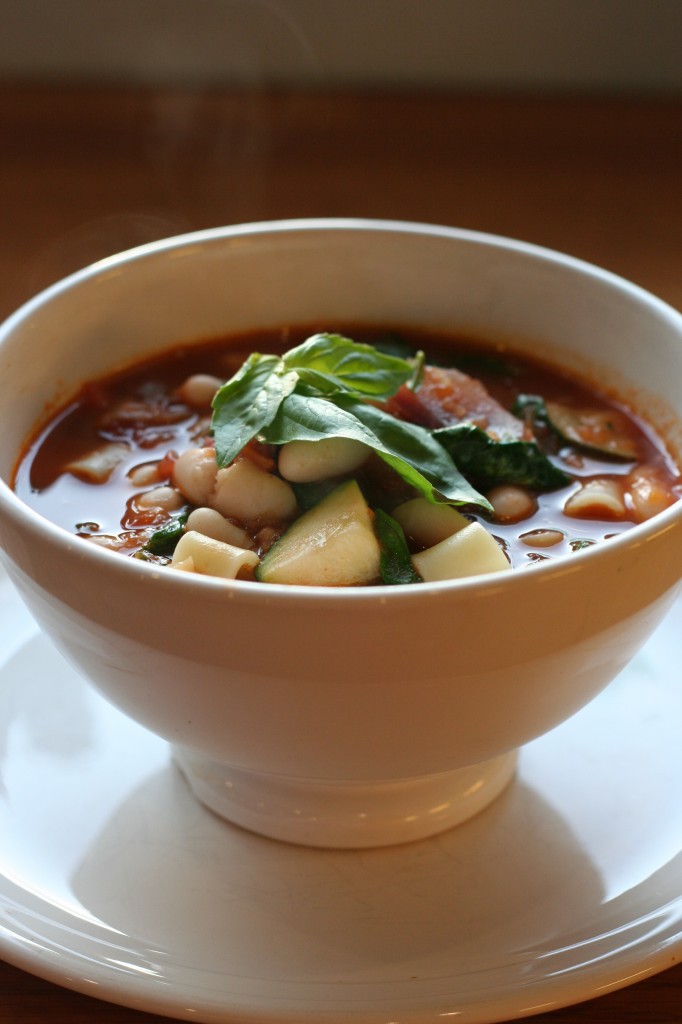
Last week, an old friend came to visit from London for a long weekend with his wife and baby daughter. As we were all eating dinner one night, he told us that he’d recently made such a big pot of soup that not only did they eat it for lunch and dinner for four days straight, but when he put it in the refrigerator, the pot was so heavy it cracked the shelf. We all laughed about it, even my friend, but the next day I asked him why he didn’t freeze some of the soup instead of eating the same thing for the better part of a week. “I’ve been really busy lately and it means dinner is one less thing I have to worry about,” he said, and I couldn’t fault him there. A big pot of soup does make for effortless leftovers — though maybe not such a big pot that it makes four days’ worth. Still, you could do worse than to eat this soup for a few days running, seeing as how it’s packed full of veggies, beans, some greens and carbs, with a glass of red wine to elevate it into something a little more sophisticated than your usual minestrone. So Adrian, this recipe is for you — the next time you need something to see you through a busy patch, try this soup (though try not to make so much it breaks the fridge shelf again).

early autumn minestrone

Early Autumn Minestrone
adapted from Jamie’s Italy by Jamie Oliver

Serves 4 to 6

To make this suitable for vegetarians, just leave out the bacon and use vegetable stock.

olive oil
4 slices of smoked pancetta or bacon
2 small red onions, finely chopped
2 carrots, chopped
2 sticks of celery, chopped
1/2 head of fennel, chopped
3 cloves garlic, finely chopped
a small bunch of fresh basil, finely sliced (set aside some to garnish at the end)
2 x 14-oz (400‑g) cans of good-quality whole plum tomatoes
a glass of red wine
2 small zucchini, quartered and sliced
7 oz (200 g) chard or spinach, washed and roughly sliced (including stalks)
1 1/4 pints (600 ml) good-quality chicken, ham or vegetable stock
1 x 14-oz (400‑g) can of cannellini or borlotti beans
2 handfuls (2 oz/60 g) elbow macaroni, or other small pasta shape
sea salt and freshly ground black pepper
freshly grated Parmesan cheese, to serve
crusty bread, to serve

Heat a good splash of olive oil in a saucepan and add the chopped pancetta or bacon, onions, carrots, celery, fennel, garlic and basil. Sweat very slowly on a low heat, with the lid just ajar, for around 15 to 20 minutes, until soft but not brown. Add the tomatoes, zucchini and red wine and simmer gently for 15 minutes, breaking up the whole tomatoes with the back of a spoon.

Now add the chard or spinach, stock, beans and pasta. Stir and continue to simmer until the pasta is cooked, about 15 minutes.

If you think the soup is looking too thick, add a little more stock or water to thin it down a bit. Season to taste with salt and pepper. Serve sprinkled with the reserved basil and freshly grated Parmesan cheese and some good crusty bread on the side.

***

Tarte Tatin
adapted from Gourmet, March 2001

Serves 8

You can also make a Tarte Tatin with 4 pears, peeled, cored and halved. The tart can cool in the skillet for up to 30 minutes. It can also stand, uncovered, for up to 5 hours, then be heated over a moderately low heat for 1 to 2 minutes to loosen the caramel. Shake the skillet gently to loosen the tart before inverting. If you need to let the tart stand for any length of time before serving it, leave it in the skillet and don’t invert it, otherwise the caramel will make the puff pastry base turn soggy.

1 frozen puff pastry sheet
1/4 cup (60 g) unsalted butter, softened
1/2 cup (100 g) sugar
7 to 9 Gala apples (3 to 4 lb/1.4 to 1.8 kg), peeled, quartered lengthwise and cored (or use any firm dessert apple, such as Golden Delicious)
whipped cream, crème fraîche or vanilla ice cream, to serve

Note: You will need a well-seasoned 10-inch cast-iron skillet or an ovensafe 10-inch skillet

Preheat the oven to 425°F (220°C).

Roll the puff pastry sheet into a 10 1/2‑inch square on a floured work surface with a floured rolling pin. Brush off the excess flour and cut out a 10-inch round with a sharp knife, using a plate as a guide. Transfer the round to a baking sheet and chill.

Spread the butter thickly on the bottom and side of the skillet and sprinkle the sugar evenly over the bottom. Arrange as many apples as will fit vertically on the sugar, packing them tightly in concentric circles. The apples will stick up above the rim of the skillet.

Cook the apples over a moderately high heat, undisturbed, until the juices are deep golden and bubbling, which will take about 18 to 25 minutes. (Don’t worry if the juices color unevenly.) It’s important not to stir the caramel while it’s cooking, otherwise it might crystallize.

Lay the pastry round over the apples and tuck it in around the edges. Put the skillet in the middle of the oven over a piece of foil to catch any drips. Bake for 20 to 30 minutes, until the pastry is browned. Transfer the skillet to a rack and cool for at least 10 minutes. Be careful when handling the skillet from here on out — don’t forget that the handle will be very hot!

Just before serving, invert a platter with a lip over the skillet and, using potholders to hold the skillet and plate tightly together, invert the tart onto the platter. Replace any apples that stick to skillet. (Don’t worry if there are black spots; they won’t affect the flavor of the tart.) Brush any excess caramel from the skillet over the apples. Serve immediately with whipped cream, crème fraîche or vanilla ice cream.

Braised Spareribs with Fennel, Mashed Potatoes, and Curried Split Pea Soup

After a 10-minute dig into my deep freezer, I sadly realized we had eaten the last of our Tamworth ham from Farmer Nick’s. Though momentarily disappointed that I couldn’t make the scalloped potatoes and ham I’d been craving, I was thrilled to spot a rack of spareribs hiding beneath the frost. I usually bake spareribs and sauerkraut together for an easy, hearty meal, but I’d already made cabbage once that week and, frankly, didn’t relish the idea of another cabbage-based dinner. Instead, I settled on a braised spareribs recipe. But “settled” isn’t the appropriate word for this dish. “Spectacular” is more accurate. I know I rave about recipes more often than not, but this really is a fantastic preparation, really. The meat falls off the bone and the sauce is perhaps the most savory thing I’ve tasted all year. The only leftovers from the meal were a small bowl of mashed potatoes and a few tablespoons of the sauce. I mixed the two together the next day for lunch, which made for some damn good fried mashed potato patties.

Like the spareribs recipe, the soup recipe is also new to me, sent by my friend Allison. I loved it as a starter for dinner but enjoyed it even more the next day for lunch after the curry flavor developed. Not only was this a tasty soup, but it gave me an excuse to finally buy a stick blender (very fun item, by the way). Thanks for sharing, Allison! Which reminds me — if anyone has recipes they would like us to try out, please send them our way.

Braised Spareribs with Fennel
adapted from Anne Burrell at Food Network

Serves 4

1 rack spareribs, cut into ribs
2 tablespoons olive oil
kosher salt
1 large onion, cut into large dice
1 large fennel bulb, fronds removed, cut into large dice
6 garlic cloves
1 1/2 cups (360 ml) dry white wine
2 bay leaves
1 bundle thyme
pinch crushed red pepper
2 1/2 cups (600 ml) chicken broth

Preheat the oven to 400°F (200°C).

Coat a Dutch oven with olive oil and bring to a high heat. Season the ribs with salt and brown in the hot oil. Brown ribs on both sides. Remove ribs from the pan.

While the ribs are browning, puree the onion, fennel and garlic in the food processor to a coarse paste. After the ribs are browned and removed from pan, add the pureed vegetables and saute for 5 to 6 minutes, until golden.

Return the ribs to the pan and add the white wine, bay leaves, thyme and crushed red pepper flakes. Cook over a medium-high heat for 8 to 10 minutes, until the wine is reduced to about 1 cup (240 ml). Add the chicken broth, cover and place in the preheated oven. Cook the ribs for 2 hours or until they are very soft and almost falling off the bone. Check the ribs periodically to make sure the liquid hasn’t reduced too much. Serve the ribs and sauce over mashed potatoes.

***

Curried Split Pea Soup
adapted from Alton Brown at Food Network

Serves 8

2 tablespoons unsalted butter
1 onion, chopped
kosher salt and freshly ground black pepper
1 tablespoon minced fresh garlic
5 or 6 carrots, chopped
5 or 6 stalks of celery, chopped
1 lb (450 g) dried green or yellow split peas, picked over and rinsed
8 cups (1.9 liters) chicken broth (reserve 1 cup (240 ml) to thin out soup if it’s too thick)
1 tablespoon curry powder

Place the butter into a large saucepan or stock pot over medium-low heat. Once melted, add the onion and a generous pinch of salt and sweat for 2 to 3 minutes. Add the garlic and continue to sweat for an additional 1 to 2 minutes, making certain not to allow the onions or garlic to brown.

Add the peas, carrots, celery, 7 cups (1.7 liters) of chicken broth and curry powder. Increase the heat to high and bring to a boil. Reduce the heat to low, cover and cook at a simmer until the vegetables are very tender, approximately 45 to 50 minutes. Taste and adjust seasoning as needed. Using a stick blender, puree the soup until the desired consistency. If the soup is too thick, add some of the remaining chicken broth.

Shrimp Won Tons in Soup and Roasted Asparagus

I’ve probably mentioned that my son loves Asian food before, but I don’t think I mentioned how glad I am of this fact. Asian food, whether Japanese soba, Chinese stir-fry or Thai satay, is quick to prepare and relatively light. Sure beats serving mac and cheese and chicken nuggets. I also love salty sweet tastes, which are easy to find in Asian cuisines.

Though won tons aren’t exactly quick to throw together, using store-bought won ton skins and broth helps reduce the prep time. This was my first time making won tons; my husband usually takes care of it. I’ve included more pictures than usual not because they’re good pictures (they’re actually not good at all), but because I found the picture in the cookbook very helpful. I don’t want to break any copyright laws, so you’re all stuck with my amateur “how to” pictures. Kelly’s birthday wish list: better digital camera with a decent flash.

Shrimp Wontons

Shrimp Won Tons in Soup
adapted from Chinese Snacks Wei-Chuan Cooking Book by Huang Su Huei

Serves 3

for the filling:
10 medium raw, shelled shrimp (about 1/3 lb/170 g)
1/2 teaspoon rice wine
1/2 teaspoon salt
1/2 teaspoon cornstarch
1/4 cup minced bamboo shoots
1 teaspoon minced ginger
30 won ton skins

for the soup:
6 cups (1.4 liters) broth
1 teaspoon rice wine
1 1/2 teaspoon salt
1 tablespoon shredded ginger
6 oz (170 g) spinach or other green vegetable

Garnishes: black pepper, sesame oil, soy sauce, chopped green onion, mustard powder or Chinese mustard

Rinse and devein the shrimp. Drain them and cut each into 3 pieces, then mix thoroughly with the remaining filling ingredients.

Step 1Picture 1

Step 2Picture 2

To prepare each won ton, taking one won ton skin, put a teaspoon of filling in the center (picture 1). Fold over in half to form a triangle; make another fold one-quarter from the longest diagonal edge (picture 2).

Step 3Picture 3

Step 4Picture 4

Bring the two outside corners together (the one-quarter fold should be on the inside) and using a drop of water, pinch these 2 edges together to seal (pictures 3 and 4).

Put a large pot of water on to boil (this will be used to cook the won tons). While the water heats, make the soup. Heat the broth, rice wine, salt and ginger in a large saucepan until boiling. Reduce the heat and simmer for 5 to 10 minutes.

Once the won ton water is boiling, add the won tons and spinach, then cover. When the won tons rise to the surface of the water, remove them and the spinach and drain. Portion into serving bowls. and ladle some soup over them. Serve immediately with garnishes: 1/4 teaspoon black pepper, 1/2 teaspoon sesame oil, 1/2 tablespoon soy sauce, 1 tablespoon green onion, and a pinch of mustard powder are recommended for each serving.

***

Roasted Asparagus

Serves 2

1 bunch asparagus spears
good-quality olive oil
salt and freshly ground black pepper
sesame oil (optional)
sesame seeds (optional)

Preheat the oven to 425°F (220°C).

Snap the tough ends off the asparagus spears. Lay the spears in a single layer on a baking sheet. Drizzle with olive oil, salt and pepper. Roast for 5 to 10 minutes, until tender, depending on the size of spear. Drizzle with sesame oil and garnish with sesame seeds if desired.