Baked Haddock with Spinach, Peppers, and Capers with Garlic Delicata

Today, another mom and I exchanged dinner menus as we picked our toddlers up from daycare. Bobby’s mom: “Bobby, we’re having noodles tonight.” Me: “Sam, we’re having baked fished tonight.” Bobby’s mom: “Oh, fish sounds a lot better to me than noodles.” Me: “Fish sounds a lot better to me, too.” In the car, I realized how rude I had been and also how odd our meals must sound to some people. So apologies to Bobby’s mom if I slighted your noodles. And thanks, Sam, for eating (most of) what I put on your plate each evening.

Baked Haddock with Spinach, Peppers, and Capers

Serves 4

4 x 6‑oz (170‑g) haddock fillets
salt and freshly ground black pepper
8 oz (225 g) baby spinach
4 tablespoons olive oil
1/2 bell pepper, julienned
1/2 onion, sliced into very thin half moons
4 teaspoons capers
4 tablespoons minced parsley
4 tablespoons butter
1 lemon, quartered

Preheat the oven to 375°F (190°C). Season the fish with salt and pepper to taste.

Divide the spinach evenly among four pieces of aluminum foil or parchment paper, each about 12 inches long. Season the spinach with salt and pepper and drizzle each pile of spinach with 1 tablespoon of olive oil. Lay 1 fish fillet on each pile of spinach. Divide the bell peppers and onions among the fillets, then top each fillet with 1 teaspoon capers, 1 tablespoon parsley, 1 tablespoon butter and the juice from a quarter wedge of lemon.

Fold or crimp the foil or parchment packets until sealed. Place the packets on a baking sheet. Bake the packets until the fish just flakes and the vegetables are tender, about 20 minutes.

***

Garlic Delicata
adapted from Allrecipes.com

Serves 6

3 delicata squash (or 1 butternut squash)
1/4 cup (60 ml) olive oil
3 cloves garlic, minced
4 tablespoons chopped fresh parsley

Preheat the oven to 375°F (190°C). Peel the squash, slice in half lengthwise and remove the seeds, then cut into 1/2‑inch thick slices. If using butternut squash, cut into 1/2‑inch cubes. Toss the squash with the olive oil, garlic, and parsley. Transfer to a 13 x 9 baking dish and bake for 30 to 35 minutes, until tender.

Eight-layer Burritos with Slow Cooker Black Beans and Apple Bars

I’m back at work after a wonderful 16 weeks of maternity leave (probably shockingly short to our non‑U.S. readers). Life is hectic now, to say the least. There is less time for sleeping, cleaning, snuggling, and, of course, cooking. Family dinners together are still one of my top priorities though. I’d rather have a messy house than skip the half-hour table time with my husband and little ones. So, in an attempt to protect our family dinnertime, I’ve taken my Crock-Pot out of storage. I have a feeling I may need to clear a permanent space on the kitchen counter for it.

Beans are one of my favorite dishes to make in a Crock-Pot. Unlike a lot of other ingredients that tend to dissolve in the slow cooker, the texture of beans doesn’t suffer much after a full day of slow cooking. Since Reuben took care of the beans in the morning, dinner was a cinch to put together. I even had enough to energy to bake a cake when he mentioned that he “could go for some cake” after we finished our burritos. Thank you to my friend Lucinda for this bars/snack cake recipe. It’s quick and easy enough to throw together after dinner and I almost always have the ingredients in my house. Kristin also pointed out that this cake would be a great way to celebrate Apple Day, which is today.

Eight-layer Burritos with Slow Cooker Black Beans

Serves 6

1 lb (450 g) dry black beans, rinsed and picked over
1 onion, chopped
2 cloves garlic, minced
1/2 teaspoon red pepper flakes
1 teaspoon cumin
8 cups (2 liters) water
4 slices bacon, cooked and crumbled (optional)
salt
12 flour tortillas
2 to 3 cups (200 g to 300 g) cooked rice (white or brown)
toppings: shredded cheddar or Monterey jack cheese, salsa, sour cream, avocado, diced tomatoes, julienned bell pepper

Combine the beans, onion, garlic, red pepper flakes, cumin, water and bacon (if using) in a slow cooker. Cook on the low setting for 7 to 9 hours, until the beans are tender. Add salt to the cooked beans to taste, usually 1 to 2 teaspoons.

Toast the tortillas over an open flame on a gas burner for 10 to 20 seconds on each side. If you don’t have a gas stove, warm on a baking sheet in a preheated oven for 5 minutes.

Fill each tortilla with rice, beans and toppings, to taste.

***

Apple Bars

from allrecipes.com

Makes 16 bars

1/2 cup (110 g) butter, melted
1 cup (200 g) white sugar
1 egg
1 cup (120 g) all-purpose flour
1/2 teaspoon baking soda
1 teaspoon ground cinnamon
1 cup (110 g) apples, peeled, cored and finely diced
1 cup (100 g) chopped walnuts

Preheat the oven to 350°F (180°C). Grease and flour an 8 x 8‑inch baking pan.

In a large bowl, mix the melted butter with the sugar and egg. Mix in the flour, baking soda and cinnamon, and then stir in the apple and walnuts. Spread the batter into the prepared pan. Bake for approximately 40 minutes, or until a small knife inserted in the center comes out clean.

Sicilian Lamb Patties Braised with Eggplant, Peppers, and Tomatoes with Polenta

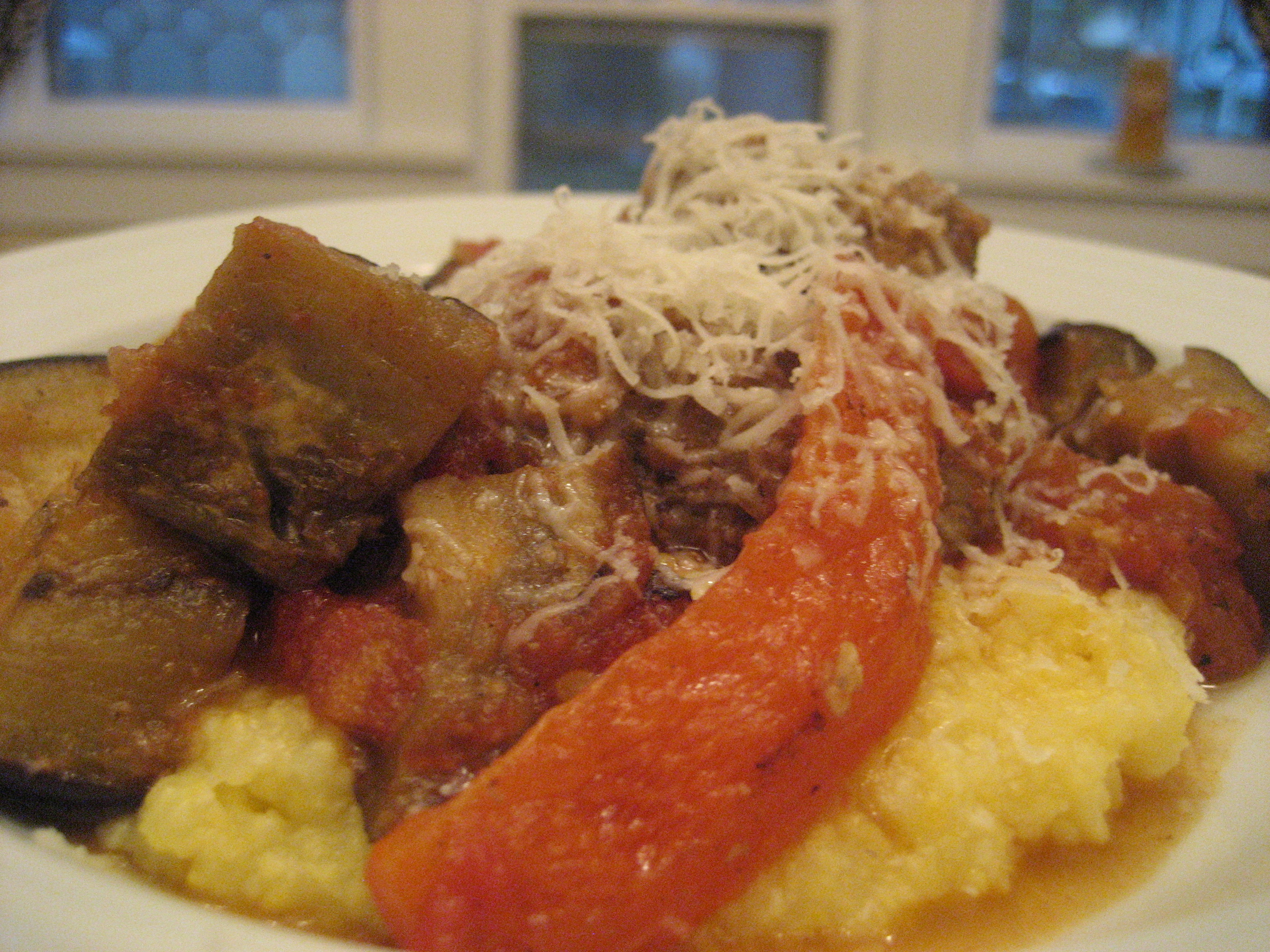
Though this blog project is a tad more work than I expected, it’s worth it for many reasons, one being the new recipes I get to try out. And I like that Kristin keeps me on my toes in the kitchen. After reading through her meals each week, I’m too embarrassed to cook/post some of my old standby recipes. After all, how many times can you type up an adaptation of the same stir-fry? So often I end up in food ruts because my old standby recipes are standby recipes for a reason — they’re good, they’re easy. But food ruts are dangerous, an easy way to forget how amazing food can taste or the thrill of finding that perfect new recipe or pulling off a multi-course dinner for a party of 10.

For those of us that love cooking, it’s not about filling our stomachs as much as creating a meal, an experience, a taste. These days I don’t have the energy to wax poetic about why I love cooking. Luckily, Jonah Lehrer has written a brilliant essay that explains the attraction quite well. All of this is a long way of saying that I’m happy this blog forces me to try new things, like making polenta for the first time. The polenta was easy to make, comforting, and the perfect base for the lovely braised lamb dish.

braised lamb paaties

Sicilian Lamb Patties Braised with Eggplant, Peppers, and Tomatoes
adapted from Bon Appétit, October 2008

Serves 6

In place of polenta, you could serve this over penne, ziti or rigatoni.

for the lamb patties:
1/2 cup (25 g) fresh breadcrumbs (from crustless French bread ground in a food processor)
1/4 cup (60 ml) water
1 1/4 lb (570 g) ground lamb
1/2 cup (30 g) finely grated Pecorino cheese
1 large egg, beaten to blend
1 tablespoon chopped fresh marjoram
1 teaspoon coarse kosher salt
1/2 teaspoon freshly ground black pepper
1/8 teaspoon ground cinnamon

for the eggplant mixture:
2 small or 1 large eggplant (about 1 1/2 lb/680 g), unpeeled, cut into 1‑inch cubes
7 tablespoons extra virgin olive oil, divided
coarse kosher salt
1 large red bell pepper, halved, seeded and cut into 1/2‑inch-wide strips
1 onion, finely chopped
1 1/3 cups (320 ml) dry white wine
3 large garlic cloves, minced
2 1/2 cups (450 g) chopped, seeded, peeled tomatoes

for the polenta:
4 cups (1 liter) water
1 teaspoon salt
1 cup (150 g) polenta (coarse cornmeal)
grated Pecorino cheese

To make the lamb patties, combine the breadcrumbs and water in a small bowl. Soak for 5 minutes, then squeeze all the water from the crumbs. Place the crumbs in a large bowl. Add the lamb and remaining ingredients and mix gently to combine. Shape into 12 oval patties, each about 2 1/2 inches long and 3/4 inch thick.

To make the eggplant mixture, preheat the oven to 350°F (180°C). Combine the cubed eggplant and 5 tablespoons of oil in a large bowl and toss to coat. Spread the eggplant out on a rimmed baking sheet and sprinkle with coarse kosher salt and pepper. Bake for 12 minutes, then turn the eggplant over and bake until soft, about 12 minutes longer.

Heat 1 tablespoon oil in a large, deep skillet over a medium-high heat. Add the lamb patties and saute until brown, about 3 minutes per side. Transfer the lamb patties to a plate. Add the bell pepper strips to the drippings in the skillet and saute until they begin to soften, about 4 minutes. Transfer the pepper to the plate with the lamb.

Reduce the heat to medium. Add the remaining 1 tablespoon olive oil and the chopped onion to the same skillet. Cover and cook until the onion is soft, stirring occasionally, about 5 minutes. Add the wine and garlic. Cook, scraping up any browned bits, until the wine is reduced to a glaze, about 7 minutes. Return the lamb and peppers to the skillet, then add the eggplant, tomatoes, and marjoram. Reduce the heat to medium-low. Cover and simmer until the lamb is cooked through and the vegetables are tender, about 12 minutes. If the sauce is thin, simmer, uncovered until it has thickened to the desired consistency. Season the sauce to taste with coarse salt and pepper.

To make the polenta, bring the water and salt to boil in a heavy, large saucepan over a medium-high heat. Gradually whisk in the polenta and reduce the heat to medium-low. Simmer until the polenta is very thick, whisking often, about 20 minutes.

Spoon the polenta into shallow bowls. Top with the lamb and vegetables, sprinkle with Pecorino cheese and serve.

Cider-brined Pork Chops with Apples and Creamed Leeks

We went on our annual apple- and pumpkin-picking expedition last weekend. After last year’s horrendous experience at Apple Holler orchard (the name should have warned us!), we returned to Barthel’s Fruit Farm, the sedate little orchard just north of us in Mequon. Before this summer, I always thought of Mequon as a snooty little suburb which happened to have a great orchard. Now I think of Mequon as Anabelle’s town, since she was born there at Columbia Birth Center this June. (The birth center is fabulous, by the way — a wonderful place for anyone interested in a birth setting that is more like a spa than a hospital.)

One of the things that intrigued me about this recipe is its author, Sanford D’Amato. D’Amato is a well-known and respected chef here in Milwaukee. His restaurant, Sanford, is by all accounts the best place to eat in the city. I haven’t had the pleasure of eating there myself (I was too cheap in my childless days and now too busy in my child-filled days), but I’ve dined quite often at his more casual Coquette Cafe. His recipe doesn’t disappoint. Not only does the dish taste fantastic and look impressive, but you can do much of it ahead of time. I brined my chops and creamed my leeks last night, then cooked the rest of the dish (along with some mashed potatoes) when I returned home from work. Total dinner cooking time was about 35 minutes. After a long day at work, a dinner made in less than an hour tastes far better than one you’ve had to slave over. And far, far better than takeout Chinese.

cider brined pork

Cider-brined Pork Chops with Apples and Creamed Leeks
adapted from Bon Appétit, September 2001 (recipe by Sanford D’Amato)

Serves 4

4 1/2 cups (1 liter plus 120 ml, divided) good-quality apple juice or cider
3 tablespoons coarse salt
6 allspice berries
1 bay leaf
4 bone-in center-cut pork rib chops (I used 2 bone-in chops and 4 smaller, boneless chops)
4 tablespoons (1/2 stick/60 g) butter
4 large leeks (white and pale green parts only), thinly sliced
3/4 cup (175 ml) half and half or cream
1 1/2 lb (680 g) apples, peeled, cored and halved, each half cut into 4 wedges (Granny Smith, Macintosh, or Jonathan recommended)
2 tablespoons sugar
1/2 cup (120 ml) chicken stock or canned low-sodium chicken broth
olive oil

Bring 4 cups of the cider, salt, allspice, and bay leaf to boil in a large saucepan, stirring to dissolve the salt. Cool completely. Place the pork in a 13 x 9 x 2‑inch or similar-sized glass baking dish. Pour the brine over. Cover and refrigerate overnight.

Melt 2 tablespoons of butter in a heavy large skillet over a medium-low heat. Add the leeks and saute until tender, about 7 minutes. Add the half and half or cream and simmer until slightly thickened, about 3 minutes. Season to taste with salt and pepper. (Creamed leeks can be made 1 day ahead. Cover and chill.)

Melt the remaining 2 tablespoons of butter in a large nonstick skillet over a medium heat. Add the apples and saute for 5 minutes. Add the sugar and saute until the apples are golden, about 6 minutes longer. Add the stock, then the remaining 1/2 cup juice or cider. Simmer until the liquid thickens slightly and the apples are tender, stirring occasionally, about 5 minutes. Set aside. Prepare the barbecue (medium heat) or preheat the broiler. Drain the pork and rinse under cold water, then pat dry. Brush the pork with oil. Grill or broil to desired doneness, about 5 minutes per side for medium.

Meanwhile, rewarm the leeks, thinning with 1 to 3 tablespoons half and half or cream if necessary. Bring the apples to a simmer. Spoon the leeks onto plates. Top with the pork, then apples. Serve with mashed potatoes or good crusty bread.

Pasta with Chickpeas (Pasta e Ceci) and Ginger Cookies

I always feel better knowing there’s a can of chickpeas in the pantry, since I can turn it into a quick lunch with some couscous, lemon and diced feta. Or I can turn it into one of my favorite kitchen cupboard dinners — you know the kind, the ones you pull together from whatever you have lurking in the pantry or at the back of the crisper in the fridge, usually on the night before you do your grocery shopping when there’s nothing else in the house — spaghetti with chickpeas, lemon juice, parsley and freshly grated Parmesan, a recipe I picked up from Denis Cotter’s Paradiso Seasons. Jamie Oliver calls this a cousin of pasta e fagioli, the traditional Italian peasant dish of beans and pasta, so if you like that dish, chances are good you’ll like this one too.

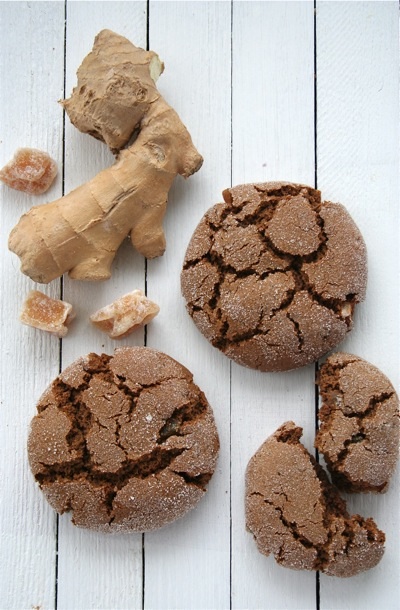
But enough about soup. Let’s talk about these cookies. Ina Garten really knows how to make perfect autumn food — first it was her date nut spice bread, and now these cookies. Both recipes use a combination of cinnamon, nutmeg and cloves that creates an atmosphere while you’re baking them that you want to wrap yourself up in. I gave one of the cookies to the woman who delivers our organic fruit and veg, and the first thing she did was hold it up to her nose to smell it and sigh appreciatively. I said before that the date nut spice bread might be the best thing I bake this autumn, but these cookies are a close contender.

Pasta with Chickpeas (Pasta e Ceci)
adapted from Jamie’s Italy by Jamie Oliver

Serves 4

1 small onion, finely chopped
1 stick of celery, finely chopped
1 garlic clove, finely chopped
extra virgin olive oil
1 sprig of fresh rosemary, leaves picked and finely chopped
2 x 14-oz (400‑g) cans of chickpeas
2 1/4 cups (540 ml) chicken or vegetable stock
3 1/2 oz (100 g) ditalini or macaroni
sea salt and freshly ground black pepper
a small handful of chopped fresh basil or parsley, to serve
freshly grated Parmesan cheese, to serve
crusty bread, to serve

Put the finely chopped onion, celery, and garlic into a saucepan with a little extra virgin olive oil and the rosemary and cook as gently as possible, with the lid on, for 15 to 20 minutes, until all the vegetables are soft, without any color.

Drain the chickpeas well and rinse them in cold water, then add them to the pan and cover with the stock. Cook gently for 30 minutes. Using a slotted spoon, remove half the chickpeas and put them to one side in a bowl.

Puree the soup in the pan using a handheld immersion blender. (If you don’t have one, you can whiz it up in a food processor instead, then pour it back into the pan.) Add the reserved whole chickpeas and the pasta, season the soup with salt and pepper, and simmer gently for about 15 minutes, until the chickpeas are tender and the pasta is cooked.

At this point, if the soup is a little thick, pour in some boiling water from the kettle to thin it down, and add more salt and pepper if needed. Serve drizzled with good-quality extra virgin olive oil and sprinkled with some basil or parsley and Parmesan cheese. Serve some warm crusty bread alongside.

***

The Barefoot Contessa’s Ultimate Ginger Cookies
adapted from The Barefoot Contessa at Home by Ina Garten

Makes 16 cookies

2 1/4 cups (270 g) all-purpose flour
1 teaspoon baking soda
2 teaspoons ground cinnamon
1 1/2 teaspoons ground cloves
1/2 teaspoon ground nutmeg
1/2 teaspoon ground ginger
1/4 teaspoon kosher salt
1 cup (170 g) dark brown sugar, lightly packed
1/4 cup (60 ml) vegetable oil
1/3 cup (80 ml) unsulfured molasses or black treacle
1 extra-large egg, at room temperature
1 1/4 cups (170 g) chopped crystallized ginger
granulated sugar, for rolling the cookies

Preheat the oven to 350°F (180°C). Line 2 sheet pans with parchment paper.

In a large bowl, sift together the flour, baking soda, cinnamon, cloves, nutmeg, ginger, and salt and then combine the mixture with your hands. In the bowl of an electric mixer fitted with the paddle attachment, beat the brown sugar, oil, and molasses on medium speed for 5 minutes. Turn the mixer to low speed, add the egg, and beat for 1 minute. Scrape the bowl with a rubber spatula and beat for 1 more minute. With the mixer still on low, slowly add the dry ingredients to the bowl and mix on medium speed for 2 minutes. Add the crystallized ginger and mix until combined.

Scoop the dough with 2 spoons or a small ice cream scoop (I used a 1/4 cup measuring cup, which is 90 g of dough). With your hands, roll each cookie into a 1 3/4‑inch ball and then flatten them lightly with your fingers. Press both sides of each cookie in granulated sugar and place them on the sheet pans. Bake for exactly 13 minutes. The cookies will be crackled on the top and soft inside. Let the cookies cool on the sheets for 1 to 2 minutes, then transfer to wire racks to cool completely.

Chicken Braised with Chicory and Crème Fraîche, Green Beans with Lemon and Olive Oil, Roast New Potatoes, and Baileys Cream Pots

In the short story ‘Simon’s Luck’ by Alice Munro, a woman, Rose, goes to the grocery store to stock up before a guest arrives:

“You must’ve brought home company,” said the woman who kept the store. She spoke with no surprise or malice or censure, just a comradely sort of envy.

“When I wasn’t expecting it.” Rose dumped more groceries on the counter.  […] “Look at that bacon. And cream.”

“I could stand a bit of it,” the woman said.

What’s this then? You mean not everyone includes bacon and cream as part of their weekly shop? I never considered them to be foods reserved only for guests, since they’re pretty much staples in my fridge. Still, when I have company, I do tend to pull out all the stops at the grocery store, like Rose, and all my recent entertaining meant there was plenty of bacon and cream to go around.

This is my go-to menu if we have company for dinner. The great thing about it is that you can prepare the chicken, then bang it into the oven to happily cook for an hour, giving you plenty of time to clean up the kitchen before your guests arrive, plus visit with them before dinner. The roast potatoes can cook in the hot oven along with the chicken and the Baileys cream pots can be made up to a day ahead, so all you have to do is prep the green beans ahead of time, then boil them when you’re just about ready to sit down to eat. I know chicken braised with chicory and crème fraîche might not sound like much on paper, but I think everyone I’ve ever served this to has asked for the recipe afterward, with some friends stopping just short of licking their plates. But don’t wait for company to come over to make this — it’s a great meal for any weekend when you have a bit of extra time to cook (and when you can lick the plate with no one watching).

Chicken Braised with Chicory and Crème Fraîche
adapted from Real Food by Nigel Slater

Serves 4

Don’t worry if you can’t get chicory, I make this without it more often than not and it’s still fantastic.

3 tablespoons groundnut oil
a thick slice of butter
4 chicken breasts
4 heads of chicory, cut in half lengthwise
1 tablespoon brown sugar
4 shallots, peeled and finely chopped
juice of 1 lemon
3/4 cup (175 ml) medium-dry white wine
1 cup (240 ml) crème fraîche
a few sprigs of parsley, chopped

Preheat the oven to 400°F (200°C).

Heat the groundnut oil with the butter in a large, deep, heavy casserole, ideally one to which you have a lid, on the stove top. When the butter starts to bubble, carefully put in the chicken (in 2 batches if you need to) and cook them until they’re golden brown on each side. Try not to move them too often, that way you’ll get a nice brown crust on the skin.

Lift the chicken out of the pan and set aside. On no account get rid of the sticky bits on the bottom of the pan, that’s where much of the flavor is. Put the chicory in the dish, then season with the sugar and some salt and pepper. Let it cook over a moderate heat until the outside leaves start to caramelize and darken and soften, about 5 minutes. (If you’re not using the chicory, add the sugar, salt and pepper along with the shallots and lemon juice in the next step.)

Add the shallots and lemon juice, then return the chicken to the pan. Pour over the wine and bring to the boil. Turn the heat down and simmer for about 10 minutes, until the wine and cooking juices have reduced a bit. Spoon in the crème fraîche, season with salt and pepper and stir as best you can so that the juices mingle with the cream. Cover with a lid (or just tightly with aluminum foil) and put in the oven for about 1 hour. Move the pieces of chicken and chicory around halfway through cooking.

After 1 hour, lift the chicken and chicory out of the sauce with a draining spoon and put on the plates. Add the parsley to the sauce in the pan, give it a bit of a stir, then pour the sauce over the chicken. (If the sauce is too thin, simmer it on the stove top for a few minutes until it thickens.)

***

Green Beans with Lemon Juice, Sea Salt and Olive Oil
adapted from Rachel’s Favourite Food by Rachel Allen

Serves 4 to 6

Not only is this good hot, served with fish or chicken, but it’s also great served at room temperature. You can also use it as a base for a fresh, light salad –- add thinly sliced red onions, some cannellini beans or chickpeas (drained from the can), canned tuna and crumbled feta cheese for a fabulous and nutritious packed lunch or summer supper (also good in a pitta bread).

1 level teaspoon salt
1 lb 2 oz (500 g) green beans
2 tablespoons extra virgin olive oil
juice of 1/2 lemon
sea salt and freshly ground black pepper

Put a large pot of salted water on to boil. Top and tail the beans and cut in half at an angle, if you wish. Add to the boiling water and put the lid back on until the water comes back to the boil. As soon as it does, take the lid off to keep the beans’ bright green color and continue to cook on a high heat until the beans are just cooked, but still have a bit of bite. Drain and immediately add the olive oil, lemon juice and sea salt and pepper to taste. You must dress the beans while hot so that they soak up the fresh citrus flavor.

***

Bailey’s Cream Pots
from Full on Irish by Kevin Dundon

Serves 4

1 1/4 cup (300 ml) cream
4 tablespoons Baileys Irish Cream
1/4 cup (60 ml) freshly brewed espresso, cooled (or very strong coffee)
9 oz (250 g) mascarpone cheese
2 tablespoons icing sugar, sifted, plus extra for dusting

to serve:
chocolate curls (optional)
cocoa powder (optional)
shortbread cookies

Whip the cream in a bowl until soft peaks have formed. Place the Baileys in a separate bowl with the coffee, mascarpone and icing sugar. Beat until well combined, then fold in the cream. Divide between four ramekins or small cups and chill for at least 2 hours, or overnight.

To serve, arrange the Baileys pots on serving plates and decorate with chocolate curls. Add the shortbread on the side and lightly dust with icing sugar and cocoa powder.

Roast Chicken with Bacon and Coffee Spice Rub, Sweet Potato Puree and Apple Cranberry Oat Crumble

I love bacon and I love coffee, so when I read about this roast chicken recipe last month, taken from Zingerman’s Guide to Better Bacon, it immediately got my attention. I usually gloss over recipes that call for highly specific, hard-to-find ingredients like this coffee rub*, but it just so happens that my in-laws live in Ann Arbor, Michigan, home of the Zingerman’s deli that sells it. It also just so happens that my father-in-law recently came over to Ireland, so I asked him if he could pop into Zingerman’s to pick up a jar of this rub for me, with the promise that I’d make this recipe for him when he came to see us if he did. He came through and got me a jar, and I held up my end of the deal and made this dinner.

For the menu planning, I took my cue from Caroline Russock at Serious Eats, who said this recipe is like a one-dish Thanksgiving dinner, and she was right (and in fact, the rub was originally developed to season Thanksgiving turkey). The layers of bread, onions and apples underneath the chicken basically turn into stuffing — but stuffing that has been flavored with the butter and lemon juice from the chicken as well as its drippings. I kept things simple by only serving a sweet potato puree alongside the chicken and stuffing, but like Caroline says, this recipe lends itself to any of your favorite Thanksgiving or holiday side dishes. If you’re starting to think about what to serve for the holidays this year, try this coffee spice rub on the turkey or even roast potatoes for a change from your usual standbys.

*US customers can buy Zingerman’s Coffee Spice Rub online. But don’t dismiss this recipe if you can’t get the rub — this is still delicious if you simply season the chicken with salt and pepper. I did just that on a quarter of the chicken because I was making this meal to serve to my two little kids as well, and I knew the coffee rub would be too strong for them (plus it does have some zip to it). When I run out of this rub, I’ll continue to make this just with salt and pepper.

Roast Chicken with Bacon and Coffee Spice Rub
adapted from Zingerman’s Guide to Better Bacon by Ari Weinzweig (recipe via Serious Eats)

3 tablespoons olive oil
2 large onions, cut in half lengthwise and sliced into thin half-circles
4 stalks celery, cut into 1/8‑inch-thick slices
1 1/4 lb (570 g) tart apples (3 medium or 4 small apples), unpeeled and chopped into 1/2‑inch dice
1 cup (160 g) dried currants (or raisins)
1 clove garlic, minced
1/2 teaspoon dried thyme or 1 tablespoon fresh thyme
1 tablespoon lemon zest
1 teaspoon coarse sea salt
1 teaspoon freshly ground black pepper
1/4 cup (10 g) parsley, chopped
2 tablespoons butter, plus extra for greasing the roasting tin
1/2 loaf leftover counrty bread, such as a good crusty white loaf, sliced 3/4‑inch
6 slices of bacon
1 roasting chicken (3 to 4 lb/1.4 to 1.8 kg), split in half and backbone removed (get your butcher to do this for you)
2 to 3 tablespoons Zingerman’s Coffee Spice Rub (or substitute coarse sea salt and freshly ground black pepper)
1/4 cup freshly squeezed lemon juice

Preheat the oven to 400°F (200°C).

Heat the olive oil in a large skillet over a low heat. Add the onion and celery. Cover and sweat, stirring occasionally, for 15 minutes, or until soft. Add the apple, currants, garlic, thyme, lemon zest, salt, and pepper. Stir to mix. Cook, covered, until the onions and celery are translucent, about 5 to 7 more minutes. Remove from the heat, stir in the parsley and set aside.

Lightly smear the bottom and sides of a 15-inch oval roasting pan (or other large ovenproof casserole dish) with butter. Arrange the bread slices to cover the entire bottom of the baking dish. (If the bread is too big to fit easily, simply cut the slices into smaller pieces so that they tile the entire bottom of the dish properly.)

Layer the onion and apple mixture on top of the bread. Place the chicken, skin side up, over the onion mixture and bread. Rub it with 2 tablespoons of butter and 2 to 3 tablespoons of the coffee rub (or just season generously with coarse sea salt and freshly ground black pepper). Pour the lemon juice over the chicken, then lay the bacon slices across the top of the chicken.

Place the entire dish in the oven and cook, uncovered, for 45 minutes. After this time, check that the bacon has crisped on top of the chicken. Once it has, pull it off the chicken and lay it directly onto the bread mixture so that the chicken can brown. Change the oven function to broil, but continue at 400°F (200°C). The chicken should be done in 15 to 20 minutes; the skin should be nicely crisped and the juices should run clear when the bird is pricked with a fork.

Remove the pan from the oven and remove the chicken to a cutting board and cut it into quarters. Draw a sharp knife through the bacon, bread, and onion mixture to break it up. Spoon some of the mixture onto each plate and place the chicken on top.

***

Sweet Potato Puree with Goat’s Cheese and Smoked Paprika*

Serves 6 to 8

*Amanda Hesser and Merrill Stubbs chose this recipe as one of their editors’ picks at Food52!

If you’re making this for the holidays (or any day) and are pressed for time or oven space, you can just boil the potatoes in a large saucepan of boiling salted water for 10 to 15 minutes, though you’ll lose that extra depth of flavor you get from roasting them.

3 lb (1.4 kg) sweet potatoes
4 oz (110 g) goat’s cheese
1/2 teaspoon smoked paprika
salt and freshly ground black pepper

Preheat the oven to 400°F (200°C).

Line a baking sheet with aluminum foil. Prick the potatoes with a fork and place them on the foil-lined baking sheet. Bake for 1 to 1 1/2 hours, until the potatoes are tender. (If using very large potatoes, make sure they are cooked all the way through.) Remove from the oven and allow to cool.

When the potatoes are cool enough to handle, peel them or scoop out the flesh with a spoon and transfer to a food processor. Add the goat’s cheese and smoked paprika and process until the mixture is smooth. Taste the puree to see if it needs more paprika. Season to taste with salt and pepper.

Gently reheat the puree either in a saucepan over a medium heat or in a microwave. Serve immediately.

***

Apple and Cranberry Oat Crumble
adapted from Rustic Fruit Desserts by Cory Schreiber and Julie Richardson

Serves 8 to 12

This crumble is best served the day it’s made, but any leftovers can be wrapped in clingfilm and kept at room temperature for 2 or 3 days. Reheat in a 300°F (150°C) oven for 10 to 15 minutes, until warm.

for the topping:
2 cups (200 g) rolled oats
1 1 /2 cups (180 g) flour
1 1 /3 cups packed (230 g) brown sugar
1/2 teaspoon salt
3/4 cup (170 g) unsalted butter, melted

for the fruit filling:
8 large apples, peeled, cored and sliced 1/4‑inch thick (3 1/2 lb/1.5 kg prepped)
2 cups (225 g) cranberries, fresh or frozen, or 1 cup (100 g) dried cranberries
1 1/3 cups (275 g) sugar
2 tablespoons cornstarch
2 teaspoons ground cinnamon

vanilla ice cream, whipped cream or custard, to serve

Preheat the oven to 375°F (190°C). Butter a 3‑quart (3‑liter) baking dish.

To make the topping, mix the oats, flour, brown sugar and salt together in a bowl. Stir in the butter, then press the topping together with your hands to form small clumps. Put the topping in the freezer while you assemble the filling.

To make the filling, toss the apples, cranberries, sugar, cornstarch and cinnamon together in a large bowl. Transfer the filling to the prepared pan and spread it out, pressing the fruit down into the corners.

Press the oat crumble evenly over the fruit, then bake for 60 to 70 minutes. Cool for 20 minutes or so to temper the heat before serving, then top with a scoop of vanilla ice cream, a small dollop of whipped cream or warm custard served on the side.
Chard Tacos with Sweet Potato and Black Bean Salad

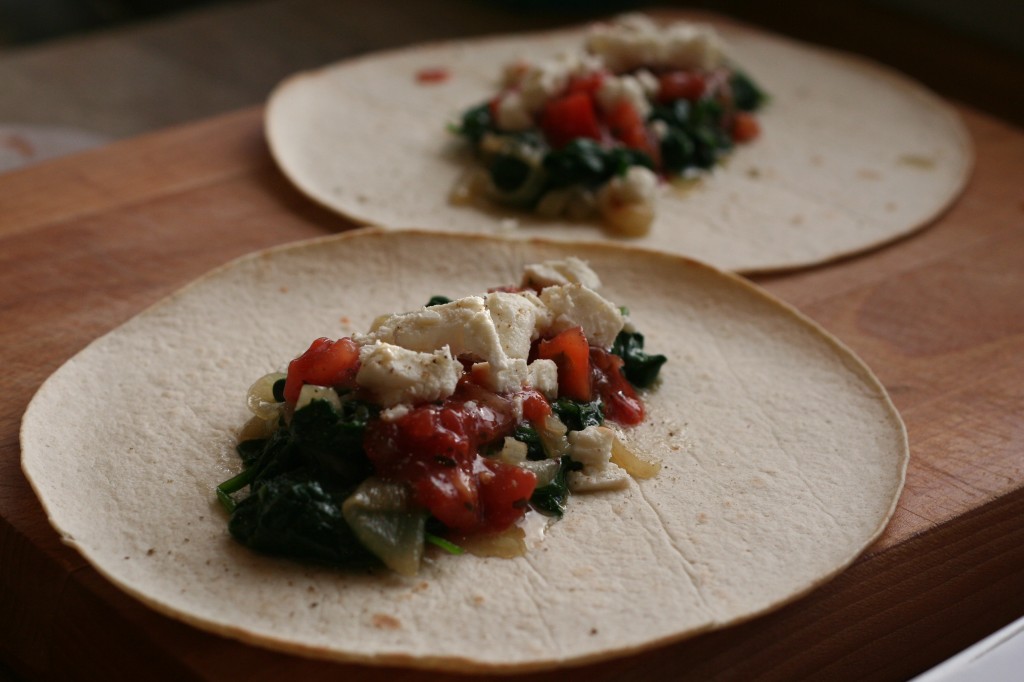
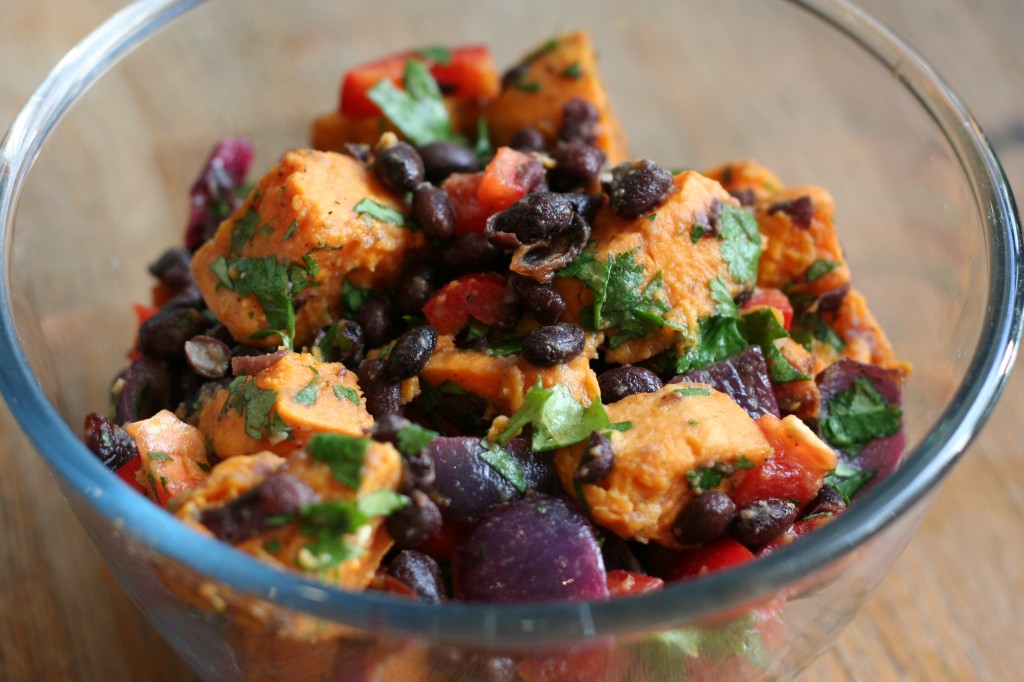
Remember how I was recently lamenting the fact that greens rarely get to be the star of the show at dinnertime? If you want to eat more greens but aren’t sure how to incorporate them, these chard tacos are another great recipe, and can use either chard or spinach. When paired with this sweet potato and black bean salad, it makes a fresh, filling dinner that still has an autumnal feel.

chard tacos

Chard Tacos
adapted from Mexican Everyday by Rick Bayless

Serves 2

Rick Bayless says that to make a heartier meal, you could add some shredded leftover chicken or steak to the greens during the final few minutes of cooking. Flaked tuna or smoked salmon is a nice add-in, but to keep it vegetarian, you could also try smoked firm tofu.

12 oz (340 g) Swiss chard, thick lower stems cut off, OR 10 oz (280 g) spinach, rinsed well
1 1/2 tablespoons vegetable oil or olive oil
1 large white or red onion, sliced 1/4‑inch thick
3 garlic cloves, finely chopped
pinch of red pepper flakes
1/2 cup (120 ml) chicken or vegetable broth or water
1/2 teaspoon salt
8 warm corn tortillas (though flour ones will also work fine, as you can see from the photo I used here; you may need fewer flour ones)
1 cup (100 g) crumbled Mexican queso fresco, feta or goat’s cheese
3/4 cup (175 ml) salsa

Cut the chard crosswise into 1/2‑inch slices (small spinach leaves can be left whole). In a large skillet, heat the oil over a medium-high heat. Add the onion and cook, stirring frequently, until golden brown but not entirely soft, about 4 to 5 minutes. Add the garlic and red pepper flakes and stir for a few seconds, then add the broth or water, salt and the greens. Reduce the heat to medium-low and cook until the greens are almost tender, anywhere from 2 minutes for baby spinach to 5 minutes for Swiss chard.

Uncover the pan, raise the heat to medium-high and cook, stirring continually, until the mixture is nearly dry. Taste and season with additional salt if you think it needs it. Serve with the warm tortillas, crumbled cheese and salsa.

***

sweet potato and black bean salad

Sweet Potato and Black Bean Salad
adapted from Mark Bittman at The New York Times

Serves 4 to 6

2 large sweet potatoes, peeled and cut into bite-sized chunks
1 large red onion, cut into large chunks
olive oil
salt and freshly ground black pepper
1 x 14-oz (400‑g) can of black beans, drained and rinsed
1 red pepper, deseeded and chopped
juice and zest of 1 lime
3 tablespoons olive oil
1 bunch fresh cilantro, chopped

Preheat the oven to 400°F (200°C).

Place the sweet potatoes and red onion on a baking tray. Drizzle with some olive oil and season with salt and pepper, tossing well to make sure all the vegetables are coated with oil. Roast in the hot oven for 20 to 30 minutes, until the sweet potatoes are just tender and taking care not to let the red onion burn.

When the potatoes and onion are done, transfer them to a large bowl. Add in the black beans and chopped red pepper. Whisk the lime juice and zest and olive oil together until emulsified (or shake to combine in a screw-top jar), then pour over the salad in the bowl, stirring gently to make sure everything is coated with the dressing. Add in the chopped cilantro and stir well again. Season to taste with salt and pepper. This can be served warm or at room temperature.

A Cooking Blog