All posts by Kelly

Herb-roasted Turkey with Shallot Pan Gravy, Thanksgiving Stuffing, Buttermilk Mashed Potatoes, and Honeyed Pecan Pie

This year is my first time to host Thanksgiving. In fact, except for the Christmas when I was 9+ months pregnant and didn’t dare venture away from my doctor, I’ve never hosted a major holiday, so I was really excited to spend some time researching recipes and planning our menu. Luckily, my sister-in-law and mother-in-law are also cooking dishes  so I won’t be overwhelmed with cooking. Unlike Kristin, except for the pecan pie, I haven’t made any of my Thanksgiving recipes but they sound good to me and, almost as important, they don’t seem too time consuming. Speaking of time, for those of you who are also planning your menus right now, I’ll lay out my game plan. Sunday, shop for all beverages and groceries. Monday, wash table linens and polish candlesticks. Tuesday, make herb butter (for turkey), clean house. Wednesday, bake pie and cornbread, cube cornbread and French bread (for stuffing). Thursday, put turkey in the oven, set table, prepare remaining dishes, pour glass of wine and enjoy!

Herb-roasted Turkey with Shallot Pan Gravy
from Bon Appétit, November 2000

Serves 10

3/4 cup (180 g) butter, room temperature
3 tablespoons chopped fresh parsley plus 3 whole sprigs
2 tablespoons chopped fresh sage plus 3 whole sprigs
2 tablespoons chopped fresh thyme plus 3 whole sprigs
3/4 teaspoon salt
1/2 teaspoon coarsely ground black pepper
1 x 15- to 16-lb (7‑kg) turkey, rinsed and patted dry
1 1/2 lb (680 g) shallots, peeled and halved lengthwise through root end
3 cups (720 ml) (or more) low-sodium chicken broth
1 cup (240 ml) dry white wine
2 tablespoons all-purpose flour

Mix the butter, chopped parsley, chopped sage, chopped thyme, 3/4 teaspoon salt and 1/2 teaspoon pepper in a medium bowl to blend. (This can be prepared 3 days ahead. Transfer the herb butter to a small bowl; cover and refrigerate. Bring the butter to room temperature before using.) Position a rack in the bottom third of the oven and preheat to 350°F (180°C). Sprinkle the main cavity of the turkey with salt and pepper. Place the whole parsley, sage and thyme sprigs and 4 shallot halves in the cavity. Starting at the neck end, carefully slide your hand between the skin and breast meat to loosen the skin. Spread 3 tablespoons herb butter over the breast meat under the skin. Tuck the wing tips under, then tie the legs together to hold their shape. Place the turkey on a rack set in a large roasting pan. Rub 4 tablespoons of the herb butter over the turkey. Cover only the breast area of the turkey with a sheet of heavy-duty foil. Scatter the remaining shallots in the pan around the turkey.

Roast the turkey for 30 minutes, then baste with 1/2 cup (120 ml) broth. Continue roasting the turkey for 1 1/2 hours, basting with 1/2 cup (120 ml) broth every 30 minutes. Remove the foil from over the turkey breast. Continue to roast the turkey until golden brown and a thermometer inserted into the thickest part of the thigh registers 180°F (80°C), basting with pan juices every 20 minutes, for about 1 hour longer. Transfer the turkey to a platter. Brush with 1 tablespoon of herb butter. Tent loosely with foil and let stand 20 minutes.

Using a slotted spoon, transfer the shallots from the roasting pan to a plate. Pour the pan juices into a medium bowl; spoon off the fat and discard. Add the wine and 1 cup (240 ml) of chicken broth to the roasting pan. Set the pan directly over 2 burners and bring the broth mixture to a boil, scraping up any browned bits. Continue to boil until reduced by half, about 3 minutes; pour into a large glass measuring cup. Add the degreased pan juices. Add enough broth, if necessary, to equal 3 cups (720 ml) liquid.

Blend the flour into the remaining herb butter. Pour the broth mixture into a heavy medium saucepan and bring to a boil. Gradually whisk in the herb butter mixture. Add any accumulated juices from the turkey platter. Boil until the gravy thickens enough to coat a spoon lightly, whisking occasionally, about 6 minutes. Add the shallots to the gravy and simmer for 1 minute. Season the gravy with salt and pepper. Serve the turkey with the gravy.

***

Thanksgiving Stuffing
from The Pioneer Woman 

Serves 10

1 pan of cornbread
1 loaf French bread, somewhat crusty
1 stick (110 g) butter
1 whole medium onion, diced
2 cups (250 g) celery, chopped
4 cups (1 liter) low-sodium chicken broth
1/4 cup (10 g) chopped fresh parsley
2 to 3 teaspoons fresh chopped rosemary
1/2 teaspoon dried basil
1/2 teaspoon dried thyme
salt to taste

Chop the cornbread and loaf of French bread into 1‑inch cubes. Spread them out on two baking sheets and let them dry for approximately 24 hours.

Heat a large skillet over medium heat and add the butter. When it’s melted, add the onion and celery and cook for a few minutes, until the onions are almost translucent. While the onion and celery are cooking, chop up any fresh herbs you will be using.

Add 4 cups of chicken broth and bring to a boil. Add the parsley, rosemary, basil and thyme. Stir until combined.

Place all of your dried bread cubes into a large bowl and mix them up a bit. Gradually ladle the broth mixture into the bread, tossing lightly as you go. Keep gradually adding the broth mixture, tasting as you go and adding more seasoning and herbs if needed. Add salt carefully. You don’t want to over-salt your stuffing. If the mixture isn’t quite moist enough, add a bit more chicken broth and stir.

Either stuff the bird and cook according to directions or place in a baking dish and bake at 350°F (180°C) for 20 to 25 minutes or until golden brown on top.

***

Buttermilk Mashed Potatoes 
from A New Way to Cook by Sally Schneider

Serves 4 [Note: I plan to double this recipe]

You can make the potatoes up to 3 hours ahead. About 20 minutes before serving, warm them in a double boiler, stirring frequently, until hot.

1 1/4 lb (570 g) thin-skinned potatoes, such as Yellow Finns or Yukon Golds, peeled and cut into 2‑inch chunks if large
1 1/2 teaspoons kosher salt
3/4 cup (180 ml) buttermilk, warmed (not hot)
1 tablespoon unsalted butter
freshly ground black pepper

Place the potatoes and 1 teaspoon of the salt in a medium saucepan, add enough water to cover, and bring to a boil over a high heat. Reduce the heat to moderate and simmer until the potatoes are tender when pierced with a fork, about 45 minutes. Drain, reserving 1/4 cup of the cooking water.

Return the potatoes to the pan and set over a low heat, uncovered, for about 5 minutes, stirring occasionally, to let the potatoes dry out a little (too much moisture will dilute their flavor). For the smoothest potatoes, pass them through a food mill or potato ricer. For a slightly coarser puree, mash them with a potato masher or fork or use a hand mixer. Beat the buttermilk into the potatoes with a wooden spoon until thoroughly incorporated. If you prefer even creamier potatoes, add a little of the reserved cooking liquid. Beat in the butter, the remaining 1/2 teaspoon salt, and plenty of pepper. Serve at once, or keep the potatoes warm, covered, in a double boiler over hot water for up to 1 hour.

***

Honeyed Pecan Pie

Serves 8

1 cup (170 g) brown sugar (lightly packed)
1 cup (200 g) (or a bit less) light corn syrup (or golden syrup)
1/4 cup (60 ml) honey
1/2 teaspoon salt
1/3 cup (80 g) butter, melted
3 eggs, lightly beaten
1 1/2 cups (150 g) roasted, chopped pecans
1 x 9‑inch pie crust
whipped cream (optional)

Preheat the oven to 350°F (180°C).

Combine the brown sugar, corn syrup, honey, salt, and melted butter in a large bowl. Stir in the beaten eggs and mix well. Stir in the pecans. Pour the pecan mixture into the prepared pie crust and bake at 350°F (180°C) for 1 hour. Serve the pie warm or at room temperature with a dollop of freshly whipped cream, if desired.

Slow Cooker Stracoto with Porcini Mushrooms and Carrots with Egg Noodles

Kristin brilliantly thought to add a slow cooker category to our site. Slow cookers really can be a working mom’s best friend. This stracoto (fancy word for pot roast) is my favorite slow cooker recipe. I’ve made it in the oven as per the original recipe, but actually prefer my adaptation in the slow cooker, which results in a moister piece of meat. It’s awfully hard to dry out a piece of meat, or anything else for that matter, in a slow cooker. Reuben must have liked the dinner, since he added this programmable slow cooker to his Amazon wish list within a few hours of finishing it.

Don’t forget to enter our first cookbook giveaway contest. Entries are due tomorrow. To enter, all you have to do is leave a comment in Kristin’s October 26 post.

Slow Cooker Stracoto with Porcini Mushrooms and Carrots

adapted from Giada De Laurentiis, Food Network

Serves 6

1 x 4 lb (1.8 kg) boneless beef chuck roast or arm roast
salt and freshly ground black pepper
3 tablespoons olive oil
2 onions, sliced
6 garlic cloves, coarsely chopped
1 cup (240 ml) dry red wine
1 3/4 cups (420 ml) canned beef broth
1/2 oz (15 g) dried porcini mushrooms
1 bunch carrots, peeled and halved if large, and cut into 3‑inch pieces
egg noodles or mashed potatoes, to serve

Pat the beef dry with paper towels. Sprinkle the beef generously with salt and pepper. Heat 2 tablespoons of olive oil in a large, heavy skillet (cast iron preferred) over a medium-high heat. Add the beef and cook until brown on all sides, about 15 minutes total cooking time. Transfer the beef to the slow cooker. Add the remaining tablespoon of oil to the pan, add the onions and saute until tender, scraping up the brown bits on the bottom of the pot, about 5 minutes. Add the garlic and saute for 1 minute. Add the wine and boil for 1 minute. Stir in the broth and mushrooms. Bring the liquid to a boil. Carefully pour the liquid into the slow cooker. Add the carrots. Cook on low for 8 hours, or until the meat and carrots are tender.

Transfer the beef to a cutting board. Using a slotted spoon, transfer the carrots to a serving bowl. Tent the beef with foil and let it rest for 10 minutes. Meanwhile, spoon any excess fat off the top of the sauce in the slow cooker. Using a hand-held blender, blend the sauce, onions, and garlic into a smooth puree. (If you don’t have a hand-held blender, transfer the sauce and vegetables to a blender and puree.) Season the sauce to taste with salt and pepper.

Cut the beef across the grain into 1/2‑inch-thick slices. Arrange the sliced beef on a platter and spoon the sauce over. Serve with egg noodles or mashed potatoes, passing the remaining sauce in a sauce boat.

White Cheddar Polenta with Sauteed Greens and Garlic-roasted Portobellos

Ever since my first try at making polenta a couple weeks ago, I’ve been craving another taste of it and wondering if it was only beginner’s luck that made it so delicious. How had I cooked on a daily basis for so many years without using this staple ingredient? Since last night was a work night, I certainly didn’t have the time to braise any meat as I did with my first polenta recipe. Instead, I found a dish that looked equally as tasty but could be cooked in half an hour. I also liked that it was vegetarian. Nobody needs to eat meat every day (that means you, Dad!). I served this with just a bottle of Malbec but next time I think a salad would be a nice accompaniment.

white cheddar polenta with roasted portabellos

White Cheddar Polenta with Sauteed Greens and Garlic-roasted Portobellos
adapted from Bon Appétit, January 2001

Serves 4

4 medium portobello mushrooms
8 cherry tomatoes, halved, or 4 plum tomatoes, quartered
5 tablespoons olive oil
4 garlic cloves, minced
1 tablespoon chopped fresh parsley
salt and freshly ground black pepper
4 cups (1 liter) water
1 1/2 teaspoons salt
1 cup (225 g) polenta (coarse cornmeal) or yellow cornmeal
2 tablespoons butter
1 cup (packed) grated sharp white cheddar cheese (about 4 oz/110 g)
1 large bunch Swiss chard, ribs cut away, leaves cut into 3 x 1‑inch strips
1 x 7‑oz (200‑g) bag fresh spinach leaves

Preheat the oven to 400°F (200°C). Oil a 13 x 9‑inch baking dish. Remove the stems from the mushrooms and chop the stems finely; place the stems in the prepared baking dish. Using a small spoon, scrape away the dark gills from the underside of the mushrooms and discard. Cut each mushroom cap into 8 wedges; add them to the baking dish with the chopped stems. Sprinkle the tomatoes around the pan and drizzle with about 3 tablespoons of oil. Sprinkle with 2 minced garlic cloves, parsley, salt and pepper on top, and toss to coat. Bake until the mushrooms are tender, 25 minutes.

Meanwhile, combine 4 cups (1 liter) of water and 1 1/2 teaspoons of salt in a large saucepan. Bring to a boil. Gradually whisk in the polenta. Reduce the heat to low. Cook until the polenta thickens and begins to pull away from sides of pan, whisking often, about 25 minutes for polenta or 15 minutes for yellow cornmeal. Whisk in the butter, then the cheese. Season to taste with salt and pepper.

While the polenta cooks, heat 2 tablespoons of oil in a large skillet over a medium-high heat. Add 2 minced garlic cloves and saute for 30 seconds. Add the Swiss chard and cook for 2 minutes. Add the spinach and saute until the greens are tender but still bright green, about 4 minutes more. Season with salt and pepper.

Spoon the polenta onto plates. Top with the greens and the portobello mushrooms mixture.

Pumpkin Seed and Panko-crusted Salmon with Quinoa-stuffed Squash

We’re still eating pumpkin seeds from last week’s Halloween pumpkin carvings. They’re a great snack when roasted and salted and also lend a nice nuttiness to savory dishes. As you can tell by the side dish, our quinoa obsession continues. This dish was tasty when paired with the salmon but would also make a lovely vegetarian main course, too. It may be my favorite quinoa dish yet.

Pumpkin Seed and Panko-crusted Salmon

Serves 6

6 x 6‑oz (170‑g) boneless salmon fillets
salt and pepper, to taste
1/2 cup (30 g) roasted and salted pumpkin seeds
1 cup (60 g) panko breadcrumbs
1/2 teaspoon dried thyme
1/2 teaspoon chili powder
2 tablespoons olive oil or melted butter
1 tablespoon mayonnaise

Preheat the oven to 425°F (220°C). Line a baking sheet with parchment paper. Lay each piece of salmon, skin side down, on the lined baking sheet and season with salt and pepper, to taste.

Process the pumpkin seeds in a food processor to a fine breadcrumb consistency. Sift the processed seeds through a large mesh strainer to remove any husks that did not process. Blend the processed seeds with the panko, spices and olive oil or butter, mixing to coat the crumbs evenly with the oil or butter.

Brush the top of each fillet with 1/2 teaspoon of mayonnaise. Spoon the pumpkin seed mixture on top of the salmon fillets, patting down to adhere the mixture to the fish. Roast in the preheated oven for about 10 minutes, until the salmon begins to flake. Remove the salmon from the oven and let rest for 5 minutes before serving.

***

Quinoa-stuffed Squash
adapted from Rare Earth Farm newsletter, October 29, 2009

Serves 6 as a side dish, 3 as a main course

3 carnival or acorn squash
3 tablespoons olive oil, divided
salt and freshly ground black pepper, to taste
1 1/2 cups (350 ml) broth
1 cup (170 g) quinoa, rinsed
1/2 cup (60 g) raisins
1/2 cup (50 g) slivered almonds, lightly toasted
1 onion, minced
1/2 teaspoon cinnamon (or 1 cinnamon stick)
1 cup (110 g) shredded Gruyere cheese

Preheat the oven to 375°F (190°C). Cut the squash in half and remove the seeds. (I use a grapefruit spoon to easily remove the seeds and membranes.) Coat the inside of each squash half lightly, using about 2 tablespoons of olive oil. Season the squash with salt and pepper. Put the squash in a roasting pan, cut side down, and fill the pan with 1/4 inch of water. Roast the squash for 25 to 30 minutes, until just tender.

While the squash roasts, heat the broth to a boil, then stir in the quinoa and raisins and cook, covered, until the broth is absorbed. The quinoa will be al dente, not soft. While the quinoa cooks, toast the almonds in a small skillet. Pour the almonds onto a plate to cool. Saute the onion along with the cinnamon in the same skillet for about 10 minutes, until translucent. When the quinoa is done, mix in the almonds and half the cheese, and the onions. The squash should be nearly done at this point — a knife should enter the flesh easily and the water should have evaporated. Remove the roasting pan from the oven and fill each squash half with the quinoa stuffing. Top each half with the remaining cheese. Bake for 5 minutes, until the cheese melts.

Layered Tortilla-Tomato Casserole with Greens and Melted Cheese with Black Beans

I’ll admit, I’m a bit of a Rick Bayless groupie. I love that he cooks food that tastes like what I ate while I lived in Oaxaca. I love that he lives in the same neighborhood and attended the same yoga studio that I did while I lived in Chicago. I love that he was one of the chefs who put Chicago on the map as a food destination. And I love that his restaurants Topolobampo and Frontera Grill live up to their hype. There are definitely some things about him that I don’t love, though. His role as a Burger King spokesperson, for example. Or the fact that most of his recipes take well over an hour to prepare and a double column list of ingredients to purchase. And frankly, his daughter’s overacting bothers me so much that I stopped watching his PBS cooking show. But his food always keeps me coming back for more. You may have noticed that Kristin is also a fan. We both pull a lot of recipes from his Mexican Everyday (Recipes Featured on Season 4 of the PBS-TV series “Mexico One Plate at a Time”)cookbook. Tonight’s casserole is from his Julia Child Cookbook of the Year award winner, Rick Bayless’s Mexican Kitchen. I’ve made it so often, the book automatically opens to the chipotle and tomato sauce-flecked pages of this recipe.

I always serve this casserole with black beans and plain yogurt to cut the spicy sauce and round out the flavors of the vegetables. Canned black beans are fine in a pinch or, if you have a bit more time, last month’s slow cooker version is even better.

layered tortilla casserole

Layered Tortilla-Tomato Casserole with Greens and Melted Cheese
Adapted from Rick Bayless’s Mexican Kitchen: Capturing the Vibrant flavors of a World-Class Cuisine

Serves 6 as a main dish

for the sauce:
6 garlic cloves
3 lb (1.4 kg) ripe plum tomatoes (about 15)
2 to 4 chipotle chiles en adobo (depending on your spice preference)
2 tablespoons plus 1/2 cup (120 ml) vegetable oil
salt, about 1 1/2 teaspoons

for the casserole:
10 oz (280 g) spinach
2 small or 1 medium zucchini, cut into 1/4‑inch dice
1 ear of corn, husked, kernels cut from the cob (or 1 cup frozen corn kernels, defrosted)
8 oz (225 g) shredded Monterey Jack or Chihuahua cheese
12 corn tortillas
fresh cilantro, for garnish

For the sauce: Roast the unpeeled garlic on a heavy griddle or cast iron skillet, turning occasionally, until soft, about 10 to 15 minutes. They should blacken in spots. Cool and peel. Roast the tomatoes on a baking sheet under a very hot broiler until blacked on one side, about 6 minutes. Turn the tomatoes over and roast the other side. Cool, then peel. In a food processor or blender, process the tomatoes, chiles, and garlic to a medium-fine puree. You may need to do this in two batches depending on the size of your processor.

Heat 2 tablespoons of oil in a medium to large pot (4 quarts) with tall sides. Once the oil is hot, add the tomato puree and cook for 8 to 10 minutes, stirring frequently as it sears and thickens. Taste and season with salt, usually 1 teaspoon.

For the vegetables: In a vegetable steamer, steam the spinach, covered, until tender, about 3 minutes. Immediately spread onto a baking sheet to cool, then chop roughly. Steam the zucchini until just tender, about 4 minutes, then spread out to cool. Sprinkle the vegetables with 1/4 teaspoon salt.

For the tortillas: Pour the remaining 1/2 cup (120 ml) of the oil into a small skillet and set over a medium heat. Cover a paper grocery bag with a few layers of paper towels. Quick-fry the tortillas one at a time for a few seconds per side in the hot oil to soften them. Drain the tortillas on a single layer on the paper towels, blotting off any excess oil. Cut them in half.

To assemble: Preheat the oven to 350°F (180°C). Lightly grease a large casserole dish or 11 x 7‑inch baking dish. Spread a thin layer of sauce over the bottom, then lay out 6 tortilla halves in a single layer, covering as much of the sauce as possible. Spread on the greens, then 1 cup (240 ml) of sauce, then 1/2 cup of the cheese. Top with another 6 tortilla halves. Spread on the corn and the same amount of sauce and cheese. Top with a third layer of 6 tortilla halves, the zucchini and sauce and cheese. Top with the remaining tortilla halves, sauce and cheese.

Cover lightly with foil and bake for 25 minutes.Uncover and bake for an additional 10 to 15 minutes, until bubbly and golden. Let stand for 5 to 10 minutes before cutting. Sprinkle with cilantro and serve hot.

Pork with Sweet and Sour Sauce, Jasmine Rice, and Nieman Marcus Chocolate Chip Cookies

Until this summer, I considered sweet and sour pork to be an almost inedible mess of sickly red syrup, mushy pineapple and fatty pork. This Thai version couldn’t be farther from my Chinese take-out fears. Like all good stir-fry dishes, it’s loaded with crisp vegetables and lean meat, with a light yet savory sauce. Though I was dubious of the cucumber in this dish, it’s really tasty and now I sometimes double the amount called for so I don’t have to fight Sam for it.

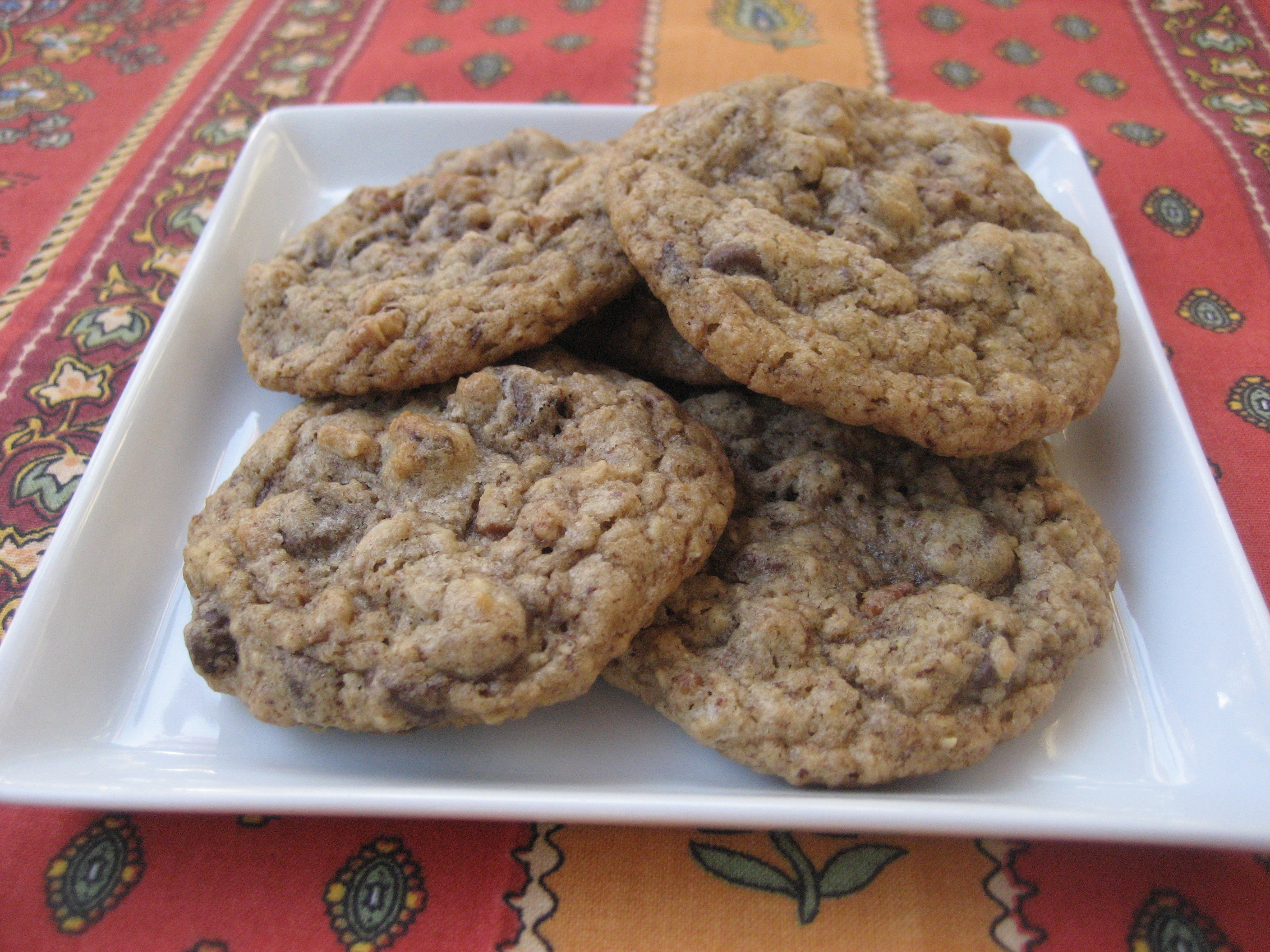
This chocolate chip cookie is the stuff of legends, or should I say urban legends. It’s commonly known as “The $250 Cookie Recipe,” since that’s the amount Neiman Marcus supposedly charged the lady that requested and received the recipe from its store while at lunch. According to Snopes.com, this amusing but false tale has been in circulation for over 50 years. Interestingly, the merchant and food item has evolved over time from a $25 fudge cake recipe “sold” by a train company in the 1940s to Waldorf-Astoria’s red velvet cake recipe in the 1960s to Mrs. Fields’ cookie recipe in the 1980s. Wherever this recipe came from, it’s my favorite chocolate chip cookie and I would gladly pay it (but thank goodness for the internet, so I don’t have to!).

Pork with Sweet and Sour Sauce
adapted from The Food of Thailand: A Journey for Food Lovers by Kay Halsey and Lulu Grimes

Serves 4

8 oz (225 g) pineapples slices in light syrup, each slice cut into 4 pieces (reserve the syrup)
1 1/2 tablespoons ketchup
2 tablespoons fish sauce
1 tablespoon sugar
2 tablespoons vegetable oil
12 oz (340 g) pork, sliced (pork tenderloin recommended)
4 garlic cloves, minced
1 carrot, sliced
1 onion, cut into 8 wedges
1/2 red capsicum (pepper) or serrano pepper, minced
1 bell pepper, cut into 1‑inch pieces
1 small cucumber, unpeeled, halved lengthwise and cut into 1/2‑inch-thick slices
1 tomato, cut into 6 wedges, or 12 baby tomatoes

Mix the pineapple syrup with the ketchup, fish sauce and sugar in small bowl until smooth.

Heat the oil in a wok or deep frying pan over a medium heat and fry the pork until nicely browned and cooked. Remove the pork with a slotted spoon and drain on paper towels.

Add the garlic to the wok and fry over medium heat for 1 minute or until lightly browned. Add the carrot, onion, and peppers and stir-fry for 3 to 4 minutes. Stir in the cucumber, tomato, pineapple and pineapple syrup mixture. Stir-fry for another minute. Taste, then adjust the seasoning, if necessary. Return the pork to the pan and gently stir. Spoon onto a serving plate and garnish with cilantro. Serve with brown or white jasmine rice.

***

NM chocolate chip cookies

Nieman Marcus Chocolate Chip Cookies

Makes about 4 dozen

1 cup (225 g) butter
1 cup (200 g) granulated sugar
1 cup (170 g) brown sugar
2 eggs
1 teaspoon vanilla
2 cups (240 g) flour
2 1/2 cups (200 g) blended oatmeal (measure oatmeal, then blend in blender to a fine powder)
1/2 teaspoon salt
1 teaspoon baking powder
1 teaspoon baking soda
12 oz (340 g) chocolate chips
4 oz (110 g) Hershey bar, grated (I used a Lindt dark chocolate bar)
1 1/2 cups (150 g) chopped nuts (your choice)

Preheat the oven to 375°F (190°C) degrees. Cream the butter and both sugars. Add the eggs and vanilla to the butter mixture. In a separate bowl, mix together the flour, oatmeal, salt, baking powder, and soda.  Add the flour mixture to the sugar/egg mixture. Add the chocolate chips, grated chocolate and nuts. Roll into balls and place 2 inches apart on a cookie sheet. Bake for 10 minutes at 375°F (190°C).

Curried Pork Stew with Potatoes

I felt especially domestic yesterday as I whipped up my butternut squash lasagna and made this curried pork stew at the same time. The stew came together in a flash. There is minimal prep time; the vegetables are roughly cut and you use a curry paste instead of mincing and measuring a long list of the usual curry ingredients. I’ve minced plenty of garlic, seeded countless chiles, and pounded enough lemongrass in my lifetime to really appreciate this shortcut. After letting the cooked stew cool, I refrigerated it in the same pan I cooked it in. Dinner tonight was as easy as reheating the stew and baking some store-bought naan.

We buy our curry paste for about $.89 a can at nearby Asian Mart. As the name suggests, this store supplies Asian and Asian-inspired ingredients and cooking tools. It’s fun to shop there because you never know what you’ll find. I’ve walked out with a wide variety of items you just can’t find anywhere else, like a 20-pound mortar and pestle, an economy pack of chopsticks, long beans, and tamarind paste, to name a few. The owners are delightful and it’s fun to see what chefs from Milwaukee’s ethnic restaurants pick up as they shop alongside you.

Curried Pork Stew with Potatoes 

adapted from Whole Foods Market

Serves 6

1 tablespoon olive oil
12 oz (340 g) boneless pork sirloin chops, cut into 1‑inch cubes
salt and freshly ground black pepper
1 red onion, roughly chopped
1 1/2 cups (360 ml) chicken broth
1 cup (240 ml) coconut milk
3 tablespoons green curry paste, or to taste (3 tablespoons makes a very spicy curry)
1 lb (450 g) red potatoes, cut into 1‑inch chunks
1 lb (450 g) carrots or parsnips, cut into 1‑inch chunks

Heat the oil in a large pot over a medium-high heat. Season the cubed pork with salt and pepper. Cook until deep golden brown. Add the onions and about 2 tablespoons water to loosen the browned bits in the bottom of the pot and cook, scraping the bottom of the pan, until the onions are just softened, about 3 minutes. Add the broth, coconut milk and curry paste and bring to a boil. Cover and simmer for 30 minutes. Add the potatoes and carrots and simmer for 10 minutes, then uncover and simmer until the vegetables are tender and the stew is thickened, about 30 minutes. Season to taste with salt and pepper and serve with naan or rice (or both).

Butternut Squash Lasagna and Steamed Green Beans

Butternut squash lasagna is my ideal comfort food. Savory, cheesy, noodle‑y, but still delicate and with some veggies to ease the guilt. The first time I made this lasagna I followed the directions exactly. This time, I experimented with some shortcuts (pesto, hand-held blender), lightened the recipe some, and also added turkey sausage for texture and a bit of protein. I like my shortcut version just as much, if not more, than the original version and hope you do, too.  If you don’t have any vegetables to steam, a simple tossed salad would taste good with this entree.

Butternut Squash Lasagna
adapted from Giada De Laurentiis

Serves 8

1 tablespoon olive oil
1 large butternut squash, peeled, seeded, and cut into 1‑inch cubes
salt and freshly ground black pepper
1/2 cup (120 ml) water
1 tablespoon amaretto
1/4 cup (55 g) butter
1/4 cup (30 g) all-purpose flour
3 1/2 cups (820 ml) milk
pinch nutmeg
3 tablespoons pesto (homemade or store bought)
12 to 16 no-boil lasagna noodles
2 1/2 cups (280 g) shredded mozzarella cheese
8 oz (225 g) turkey sausage, browned and crumbled (optional)
1/3 cup (30 g) grated Parmesan

Heat the oil in a heavy, large skillet over a medium-high heat. Add the squash and toss to coat. Sprinkle with salt and pepper. Pour the water into the skillet and then cover and simmer over a medium heat until the squash is tender, stirring occasionally, about 20 minutes. Cool slightly. Using a hand-held blender, blend until smooth. Stir in the amaretto. Season the squash puree to taste with more salt and pepper.

Melt the butter in a heavy medium-sized saucepan over a medium heat. Add the flour and whisk for 1 minute. Gradually whisk in the milk. Bring to a boil over a medium-high heat. Reduce the heat to medium and simmer until the sauce thickens slightly, whisking often, about 5 minutes. Whisk in the nutmeg and cool slightly. Stir in the pesto. Season the sauce with salt and pepper, to taste.

Position the rack in the center of the oven and preheat to 375°F (190°C).

Lightly butter a 13 x 9 x 2‑inch glass baking dish. Spread 3/4 cup (180 ml) of the sauce over the prepared baking dish. Arrange 3 to 4 lasagna noodles on the bottom of the pan. Spread one-third of the squash puree over the noodles. Spread one-third of the sausage (if using) over the puree. Sprinkle with 1/2 cup (55 g) of mozzarella cheese. Drizzle 1/2 cup (120 ml) of sauce over the noodles. Repeat layering 3 more times, ending with a layer of noodles covered with sauce.

Tightly cover the baking dish with foil and bake the lasagna for 40 minutes. Sprinkle the remaining mozzarella and Parmesan cheeses over the lasagna. Continue baking, uncovered, until the sauce bubbles and the top is golden, 15 minutes longer. Let the lasagna stand for 15 minutes before serving.