Category Archives: Desserts

Fish en Papillote with Julienned Vegetables and Truffle Oil, Cauliflower Gratin, and Roasted Figs with Yogurt, Honey, and Walnuts

“So what do you do with parchment paper?” My mom asked me this last week after noting how easy the paper made removing carrot cake from its pan. I’m sure there are 1,001 uses for it, but personally, I only use it for lining pans when baking and for cooking fish. Steaming fish in parchment paper packets keeps it moist and locks in all the flavors you add to it. After a few days of thinking nonstop about fish en papillote, I decided to make it. In this version, leeks and truffle oil turn mild (a.k.a. boring) tilapia into an elegant dish.

Reuben’s grandma and mom joined us again for dinner and graciously agreed to be my guinea pigs as I experimented with roasting figs. Until this week, I had never eaten fresh figs. They looked beautiful at the grocery store so I decided to take a chance and buy a carton. I’m glad I did. The slight sourness of the yogurt in my recipe/experiment nicely balanced the sweetness of the figs and honey. As with most of my favorite desserts, the roasted figs dish is great for breakfast.

Fish with vegetables

Fish en Papillote with Julienned Vegetables and Truffle Oil
adapted from Sara Moulton Cooks at Home
by Sara Moulton

Serves 4

1 1/2 tablespoons plus 2 teaspoons unsalted butter
2 carrots, julienned
1 large leek, julienned
1 celery rib, julienned
kosher salt and freshly ground black pepper, to taste
vegetable oil, for brushing (or spray canola oil)
4 x 6‑oz (170‑g) thin fish fillets, no thicker than 1/3 inch each, such as tilapia or flounder, skin removed
4 teaspoons fresh lemon juice
4 teaspoons white truffle oil

Melt 1 1/2 tablespoons of the butter in a large heavy skillet over medium heat. Add the carrot, leek, and celery. Season with salt and pepper. Cook gently, stirring often, until softened, 5 to 7 minutes. Remove from the heat and set aside to cool.

Preheat the oven to 425°F (220°C). Cut out a parchment paper rectangle, about 10 inches by 12 inches. Fold in half, then reopen. Brush the whole rectangle lightly with some oil (or spray lightly with canola oil). Lay a fish fillet on one half of the oiled parchment, skinned side down, and season with salt and pepper. Drain the vegetables of as much liquid as possible and place 1/4 of the mixture on top of the fillet. Drizzle with 1 teaspoon lemon juice. Top the vegetable mound with 1 teaspoon butter and drizzle with 1 teaspoon of the truffle oil. Repeat with the remaining 3 fillets.

To close the parchment packages, fold the other half of the paper over the fillet and, starting with the top, make 1/4‑inch folds all around the perimeters and press to crimp and seal. Close the final crimp with a paper clip. Place the packets on baking sheets (2 packets on each sheet) and bake until puffed and lightly browned, 10 to 12 minutes. Transfer to warmed serving plates and serve at once, preferably while the packets  are still puffed. Serve with rice, mashed potatoes, or french bread to soak up the juices.

***

Cauliflower Gratin

Serves 6

1 large head cauliflower, cut into large florets
2 tablespoons unsalted butter, divided
3 tablespoons all-purpose flour
2 cups (480 ml) milk
1/2 teaspoon freshly ground black pepper
4 oz (110 g) grated cheddar, divided
2 oz (50 g) grated Parmesan

Preheat the oven to 375°F (190°C). Bring a large pot of salty water to boil. Boil the cauliflower florets for about 5 minutes, until just tender. (It’s better to undercook than to overcook the florets.) Drain the florets and pour into a greased casserole dish.

In a saucepan, melt the butter over a medium heat. Whisk the flour with the butter to make a paste. Cook the paste for about 1 minute, until it smells nutty. Take care not to let the paste brown. Slowly whisk in the milk. Bring just to a boil, the reduce the heat and simmer for 2 to 3 minutes, until the sauce thickens. Remove from the heat and stir in half the cheddar cheese.

Pour the cheese sauce over the cauliflower so that all the florets are covered. Sprinkle with the remaining cheddar and the Parmesan. Bake for 30 minutes, until lightly browned and bubbly.

***

Roasted Figs with Yogurt, Honey, and Walnuts

Serves 4

8 black or mission figs
14 oz (400 g) Greek-style yogurt
6 tablespoons honey, divided
4 oz (110 g) chopped walnuts

Preheat the oven to 425°F (220°C). Cut the figs in half lengthwise. Place the figs cut side up in a baking dish. Brush 2 tablespoons of honey over the cut side of the figs. Bake for 12 minutes, until just softened and heated through. Let cool 5 to 10 minutes.

For each serving, lay 4 fig halves on a serving plate. Spoon about 1/2 cup (90 g) yogurt on top of the figs. Drizzle 1 tablespoon of honey over the yogurt and figs. Sprinkle 1 oz (30 g) of walnuts on each serving.
Spaghetti with Fresh Tomato Sauce and Chocolate Pavlova with Strawberries

One of my favorite things to do when I visit my mom is to sit down with a cup of coffee and flip through her stash of magazines. I never buy them myself, so it’s a treat to have so many to look through at one time, and she always has half a dozen cooking ones lying around (some of which invariably find their way into my suitcase … sorry Mom!). If I remember correctly, I first came across this recipe in one of her Martha Stewart magazines about 10 years ago, and it was the first time I’d ever heard of peeling tomatoes. It quickly became a favorite summertime staple, one that we look forward to having as soon as good tomatoes are available. If I had to pick just one dish that sums up summertime to me, this would be it.

Still looking for more ways to use up tomatoes? Try Chicken Cacciatore, Tomato and Goat’s Cheese Tart, Ravioli and Tomato Salad, Oven-roasted Ratatouille or Spaghetti with Roast Cherry Tomatoes, Chili and Basil.

Spaghetti with Fresh Tomato Sauce

Serves 4

3 lb (1.4 kg) ripe tomatoes
1 tablespoon olive oil
2 cloves garlic, finely chopped
1 bunch fresh basil, chopped
1 teaspoon sugar (optional)
salt and freshly ground black pepper
1 lb (450 g) spaghetti (or angel hair or linguine)
freshly grated Parmesan, to serve

First, skin the tomatoes. To do this, cut a shallow X in the bottom of each tomato with a sharp knife, then pour boiling water over them and leave until the skin around the X starts to curl away, about 1 to 2 minutes. Drain and allow to cool, then slip off their skins. Cut into quarters or roughly chop them — it doesn’t matter too much since they’ll break up during the cooking anyway. If you want,  you can deseed the tomatoes to make a thicker, more concentrated sauce, but I rarely bother and just let it simmer for longer instead.

Heat the oil in a large frying pan or stockpot (one that is big enough to hold all the tomatoes). Saute the garlic for 1 minute, taking care not to let it burn or it will ruin the flavor of the sauce. Add the tomatoes, basil and the teaspoon of sugar. Season well with salt and pepper. Bring to the boil, then reduce the heat and simmer, uncovered, for 30 minutes, until the sauce has thickened, stirring now and then. You could serve the sauce now, or let it continue simmering until it has reduced even further — I always let it bubble away for at least 1 hour, and preferably 90 minutes.

Put a pot of water on to boil and cook the pasta according to the packet instructions. Divide the pasta between 4 bowls and spoon the tomato sauce over. Top with freshly grated Parmesan and serve. This is fantastic with a simple green salad and garlic bread.

***

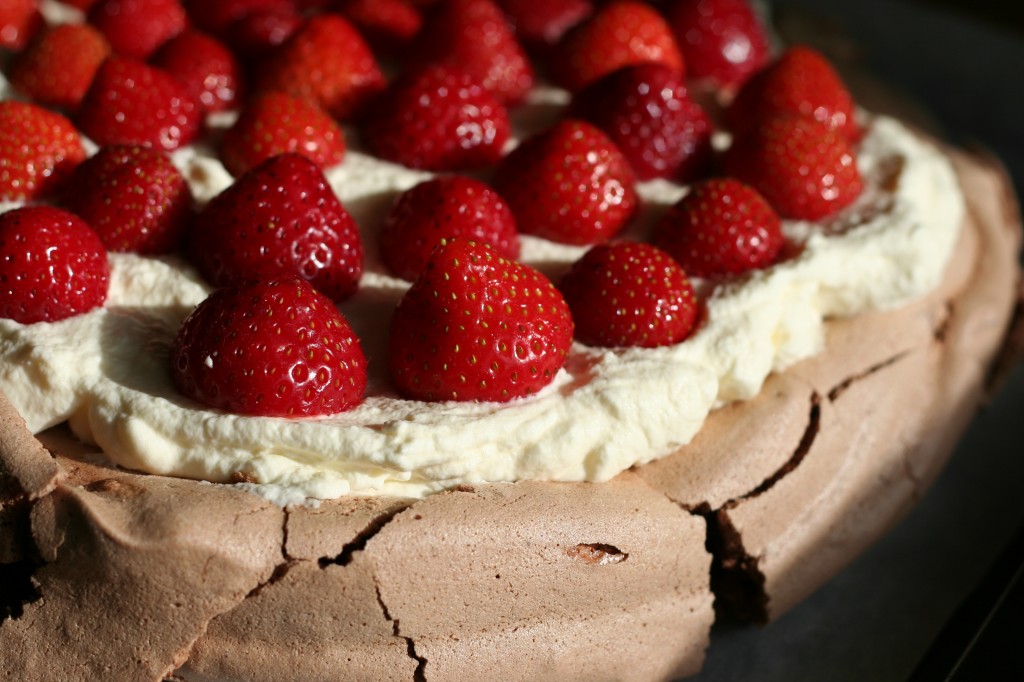
chocolate pavlova with strawberries

Chocolate Pavlova with Strawberries
adapted from Forever Summer by Nigella Lawson

Serves 8 to 10

for the chocolate meringue base:
6 egg whites
1 1/2 cups (300 g) caster sugar
3 tablespoons cocoa powder, sieved
1 teaspoon balsamic or red wine vinegar
1/4 cup (50 g) dark chocolate, finely chopped

for the topping:
2 cups (480 ml) cream
1 lb (450 g) strawberries or raspberries
2–3 tablespoons coarsely grated dark chocolate

Preheat the oven to 350°F (180°C). Line a baking tray with baking parchment and draw a circle approximately 9 inches (23 cm) in diameter onto the paper with a pencil (or just trace around a dinner plate). Just make sure the circle doesn’t go too close to the edge of the baking sheet, because the pavlova will spread a bit during cooking. Flip the paper over so that the penciled-in circle is facing down onto the sheet (so that the pavlova doesn’t come into direct contact with the pencil lead).

Beat the egg whites in a spotlessly clean and perfectly dry bowl until satiny peaks form, then beat in the sugar a spoonful at a time until the meringue is stiff and shiny. Sprinkle over the cocoa, vinegar and chopped chocolate. Gently fold everything until the cocoa is thoroughly mixed in.

Mound the mixture onto the circle you’ve drawn onto the baking parchment, smoothing the sides and top. Place in the oven, then immediately turn the temperature down to 300°F (150°C) and cook for about 1 to 1 1/4 hours. When it’s ready it should look crisp around the edges and on the sides and be dry on top, but when you prod the centre you should feel the promise of squidginess beneath your fingers. Turn off the oven and open the door slightly, and let the chocolate meringue disc cool completely (or you could even leave it in the oven overnight).

When you’re ready to serve, invert the cooled pavlova onto a big, flat-bottomed plate. Whisk the cream till thick but still soft and pile it on top of the meringue, then scatter over the fruit. Coarsely grate the chocolate so you get curls rather than rubble, as you don’t want the berries’ luscious colour and form to be obscured, and sprinkle haphazardly over the top, letting some fall, as it will, on the plate’s rim.

Zucchini Carbonara and Peach and Blueberry Sour Cream Cobbler

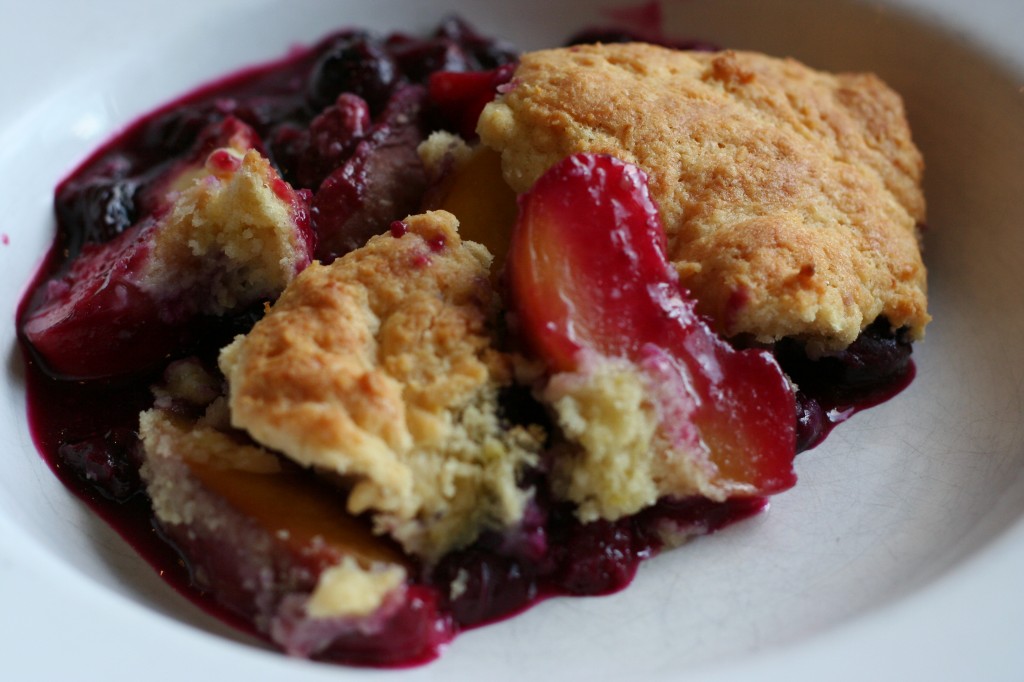
It turns out I’m not the only one around these parts with a weakness for American bacon. We’re having our house repainted at the moment, and today the painter was working inside to do the window frames. He spent 15 years living in America and only moved back about five years ago, and was chatting with us in the kitchen as I started to fry up the pancetta for this dish. “That’s not streaky bacon, is it?” he asked, streaky bacon being somewhat closer to American bacon than rashers, but still too thick cut to get as crispy as I like it to be. So he got the whole story of how much I’d missed bacon and then finding the pancetta at the grocery store. He told me how his oldest daughter prefers American bacon too, and how he’d have to get her some now that he knew about it. He was also eying up this cobbler as I made it and dropping hints about how good it looked, so he was pretty pleased when he was still around when it came out of the oven and I gave him some to have with his coffee.

It’s true that carbonara isn’t for the calorie-conscious, but even so, once you break it down per serving, there’s “only” one or two tablespoons of cream, one egg yolk, a couple tablespoons of cheese and a few slices of pancetta per serving, so for being a decadent dish, it’s not all that bad, though certainly not something you’d want to have every day. But as for the cobbler, there’s only two tablespoons of sugar in the entire dessert, making it the kind of treat I don’t at all mind giving my kids.

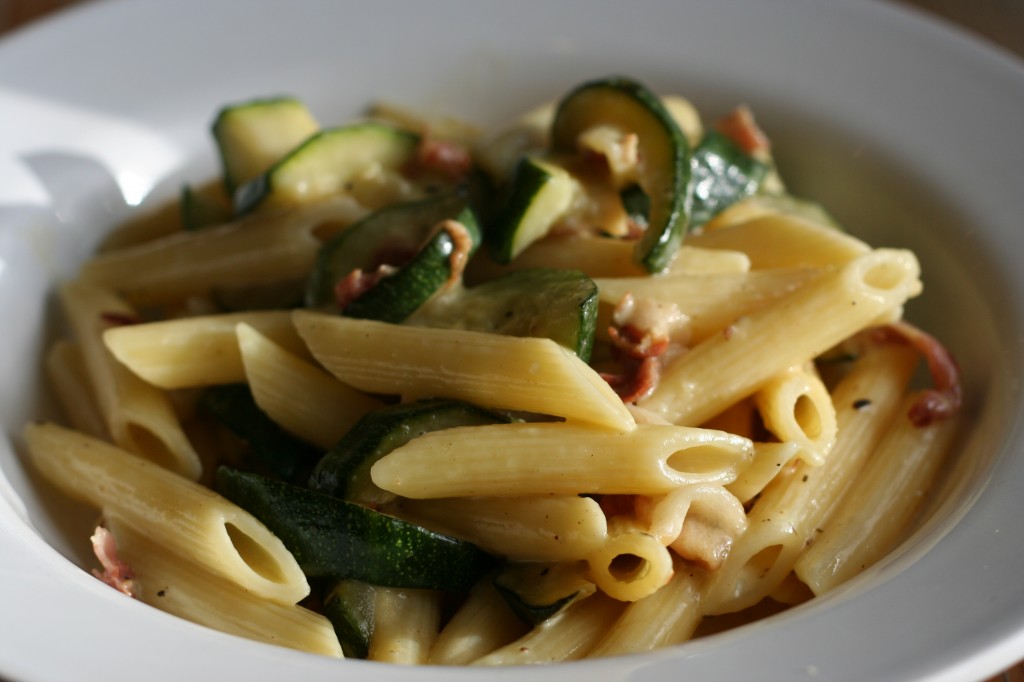
zucchini carbonara

Zucchini Carbonara
adapted from Jamie at Home by Jamie Oliver

Serves 4

6 medium green and yellow courgettes
1 lb (450 g) penne
4 large free-range or organic egg yolks
1/2 cup (120 ml) heavy cream
2 good handfuls of freshly grated Parmesan cheese
salt and freshly ground black pepper
olive oil
12 thick slices of pancetta or smoked streaky bacon, cut into chunky lardoons
a small bunch of fresh thyme, leaves picked and chopped (or 1/2 teaspoon dried)

Put a large pan of salted water on to boil. Halve and then quarter any larger courgettes lengthways. Cut out and discard any fluffy middle bits, and slice the courgettes at an angle into pieces roughly the same size and shape as the penne. Smaller courgettes can simply be sliced finely. When the water boils, add the penne to the pan and cook according to the packet instructions.

To make the carbonara sauce, put the egg yolks into a bowl, add the cream and half the Parmesan, and mix together with a fork. Season lightly and put to one side.

Heat a very large frying pan (one that will be able to hold all the sauce plus the pasta later on), add a good splash of olive oil and fry the pancetta or bacon until dark brown and crisp. Remove with a slotted spoon and to a plate lined with a paper towel to drain. Drain off all but 1 tablespoon or so of the bacon fat.

Add the courgette slices and 2 big pinches of black pepper, not just to season but to give it a bit of a kick. Sprinkle in the thyme leaves, give everything a stir, so the courgettes become coated with all the lovely bacon-flavoured oil, and fry until they start to turn lightly golden and have softened slightly. Crumble or chop the bacon and add it back to the pan.

It’s very important to get this next bit right or your carbonara could end up ruined. You need to work quickly. When the pasta is cooked, drain it, reserving a ladleful or two of the cooking water. Immediately toss the pasta in the pan with the courgettes and bacon, then remove from the heat and add a ladleful of the reserved cooking water and your creamy sauce. Stir together quickly. (No more cooking now, otherwise you’ll scramble the eggs.)

While you’re tossing the pasta and sauce, sprinkle in the rest of the Parmesan and a little more of the cooking water if needed, to give you a silky, shiny sauce. Taste quickly for seasoning. Serve and eat immediately, as the sauce can become thick and stodgy if left too long.

***

peach and blueberry sour cream cobbler

Peach and Blueberry Sour Cream Cobbler
adapted from The Kitchen Diaries by Nigel Slater

Serves 4

4 ripe peaches, sliced
about 3 cups (400 g) blueberries
juice of 1 lemon
1 tablespoon sugar
1 tablespoon flour

for the crust:
1 1/3 cups (150 g) flour
pinch of salt
2 teaspoons baking powder
1 heaped tablespoon sugar, plus extra for sprinkling
zest of 1 lemon
6 tablespoons (90 g) butter
1/2 cup (140 ml) sour cream
ice cream, cream or custard, to serve

Preheat the oven to 400°F (200°C).

For the cobbler crust, put the flour, salt, baking powder, sugar, lemon zest and butter in a food processor and blitz for a few seconds, until the mixture resembles breadcrumbs. Tip into a bowl and set aside.

Put the sliced peaches and blueberries into an ovenproof dish. Toss them with the lemon juice, sugar and flour.

Mix the sour cream into the crumb mixture to make a soft dough. Break off walnut-sized pieces and flatten them lightly. Lay them on top of the fruit. Sprinkle the rounds of dough with sugar, then bake for 25 minutes, till the cobbler is golden and the fruit is bubbling. Serve with ice cream, a drizzle of cream or some warm custard.

Ravioli and Tomato Salad and Honey Vanilla Poached Apricots

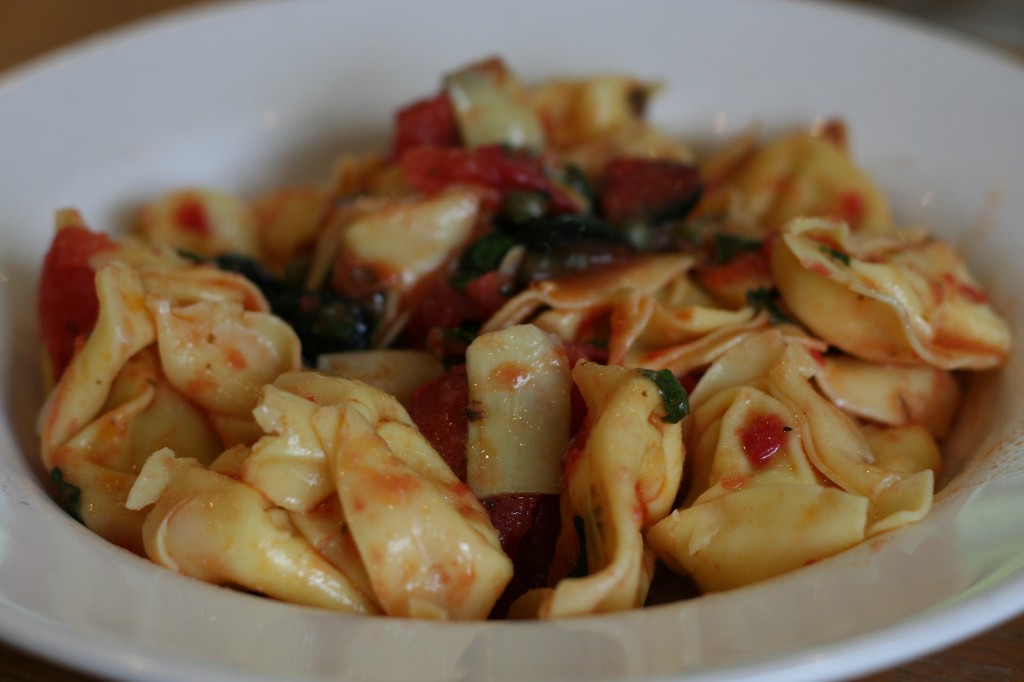
One of the quintessential smells of summer for me is a bunch of fresh basil — I’m sure I’m not alone in this. When I had gardens in the Midwest, it grew so quickly that I often couldn’t use it all fast enough. In Ireland, though, it’s so cool in the summer that it won’t grow outside at all, which means you either have to be content with whatever you can fit on your windowsill or grow it in a greenhouse or polytunnel. That’s been a huge disappointment for me, since having a nonstop supply of basil throughout the summer was one of the things I’d been looking forward to when we started our garden three years ago. I also couldn’t wait to grow tomatoes, but after losing all of our plants during the past two summers due to record-breaking rain, we didn’t even bother planting any this year (and good thing too, seeing as how this July was the wettest for 50 years). It’s just another thing that will have to wait until we get a tunnel, hopefully next year. In the meantime, I begrudgingly buy meager packets of fresh herbs, instead of the heaps I’d hoped to be growing myself. But for anyone with basil to spare, and tomatoes too (lucky you!), this recipe is for you.

IMG_8810

Still looking for more ways to use up tomatoes? Try Chicken Cacciatore, Tomato and Goat’s Cheese Tart, Oven-roasted Ratatouille, Spaghetti with Fresh Tomato Sauce or Spaghetti with Roast Cherry Tomatoes, Chili and Basil.

Ravioli and Tomato Salad with Masses of Basil
from Vegetarian Cooking for Everyone by Deborah Madison

Serves 4 to 6

This will be even better if you can make it ahead of time, giving the flavors plenty of time to blend together. It would be perfect for a picnic.

1 lb (450 g) cheese ravioli or tortellini
2 lb (900 g) ripe tomatoes
1 x 6‑oz (170‑g) jar artichoke hearts, drained and halved (optional)
1 bunch basil, leaves torn into pieces
1/2 cup (90 g) olives, pitted and halved
3 tablespoons capers, rinsed
1/4 cup (60 ml) extra virgin olive oil
salt and freshly ground black pepper
red wine vinegar

Bring a large pot of water to boil for the ravioli. Meanwhile, skin the tomatoes. (To do this, cut a shallow X in the bottom of each tomato with a sharp knife, then pour boiling water over them and leave until the skin around the X starts to curl away, about 1 to 2 minutes. Drain and allow to cool, then slip off their skins.) Deseed them and chop them into large pieces. Put the tomatoes and artichokes in a large bowl along with the basil, olives, capers, and oil.

Once the water is boiling, add the ravioli or tortellini and cook according to the package instructions, then drain well. Add the pasta to the tomato mixture in the bowl and toss gently with a rubber spatula. Taste for salt, season with pepper and sprinkle with vinegar to taste. Serve warm or at room temperature.

***

honey vanilla poached apricots

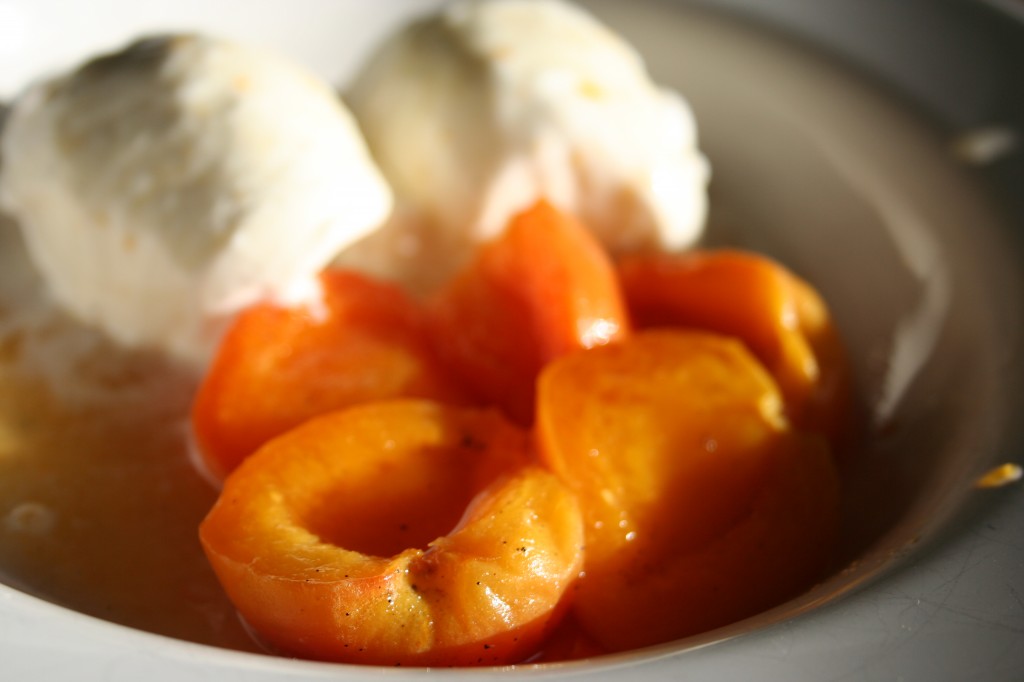
Honey Vanilla Poached Apricots
from Gourmet, June 1996

Serves 2

1 cup (240 ml) water
3 tablespoons honey
3 tablespoons sugar
1/2 vanilla bean, halved lengthwise
3/4 lb (340 g) fresh apricots (about 9 or 10 apricots), halved lengthwise and pitted
vanilla ice cream, to serve

In a 1 1/2‑quart saucepan, simmer the water, honey, sugar, and vanilla bean, covered, for 5 minutes. Add the apricots and simmer, covered, until just tender but not falling apart, 2 to 5 minutes (mine were done after 2 minutes), depending on how ripe the fruit is.

Transfer the apricots with a slotted spoon to a bowl and boil the syrup until it has reduced to about 1/2 cup (120 ml). Pour the syrup over the apricots and chill for 25 minutes. Serve with vanilla ice cream, with the syrup spooned over.

Stuffed Pork Tenderloin on Grape Tomatoes, Middle Eastern Couscous with Saffron, Green Beans, and Lemon Bars

Regretfully, I forgot to take a picture of this dish. Trust me, it looks as good as it tastes. The colors are amazing. Frankly, it smelled too good for me to wait even 5 minutes to snap a blog-suitable photo of it. So you get a picture of dessert instead, taken at leisure after dinner was finished.

Pork tenderloin is one of my favorite meats to cook. It cooks quickly, stays tender, and can be used in a variety of dishes. Though I try to keep a tenderloin in my freezer for quick weeknight dinners, this stuffed preparation would make an impressive dinner party offering. No one will guess how easy it is to make. For the green beans, simply boil or steam them for a few minutes until they are tender.

Stuffed Pork Tenderloin on Grape Tomatoes

adapted from More Fast Food My Way by Jacques Pepin

Serves 4

4 tablespoons good olive oil
1 small onion, chopped
1 bunch (about 12 oz/340 g) fresh spinach, washed, dried and stems removed
3/4 teaspoon salt
3/4 teaspoon freshly ground black pepper
1 large pork tenderloin (about 1 1/2 lb/680 g)
about 3/4 cup (90 g) grated cheddar cheese
1 box grape tomatoes (about 12 oz/340 g)

Heat 2 tablespoons of the olive oil in a large skillet over a high heat. Add the onion and cook for 2 minutes. Add the spinach, pushing it down into the skillet, and 1/4 teaspoon each of the salt and pepper. Cover and cook over a medium heat for about 1 1/2 minutes, until the spinach is wilted. Remove the lid and cook, uncovered, until the liquid from the spinach has evaporated. Transfer to a plate and allow to cool.

Trim the tenderloin of any fat and silver skin. To butterfly the tenderloin for stuffing, lay it flat on the cutting board so one end is close to you and the other end is near the top of the board. Holding your knife so the blade is parallel to the board, cut through the long side of the tenderloin, stopping when you are about 1/2 inch from the other side. Turn the tenderloin so the uncut side is closest to you and make another parallel cut below the first one, again stopping about 1/2 inch before you reach the other side. Open up the butterflied tenderloin and pound it a little to extend it to about 12 inches long by 7 inches wide.

Preheat the oven to 350°F (180°C). Arrange half the spinach mixture down the center of the butterflied tenderloin and top with the cheese. Add the rest of the spinach, fold in the sides, and roll the tenderloin back and forth to evenly distribute and encase the filling. Wrap 4 pieces of kitchen twine, each 6 to 7 inches long, around the tenderloin to secure the stuffing inside.

Heat the remaining 2 tablespoons oil in a large ovenproof nonstick skillet. Sprinkle the outside of the tenderloin with 1/4 teaspoon each of the salt and pepper. Place the tenderloin carefully in the skillet and brown it, turning occasionally, for about 5 minutes. Bake the tenderloin in the oven for 10 to 12 minutes, when it will be slightly pink in the center. Carefully remove the kitchen twine from the tenderloin. Transfer the tenderloin to a plate, cover, and keep warm in the oven while you prepare the tomatoes (the pork will continue to cook as it sits).

Add the tomatoes and the remaining 1/4 teaspoon each salt and pepper to the skillet in which you browned the tenderloin and sauté over high heat for 2 minutes, until just softened. Divide among 4 warm plates. Slice the tenderloin crosswise into 8 medallions and arrange 2 slices in the middle of the tomatoes on each plate. Serve.

***

Middle Eastern Couscous with Saffron
adapted from More Fast Food My Way by Jacques Pepin

Serves 4

2 tablespoons good olive oil
1 small onion, finely chopped
1/4 cup (about 20 g) pine nuts
1/2 teaspoon crushed saffron pistils
1 1/2 cups (225 g) Israeli couscous
1 3/4 cups (415 ml) chicken broth
1/4 teaspoon salt
1/4 teaspoon pepper

Heat the oil in a medium saucepan over high heat and add the onion, pine nuts, and saffron. Cook for 1 to 2 minutes, then add the couscous and mix well. Add the stock, salt, and pepper, mix well, and bring to a boil. Reduce the heat to very low, cover, and cook for 10 minutes. Uncover and cook over a medium heat, stirring occasionally, for 1 to 2 minutes longer to dry the grains and make them fluffy.

***

Lemon bar

Lemon Bars
from Gourmet, March 1999

makes 24 bars

These bar cookies will keep, covered and chilled, for 3 days.

1 1/2 sticks (3/4 cup/170 g) unsalted butter
2 cups (220 g) all-purpose flour
1/2 cup (100 g) packed light brown sugar
1/2 teaspoon salt
4 large eggs
1 1/2 cups (340 g) granulated sugar
3/4 cup (175 ml) fresh lemon juice (I used the juice from 2 lemons and 2 limes)
1/3 cup (40 g) all-purpose flour
3 tablespoons confectioners’ sugar

Preheat the oven to 350°F (180°C).

Cut the butter into 1/2‑inch pieces. In a food processor, process all ingredients until the mixture begins to form small lumps. Sprinkle the mixture into a 13 x 9 x 2‑inch baking pan and with a metal spatula press evenly onto the bottom. Bake the shortbread in the middle of the oven until golden, about 20 minutes. Set aside.

While the shortbread is baking, prepare the topping. In a bowl, whisk together the eggs and granulated sugar until combined well, then stir in the lemon juice and flour. Pour the lemon mixture over the hot shortbread. Reduce the oven temperature to 300°F (150°C) and bake in the middle of the oven until set, about 30 minutes. Cool completely in the pan and cut into 24 bars. Sift confectioners’ sugar over the bars before serving.

Warm Lentil Salad with Roasted Beets and Goat’s Cheese and Plum Raspberry Crumble

My two-year-old loves beets and goat’s cheese. Really. He will ask for beets if you serve him goat’s cheese and will demand goat’s cheese if you serve him beets without it. He loved this meal, as did his parents. For a vegetarian meal to remember, simply omit the bacon. The crumble is another must-try recipe. The raspberries and plums are wonderful together.

Warm Lentil Salad with Roasted Beets and Goat’s Cheese
adapted from Bobby Flay, Boy Meets Grill

3 lb (1.4 kg) fresh beets, washed and trimmed
olive oil
1 medium yellow onion, quartered
1 carrot, quartered
1 stalk celery, quartered
1 fresh or dried bay leaf
4 sprigs fresh thyme
3 cups (720 ml) chicken stock
2 cups (480 ml) water
1 1/2 cups (300 g) dried lentils
salt and freshly ground black pepper
2 tablespoons olive oil
1/4 lb (110 g) slab bacon, diced
2 cloves garlic, finely chopped
1 small carrot, finely diced
2 teaspoons finely chopped fresh thyme leaves
1 tablespoon sherry vinegar
4 cups frisée or mixed greens
2 oz (60 g) goat’s cheese

Begin by roasting the beets. Preheat the oven to 415°F (210°C). Coat the washed and trimmed beets lightly with oil. Wrap the beets in aluminum foil, place on a baking sheet, and roast in the oven for about 1 hour, until cooked through. (I usually put 2 beets on each piece of foil.) Remove from the oven, let cool for 10 minutes, then peel and slice into 1/4‑inch-thick slices.

While the beets roast, cook the lentils. Tie the onion, carrot, celery, bay leaf, and thyme sprigs together in cheesecloth. Place the chicken stock, water and cheesecloth bag in a medium saucepan and bring to a boil. Stir in the lentils, season with salt and pepper, and reduce the heat to medium-low and cook until the lentils are tender, about 20 minutes. Drain well and discard the cheesecloth bag of aromatics.

Heat the oil in a large saute pan over medium heat. Add the bacon and cook until lightly golden brown. Remove the bacon with a slotted spoon to a dish lined with paper towels. Add the garlic and carrot to the pan and cook until soft, about 5 minutes. Add the cooked lentils and bacon to the pan and stir to combine. Stir in the chopped thyme and sherry vinegar. Season to taste with salt and pepper. Keep warm.

To assemble, place the greens in a large bowl, toss with half of the vinaigrette (recipe below), and season with salt and pepper. Arrange the roasted beets around the outside of 4 dinner plates. Divide the greens among each plate in the center. Top the greens with some of the warm lentils and crumble some goat’s cheese on top. Drizzle each salad with the remaining vinaigrette. Serve with a good baguette.

Sherry Vinaigrette

1/4 cup (60 ml) sherry vinegar
2 teaspoons Dijon mustard
1 teaspoon chopped fresh thyme
1/4 teaspoon salt
1/4 teaspoon freshly ground pepper
1/2 cup (120 ml) olive oil

Whisk together the vinegar, mustard, thyme and salt and pepper in a small bowl. Slowly drizzle in the oil and whisk until emulsified.

***

plum raspberry crumble

Plum Raspberry Crumble
adapted from Barefoot in Paris by Ina Garten

Serves 8

2 lb (900 g) black plums, halved, pitted, and cut in 1‑inch wedges
2/3 cup (150 g) granulated sugar, divided
1 1/4 cups (140 g) all-purpose flour, divided
2 tablespoons orange juice
1/2 pint raspberries
1/3 cup (65 g) light brown sugar, packed
1/4 teaspoon kosher salt
8 tablespoons (110 g) cold unsalted butter, diced
1/2 cup (50 g) quick-cooking oats
1/2 cup (35 g) sliced almonds, plus extra for sprinkling
ice cream or fresh whipped cream, to serve

Preheat the oven to 350°F (180°C).

In a large bowl, combine the sliced plums, 1/3 cup (75 g) of the granulated sugar, 1/4 cup (30 g) of the flour, and the orange juice and toss well. Add the raspberries and toss lightly. Pour into a 9 x 12 x 2‑inch baking dish.

For the topping, place the remaining 1 cup (110 g) of flour, the remaining 1/3 cup (75 g) of granulated sugar, the brown sugar, and the salt in the bowl of a food processor fitted with a steel blade and pulse a few times to combine. Add the butter and pulse until the butter is the size of peas. Pour the mixture into a bowl, add the oats, and work it with your hands until it forms large crumbles. Add 1/2 cup (35 g) of the almonds and mix well.

Spread the topping evenly over the plums and raspberries, making sure the fruit is covered. Sprinkle with some extra almonds. Bake for 40 minutes, or until the fruit is tender and bubbly and the topping is golden brown. Serve warm with ice cream or fresh whipped cream.

Chicken Wrapped in Parma Ham with Cantaloupe Salsa, Romaine Salad with Lime-Garlic Dressing and Roasted Peaches Stuffed with Amaretti

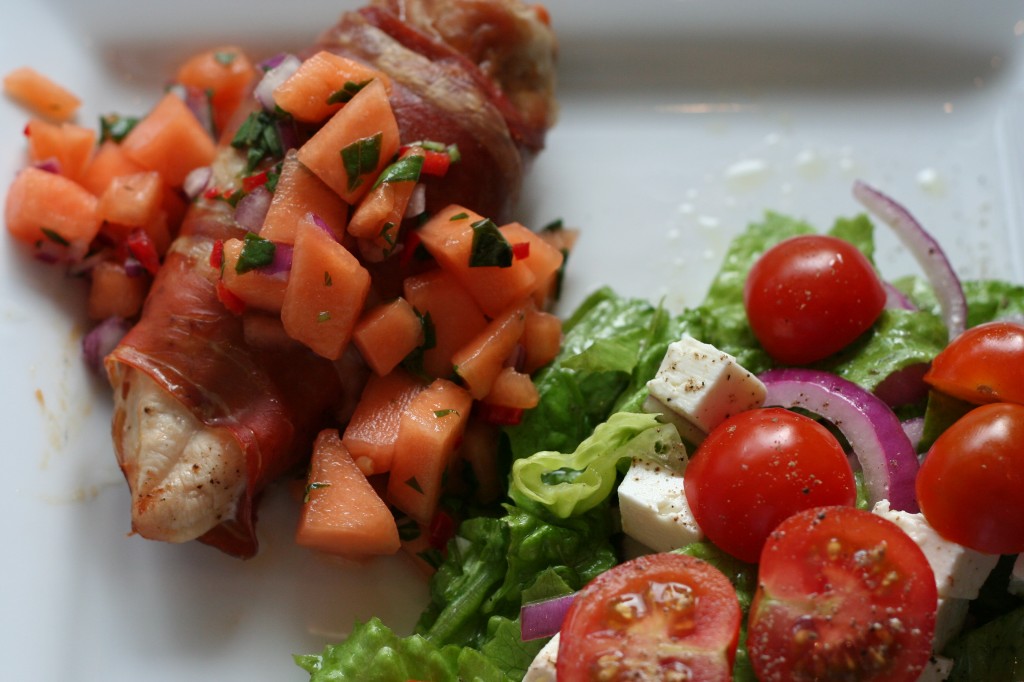
I’ve been thinking about this cantaloupe salsa ever since seeing it on my favorite cooking blog, Smitten Kitchen, a couple weeks ago. The question was, as ever, what to pair it with as part of a meal (tempting as it may be to just eat it straight up with tortilla chips). Grilled chicken seemed like a good choice, but boring. But chicken wrapped in Parma ham? That’s more like it. Parma ham and melon is a classic combination, and this dinner plays on that. The lime-garlic dressing in this fast, easy spin on a Greek salad also helps to balance out the salty Parma ham and keep the dinner light for summertime. But if you make nothing else from my posts this week, make these melt-in-your-mouth roasted peaches.

chicken wrapped in parma ham with romaine salad

Chicken Wrapped in Parma Ham

Serves 4

Stuffing the chicken breasts with slices of buffalo mozzarella would also work well here — cut the chicken breast in half (but not right through), stuff with two or three mozzarella slices, then fold the breast back together and wrap the Parma ham around it. If you’re serving this without the salsa, you could spread a thin layer of pesto on the Parma ham slices before wrapping the chicken up in them. If you’d like some visual step-by-step instructions on how to prepare the chicken for this recipe, Bon Appétit has a tutorial here.

4 chicken breasts
8 slices Parma ham (or bacon)

Preheat the oven to 350°F (180°C) and oil a baking tray. Season the chicken breasts with salt and freshly ground black pepper.

Lay 2 slices of Parma ham on a piece of greaseproof or parchment paper or aluminium foil, making sure they overlap slightly. Place a chicken breast at one end and, using the paper or foil to get started, gently roll it up in the ham. Carefully transfer the wrapped-up chicken breast to the well-oiled baking tray. Repeat for the other chicken breasts. Cook for 25 to 30 minutes. Serve with the cantaloupe salsa spooned on top.

***

Cantaloupe Salsa
from Smitten Kitchen

Makes about 2 cups of salsa

2 cups (300 g) diced cantaloupe
1/4 cup (30 g) diced red onion
2 tablespoons chopped fresh basil or cilantro
1 red or green chili, deseeded and minced
2 tablespoons fresh lime juice
1/4 teaspoon salt

Mix everything and eat immediately.

***

Summer Romaine Salad with Lime-Garlic Dressing
from Orangette

Serves 3 to 4

This dressing will keep, covered and chilled, for up to 1 week. Some fresh finely chopped cilantro added to the dressing would also be good.

for the dressing:
3 tablespoons plus 1 teaspoon fresh lime juice (or more to taste)
5 tablespoons good-quality olive oil
1/4 teaspoon minced garlic
1/8 teaspoon fine sea salt

for the salad:
1 head Romaine lettuce, washed, dried and cut into rough 1/2‑inch strips
1 pint (1 punnet) cherry or grape tomatoes, halved
1/2 red onion, finely sliced
1/2 cup (100 g) feta cheese, crumbled

To make the dressing, combine the lime juice, olive oil, garlic, and salt in a small bowl (or shake to combine in a screw-top jar). Whisk until emulsified and set aside.

In a salad bowl, combine the lettuce, tomatoes, and red onion. Toss with dressing to taste and top with plenty of feta. Serve.

***

Roasted Peaches Stuffed with Amaretti Cookies
from Everyday Italian by Giada De Laurentiis

Serves 6

3 large, ripe, firm peaches (about 5 oz/140 g each), halved and pitted (nectarines would also work well here, or even a mix of peaches and nectarines)
1 1/2 oz (40 g) amaretti cookies (about 12 small cookies)
3 teaspoons sugar (1/2 teaspoon per peach half)
1 tablespoon (15 g) unsalted butter (1/2 teaspoon per peach half)
fresh whipped cream or vanilla ice cream, to serve

Preheat the oven to 375°F (190°C). Butter the bottom of an 8‑inch baking dish and set aside.

Using a melon baller or a spoon, clean out the red flesh from the center of each peach. Arrange the peaches cut side up in the prepared dish. In the bowl of a food processor, add the amaretti cookies and pulse until finely crumbled (or place in a Ziploc bag and bash with a rolling pin). Divide the amaretti crumbs between the peaches, filling the center of each peach with the amaretti cookie crumbs. Sprinkle 1/2 teaspoon of sugar over each. Dot each peach with 1/2 teaspoon of butter.

Bake until the peaches are tender and the filling is crisp on top, about 30 minutes. Serve warm with whipped cream or vanilla ice cream.

Thai Crumbled Beef in Lettuce Wraps with Cucumber Carrot Salad and Mango Fool

I don’t know what tempted me to try making something with nam pla for the first time — a sauce made from fermented fish doesn’t exactly get your mouth watering. But now if I see a recipe that calls for it, especially when combined with lime juice, chances are good that I’m going to make it. If you’ve never had it before, do try it. (If you’re still not convinced, check out what this couple has to say about fish sauce.) The flavors in this menu are cool, crisp and perfect for summer.

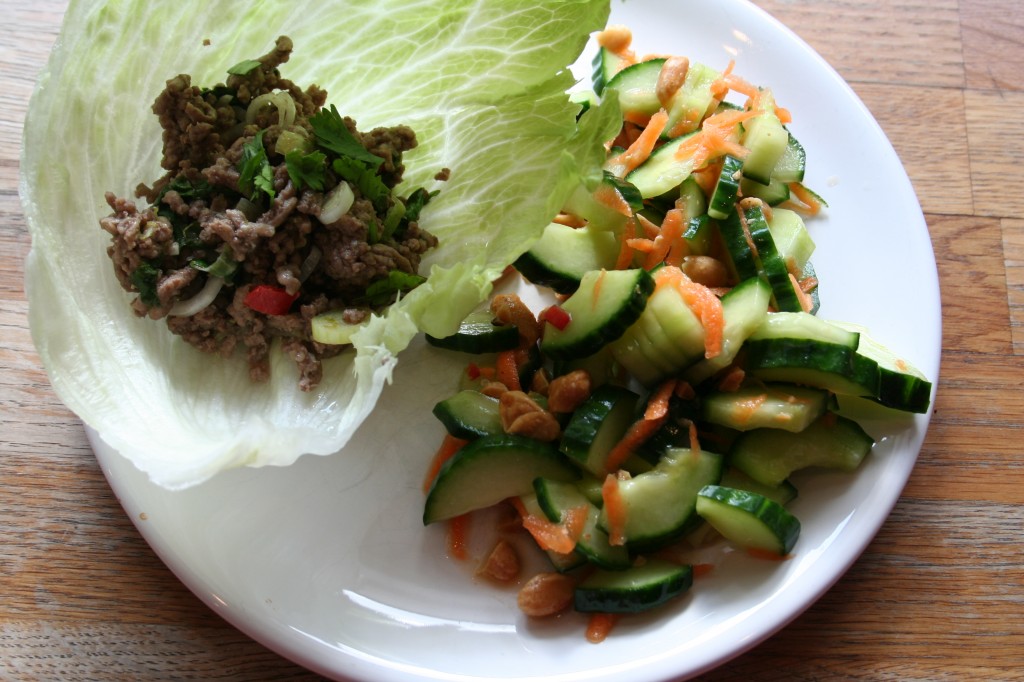
Thai Crumbled Beef in Lettuce Wraps
from Forever Summer by Nigella Lawson

Serves 6 as an appetizer or 2 to 3 as a main course

If you want to perk the lettuce leaves up a little, making sure they curve into appropriate cups for later, leave them in a sinkful of very cold water while you cook the minced beef, then make sure you drain them well before piling them up on a plate.

1 teaspoon vegetable oil
2 chilies, finely chopped
13 oz (375 g) beef mince
1 scant tablespoon Thai fish sauce (nam pla)
4 green onions, dark green bits removed, finely chopped
zest and juice of 1 lime
3–4 tablespoons chopped fresh cilantro
1 iceberg lettuce, leaves broken off

Heat the oil in a non-stick frying pan on medium heat. Add the finely chopped chillies and cook for a couple of minutes, stirring occasionally, taking care not to let the chillies burn.

Add the beef, turn up the heat and, breaking up the mince with a wooden spoon or fork, cook for 3 or 4 minutes, until no trace of pink remains. Add the fish sauce and, still stirring, cook till the liquid has evaporated. Off the heat, stir in the spring onions, lime zest and juice and most of the cilantro. Turn into a bowl and sprinkle over the remaining cilantro just before serving. (Note: If your meat is very fatty, strain it into a serving bowl with a slotted spoon.)

Arrange the iceberg lettuce leaves on another plate — they should sit one on top of another easily enough — and let people serve themselves at the table, filling the leaves with spoonfuls of the meat and wrapping it in the lettuce like you would with a burrito.

***

beef wraps with cucumber carrot salad

Cucumber Carrot Salad
adapted from Gourmet, June 1994

Serves 6

The salad can be made up to 4 hours ahead and kept chilled and covered, but the cucumber will wilt and give off liquid.

2 tablespoons fresh lime juice
1 1/2 tablespoons Thai fish sauce (nam pla)
1 tablespoon sugar
1 chili, or to taste, seeded and minced
2 cucumbers, deseeded
1 carrot, coarsely grated
1/4 cup peanuts, chopped

In a bowl, stir together the lime juice, fish sauce, sugar, and chili until the sugar is dissolved.

Thinly slice the cucumbers (a food processor makes short work of this) and add to the chili mixture along with the grated carrot and peanuts. Toss the salad well.

***

Mango Fool
adapted from Gourmet, April 2000

Serves 6

The Gourmet recipe says that canned mangoes are excellent in this dessert if ripe fresh ones are unavailable. Use a drained (1 lb 14 oz/850 g) can of mango slices in syrup. If the canned fruits you buy are Alphonso mangoes (their favorite variety of mango), add an additional 1/2 cup (120 ml) cream. If you don’t want to bother putting the purée through a sieve, it won’t suffer for not having a perfectly smooth texture. I think you could also get away with not adding the gelatin, which would make this more of a traditional fool recipe of just sweetened fruit and whipped cream, though the gelatin elevates this into more of a mousse.

1 1/4 teaspoons unflavored gelatin
1 1/2 tablespoons fresh lime juice
3 large very ripe mangoes, flesh coarsely chopped (4 cups)
1/4 cup sugar (55 g), or to taste depending on sweetness of mangoes
3/4 cup (180 ml) heavy cream

Sprinkle the gelatin over the juice in a small heatproof cup and let it stand 1 minute to soften. Purée the mangoes with the sugar in a blender until very smooth and force through a sieve into a large bowl.

Melt the softened gelatin in the cup in a pan of simmering water or in a microwave and stir into the purée. Beat the cream with an electric mixer until it just holds stiff peaks and gently fold into the purée.

Transfer the purée into 6 ramekins, small glasses, etc., or 1 large serving dish. Chill the fool, covered, for at least 8 hours.