Category Archives: Mexican food

Steak Fajitas with Pico de Gallo

In Milwaukee, you can find dozens of restaurants that serve fajitas, but it’s hard to find great fajitas. Maybe my expectations are too high after a childhood of eating Tex-Mex on a regular basis — in Texas, I should add. In my experience, fajitas are only as good as their ingredients. The meat is especially important, and a charcoal grill is essential. I think this is why so many restaurant fajitas fail — cheap meat and lack of charcoal flavor. There are a few things that made last night’s fajitas good. I made the pico de gallo with tomatoes and onions fresh from Rare Earth Farm. Reuben grilled the Sulzer’s rib-eye steaks to a perfect medium rare on our Weber grill. And last but not least, Whole Foods had fresh baked-in-store whole wheat tortillas in stock. How could we go wrong?

Steak Fajitas

Serves 4 to 6

2 rib-eye steaks
salt and freshly ground black pepper
juice of 1 lime
2 onions (red and/or white)
2 bell peppers (any color)
1 tablespoon olive oil
toppings: pico de gallo, avocado, Monterey jack or cheddar cheese, salsa, sour cream

Season the steaks generously with salt and pepper and marinate in the lime juice in a shallow dish. Prepare the grill with charcoal banked to one side (you’ll need direct and indirect heat for this meal).

While the grill heats up and the steaks marinate, peel and slice the onion into thin half moons (about 1/4 cm thick). Cut the bell pepper into 1/2‑cm-wide strips. Place the vegetables onto aluminum foil (preferably heavy-duty foil). You’ll need enough foil to completely wrap up the vegetables, about 18 inches or so. Drizzle the vegetables with olive oil and season with salt and pepper. Crimp together the foil over the vegetables, starting with the short sides, then folding over the long sides. You’ll end up with a rectangular-shaped packet. The foil should be secure enough to remain closed throughout the grilling process.

When the grill is hot, place the foil packet of vegetables on the grill and cook over indirect heat for about 10 minutes (cooking time will vary depending on the size of the vegetable slices and the heat of the grill). If the vegetables aren’t tender, reseal the foil packet and cook for a few more minutes. Once tender, transfer the vegetables to a serving dish.

The steak can be cooked at the same time as the vegetables. Grill over a medium-high heat until desired doneness. Remove the steaks from the grill and allow to rest for 5 minutes. While the meat rests, heat the tortillas on the grill for a few seconds on each side. After the meat has rested, slice it into thin strips against the grain of the meat.

To assemble the fajitas, place some sliced meat on a tortilla and top with onions, peppers, and other toppings (pico de gallo, avocado, cheese, salsa, and/or sour cream), al gusto, to taste.

***

Pico de Gallo

Makes about 3 cups (720 ml)

1 medium white onion, minced
3 large vine-ripened tomatoes, diced small
1 or 2 jalapenos, minced
1 clove garlic, minced
juice of 1 lime (or 1 tablespoon white vinegar)
1 teaspoon salt
1/4 teaspoon freshly ground black pepper
3 tablespoons chopped cilantro

Rinse the onion in a colander under cold water for about 30 seconds. This will sweeten the onion and keep it crispy. Mix the onion and remaining ingredients in a medium bowl. Serve with tortilla chips or as an accompaniment to any Mexican meal.

Chipotle Lime Chicken Salad Wraps with Potatoes and Avocado and Mexican Red Rice

When Kelly and I decided to start this blog earlier this summer, we weren’t sure what the copyright implications of sharing recipes online might be. I’ve been reading cooking blogs for years and had always wondered about it, never for a minute believing that all the bloggers out there were writing off to Gourmet or Ina Garten’s publisher to formally ask permission to use their recipes. But when it came time to start my own blog, would I lie awake at night like the Amateur Gourmet, fretting that the Barefoot Contessa would bring the full weight of the law down on me for posting her lemon fusilli recipe?

We set our minds at rest after reading the US Copyright Office guidelines and this Washington Post article, but what about adapting a recipe to the point where you can call it your own? Where do you cross the line from having to acknowledge the source to you being the source? Take these chicken salad wraps, for example. I was looking through my Mexican Everyday cookbook and saw Rick Bayless’s recipe for Chipotle Chicken Salad Tacos with Avocado, Red-Skin Potatoes and Romaine. I liked the sound of most of it, but decided to ditch his vinaigrette with oregano for a dressing of mayo, chipotle, lime and cilantro instead. I also used flour tortillas instead of corn, turning these into wraps instead of tacos. I played around with the quantities specified in the ingredients list and pretty much wrote the instructions from scratch too. Is all that enough to call this recipe my own? Or should I stick with the guidelines issued by the International Association of Culinary Professionals and use the words “adapted from,” “based on” or “inspired by?” In the interests of sleeping soundly, “inspired by” sounds good to me.

Chipotle Lime Chicken Salad Wraps with Potatoes and Avocado
inspired by Mexican Everyday by Rick Bayless

Makes 8 wraps

for the wraps:
2 large potatoes or 6 small new potatoes
8 large flour tortilla wraps
3 handfuls sliced romaine leaves, sliced 1/4 inch across
1/2 red onion, finely chopped and deflamed (optional)
2 ripe avocados, cut into 1/4‑inch cubes

for the chipotle lime chicken salad:
1 tablespoon minced canned chipotle chillies (or 1 teaspoon dried chipotle chillies, available from Seasoned Pioneers, or a few dashes of chipotle Tabasco, to taste)
juice of 2 limes (you could add the zest too if you want an even stronger lime flavor)
1 cup (30 g) cilantro, chopped
1 cup (240 ml) mayo
4 chicken breasts, poached and coarsely shredded (or about 3 cups of any shredded chicken, such as leftover roast chicken)
salt and freshly ground black pepper

Cook the potatoes in boiling salted water until fork tender, about 7 to 10 minutes, depending on their size. Drain and allow to cool, then cut into 1/4‑inch cubes.

To make the chipotle lime chicken salad, add the chipotle chillies, lime juice (and zest, if using) and cilantro to the mayonnaise, stirring well to combine. Add the shredded chicken to the chipotle lime mayo, mixing well to make sure all the chicken is coated with mayo. Season to taste with salt and pepper.

To assemble, spread some of the chicken salad on a tortilla, then top with potatoes, lettuce, onions and avocado. Roll up tightly and cut in half on the diagonal. Repeat with the remaining wraps.

***

Mexican Red Rice
from Mexican Everyday by Rick Bayless

Serves 6 to 8

Rick Bayless also gives a few riffs on this dish: halved garlic cloves, chopped red, white or green onion and sliced mushrooms can be sautéed along with the raw rice. Cubed peeled carrots, parsnips, butternut squash, even Jerusalem artichokes or kohlrabi can go in with the salsa. Chopped snow peas or green beans can replace the peas. Or boost the flavor with a roasted poblano pepper, fresh corn kernels and a handful of chopped cilantro, arugula or watercress leaves, all added along with the peas.

1 1/2 tablespoons vegetable or olive oil
1 1/2 cups (270 g) white rice
1 cup (240 ml) good-quality tomato salsa
1 cup (240 ml) chicken or vegetable broth
1/2 teaspoon salt
1 1/2 cups (210 g) frozen peas

Preheat the oven to 350°F (180°C).

Set a medium ovenproof saucepan or casserole dish over a medium heat. Add the oil and rice. Stir frequently until the grains of rice turn from translucent to milky-white, about 5 minutes – don’t worry if some of them brown. Add the salsa, broth and salt. Stir a couple of times, then let the mixture come to a full boil.

Cover the pan and set in the middle of the oven. Bake for 20 minutes. Uncover, add the peas and re-cover. Bake for 5 minutes longer, then remove from the oven and let stand for 5 minutes. Fluff the rice, releasing the steam and mixing in the peas.

Ceviche Salad with Avocado, Cilantro and Green Chile, Black Beans, and Rice

My husband and I were browsing Time’s fascinating photo essay, What the World Eats, Part 1 and Part 2 yesterday. The differences in food costs, food variety, and presence of packaged foods is remarkable. In many parts of the world, dried legumes and grains are the backbone of daily eating, yet unfortunately, here in America, these items are rarely prepared by your average middle-class family.

If you become a regular visitor to our website, you will see that I frequently serve beans and rice. Not only are these items a complete protein when eaten together, containing all necessary amino acids, but they also serve as a very economical base to a meal; rice and beans for a family of four costs about $2.00. I also love that I can put the rice and beans on to cook before I leave for work (rice in our programmable rice cooker and beans in a slow cooker). With the addition of a few fresh, chopped vegetables or other accompaniments, dinner can be on the table in a matter of minutes. This menu takes a bit longer, as the ceviche must marinate for at least 1 hour, but it is a good example of what you can do with rice and beans as a starting point.

Ceviche, rice, and beans

Ceviche Salad with Avocado, Cilantro and Green Chile
adapted from Mexican Everyday by Rick Bayless

Serves 4

3/4 lb (340 g) raw shrimp
1/2 lb (225 g) raw squid, cleaned, with tentacles separated and “body” cut into 1/4‑inch rings
1 cup (240 ml) freshly squeezed lime juice
2 garlic cloves
1 cup (about 30 g) loosely packed cilantro, roughly chopped, plus extra for garnish
1 jalapeno, minced
1 teaspoon salt
1 avocado, flesh scooped from the skin, and cut into 1/4‑inch cubes
1 cucumber, peeled, seeded and cut into medium dice
1 head Boston/butterhead lettuce or 8 large leaves red or green leaf lettuce
2 green onions, sliced diagonally

Simmer the shrimp in boiling well-salted water until just cooked, about 2 minutes. Drain, then chill. Repeat with squid, simmering 20 to 30 minutes, until tender, then draining. Peel and chop the shrimp into 1/2‑inch pieces.

Put lime juice, garlic, cilantro, jalapeno and salt into a food processor and blend till smooth. Pour over the seafood in a bowl. Leave to marinate in the fridge for 1 to 4 hours, depending on your taste. When done, pour off half the marinade. Add the avocado, cucumber and salt, if needed. Divide the lettuce among 4 plates. Scoop a portion of the ceviche into the center of each arrangement. Garnish with cilantro and green onions.

***

Slow Cooker Black Beans

1 lb (450 g) dried black beans
1 onion, diced
2 cloves garlic, minced
1 teaspoon good-quality chili powder
1/2 teaspoon dried red pepper flakes
1 teaspoon ground cumin
1 teaspoon dried epazote or oregano
6 cups (1.5 l) water
salt

Combine the first 8 ingredients in a slow cooker. Cook on low for 7 to 8 hours, until the beans are tender. Season to taste with salt (usually about 1 teaspoon).

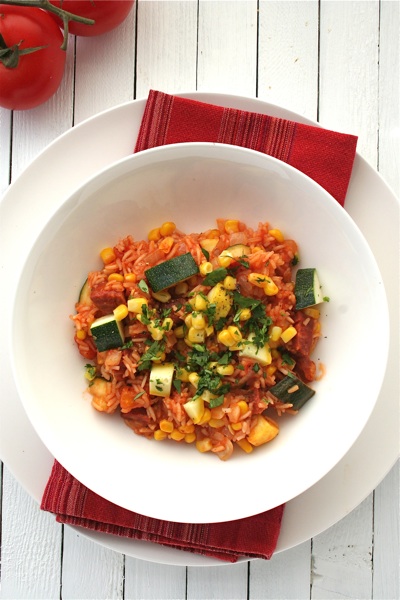
Mexican Rice Supper with Chorizo, Zucchini and Corn

You can learn a lot from reading cookbooks. By that I don’t mean just reading the recipes, but the surrounding text as well, where some good tips can be hidden. It was from Nigella Lawson’s How to Eat that I learned the great trick of substituting vermouth when a recipe calls for white wine, for the simple reason that if I open a bottle of wine to add some to whatever I’m cooking, the rest of it is going to be drunk that night. That’s not necessarily a problem, except that I like to cook with wine and that can get expensive, whereas you just need a splash of vermouth for the same effect and one bottle will last for a couple months.

Another invaluable trick is one I learned from Rick Balyess’s Mexican Kitchen: deflaming onions. I’ve never been a fan of raw onions, finding them to be too overpowering in most dishes, but deflaming them takes a lot of the bite out of them. All you do is prepare the onion as your recipe says to, then toss the cut-up onion into a strainer and rinse well under cold water. I do this all the time now.

This is a great one-dish dinner on its own, though Rick Bayless suggests pairing it with some dressed greens (try the Tangy Avocado Dressing) or a spinach salad, warm tortillas, and perhaps a small bowl of beans for, as he says, “a supper to savor.” If you’re really in the spirit of the summer season, use the kernels from 1 ear of fresh corn here.

Mexican Rice Supper with Chorizo, Zucchini and Corn
adapted from Rick Bayless’s Mexican Kitchen by Rick Bayless

Serves 4

If you have your own favorite salsa recipe, then by all means use that instead here. If you don’t want to bother making your own salsa, just substitute 2 cups (480 ml) of a good store-bought one. This dish can be made a day ahead, though the zucchini will suffer a bit in the reheating.

for the salsa:
2 medium round tomatoes or 4 to 6 plum tomatoes, chopped into 1/4‑inch dice
1 or 2 red chilies (or 3 to 5 fresh Serrano chilies), deseeded and finely chopped
1 large garlic clove, finely chopped
3 tablespoons chopped cilantro, plus extra to garnish
1 small onion, finely chopped

for the rice:
1 cup (225 g) chorizo sausage, casing removed
1 cup (180 g) rice, preferably medium grain
3/4 cup (175 ml) chicken, beef or vegetable stock (or water)
salt and freshly ground black pepper
2 small zucchini, cut into 1/2‑inch dice
1 cup (200 g) corn

To make the salsa, mix together the tomatoes, chillies, garlic and cilantro. Place the chopped onion into a strainer, rinse under cold water, shake off the excess and add to the mixture.

To make the rice, break up the chorizo into a medium heavy-bottomed saucepan (it will need to be big enough to accommodate all the ingredients) and set over a medium heat. Stir regularly, breaking up any lumps, until the chorizo is thoroughly cooked, about 10 minutes. Remove it with a slotted spoon, then pour off all but 1 tablespoon or so of the fat. Add the rice to the pan, return to the heat and stir regularly until the rice is lightly browned, about 7 minutes. Add the salsa, raise the heat to medium-high and cook, stirring every once in a while, until very thick and reduced, about 7 minutes.

While the mixture cooks, bring the stock (or water) to a boil in a small saucepan. Add to the rice mixture, stir once, scrape down any rice kernels clinging to the side of the pan, cover and cook over a medium-low heat for 10 minutes.

Add the cooked chorizo, zucchini and corn, re-cover and cook 5 minutes longer. Uncover and bite into a grain of rice: it should be nearly cooked through. If the rice is ready, turn off the heat, cover, and let stand for 5 to 10 minutes longer to complete the cooking. If the rice seems far from done, continue cooking for 5 minutes or so, retest, then turn off the heat and let stand for a few more minutes.

Divide into 4 warmed bowls, sprinkle with the extra cilantro, and serve.

Salmon in Luxurious Green Sesame Pipian, Brown Rice, and Kale

When I want salmon with a bit of a kick, this is the dish I cook. The salmon is poached in an easy-to-make tomatillo and sesame sauce. The sauce is especially wonderful over brown rice, which accents the nuttiness of the sesame paste. If you aren’t a fan of brown rice, try it again with this sauce. I also recommend investing in a good rice cooker. I scoffed at my husband’s Christmas request for the Zojirushi Neuro Fuzzy rice cooker, but it has turned out to be one our most-used small appliances — second only to our espresso machine. The cooker has a timer so your rice can be perfectly cooked and waiting for you when you arrive home in the evening. This is especially useful when cooking brown rice, which can take an hour or more to cook on the stove top.

Salmon, rice, kale

Salmon in Luxurious Green Sesame Pipian
adapted from Mexican Everyday by Rick Bayless

2 cups (480 ml) store-bought or homemade tomatillo salsa (Xochitol brand recommended)
1 1/2 tablespoons vegetable or olive oil
1 cup (240 ml) chicken broth
3 tablespoons tahini (sesame paste)
salt
1/4 to 1/2 teaspoon sugar
1  heaping cup (150 g) peas (fresh or frozen)
4 boneless, skinless salmon, halibut, walleye, snapper or striped bass fillets, 4 to 5 oz each, about 1/2 inch thick
1 tablespoon sesame seeds, for garnish
chopped cilantro, for garnish

In a blender or food processor, process the salsa to a smooth purée. Heat the oil in a very large (12-inch) skillet over a medium-high heat. When quite hot, add the salsa all at once. Stir until the salsa reduces to the consistency of tomato paste, about 5 minutes. Stir in the broth and tahini. Return to a boil, then reduce the heat to medium-low and simmer for 10 minutes. Taste and season with salt (if needed) and sugar to balance the tartness of the salsa.

While the sauce is simmering, steam the peas until just hot and tender. When the sauce has cooked for 10 minutes, nestle the fish fillets in it, completely submerging them. Continue simmering gently until the fish flakes when pressed firmly, usually 5 to 6 minutes. Check by lifting a fillet from the sauce on a metal spatula and pressing with your finger or the back of a spoon.

Transfer a fish fillet to each dinner plate and spoon a portion of the sauce over top. Strew with peas, sesame seeds and cilantro.

***

Boiled Kale

There are two basic ways to cook kale: sauteed or boiled. I used boiled kale for this menu, mixing it with a bit of the sesame pipian as I ate. To prepare the kale, rinse the leaves well under warm water and drain in a colander, discarding any discolored leaves. Trim away and discard any tough stem ends, making a V‑shaped cut at the stem end. Slice leaves cross-wise into 1‑inch strips. Place into a large pot filled with well-salted boiling water. Boil for 5 to 10 minutes, until the kale is tender. Drain the kale, then serve with the topping of your choice (butter, sesame seeds, soy sauce, etc.). For this menu, I kept the kale in the cooking water (off the heat) until I was ready to plate it, ensuring that it was piping hot and tender when served.

Beef and Bean Tostadas and Tossed Salad with Tangy Avocado Dressing

The problem: It’s hot. I’m tired. I have a two year old that “needs dinna momma.” The solution: Tostadas. Fast, fresh, fun, and infinitely variable, tostadas are on regular rotation in my dinner arsenal. I usually make vegetarian tostadas (sin carne) but had a taste for something a bit richer tonight.

Beef and Bean Tostadas

Serves 4

1 lb (450 g) ground beef
1 large clove garlic, minced
1 shallot, minced
1/2 teaspoon ground cumin
1 teaspoon chilli powder
1/2 teaspoon salt
1 teaspoon tomato paste
3 tablespoons water
8 tostada shells
1 x 15 oz (425 g) can refried beans, heated
about 1 1/2 cups (110 g) shredded cheddar or Monterey Jack cheese

suggested toppings: avocado, salsa, shredded lettuce, diced tomato, sour cream or whole milk yogurt, sliced jalapenos, sliced black olives

In a large skillet, brown the beef over a medium heat. Stir in the garlic, shallot, and spices. Cook for 2 to 3 minutes, until the garlic just begins to turn golden and the spices become fragrant. Stir in the tomato paste and water. Cook for about 5 minutes, stirring occasionally.

To assemble each tostada, spread a thin layer of refried beans on a tostada shell. Top with cheese, then beef. Add whatever additional toppings you like. I personally like all of the toppings listed but rarely have them all in the house at the same time.

***

This creamy avocado dressing tastes best with heartier greens and vegetables such as chopped romaine and radishes. If serving with more delicate greens (like in the photo), thin the dressing with a few additional tablespoons of water.

Tangy Avocado Dressing

Tangy Avocado Dressing
adapted from Mexican Everyday by Rick Bayless

Serves 8

1/4 cup (60 ml) vegetable oil
1/4 (60 ml) olive oil
3 tablespoons fresh lime juice
1 clove garlic, minced
1/2 cup (120 ml) mayonnaise
1 teaspoon Worcestershire sauce
1 avocado
1/2 cup (10 g) cilantro leaves, chopped
2 green onions, chopped (white and green parts)
3/4 teaspoon salt
3 teaspoons cold water

Add all the ingredients to a food processor or blender. Process until smooth. Season with salt and pepper to taste and serve.