Category Archives: Salad dressings

Cheddar Chicken Salad and Farro with Cucumber

There are a million ways to make chicken salad, but my mom’s recipe makes a knock-your-socks-off, can’t-go-wrong sandwich, especially when served on a buttery croissant. It’s perfect to take to baby showers, wedding showers, work lunches, picnic lunches, or any other place where you aren’t sure how picky the eaters are going to be. Everyone enjoys it. Pair it with this fresh and fabulously textured farro salad or, if you don’t feel like babysitting a pot of simmering farro or wheat berries but want an equally healthy and tasty side dish, try some roasted chickpea snacks. The Good Bean sent me a few complimentary packets of their pre-packaged version and we all loved them, especially my husband. I plan to pack them in lunches and throw them in my purse for snack emergencies.

Cheddar Chicken Salad

Makes a dozen cocktail sandwiches (or 6 full-size sandwiches)

3 cooked chicken breast halves (boneless, skinless), diced
1/2 cup (125 ml) mayonnaise or Miracle Whip
4 oz (100 g) chopped pitted black olives
1/2 cup (50 g) shredded cheddar cheese
1/2 green bell pepper, chopped fine
1/2 small onion, chopped fine
small croissants or cocktail rolls (about 1 dozen)

Gently mix all the ingredients together except the rolls (obviously). Fill the rolls and serve. If not serving immediately, chill the salad for up to 24 hours or filled rolls for up to 2 hours in the fridge, covered.

***

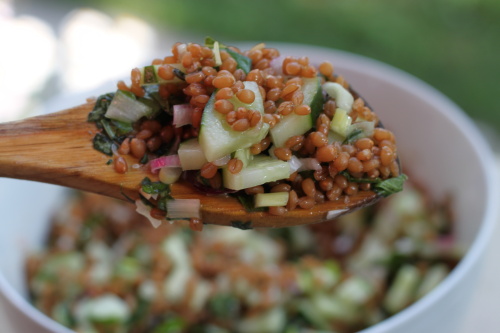
Farro with Cucumber
adapted from Molto Gusto: Easy Italian Cooking by Mario Batali

Serves 6

As much as I love this recipe and Molto Gusto: Easy Italian Cooking, the cookbook it came from (currently on its third renewal from my local library), it doesn’t taste great as leftovers. Try to eat it within 24 hours of preparing it unless you like seriously chewy grains.

8 oz (225 g) farro or wheat berries, picked over and rinsed
1 lb (450 g) cucumbers, cut into 1/4‑inch dice
1 medium red onion, cut into 1/4‑inch dice
1 red finger chile or serrano chile, cut into tiny dice
1/3 cup (10 g) packed fresh basil leaves, thinly sliced (chiffonade)
1/2 cup (125 ml) red wine vinaigrette (below)
Maldon or other flaky sea salt

Combine the farro and water to cover by 2 inches in a large saucepan and bring to a simmer, skimming off the foam. Reduce the heat to a bare simmer and cook until the farro is just tender, about 25 minutes if using pearled farro, about 1 1/2 hours if using wholegrain farro (or wheat berries).

Drain the farro and transfer to a large bowl. Add the cucumbers, onion, chile and basil, mixing well. Add the vinaigrette, tossing well. Season well with salt and serve, or let stand at room temperature for 1 hour to bring out the flavors.

Red Wine Vinaigrette

Makes 1 cup (250 ml)

1/2 cup (125 ml) extra virgin olive oil
1/4 cup (60 ml) good-quality red wine vinegar
1/4 cup (60 ml) sparkling water

Whisk the oil, vinegar and water together in a small bowl, or shake the ingredients together in a small, lidded jar, until well incorporated. The vinaigrette can be refrigerated for up to 5 days.

End-of-Summer Squash Sauté with Three Bean Salad

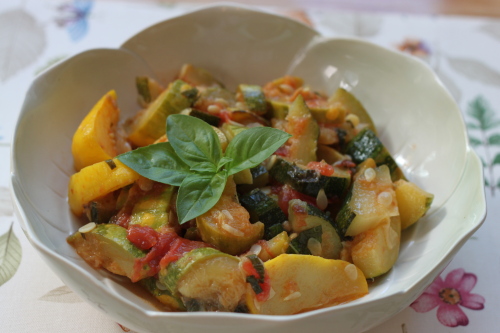
I love cooking at this time of the year. Vegetables and fruits are bountiful and at peak tastiness. It’s not too hot to use the stove top. And a week’s vacation at the end of August left me feeling (relatively) stress free at home and work. Not wanting to add any unnecessary work to my day, the dishes below provided a quick, tasty, and healthy meal and they take full advantage of the overabundant squash and beans from your or your neighbor’s backyard garden. This menu is light. If you want something more substantial for dinner or if you are cooking for guests, pick up a rotisserie chicken at the supermarket, cook up a little pasta to serve with the squash saute, or splurge on a trip to Kopp’s or your favorite ice cream store after dinner. What better way to celebrate the last few, long, warm nights of summer.

End-of-summer squash saute

End-of-Summer Squash Sauté

serves 4

2 or 3 medium summer squash (about 1 1/2 lbs / 680 g)
3 tablespoons olive oil
1 teaspoon kosher salt
1/2 teaspoon freshly ground black pepper
1/2 teaspoon garlic powder
1 large or 2 small tomatoes, peeled and coarsely chopped
3 tablespoons chopped fresh basil
freshly grated Parmesan cheese, for serving (optional)

Cut the squash in half lengthwise (or if the squash is very thick, cut it into quarters lengthwise), then dice into 1/2‑inch-thick pieces.

In a large saute pan with a lid, heat the olive oil over a medium-high heat until hot but not smoking. Add the squash and saute, stirring occasionally, for about 5 minutes, until it just begins to brown. Sprinkle the salt, pepper and garlic powder over the squash, then stir in the tomatoes. Cover and cook, stirring every few minutes, for 10 to 15 minutes longer, until the squash and tomato just begin to break down.

Remove the lid and continue to cook until your desired sauciness level. Stir in the basil and serve with grated Parmesan cheese, if desired. This dish tastes great over cooked pasta or rice or as a side dish.

***

Three Bean Salad
adapted from Molto Gusto: Easy Italian Cooking by Mario Batali

serves 6

1 tablespoon salt
1 lb (450 g) green beans [Note: smaller is better]
1 x 15 oz (425 g) can chickpeas, rinsed and drained
1 x 15 oz (425 g) white kidney beans (cannellini) or red kidney beans
1/4 cup (10 g) coarsely chopped fresh mint
1/2 cup (120 ml) Red Wine Vinaigrette (recipe below)
Maldon or other flaky sea salt and freshly ground black pepper

Bring four quarts of water to a boil in a large pot and add 1 tablespoon salt. Add the beans and blanch them until crisp-tender, about 3 minutes. Drain the beans in a colander and cool under cold running water; drain well.

Combine the green beans, chickpeas and kidney beans in a large bowl. Add the mint and toss. Add half the vinaigrette and toss gently again. Season with salt and pepper. Serve or, if possible, let stand at room temperature for 1 to 2 hours to bring out the flavors. Serve the salad with the remaining vinaigrette on the side.


Red Wine Vinaigrette

Makes 1 cup (250 ml)

1/4 cup (60 ml) good-quality red wine vinegar
1/4 cup (60 ml) sparkling water
1/2 cup (125 ml) extra virgin olive oil

Whisk the vinegar, water and olive oil together in a small bowl, or shake the ingredients together in a small, lidded jar, until well incorporated. The vinaigrette can be refrigerated for up to 5 days.

Easy Pasta Supper with Marcella Hazan’s Tomato Sauce

I’ve eaten so much pasta in my life that my blood must be part durum wheat by now. My childhood memories of dinner are crowded with images of a big bowl of salad and a basket of garlic bread on the table and a pot of spaghetti on the stove, with a huge bucket of Kemp’s ice cream in the freezer for dessert. It’s no wonder, then, that pasta is still my go-to comfort food or the first thing I think of when I want a quick dinner. After two weeks of time-consuming holiday cooking, I’m in the mood these days for something effortless but still satisfying. This famous tomato sauce from Marcella Hazan fits the bill on both counts. The recipe couldn’t be easier — melt some butter, put a halved onion in the pan, pour in some canned tomatoes and let it all simmer for 45 minutes — but the result is an alchemical kind of magic. It’s the little black dress of pasta sauces — simple, sophisticated and versatile. You wouldn’t think it was possible for a humble can of tomatoes to be transformed into such a silky-smooth sauce so full of flavor, but don’t wait much longer to try this and see for yourself. Add in a baby leaf salad tossed with my favorite balsamic vinaigrette, a loaf of Parmesan garlic bread and a nice bottle of wine, and my favorite childhood dinner feels all grown up.

Marcella Hazan’s Tomato Sauce
adapted from Essentials of Classic Italian Cooking by Marcella Hazan

Makes enough sauce for about 1 lb (450 g) of pasta, or 4 servings

5 tablespoons (75 g) unsalted butter
1 medium yellow onion, peeled and cut in half
1 x 28 oz can (or 2 x 14 oz/400 g cans) whole plum tomatoes, with their juices
salt and freshly ground black pepper

To make the tomato sauce, melt the butter in a large pot (one that can also accommodate all the pasta later) over a medium heat, then add in onion halves and pour in the tomatoes with their juices. Season generously with salt and pepper. Bring the sauce to a simmer, mashing up the tomatoes gently with the back of a wooden spoon. Cook, uncovered, at a very slow but steady simmer, adjusting the heat as necessary, for about 45 minutes, or until droplets of fat float free from the tomato and the sauce has reduced and thickened. Stir occasionally, continuing to mash any large pieces of tomato with the wooden spoon. Taste for seasoning, then discard the onion when the sauce is ready. Add your cooked, drained pasta directly to the sauce in the pot and stir until all the pasta is coated.

***

Balsamic Vinaigrette
adapted from Epicurious, March 2003

Makes about 3/4 cup (180 ml)

3 tablespoons balsamic vinegar
1 tablespoon Dijon mustard
1 garlic clove, minced
1/2 cup (120 ml) olive oil
salt and freshly ground black pepper

In a screw-top jar, combine the vinegar, mustard, garlic and oil, shaking well to combine. Season with salt and pepper to taste.

Halibut, Veracruz Style over Rice and Salad with Orange-Lime Cumin Vinaigrette

This was originally going to be tilapia, Veracruz style but Reuben was too enamored with the halibut to pass it up. I especially liked this preparation not only for the taste but also because the sauce can be made the night before. As you can see from my photo (thank you Reuben for my early birthday present), it’s even pretty enough for guests.

I try to serve seafood at least once a week, not only because it’s healthy, but also because it is quick. U.S. tilapia and wild Alaskan salmon are my fish of choice — the tilapia for its price and the wild salmon for its omega‑3. Both fish are also sustainable. I recommend Monterey Bay’s Seafood Watch Program to check whether your seafood choices have low toxin levels and minimal environmental impact.

Halibut, Veracruz style
Halibut, Veracruz Style 

adapted from Bon Appétit, May 2003

Serves 6

1 x 28-oz (780‑g) can diced tomatoes in juice, well drained, juices reserved
1/4 cup (60 ml) extra-virgin olive oil
1/2 onion, finely chopped
3 large garlic cloves, minced
2 small bay leaves
3 tablespoons chopped fresh parsley
1 teaspoon dried Mexican oregano
1/3 cup (50 g) chopped pitted green olives
2 tablespoons raisins
2 tablespoons drained capers
6 halibut, tilapia or red snapper fillets (about 1 1/2 lbs/680 g total)
pickled jalapeño chilies, sliced

Place the drained tomatoes in a medium bowl. Using a potato masher, crush the tomatoes to a coarse puree. Drain again, reserving juices.

Heat the oil in heavy large skillet over medium-high heat. Add the onion and stir 30 seconds. Add the garlic and stir 30 seconds. Add the tomato puree and cook 1 minute. Add the bay leaves, parsley, oregano, and 1/4 cup (60 ml) reserved tomato juices. Simmer until the sauce thickens, about 3 minutes. Add the olives, raisins, capers, and all the remaining reserved tomato juices. Simmer until the sauce thickens again, stirring occasionally, about 8 minutes. Season the sauce to taste with salt and pepper. (Can be made 1 day ahead. Cover and refrigerate.)

Preheat the oven to 425°F (220°C). Spread 3 tablespoons of sauce in the bottom of a 13 x 9‑inch glass baking dish. Arrange the fish on top of the sauce. Sprinkle the fish lightly with salt and pepper. Spoon the remaining sauce over the fish. Bake uncovered until the fish is just opaque in center, about 15 to 20 minutes. Using a long spatula, transfer the fish with sauce to plates. Garnish with the pickled jalapeño slices. Serve with rice.

***

Orange-Lime Cumin Vinaigrette 
adapted from Manger La Ville!

Makes about 1/2 cup (120 ml)

1 small clove garlic
kosher salt
3 tablespoons fresh lime juice
3 tablespoons fresh orange juice
2 teaspoons minced shallot
1/2  teaspoon ground cumin
1 tablespoon honey
1/4 cup (60 ml) olive oil
freshly ground pepper

Mince and mash clove of garlic with about 1/2 teaspoon salt. In a medium bowl whisk the garlic paste, lime, orange juice, shallot, cumin and honey. Slowly add the oil while whisking to emulsify the mixture. Season with salt and pepper to taste.

Tomato and Goat’s Cheese Tart with Potato, Spinach and Red Pepper Salad with Warm Bacon Vinaigrette

In all honesty, I could never be a vegetarian again simply because I like bacon too much (and sausages and chorizo rank pretty highly too). After 10 years of living abroad, I’ve stopped craving most of the foods I used to miss when I first moved to Ireland, but I’ve never stopped missing American-style bacon, the kind that gets crispy and will easily crumble once cooked. Irish bacon (or rashers) is more like what I grew up calling Canadian bacon, thick cut and something you have to eat with a knife and fork, and just isn’t the same at all. But a few weeks ago, I noticed that my local grocery store had started carrying pancetta, so I gave that a try. Who would have guessed that expensive imported Italian pancetta is such a good match to the Oscar Mayer stuff I’ve been hankering after all these years? I’m going to have to try hard not to buy some every week now to make up for lost time. This salad was a good place to start, and I happily tripled the amount of bacon called for (granted, the original recipe only calls for 1 slice).
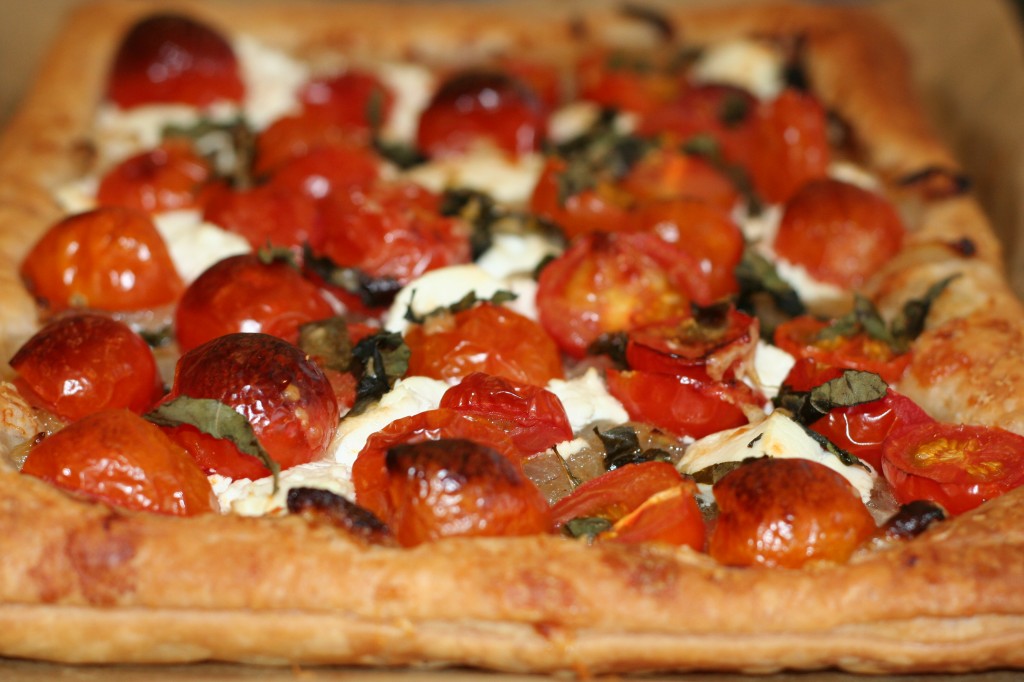
tomato and goat's cheese tart

Still looking for ways to use up tomatoes? Try Chicken Cacciatore, Ravioli and Tomato Salad, Oven-roasted Ratatouille, Spaghetti with Fresh Tomato Sauce or Spaghetti with Roast Cherry Tomatoes, Chili and Basil.

Tomato and Goat’s Cheese Tart
adapted from Barefoot Contessa Back to Basics by Ina Garten

Makes 2 large tarts or 4 individual tarts

This recipe is open to endless variations. I’ve modified the original to use cherry tomatoes, but you could just as easily use 2 or 3 large tomatoes, cut into 1/4‑inch-thick slices. A mix of yellow and red cherry tomatoes would look especially nice. The original also calls for garlic and herb goat’s cheese, though I used a plain soft goat’s cheese (as opposed to a log) dotted around the tart. If you aren’t a fan of goat’s cheese, you could try this with garlic-and-herb cream cheese or even mascarpone.

You could also use this recipe as a base to make a new potato and goat’s cheese tart: Omit the tomatoes and instead thinly slice 10 oz (280 g) of baby new potatoes. Boil the potato slices for about 5 minutes, until just tender, then neatly layer them over the Parmesan and onions on the puff pastry so that they slightly overlap, then dot the goat’s cheese over the potatoes. Use fresh chopped chives, parsley and tarragon instead of the thyme and basil and cook at 400°F (200°C) for 18 to 20 minutes.

1 package (17.3 oz/2 sheets) ready-rolled puff pastry, defrosted
3 tablespoons good-quality olive oil
2 large onions, thinly sliced yellow onions
3 large garlic cloves, cut into thin slivers
1/2 teaspoon salt
1/4 teaspoon freshly ground black pepper
3 tablespoons dry white wine
2 teaspoons minced fresh thyme leaves (or 1/4 tsp dried)
4 tablespoons freshly grated Parmesan, plus 2 oz (50 g) shaved with a vegetable peeler
4 oz (100 g) goat’s cheese
1 lb (450 g) cherry tomatoes, halved
3 tablespoons julienned basil leaves

Preheat the oven to 425°F (220°C).

Gently unroll the sheets of puff pastry and place the pastry rectangles on 2 baking sheets lined with parchment paper and refrigerate until ready to use. (Alternatively, you could make 4 individual tarts by cutting 4 circles out of the 2 sheets of puff pastry, using a 6‑inch saucer or other round object as a guide, though you might have to roll out the puff pastry a little in order to get 2 good-sized circles from each pastry sheet. Or just cut each ready-rolled rectangle in half. If you wanted to serve this as a light first course, you could cut each rectangle into quarters, and get 8 servings.)

Heat the olive oil in a large skillet over a medium to low heat and add the onions and garlic. Sauté for 15 to 20 minutes, stirring frequently, until the onions are limp and there is almost no moisture remaining in the skillet (this is important, because you don’t want the mixture to be too wet and make the pastry base soggy). Add the salt, pepper, wine and thyme and continue to cook for another 10 minutes, until the onions are lightly browned and the wine has mostly evaporated. Remove from the heat and set aside.

Using a sharp paring knife, score a 1/4‑inch-wide border around each pastry rectangle. Prick the pastry inside the score lines with the tines of a fork and sprinkle the grated Parmesan on each rectangle, staying inside the scored border.

Place half of the onion mixture on each rectangle, again staying within the scored edge. (Don’t be tempted to overload the pastry base with too much topping, or again, it will go soggy, especially if you’re making 2 large tarts.) Crumble 2 oz (50 g) of goat’s cheese on top of the onions. Scatter the halved cherry tomatoes evenly over the tart. Sprinkle with basil, salt and pepper. Finally, scatter the Parmesan shards on each tart.

Bake for 20 to 25 minutes, until the pastry is golden brown. The bottom baking sheet may need an extra few minutes in the oven. Serve hot or warm.

***

Potato, Spinach and Red Pepper Salad with Warm Bacon Vinaigrette
adapted from Bon Appétit, August 1999

Serves 4

1 lb (450 g) new potatoes, halved or quartered
1 red pepper
3 bacon or pancetta slices, chopped
4 tablespoons red wine vinegar
2 tablespoons extra-virgin olive oil
1 garlic clove, minced
1 cup (2 stalks) thinly sliced celery
2 cups (packed) baby spinach leaves (about 90 g)

Steam or boil the potatoes just until tender, about 5 to 7 minutes. Drain and transfer to a large bowl.

Roast the pepper over a flame or in the broiler until blackened on all sides. (Alternatively, line a baking tray with foil, cut the pepper in half and deseed it, then place the two halves, cut side down, on the foil and roast at 400°F (200°C) for about 30 minutes, or until the skin starts to blacken.) Enclose in a paper bag or wrap up in the tin foil you roasted it on and allow to stand for 10 minutes. Peel, seed and chop the pepper, then transfer to the bowl with the potatoes.

Sauté the chopped bacon in a small skillet over a medium heat until crisp, about 3 minutes, until cooked through. Using a slotted spoon, transfer the bacon to a paper towel and drain.

Whisk the vinegar, oil and garlic in small saucepan. Stir over a low heat just until warm, about 1 minute. Stir in the bacon.

Add the warm vinaigrette to the potato mixture. Mix in the celery and spinach and toss together well so that the dressing coats everything. Season to taste with salt and pepper and serve.
Beef and Bean Tostadas and Tossed Salad with Tangy Avocado Dressing

The problem: It’s hot. I’m tired. I have a two year old that “needs dinna momma.” The solution: Tostadas. Fast, fresh, fun, and infinitely variable, tostadas are on regular rotation in my dinner arsenal. I usually make vegetarian tostadas (sin carne) but had a taste for something a bit richer tonight.

Beef and Bean Tostadas

Serves 4

1 lb (450 g) ground beef
1 large clove garlic, minced
1 shallot, minced
1/2 teaspoon ground cumin
1 teaspoon chilli powder
1/2 teaspoon salt
1 teaspoon tomato paste
3 tablespoons water
8 tostada shells
1 x 15 oz (425 g) can refried beans, heated
about 1 1/2 cups (110 g) shredded cheddar or Monterey Jack cheese

suggested toppings: avocado, salsa, shredded lettuce, diced tomato, sour cream or whole milk yogurt, sliced jalapenos, sliced black olives

In a large skillet, brown the beef over a medium heat. Stir in the garlic, shallot, and spices. Cook for 2 to 3 minutes, until the garlic just begins to turn golden and the spices become fragrant. Stir in the tomato paste and water. Cook for about 5 minutes, stirring occasionally.

To assemble each tostada, spread a thin layer of refried beans on a tostada shell. Top with cheese, then beef. Add whatever additional toppings you like. I personally like all of the toppings listed but rarely have them all in the house at the same time.

***

This creamy avocado dressing tastes best with heartier greens and vegetables such as chopped romaine and radishes. If serving with more delicate greens (like in the photo), thin the dressing with a few additional tablespoons of water.

Tangy Avocado Dressing

Tangy Avocado Dressing
adapted from Mexican Everyday by Rick Bayless

Serves 8

1/4 cup (60 ml) vegetable oil
1/4 (60 ml) olive oil
3 tablespoons fresh lime juice
1 clove garlic, minced
1/2 cup (120 ml) mayonnaise
1 teaspoon Worcestershire sauce
1 avocado
1/2 cup (10 g) cilantro leaves, chopped
2 green onions, chopped (white and green parts)
3/4 teaspoon salt
3 teaspoons cold water

Add all the ingredients to a food processor or blender. Process until smooth. Season with salt and pepper to taste and serve.

Crab Cakes with Rémoulade Sauce and Baby Spinach Salad with Lemon Vinaigrette

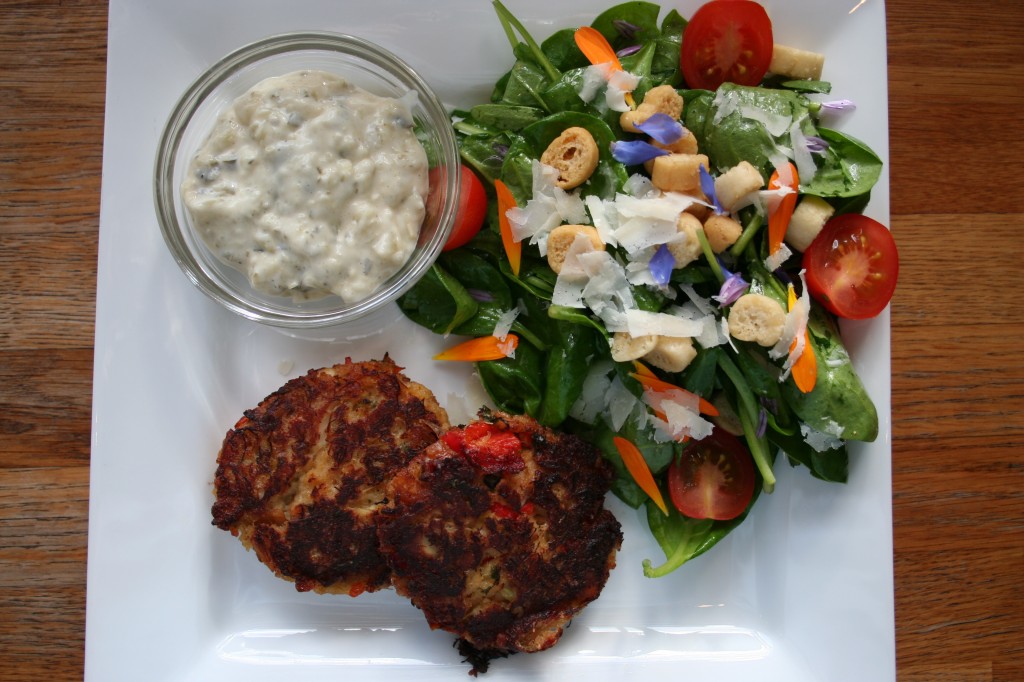
I’m coming full circle to finish up my first week of posts, which started with potato cakes and salad and is ending with crab cakes and a simpler, lighter spinach salad. I admit that there are plenty of crab cake recipes out there that are faster to make than this one, but I like that this one sneaks in some vegetables (always a consideration when feeding two little ones). You’ve probably already guessed that we like to eat as much salad as we can in the summertime, while greens are fresh from the garden or market and, in this case, with pretty edible flowers too. The potato cakes and crab cakes were big hits with both of my children — what kid doesn’t like to eat with their hands instead of a fork?

crab cakes with rémoulade sauce

Crab Cakes with Rémoulade Sauce
adapted from The Barefoot Contessa Cookbook by Ina Garten

Makes about 24 small cakes to serve as appetizers or 8 to 10 large ones for a main course

Don’t be put off by the long list of ingredients for the crab cakes, it comes together quicker than you might think, especially if you use a food processor to dice the vegetables (just be careful not to overdo it, you don’t want them to turn to mush). If you have any leftover vegetable mixture, use it with some chopped ham to make a Denver omelette. And as for the rémoulade sauce, store-bought tartar sauce would be a perfectly fine substitute. If you can’t get the Old Bay Seasoning called for here, you could make your own, or just leave it out altogether. And of course you could make this with fresh crab, which is what the original recipe calls for.

We had a couple crab cakes left over that we had for lunch the next day, and surprisingly, they were much better the second day. Consider making them ahead of time and leaving overnight.

2 tablespoons (30 g) unsalted butter
2 tablespoons olive oil
3/4 cup (1 small onion) small-diced red onion
1 1/2 cups (4 stalks) small-diced celery
1/2 cup (1 small pepper) small-diced red pepper
1/2 cup (1 small pepper) small-diced yellow pepper
1/4 cup (5 g) minced fresh flat-leaf parsley
1 tablespoon capers, drained
1/4 teaspoon Tabasco
1/2 teaspoon Worcestershire sauce
1 1/2 teaspoons Old Bay Seasoning
1/2 teaspoon kosher salt
1/2 teaspoon freshly ground black pepper
1/2 pound (225 g) canned crab meat, drained
1/2 cup (25 g) plain dry breadcrumbs
1/2 cup (120 ml)  good mayonnaise
2 teaspoons Dijon mustard
2 extra-large eggs, lightly beaten
4 tablespoons (60 g) unsalted butter, for frying
1/4 cup (60 ml) olive oil, for frying

Place the 2 tablespoons butter, 2 tablespoons oil, onion, celery, red and yellow peppers, parsley, capers, Tabasco, Worcestershire sauce, Old Bay Seasoning, salt, and pepper in a large frying pan over medium-low heat and cook until the vegetables are soft, approximately 15 to 20 minutes. Cool to room temperature.

In a large bowl, break the crab meat into small pieces and toss with the breadcrumbs, mayonnaise, mustard, and eggs. Add about three-quarters of the cooked vegetable mixture and mix well, then judge whether you need to add more of the vegetable mixture – you don’t want the cakes to be too loose. Alternatively, you could add more breadcrumbs. Cover and chill in the refrigerator for 30 minutes (or overnight to let the flavors develop). Shape into about 2 dozen bite-sized or 8 to 10 larger crab cakes.

Heat the butter and olive oil for frying over a medium heat in a large frying pan. Add the crab cakes and fry for 4 to 5 minutes on each side, until browned. Drain on paper towels. Keep them warm in a 250°F (120°C) oven and serve hot with the rémoulade sauce.

Rémoulade Sauce
Makes 3/4 cup (175 ml)

1/2 cup (120 ml) good mayonnaise
2 tablespoons small-diced pickles or cornichons
1 teaspoon coarse-grained mustard
1 tablespoon white wine vinegar
pinch sea salt and freshly ground black pepper

Place all the ingredients in a food processor fitted with a steel blade and pulse several times until the pickles are finely chopped and all the ingredients are well mixed but not puréed.

***

Baby Spinach Salad with Lemon Vinaigrette

To make this salad for 2 adults, I used 2 or 3 handfuls of washed baby spinach, lightly dressed in lemon vinaigrette and topped with halved cherry tomatoes, Parmesan shavings, croutons and edible flowers from our garden (borage, chive and marigold).

Lemon Vinaigrette
from Bon Appétit, December 1998

Makes about 3/4 cup (175 ml)

1/2 cup (120 ml) good-quality olive oil
3 tablespoons fresh lemon juice
1 tablespoon minced shallot
1 1/2 teaspoons Dijon mustard
1/2 teaspoon grated lemon peel
1/2 teaspoon sugar

Whisk all the ingredients in a bowl to blend (or shake to combine in a screw-top jar). Season to taste with salt and pepper. This can be made 1 day ahead and chilled, just bring to room temperature before using.

Chicken Wrapped in Parma Ham with Cantaloupe Salsa, Romaine Salad with Lime-Garlic Dressing and Roasted Peaches Stuffed with Amaretti

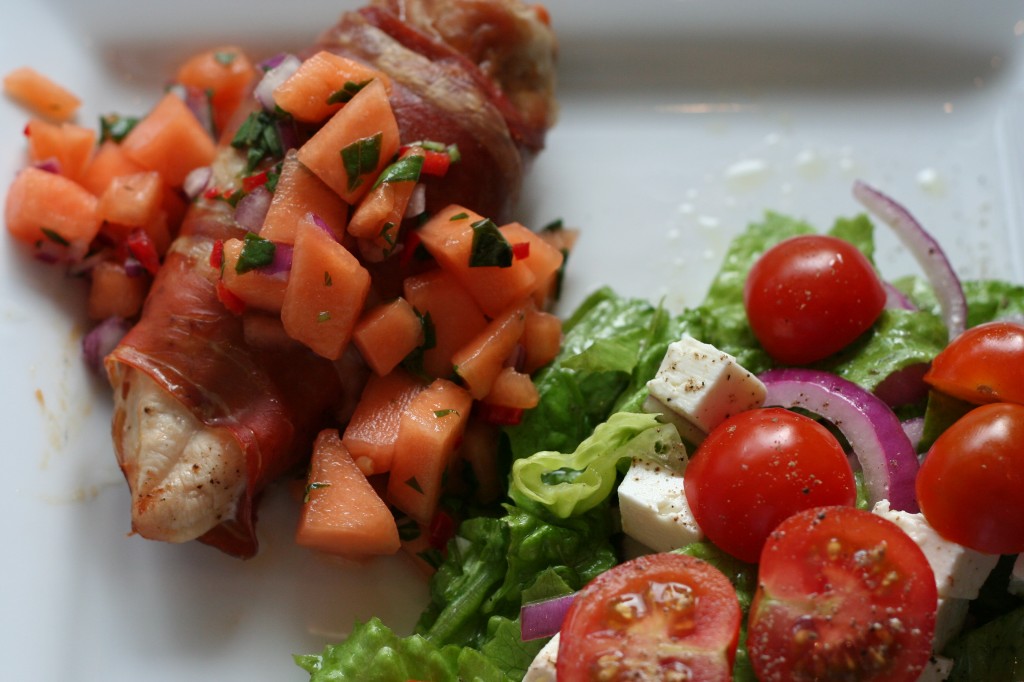
I’ve been thinking about this cantaloupe salsa ever since seeing it on my favorite cooking blog, Smitten Kitchen, a couple weeks ago. The question was, as ever, what to pair it with as part of a meal (tempting as it may be to just eat it straight up with tortilla chips). Grilled chicken seemed like a good choice, but boring. But chicken wrapped in Parma ham? That’s more like it. Parma ham and melon is a classic combination, and this dinner plays on that. The lime-garlic dressing in this fast, easy spin on a Greek salad also helps to balance out the salty Parma ham and keep the dinner light for summertime. But if you make nothing else from my posts this week, make these melt-in-your-mouth roasted peaches.

chicken wrapped in parma ham with romaine salad

Chicken Wrapped in Parma Ham

Serves 4

Stuffing the chicken breasts with slices of buffalo mozzarella would also work well here — cut the chicken breast in half (but not right through), stuff with two or three mozzarella slices, then fold the breast back together and wrap the Parma ham around it. If you’re serving this without the salsa, you could spread a thin layer of pesto on the Parma ham slices before wrapping the chicken up in them. If you’d like some visual step-by-step instructions on how to prepare the chicken for this recipe, Bon Appétit has a tutorial here.

4 chicken breasts
8 slices Parma ham (or bacon)

Preheat the oven to 350°F (180°C) and oil a baking tray. Season the chicken breasts with salt and freshly ground black pepper.

Lay 2 slices of Parma ham on a piece of greaseproof or parchment paper or aluminium foil, making sure they overlap slightly. Place a chicken breast at one end and, using the paper or foil to get started, gently roll it up in the ham. Carefully transfer the wrapped-up chicken breast to the well-oiled baking tray. Repeat for the other chicken breasts. Cook for 25 to 30 minutes. Serve with the cantaloupe salsa spooned on top.

***

Cantaloupe Salsa
from Smitten Kitchen

Makes about 2 cups of salsa

2 cups (300 g) diced cantaloupe
1/4 cup (30 g) diced red onion
2 tablespoons chopped fresh basil or cilantro
1 red or green chili, deseeded and minced
2 tablespoons fresh lime juice
1/4 teaspoon salt

Mix everything and eat immediately.

***

Summer Romaine Salad with Lime-Garlic Dressing
from Orangette

Serves 3 to 4

This dressing will keep, covered and chilled, for up to 1 week. Some fresh finely chopped cilantro added to the dressing would also be good.

for the dressing:
3 tablespoons plus 1 teaspoon fresh lime juice (or more to taste)
5 tablespoons good-quality olive oil
1/4 teaspoon minced garlic
1/8 teaspoon fine sea salt

for the salad:
1 head Romaine lettuce, washed, dried and cut into rough 1/2‑inch strips
1 pint (1 punnet) cherry or grape tomatoes, halved
1/2 red onion, finely sliced
1/2 cup (100 g) feta cheese, crumbled

To make the dressing, combine the lime juice, olive oil, garlic, and salt in a small bowl (or shake to combine in a screw-top jar). Whisk until emulsified and set aside.

In a salad bowl, combine the lettuce, tomatoes, and red onion. Toss with dressing to taste and top with plenty of feta. Serve.

***

Roasted Peaches Stuffed with Amaretti Cookies
from Everyday Italian by Giada De Laurentiis

Serves 6

3 large, ripe, firm peaches (about 5 oz/140 g each), halved and pitted (nectarines would also work well here, or even a mix of peaches and nectarines)
1 1/2 oz (40 g) amaretti cookies (about 12 small cookies)
3 teaspoons sugar (1/2 teaspoon per peach half)
1 tablespoon (15 g) unsalted butter (1/2 teaspoon per peach half)
fresh whipped cream or vanilla ice cream, to serve

Preheat the oven to 375°F (190°C). Butter the bottom of an 8‑inch baking dish and set aside.

Using a melon baller or a spoon, clean out the red flesh from the center of each peach. Arrange the peaches cut side up in the prepared dish. In the bowl of a food processor, add the amaretti cookies and pulse until finely crumbled (or place in a Ziploc bag and bash with a rolling pin). Divide the amaretti crumbs between the peaches, filling the center of each peach with the amaretti cookie crumbs. Sprinkle 1/2 teaspoon of sugar over each. Dot each peach with 1/2 teaspoon of butter.

Bake until the peaches are tender and the filling is crisp on top, about 30 minutes. Serve warm with whipped cream or vanilla ice cream.