Category Archives: Irish food

Steak, Guinness and Cheddar Pie and Chocolate Guinness Cake

I have a confession to make — I don’t like Guinness. When I first moved to Ireland, I tried to like it, I really did. At my first publishing job in Temple Bar in Dublin, the five of us who worked there would often go to the pub for lunch together, and the man from Manchester who I worked with would sometimes skip food altogether and only have a pint of plain for his lunch. My husband tells the story of how the doctor even told his Irish grandmother to drink it when she was pregnant, saying it would help keep her iron levels up — Guinness is good for you and all that. My first six months here I kept ordering pints of it in the pub in the hopes that it might be an acquired taste, but I could only ever get halfway through them. I officially gave up when I was out with the same publishing crowd at the Stag’s Head in Dublin and one of my co-workers suggested I order it with a shot of blackcurrant syrup, saying a lot of girls drank it that way. I thought it tasted even worse and could only take one sip before pushing away the glass, and it’s been ales and lagers for me ever since.

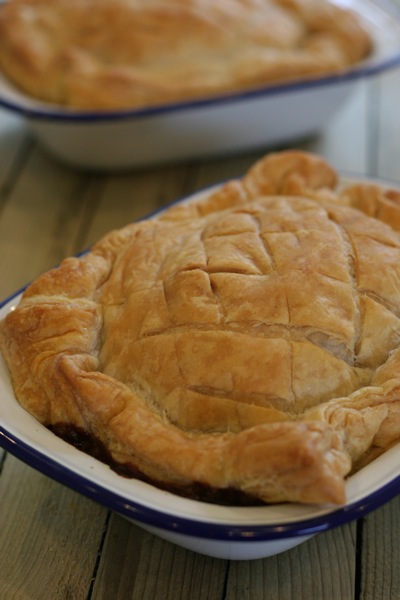
While I don’t like to drink it straight up, I do like to cook with it. Beef and Guinness go together like bread and butter, and this steak, Guinness and cheese pie from Jamie Oliver gives my favorite beef and Guinness stew a run for its money. You would probably never think of baking with beer, much less in a chocolate cake, but Nigella Lawson pulls it off. I made it for my father-in-law’s birthday back in January and it’s become one of Kelly’s favorites. So all these years later, I’ve started buying Guinness again — though in a roundabout way for the likes of stews and cakes. Sláinte!
Looking for more Irish recipes for St. Patrick’s Day? Try beef and Guinness stew with champ, Irish soda bread or Guinness gingerbread.

Steak, Guinness and Cheddar Pie
adapted from Jamie at Home by Jamie Oliver

Serves 4

Jamie Oliver’s original recipe calls for lining the bottom of the pie dish with the puff pastry as well, but I simplified it to just cover the top with a puff pastry lid. He also says to add enough water just to cover the beef — I found that I didn’t need to add any at all because the beef was covered enough using only the Guinness, which also meant the pie filling was the perfect consistency and wasn’t too runny. If you don’t have a Dutch oven or an ovenproof casserole with a lid, you can just simmer the beef on the stovetop instead over a low-medium heat.

olive oil
3 medium red onions, chopped
3 cloves of garlic, chopped
2 tablespoons (30 g) butter
2 carrots, peeled and chopped
2 sticks of celery, trimmed and chopped
4 large mushrooms, sliced (optional)
2 lb (1 kg) brisket of beef or stewing beef, cut into 1 inch cubes
a few sprigs of fresh rosemary, leaves picked and chopped (or you could substitute thyme)
salt and freshly ground black pepper
2 cups (500 ml) Guinness
2 heaped tablespoons flour
2 cups (200 g) grated Cheddar cheese
2 sheets of ready-rolled puff pastry
1 large egg, beaten
freshly cooked peas, to serve

Preheat the oven to 375ºF (190°C). In a large ovenproof pot, heat a generous splash  of olive oil on a low heat. Add the onions and fry gently for about 10 minutes with a pinch of salt so that they don’t brown too much. Turn the heat up, add the garlic, butter, carrots and celery and scatter in the mushrooms. Mix everything together before stirring in the beef, rosemary, a pinch of salt and a level teaspoon of pepper.

Fry fast for 3 or 4 minutes, then pour in the Guinness, stir in the flour and add just enough water to cover (I didn’t need to add any water at all, see note above). Bring to a simmer, cover the pot  with a lid and place in the preheated oven for about 1 1/2 hours. Remove the pot from the oven and give the stew a stir. Put it back into the oven and continue to cook it for another hour, or until the meat is very tender and the stew is rich, dark and thick. A perfect pie filling needs to be robust, so if it’s still quite liquid, place the pot on the stovetop and reduce, uncovered, until the sauce thickens. Remove from the heat and stir in half the cheese, then season carefully and leave to cool slightly. Tip the stew into a pie dish or individual dishes and even it out before sprinkling over the remaining cheese.

Cut the ready-rolled sheet of pastry to fit the top of the pie dish (or individual dishes), rolling it out a little on a lightly floured countertop with a rolling pin if you need to in order for it to cover your dish. Criss-cross the pastry lightly with a sharp knife. Place it over the top of the pie and tuck it down around the stew. Brush the top with beaten egg, then bake the pie in the oven for 45 minutes, or until the pastry is cooked, puffed and golden. Delicious served simply with peas on the side.

***

Chocolate Guinness Cake
adapted from Feast by Nigella Lawson

Serves 12

Nigella Lawson likes to ice the top of the cake so that it resembles the famously frothy head that sits on top of a pint of stout, but she says it also tastes perfectly good if you leave it uniced and plain.

for the cake:
1 cup (250 ml) Guinness
9 oz (250 g) unsalted butter, cubed or sliced
3/4 cup (75 g) unsweetened cocoa
2 cups (400 g) sugar
3/4 cup (or 1 x 142 ml pot) sour cream
2 eggs
1 tablespoon vanilla extract
2 1/4 cups (275 g) flour
2 1/2 teaspoons baking soda

for the topping:
11 oz (300 g) Philadelphia cream cheese
1 1/4 cups (150 g) confectioners’ sugar (icing sugar)
1/2 cup (125 ml) heavy cream (double or whipping cream)

Preheat the oven to 350°F (180°C) and butter and line a 9 inch (23 cm) springform tin.

Pour the Guinness into a large pot. Add the butter cubes or slices and heat until the butter melts, then whisk in the cocoa and sugar. In a separate bowl, beat the sour cream with the eggs and vanilla, then pour into the beer and butter mixture. Lastly, whisk in the flour and baking soda. Pour the cake batter into the greased and lined tin and bake for 45 minutes to 1 hour. Leave to cool completely in the tin on a cooling rack, as it’s quite a damp cake.

When the cake is completely cold, sit it on a flat platter or cake stand to ice it. Lightly whip the cream cheese until smooth, sieve over the confectioners’ (icing) sugar and then beat them both together. (Alternatively, you can do this in a food processor, putting the unsieved icing sugar in first, and blitz to remove lumps before adding the cheese.) Add the cream and beat again until it’s a spreadable consistency. Ice the top of the black cake so that it resembles the frothy top of the famous pint.

Beef and Guinness Stew with Champ

In Ireland, it’s easy to take the top-quality food for granted. We have butter that’s a creamy yellow, the way it should be; bread that’s baked fresh every day and delivered to the stores first thing in the morning; brown eggs that are so fresh they’re often not even refrigerated in the grocery store; lamb that’s world famous; and grass-fed beef.

I didn’t appreciate how special the beef in particular is until I read Michael Pollan’s In Defense of Food recently, in which he says that 100% grass-fed beef commands premium prices in America (and indeed, a recent article in The Village Voice said a 1‑lb grass-fed, local steak set them back $26 compared to $9.99 for a typical feedlot steak of the same weight). Yet in Ireland, famous for the lush green grass (it’s not called the Emerald Isle for nothing), it’s just the way beef is. As I type this, I can look out my window and see my neighbor’s cattle grazing in the field just across the road. When I cook in my kitchen, I look west over a patchwork quilt of fields of potatoes, wheat, more cows and sheep too. When I take a walk with my son in my rural neighborhood, we pass another neighbor’s dairy farm, and if I walk further still, we pass the lambs that eventually wind up in the local butcher. If I walk east, I can stand at the top of our hill and see the Irish Sea about ten miles away, where small, colorful fishing boats trawl the waters. Compared to the US, where the average food item in a typical meal travels 1,500 miles to reach your plate, I feel very lucky indeed to be able to stand on my front step and practically be able to see where my milk, beef, lamb and fish come from, not to mention potatoes and various grains as well.

If you want to cook something special to celebrate St. Patrick’s Day on Wednesday, this beef and Guinness stew with a traditional Irish champ (brúitín) is just the thing. The stew is robust and full of flavor, given the pint of plain that’s in it. The bite of the spring onions in the champ is the perfect accompaniment to the rich stew, but feel free to serve it with plain mashed potatoes instead. If you want to round this off with an Irish dessert, try these easy Baileys cream pots. But don’t limit yourself to only serving this stew on Paddy’s Day. It’s actually the best beef stew I’ve ever made.

Beef and Guinness Stew
adapted from Gourmet, October 2004

Serves 4

To make this into a one-pot meal, add some baby potatoes right into the stew along with the beef stock, Guinness and herbs instead of serving with the champ. And don’t be tempted to skip tossing the beef in the flour — the flour helps give the sauce its gorgeous, thick consistency later on. Like most stews, this one actually improves in flavor after a day, so the leftovers are even better.

2 lb (900 g) boneless beef chuck (stewing beef), cut into 1‑inch pieces
1/4 cup (30 g) flour
1 teaspoon salt
1/2 teaspoon black pepper
1/4 cup (60 ml) olive oil
2 onions, roughly chopped
4 to 6 carrots, cut into 1‑inch pieces on the diagonal
3 large cloves garlic, finely chopped
2 tablespoons tomato paste
4 cups (960 ml) beef stock or broth
approx. 2 cups (500 ml) Guinness (or another stout)
1 tablespoon Worcestershire sauce
1 tablespoon dried thyme
2 bay leaves
chopped fresh parsley, to garnish

Pat the beef dry. Stir together the flour, salt and pepper in a bowl. Add the beef, turning to coat all the pieces, then shake off the excess flour and transfer to a plate.

Heat the oil in a pot over a moderately high heat, until just smoking, then brown the beef in 3 batches, turning occasionally, about 5 minutes per batch (don’t crowd the pot, otherwise the beef will steam, not brown). Transfer to a bowl and set aside.

Reduce the heat to medium. Add the onions and carrots to the pot and saute for 10 minutes, scraping up any brown bits from the bottom of the pan and stirring frequently. Add the garlic and cook for 1 minute. Add the tomato paste, stir to coat the vegetables, and cook for 1 minute more. Stir in the beef along with any juices accumulated in the bowl. Add in the beef stock, Guinness, Worcestershire sauce, thyme and bay leaves. Stir to combine. Bring the stew to a boil, then reduce the heat to medium-low. Simmer, uncovered, for 1 to 1 1/2 hours, stirring occasionally, until the beef is fork-tender and the sauce has reduced and thickened.

To serve, spoon off any fat that may have risen to the top of the stew. Taste for seasoning. Spoon some champ into individual shallow bowls or plates, making a well in the center. Ladle the stew on top of the champ, garnish with the chopped parsley and serve.

***

Champ

Serves 4

If you have your own favorite recipe for mashed potatoes, just follow that and add the scallions at the end, and voilà! Now you have champ. Or you could try making colcannon, another traditional Irish potato dish and first cousin to champ.

2 lb (900 g) floury potatoes, such as Kerr’s Pink, Maris Piper or Yukon Gold
1/2 cup (120 ml) milk
4 oz (110 g) butter
6 spring onions (scallions), white and green parts finely sliced
salt and freshly ground black pepper

Peel the potatoes and slice them 1/4 inch thick. Put them in a large pot of generously salted water and bring to the boil. Simmer until the potatoes are tender, then drain. Return the potatoes to the pot off the heat, cover with a clean tea towel and allow to sit for 5 minutes (this helps to dry out the potatoes, resulting in a fluffier mash). Meanwhile, while the potatoes are cooking, place the milk, butter and spring onions in a saucepan over a medium heat, until the butter has melted. Mash the potatoes, then pour in the hot milk and spring onion mixture and beat with a wooden spoon until the mash is fluffy and light. Taste for seasoning and serve piping hot.

Roasted Potato Leek Soup with Irish Soda Bread

How does Ina Garten do it? She can take any recipe and somehow make it 10 times better than any other version. What’s her secret? Maybe it’s that she often roasts vegetables to bring out their natural sweetness, and she’s not afraid of butter or cream either — and lots of it. I’ve been making a potato leek soup from The New Vegetarian Epicure as my standby recipe for years, but no longer (sorry, Anna Thomas). As for the soda bread, the Avoca Café recipe here is the only one I’ve ever made. It’s so easy and foolproof — flour, baking soda, sugar, salt and buttermilk — that I doubt even the Barefoot Contessa could improve on it.

Roasted Potato Leek Soup
adapted from Barefoot Contessa Back to Basics by Ina Garten

Serves 6 to 8

Don’t worry if you can’t find any arugula (rocket), the soup would still be good without it.

2 lb (900 g) Yukon Gold potatoes, peeled and cut into 3/4‑inch chunks (or substitute any waxy or red-skinned potato)
4 leeks, white and light green parts chopped and cleaned well
1/4 cup (60 ml) good-quality olive oil
salt and freshly ground black pepper
3 cups (50 g) baby arugula, lightly packed
1/2 cup (120 ml) dry white wine, plus extra for serving
6 to 7 cups (1.4 to 1.7 liters) chicken stock (or use vegetable stock for a vegetarian version)
3/4 cup (180 ml) heavy cream
1 cup (225 g) crème fraîche
1/4 cup (25 g) freshly grated Parmesan, plus extra for garnish

Preheat the oven to 400°F (200°C).

Combine the potatoes and leeks on a sheet pan in a single layer. Add the olive oil, 1 teaspoon salt, and 1/2 teaspoon pepper and toss to coat the vegetables evenly. Roast for 40 to 45 minutes, turning them with a spatula a few times during cooking, until very tender. Add the arugula and toss to combine. Roast for 4 to 5 more minutes, until the arugula is wilted. Remove the pan from the oven and place over 2 burners. Stir in the wine and 1 cup (240 ml) of the stock and cook over a low heat, scraping up any crispy roasted bits sticking to the pan.

In batches, transfer the roasted vegetables to a food processor fitted with the steel blade, adding the pan liquid and about 5 cups (1.2 liters) of the stock to make a puree. Pour the puree into a large pot or Dutch oven. Continue to puree the vegetables in batches until they’re all done and combined in the large pot. Add enough of the remaining 1 to 2 cups (240 to 480 ml) of stock to make a thick soup. Add the cream, crème fraîche, 2 teaspoons salt, and 1 teaspoon pepper and check the seasonings.

When ready to serve, reheat the soup gently and whisk in 2 tablespoons white wine and 1/4 cup (25 g) of Parmesan. Serve hot with an extra grating of Parmesan.

***

Irish Soda Bread
adapted from Avoca Café Cookbook

Makes 1 loaf

This is the easiest bread to make, and it cooks in only half an hour. Don’t worry about its lumpy appearance — it’s meant to look that way. It’s fabulous with hearty, wintry soups, but the leftovers are equally as good for breakfast the next morning, lightly toasted and spread with jam and butter.

3 3/4 cups (450 g) plain flour
1 level teaspoon baking soda
1 teaspoon sugar
1/2 teaspoon salt
1 3/4 cups (400 ml) buttermilk

Preheat the oven to 450?F (230°C). Grease a loaf tin very well.

Mix all the dry ingredients together in a large bowl. Gradually mix in the buttermilk to make a moist dough. Place in the greased loaf tin and bake in the preheated oven for 30 minutes, until the loaf sounds hollow when turned out of the tin and tapped underneath. Place on a wire rack to cool.

Chicken a la Veracruzana and Barm Brack

I have a friend who used to work in the famous Bewley’s Cafe on Grafton Street in Dublin. She told me once about about the letters they got around this time of year, usually from tourists who had bought a loaf of barm brack in the store to take back home with them. The people writing the letters were concerned that they’d found a ring in their bread, with one person saying they’d had it appraised, and another one joking that they were relieved they hadn’t also found the finger that came with the ring. Most people sent the ring back.

They obviously didn’t know just what they’d bought. Barm brack (or báirín breac in Irish, from báirín, a loaf, and breac, speckled, due to the raisins in it) is a traditional Halloween treat, falling somewhere in between regular bread and cake. What makes it special is the ring and coin that are usually baked into the bread, turning it into a bit of a fortune-telling game: whoever gets the coin will be rich, and whoever gets the ring will be married within the year. Who knows what chances for love those well-meaning tourists sent back?

barm brack ring

This is the ring that came in the store-bought barm brack I bought last year (oh, those chubby, dimpled little toddler hands get me every time). But after making my own this year and seeing how quick and easy it is, we’ll only be having homemade brack from now on.

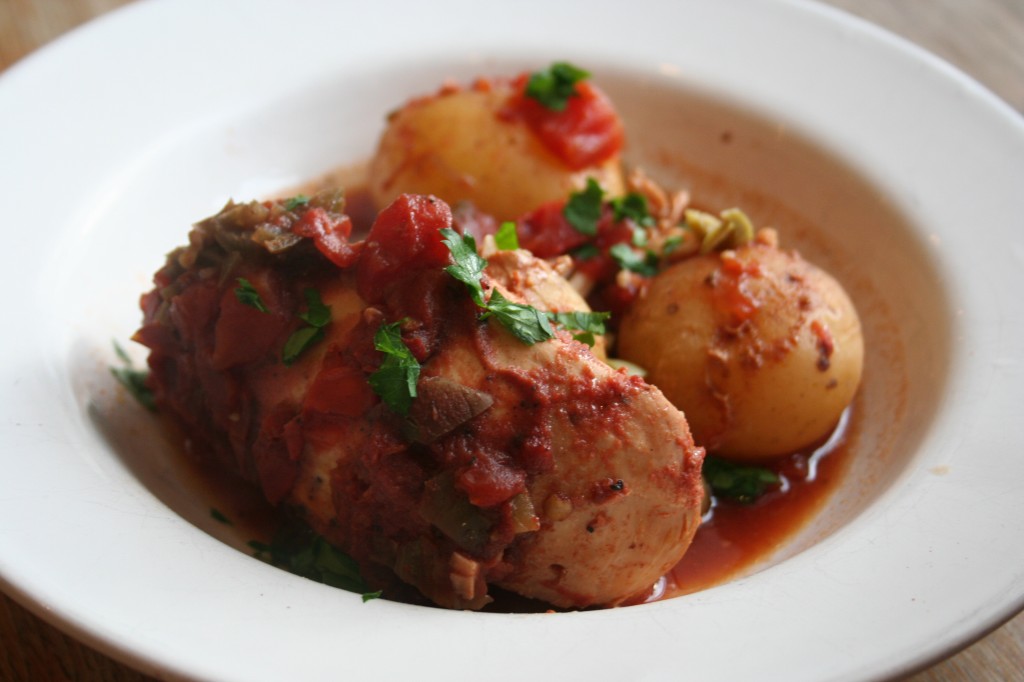
Chicken a la Veracruzana
adapted from Mexican Everyday by Rick Bayless

Serves 6

Rick Bayless suggests using 2 lb (900 g) of pork shoulder or beef chuck, cut into 1‑inch cubes, in place of the chicken. If using pork, he recommends replacing the potatoes with sweet potatoes cut into 1/2‑inch cubes. If using beef, try quartered sweet turnips, cubed carrots or peeled, cubed yuca. Chicken a la Veracruzana can also be used as a soft taco filling — just shred the chicken and stir it into the sauce with the olive and parsley and smash the potatoes into smaller pieces (this is how I served this meal to my kids, with a little grated Cheddar cheese too).

1 lb (450 g) new potatoes (or you could cut 4 medium potatoes into wedges)
6 boneless, skinless chicken breasts
1 x 28-oz (or 2 x 14-oz/400‑g) can diced tomatoes (preferably fire roasted), drained
4 to 6 canned pickled jalapeños, stemmed, deseeded and cut into strips
3 cloves garlic, finely chopped
2 tablespoons Worcestershire sauce
1/8 teaspoon dried thyme
1/8 teaspoon ground cloves
1/4 teaspoon ground cinnamon
1 teaspoon salt
1/2 cup (100 g) coarsely chopped green olives
1/4 cup (loosely packed) (10 g) roughly chopped flat-leaf parsley

Place the potatoes over the bottom of a slow cooker and put the chicken breasts over the potatoes. In a medium bowl, mix together the drained tomatoes, jalapenos, garlic, Worcestershire, thyme, cloves, cinnamon and salt. Pour the sauce evenly over the chicken. Set the lid in place and cook on high for 6 hours (the dish can hold on the slow cooker’s “keep warm” function for 4 more hours or so).

Carefully transfer a chicken breast and a portion of potatoes to each of 6 dinner plates, leaving as much sauce behind as possible. Mix the olives and parsley into the sauce, then taste and season with more salt if it needs it. Spoon the sauce over the chicken and potatoes and serve.

No slow cooker?
Put the chicken in a medium-large heavy pot, preferably a Dutch oven, and top with the potatoes. Cover with the sauce, set the lid in place and braise at 300°F (150°C) for 2 to 2 1/2 hours, until the chicken is completely tender. Complete the dish as described above.

chicken a la veracruzana

***

Barm Brack
adapted from Good Food Channel

Makes 1 loaf

If you want to include the traditional coin and/or ring, wrap them up well in greaseproof paper before adding them to the batter. You’d probably better wash the coin beforehand too. You can also make a yeasted version of barm brack, but you can’t beat this recipe if you want something quick and easy — it takes 10 minutes to make. If you want to elevate brack into a dessert, try this recipe for toffee apples on sugar-glazed barm brack.

3/4 cup (120 g) dark brown sugar
1 1/4 cups (300 ml) strong black tea
2 cups (320 g) raisins
2 tablespoons mixed candied peel
1 egg, beaten
2 cups (240 g) flour
1 heaped teaspoon baking powder
1/2 teaspoon cinnamon
1/4 teaspoon ground nutmeg

Dissolve the sugar in the tea. Add the raisins and candied peel and leave to soak overnight.

The next day, preheat the oven to 325°F (160°C). Grease an 8‑inch loaf tin or small round cake tin. Add the beaten egg to the raisins and peel as well as their soaking liquid. Sift in the flour, baking powder, cinnamon and nutmeg and stir well. Spoon the batter into the tin (add the charms now if you’re using them) and bake for 50 to 60 minutes, until a tester comes out clean. This is traditionally served toasted and buttered with a cup of tea.