All posts by Kelly

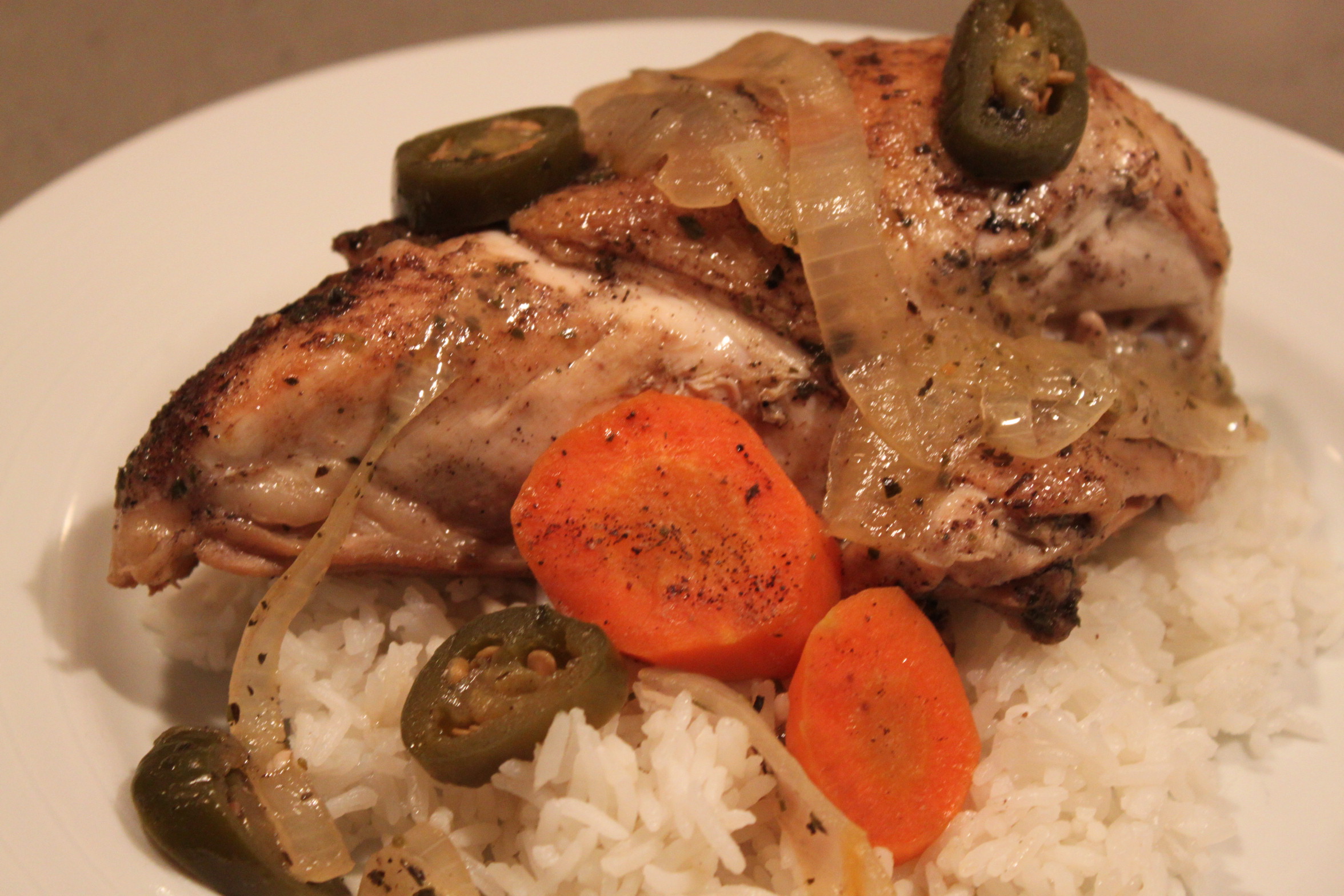
Chicken in Tangy Escabeche of Caramelized Onions, Carrots and Jalapenos with Rice

Contrary to popular (American) belief, the condiment of choice in much of Mexico isn’t salsa, but jalapenos en escabeche, which is essentially jalapenos pickled with carrots and onions. Though hesitant to abandon salsa altogether during my summer in Mexico, I grew to love the slightly tart and totally tangy bowl of escabeche vegetables served alongside every meal. A splash of the vinegar-based sauce livens up just about any cut of meat and can be used much like the sport peppers in vinegar you find on tables throughout the southern United States. The crunchy vegetables also make a great addition to dishes in need of a little texture or heat. Tonight’s Rick Bayless chicken dish draws on this classic Mexican combination, with good results. I paired the dish with white rice for a delicious dinner in less than an hour.

Chicken in Tangy Escabeche of Caramelized Onions, Carrots and Jalapenos
adapted from Mexican Everyday by Rick Bayless

Serves 4 to 6

1 teaspoon ground black pepper
1/2 teaspoon ground allspice
2 teaspoons dried oregano, preferably Mexican
1 teaspoon salt
2 lb (900 g) chicken breast halves, bones and skin intact
2 tablespoons vegetable or olive oil
1 large white onion, cut into 1/4‑inch slices
2 large carrots, peeled and sliced 1/4‑inch thick on a diagonal
4 garlic cloves, peeled and halved
1/4 cup (60 ml)  vinegar (apple cider vinegar is traditional)
2 to 4 canned pickled jalapenos, stemmed, seeded and thinly sliced [Note: I used pre-sliced pickled jalapenos]
1 cup (240 ml) chicken broth

In a small bowl, combine the black pepper, allspice, oregano and salt. Sprinkle half of this mixture over the chicken breasts.

Heat the oil in a very large (12-inch) skillet over medium heat. Lay in the chicken, skin side down, and cook for 3 to 4 minutes on each side, turning once, until richly browned. Remove the chicken to a plate, leaving behind as much oil as possible.

Add the sliced onion and carrots to the skillet and cook, stirring regularly, until the onion is browned, abut 7 minutes. Add the garlic and stir for about 1 minute, then add the remaining seasoning mixture, the vinegar, jalapenos and broth.

Nestle the chicken pieces skin side up in the onion mixture, cover the skillet (a cookie sheet works if your skillet doesn’t have a lid) and simmer gently over a medium-low heat until the chicken is just cooked through, about 15 minutes. Taste the broth and season with additional salt if you think it’s needed. Transfer a piece of chicken to each dinner plate, spooning a generous portion of the juicy vegetable mixture over the top.

Filipino-style London Broil, Oven-roasted Potatoes, and Winter Greens with Shaved Parmesan

My book club’s most recent pick, Animal, Vegetable, Miracle: A Year of Food Life by Barbara Kingsolver, provided the perfect inspiration for our meeting’s dinner menu. The book centers around the author’s year of eating only local foods, including produce and animals that she raised herself. After getting past the initial defensiveness of my own food choices, I came to love the book and have been truly inspired by it. It also provided a ready theme for our book club dinner — local. Luckily, by living in Wisconsin, I have easy access to farms that offer direct-to-seller meat and produce. I had a freezer full of beef from Sulzer Beef at my disposal. I also rediscovered Outpost Natural Foods, which in recent years has made a concerted effort to carry more local products.

My friend Alex brought a wonderful rhubarb strawberry crisp made with strawberries she picked from a nearby farm and rhubarb from her garden. For the salad, I used a winter salad mix from Milwaukee’s own urban, award-winning farm, Growing Power. To serve, I splashed some balsamic vinegar and olive oil over the greens (not local, I’m afraid), then used a vegetable peeler to grate long strips of Wisconsin Parmesan over the top. We rounded out the meal with an assortment of other Wisconsin cheeses (lemon chevre, cranberry cheddar, and Gorgonzola) and a fresh baguette from our local Breadsmith bakery.  A feast that doesn’t require gallons of petroleum to transport it to the table tastes even better than one that does.

Filipino-style London Broil
adapted from Indoor! Grilling by Steven Raichlen

Serves 4 to 6

2 medium lemons
1 cup (240 ml) soy sauce [Kikkoman brand is made in Walworth, Wisconsin]
1/2 cup (120 ml) distilled white vinegar
1/2 cup (120 ml) vegetable oil
1 medium onion, finely chopped
3 cloves garlic, finely chopped
3 bay leaves, crumbled
1 tablespoon coriander seed
1 teaspoon black pepper
1 sirloin or top or bottom round steak (1 1/2 to 2 lb/680 to 900 g)

Rinse the lemons. Cut each in half and squeeze out the juice with a citrus press. Place the lemon juice in a large nonreactive mixing bowl. Cut the rind of 1 lemon into 1/4‑inch dice and add it to the juice. Add the soy sauce, vinegar, oil, onion, garlic, bay leaves, coriander seed, and pepper and whisk to mix. Set aside half of the lemon juice mixture to use as a sauce.

Spread half of the remaining lemon juice mixture in the bottom of a nonreactive baking dish just large enough to hold the meat. Place the meat on top and spread the other half of the lemon juice mixture over it. Let the steak marinate for at least 6 hours, or ideally overnight. The beef can also be marinated in a resealable plastic bag.

Place a grill pan on the stove and preheat it to medium-high over a medium heat. When the grill pan is hot, a drop of water will skitter in the pan. When ready to cook, lightly oil the ridges of the grill pan. Drain the meat, scraping off most of the marinade with a rubber spatula. Place the beef in the hot grill pan. Sirloin or round steak will be cooked to medium-rare after 5 to 8 minutes per side. To test for doneness, use the poke method: when cooked to medium-rare the meat should be gently yielding.

Transfer the meat to a cutting board and let it sit for 5 minutes. Cut the meat into broad thin slices, holding a sharp knife blade at a 45-degree angle to the top of the meat. Spoon the reserved sauce over the slices and serve at once.

***

Oven-roasted Potatoes

Serves 6

3 large baking potatoes, cut into 1‑inch cubes
1/4 cup (60 ml) olive oil
handful of flat-leaf parsley, minced [I love parsley and use about a half bunch in this recipe]
3 cloves garlic, minced
1/2 teaspoon dried basil
1 teaspoon dried oregano
1 teaspoon paprika
salt and freshly ground black pepper

Preheat the oven to 375°F (190°C).

Toss the cubed potatoes with the olive oil, parsley, garlic, basil, oregano and paprika. Spread in a single layer on a large baking sheet (or 2 smaller baking sheets). Bake for 30 to 40 minutes, turning the potatoes halfway through cooking, until golden brown and tender. Immediately season with salt and pepper to taste.

Jambalaya with Shrimp and Ham with Toasted Garlic Kale

In celebration of Mardi Gras, Reuben cooked up a great pot of jambalaya. Out of the million and one versions of this classic Cajun cuisine, this one is my favorite. It’s low fat, cooks in one pot, and is a great way to use up leftover ham. The kale provides a burst of color and an extra serving of vegetables — very needed in my household as we struggle through the recent exchange of sicknesses between the kids. Much to our surprise, our 8‑month-old devoured her kale. Pretty impressive, Anabelle, but you’re still too young for beads.

Jambalaya with Shrimp and Ham
adapted from Ellie Krieger

Serves 4

1 tablespoon olive oil
1 large onion, diced
1 red bell pepper, diced
1 green bell pepper, diced
2 cloves garlic, minced
1/2 teaspoon salt, plus more, to taste
1/4 teaspoon freshly ground black pepper, plus more, to taste
1 teaspoon paprika
1/2 teaspoon dried oregano
1/2 teaspoon dried thyme
1 bay leaf
1/4 teaspoon cayenne pepper
1 tablespoon tomato paste
6 oz (170 g) diced, smoked ham
2 1/2 cups (600 ml) low sodium chicken broth
1 x 14-oz (400‑g) can diced tomatoes
1 cup (180 g) uncooked long-grain white rice
1 lb (450 g) peeled and deveined medium shrimp (tail-on preferred)
hot pepper sauce

Heat the oil in a large Dutch oven over a medium heat. Add the onion, peppers and garlic and saute until they begin to soften, about 10 minutes. Mix in the next 11 ingredients (salt through the diced tomatoes). Bring to a boil. Stir in the rice, cover, reduce heat and simmer for about 20 minutes, or until rice is done and most of the liquid is absorbed. Add the shrimp and cook, covered, for 5 minutes more, or until shrimp is cooked through. Season with salt and pepper, to taste. Serve with hot pepper sauce.

***

Toasted Garlic Kale

Serves 2 to 3

1 bunch kale, washed and roughly chopped
3 tablespoons olive oil
2 cloves garlic, minced

Bring a large pot of water to a boil. Salt the water as you would for cooking pasta. Add the chopped kale and simmer for 4 to 5 minutes, until the kale turns bright green. Immediately drain the kale and rinse with cold water.

In a large saute pan, heat the olive oil over a medium heat but do not let the oil smoke. Add the garlic and saute, stirring frequently, until the garlic just begins to turn golden. Add the drained kale to the oil and garlic, lower the heat, and saute until the kale is tender. Season to taste with salt and pepper.

Coca-Cola Ham, Parmesan Smashed Potatoes, and Roasted Beets with Greens and Goat Cheese

I’ve sworn off high fructose corn syrup (HFCS) for a few years now. My HFCS ban is one of the reasons I started cooking more of my own meals. At least in the United States, it’s pretty difficult to avoid HFCS in processed or convenience foods. Soda — or pop, depending on where you live — was one of the easier HFCS products to cut. I had already succumbed to the Diet Coke craze during college, like so many other calorie-conscious co-eds. Which is all a long way of saying that I’ve had a 2‑liter bottle of Coca-Cola perched on my fridge for a few months that I certainly wasn’t going to drink. I also have a freezer of pork, including several hams, begging to be eaten. It all came together to form a perfect “excuse” to make the ham in cola recipe that Kristin sheepishly sent me a few weeks ago. Despite my reservations, the ham turned out beautifully, just as Kristin promised it would.

Ham in Coca-Cola
adapted from Nigella Bites by Nigella Lawson

Serves 8

for the ham:
1 x 4 1/2‑lb (2‑kg) ham
1 onion, peeled and cut in half
1 x 2‑liter bottle cola (recommended: Coca-Cola)

for the glaze:
1 heaped tablespoon honey
2 teaspoons English mustard powder
2 tablespoons Demerara (raw cane sugar) or granulated brown sugar

For the ham: Place the ham and the onion into a large pot or Dutch oven and pour the cola on top. On a medium-high heat, allow the cola to come to a boil. Reduce the heat to medium-low and cover with a lid, though not tightly, and allow to cook for 2 1/2 hours (1 hour for every 2 lb/900 g).

Preheat the oven to 500°F (240°C).

For the glaze: Pull the ham from the pot and allow it to rest on a cutting board, reserving the cooking liquid if you want to make Nigella’s South Beach Black Bean Soup. Using a sharp knife, trim the skin, leaving a thin layer of fat on the ham. Using the knife, score the fat diagonally into large diamond cuts. Spread the honey over the meat. Gently pat the powdered mustard and sugar around the meat, so it sticks to the honey. Gently place the ham in a roasting pan (lined with aluminum foil for easier clean-up). Cook the ham for about 10 minutes, or until the glaze is burnished and bubbly.

To braise the ham in advance and then let it cool, take the ham from the refrigerator, glaze it according to the recipe, and allow it to sit at room temperature for 30 to 40 minutes. Place in a 350°F (180°C) oven for 30 to 40 minutes,  turning up the heat if you think it needs a more crispy exterior.

***

Parmesan Smashed Potatoes
adapted from the The Barefoot Contessa Cookbook by Ina Garten

Serves 8

4 lb (1.75 kg) red new potatoes, unpeeled
1 tablespoon kosher salt, plus 2 teaspoons
1 cup (240 ml) half-and-half (or half milk, half cream)
1/4 lb (110 g) unsalted butter
1/2 cup (50 g) freshly grated Parmesan
1/2 teaspoon ground black pepper

Place the potatoes and 1 tablespoon of salt in a 4‑quart saucepan and add cold water to cover. Bring to a boil, lower the heat and simmer covered for 25 to 35 minutes, until completely tender. Drain.

In a small saucepan, heat the half-and-half and butter. Put the potatoes into the bowl of an electric mixer fitted with a paddle attachment and mix the potatoes for a few seconds on low speed, to break them up. Slowly add the hot cream and butter to the potatoes, mixing on the lowest speed (the last quarter of the cream should be folded in by hand). Fold in the Parmesan cheese and the remaining salt and pepper; taste for seasoning and serve immediately. If the potatoes are too thick, add more hot cream and butter.

***

Roasted Beets with Greens and Goat Cheese

Serves 6

2 bunches beets with greens, washed well
8 tablespoons olive oil, divided
2 cloves garlic, minced
2 oz (60 g)  goat cheese, crumbled

Preheat the oven to 400°F (200°C). Remove the greens from the beets and set aside. Toss the beets in 5 tablespoons of olive oil, then wrap in aluminum foil. (I usually place 2 to 3 beets in each foil packet.) Roast until tender, 60 to 90 minutes, depending on the size of the beets. Remove from the oven and allow to cool for 15 to 20 minutes before peeling and quartering the beets. If the beets are very large, cut into 1‑inch pieces instead of quartering them.

While the beets cool, roughly chop the beet greens. Heat the remaining 3 tablespoons of olive oil in a large skillet over a medium heat. Add the garlic and cook for about 1 minute, until fragrant but not browned. Stir in the beet greens and saute, stirring frequently, for about 10 minutes, until they’re wilted and tender. If the greens begin to scorch, add a tablespoon or so of water or cover with a lid. Season the greens to taste with salt and pepper.

To serve, spoon the greens onto a plate, top with roasted beets and then crumbled goat cheese.

Tzatziki Chicken with Couscous and Hummus

I really wanted to name this post Two Dip Dinner, but I couldn’t risk setting a clever title precedent. Regardless, that’s the unofficial title in my house for this kid-friendly fare. A special thank you to our friend Leah for this menu inspiration. Kristin and I have been lucky to be friends with Leah for nearly 20 years. She’s been kind enough to share some of her favorite recipes with us so we can share them with you.

Tzatziki Chicken with Couscous and Hummus
adapted from Leah’s recipe

Serves 4

1 1/2 lb (680 g) boneless skinless chicken thighs or breasts (thighs preferred)
1 teaspoon white vinegar
1/2 teaspoon sugar
1 package plain whole wheat or regular couscous (about 6 oz/170 g)
2 to 3 cups (475 to 700 ml) chicken broth or water (check couscous package for exact amount)
2 to 4 scallions
2 tablespoons olive oil

for the tzatziki sauce:
2 small cucumbers, peeled and grated, divided
2 teaspoons coarse salt, divided
2 cups plain whole milk yogurt, divided
2 small garlic cloves, minced, divided
2 teaspoons fresh lemon juice, divided
1 teaspoon dried dill, divided

You’ll be making two separate preparations out of the tzatziki sauce ingredients: a marinade and a dipping sauce. For the marinade, put half of all the sauce ingredients into a food processor and pulse until blended and runny. Pour the marinade over the chicken in a Ziploc bag or lidded container. Seal the bag or cover and marinate the chicken for up to 24 hours.

For the dipping sauce, after grating the cucumber, put it into a paper towel and squeeze dry. Stir the grated cucumber into the remaining half of the tzatziki sauce ingredients in a small bowl. Do not put this part in a food processor. Stir in the vinegar and sugar. Refrigerate for 15 minutes before serving (though the longer it can sit in the fridge to let the flavors develop, the better).

After the chicken has marinated, preheat an outdoor grill or stove-top grill pan. Lightly grease the grill. Remove any excess marinade from the chicken and place the chicken pieces onto the hot grill. Discard the marinade. Cook the chicken for 8 to 12 minutes on each side, depending on the thickness; thighs will need more time than breasts.

While the chicken cooks, make the couscous according to package directions, using the amount of chicken broth or water recommended. Fluff the couscous after it cooks and fold in the scallions and olive oil.

Serve the chicken with with couscous, tzatziki sauce, and hummus.

***

Hummus

1 small garlic clove, minced
3 tablespoons fresh lemon juice
2 tablespoons water
1 x 14-oz (400‑g) can chickpeas, drained and rinsed
3 tablespoons tahini
1 teaspoon salt
2 tablespoons olive oil

Put all the ingredients into a food processor and puree until smooth.

Moroccan Winter Squash and Carrot Stew with Quinoa and Coconut Cream Pie

My newest working mom trick is double Sunday dinner. I find that if I can make Monday night’s dinner while cleaning up Sunday night’s dinner mess, the week goes much better. I’ve tried a few make-ahead meals with mixed results; curried pork stew is great, butternut squash lasagna, not so much. This vegan stew is one of my favorite make-ahead meals yet. You certainly won’t miss the meat. A word of warning, though: when peeling the butternut squash, throw the peels in your compost or garbage can. Do not attempt to put them down your garbage disposal. Do not attempt to put them down your mother-in-law’s garbage disposal. The cost of the plumber fixing the sink takes away from the enjoyment of the meal. Trust me on this one.

Coconut cream pie has been on my mind for a long time. When I found James Peterson’s version in his new book, Baking, I had no choice but to make it. The book, by the way, is a nice compilation of recipes and techniques ranging from bread to pastries to cakes. I’m not sure it’s the “baking education” promised on its cover, but I’ve been salivating over its pictures and recipes for weeks. Despite my several adaptations (shortcuts, really), my first coconut cream pie turned out much better than any version I’ve had from a bakery. I wish I had tried it sooner.

Moroccan Winter Squash and Carrot Stew with Quinoa
adapted from Bon Appétit, January 2006

Serves 6

for the stew:
2 tablespoons olive oil
1 onion, chopped
3 garlic cloves, chopped
2 teaspoons Hungarian sweet paprika
1 teaspoon salt
1/2 teaspoon ground black pepper
1/2 teaspoon ground coriander
1/2 teaspoon ground cumin
1/2 teaspoon turmeric
1/2 teaspoon ground ginger
1/2 teaspoon cayenne pepper
1 cup (240 ml) water
1 x 14-oz (400‑g) can diced tomatoes, drained
1 butternut squash, peeled and cut into 1‑inch cubes
5 to 7 carrots, peeled and cut into 3/4‑inch cubes

for the quinoa:
1 cup (170 g) quinoa
1 tablespoon butter
1 tablespoon olive oil
1 small onion, finely chopped
1 medium carrot, peeled and finely chopped
2 garlic cloves, minced
1/2 teaspoon salt
1/2 teaspoon turmeric
2 cups (480 ml) water
1/2 cup (15 g) chopped fresh cilantro, divided

For stew: Heat the oil in a large saucepan over medium heat. Add the onion and sauté until soft, stirring often, about 5 minutes. Add the garlic and stir for 1 minute. Mix in the paprika and the next 7 ingredients. Add 1 cup (240 ml) water and the tomatoes. Bring to a boil. Add the squash and carrots. Cover and simmer over medium-low heat until the vegetables are tender, stirring occasionally, about 20 minutes. Season with salt and pepper. (Can be prepared 1 day ahead. Cover and chill.)

For quinoa: Rinse the quinoa and drain. Melt the butter with the oil in a large saucepan over medium heat. Add the onion and carrot. Cover and cook until the vegetables begin to brown, stirring often, about 10 minutes. Add the garlic, salt, and turmeric and sauté for 1 minute. Add the quinoa and stir 1 minute. Add 2 cups (480 ml) of water. Bring to a boil, then reduce the heat to medium-low. Cover and simmer until the liquid is absorbed and the quinoa is tender, about 15 minutes.

To serve, rewarm the stew and stir in half of the cilantro. Spoon the quinoa onto a platter, forming a well in the center. Spoon the stew into the well. Sprinkle with the remaining cilantro.

***

Coconut Cream Pie
adapted from Baking by James Peterson

Makes 1 pie

1 x 10-inch pie crust (homemade or Pillsbury refrigerated recommended)
2 cups (480 ml) unsweetened coconut milk (regular or light)
1 cup (240 ml) milk
1 teaspoon vanilla
2 eggs
2 egg yolks
1/2 cup (100 g) sugar plus 2 tablespoons
1/4 cup (25 g) plus 2 tablespoons cornstarch
1/2 cup (40 g) unsweetened dessicated coconut
2 cups (180 g) sweetened shredded coconut, divided
1 cup (240 ml) heavy cream

Use a 9- to 10-inch pie pan. Roll the dough into a round about two inches larger than the pie pan. Line the pie pan with the dough, fold under the excess dough and crimp the edges. Prebake the pie shell according to your recipes (or package instructions). I highly recommend lining the crust with aluminum foil and adding an inch or so of pie weights or dried beans during the first half of the baking time. This will keep the crust from shrinking, warping, and performing other unknown pastry tricks. Carefully remove the pie weights/beans and tinfoil during the last half of the baking time to allow the crust to fully cook.

Set the oven to 350°F (180°C). In a medium saucepan, bring the coconut milk and milk to a simmer with the vanilla. In a bowl, whisk together the eggs, egg yolks, 1/2 cup (100 g) of sugar, and the cornstarch until smooth. Slowly pour half of the milk into the egg mixture, stirring constantly. Pour the mixture back into the saucepan with the rest of the milk. Stir the mixture with a whisk over medium heat until it bubbles and thickens. Immediately remove it from the heat, stir until smooth and transfer to a bowl. Cover the bowl with plastic wrap and allow to cool to room temperature.

Fold the dessicated coconut and 1 cup (90 g) of the sweetened shredded coconut into the pudding and spread this mixture in the now cool pie shell. Chill for at least 1 hour.

While the pie chills, toast the remaining 1 cup (90 g) of shredded coconut in a heavy pan over medium heat, stirring occasionally until lightly browned. Pour the toasted coconut into a small bowl to cool.

Before serving, combine the heavy cream with the 2 tablespoons of sugar and beat it to stiff peaks. Spread the whipped cream over the pudding mixture, doming the cream in the center, and sprinkle the toasted coconut over it.
Green Chile Pork Tacos and Devil’s Food Cupcakes with Vanilla Buttercream Frosting

“I have a great idea, Mom.”

“What’s that, Sam?”

“I know, let’s make chocolate muffins. With whipped cream. And sprinkles.”

Some days, folks, that all the encouragement I need to grab the sugar from the cupboard and butter from the fridge. It didn’t hurt that our main course required little more than a few minutes of prep and the able assistance of my (er, Reuben’s) new slow cooker.

Green Chile Pork Tacos

Serves 6

3 lb (1.4 kg) pork shoulder, cut into 2‑inch cubes
2 tablespoons olive oil
1 large onion, chopped
1 teaspoon ground cumin
1 teaspoon dried oregano
1 cup (240 ml) chicken stock
1 x 4‑oz (110‑g) can diced green chilies
1 x 10-oz (280‑g) can Rotel tomatoes (or other diced tomatoes with green chilies)
3 cloves garlic, minced
1 teaspoon salt
1/2 teaspoon pepper
corn or flour tortillas
toppings: avocado, salsa, cheese, green onion, cilantro, pickled jalapenos, lime wedges

In a large frying pan, brown the pork cubes in the oil until they just begin to brown. Drain the meat and place into a slow cooker. Add the remaining ingredients through salt and pepper and cook on low until the pork is tender, about 8 hours. Gently shred the pork with a fork.

Warm the tortillas and serve the pork, taco-style, with desired toppings.

***

Devil’s Food Cupcakes
adapted from Alpineberry

Makes 1 dozen

1 1/2 cups (180 g) all-purpose flour
1 cup (200 g) granulated sugar
1/4 cup (30 g) unsweetened natural cocoa powder (don’t use Dutch-processed cocoa)
1 teaspoon baking soda
1/2 teaspoon salt
1 cup (240 ml) water
1/3 cup (80 ml) unflavored oil (canola, grapeseed, etc.)
1 tablespoon white or apple cider vinegar
1 teaspoon vanilla extract

Preheat the oven to 350°F (180°C). Line the wells of a standard muffin pan with paper liners.

Sift the flour, sugar, cocoa, baking soda and salt into a large mixing bowl. In another bowl, mix together the water, oil, vinegar and vanilla. Add the wet to the dry ingredients and mix until just combined and the batter is smooth. Be careful not to overmix.

Divide the cupcake batter evenly among the wells of your muffin pan. Bake for about 20 to 25 minutes, or until the cupcakes feel springy when gently pressed. Cool in the pan for 5 minutes, then gently remove the cupcakes from the pan and allow to cool fully on a wire rack.

Vanilla Buttercream Frosting
adapted from Magnolia Bakery

Makes enough for one 2‑layer 9‑inch cake or 2 dozen cupcakes [Note: I halved recipe for 1 dozen cupcakes]

1 cup (225 g) unsalted butter, softened
6 to 8 cups (720 g to 960 g) confectioners’ sugar (a.k.a. icing sugar)
1/2 cup (120 ml) milk
2 teaspoons vanilla extract

Place the butter in a large mixing bowl. Add 4 cups (480 g) of the sugar and then the milk and vanilla. On the medium speed of an electric mixer, beat until smooth and creamy, about 3 to 5 minutes. Gradually add the remaining sugar, 1 cup (120 g) at a time, beating well after each addition (about 2 minutes), until the icing is thick enough to be of good spreading consistency. You may not need to add all of the sugar. If desired, add a few drops of food coloring and mix thoroughly. Use and store the icing at room temperature because icing will set if chilled. Icing can be stored in an airtight container for up to 3 days.

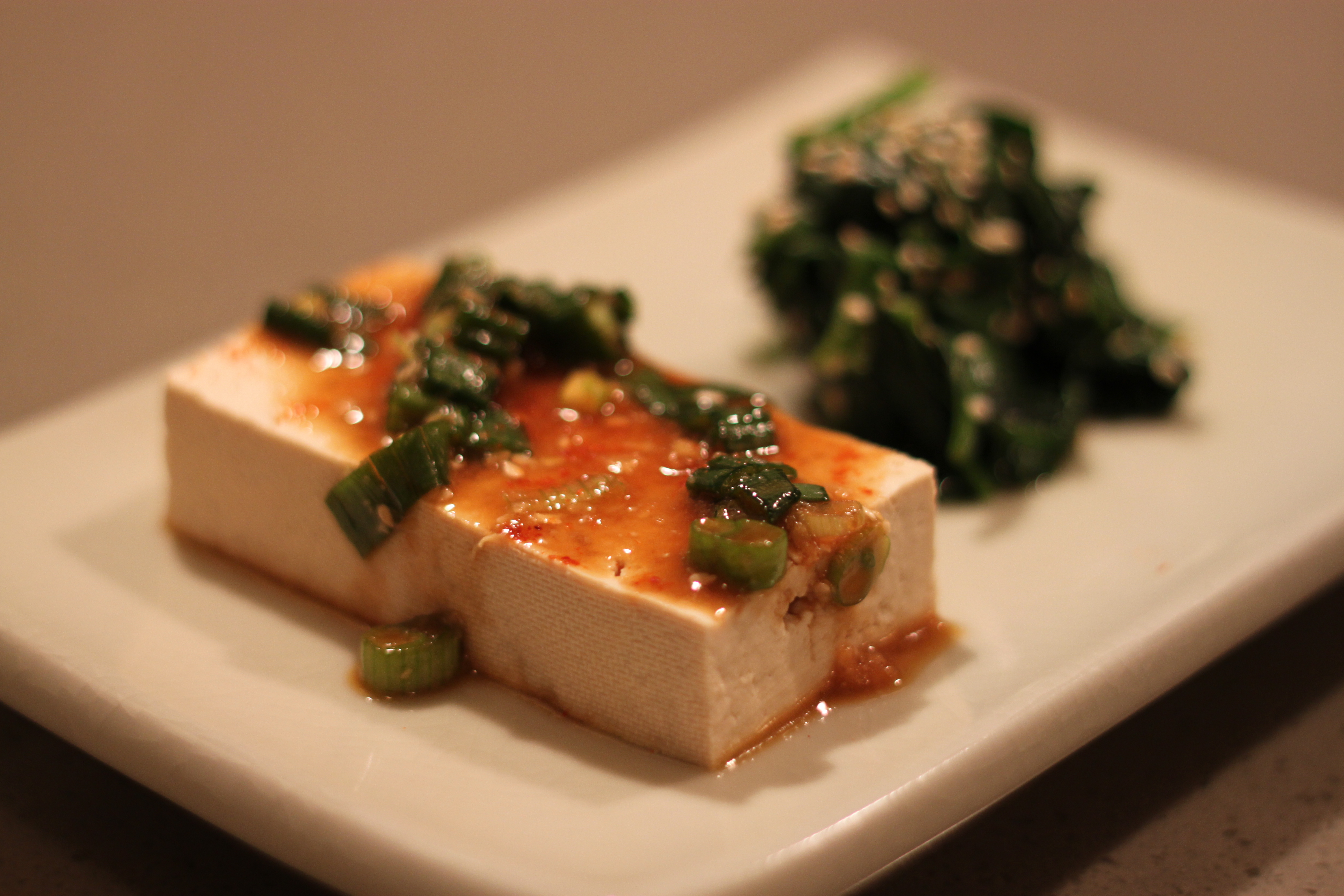
Warm Tofu with Spicy Garlic Sauce, Rice, and Steamed Spinach, Japanese Style

Like many teenage girls, I tried out vegetarianism in high school for about three months. I lost weight, my skin turned an odd(er) shade of white, and all I could think about was turkey croissants and sausage. Although my vegetarian experiment didn’t last long, I still try to eat vegetarian at least once a week. It’s healthy, of course, but also cheap. Tonight’s dinner, made with all organic ingredients, served two adults and one toddler and cost about $6, about the price of a fast-food value meal.

Warm Tofu with Spicy Garlic Sauce
adapted from Gourmet, March 2009

Serves 2 to 3

1 x 15-oz (425‑g) package soft tofu (not silken)
1 small clove garlic, chopped
4 scallions, chopped
2 teaspoons sesame seeds, toasted and crushed with the side of a heavy knife
3 tablespoons soy sauce
1 tablespoon sesame oil
1/2 teaspoon sugar
1 teaspoon coarse Korean hot red pepper flakes or other ground hot pepper

Carefully rinse the tofu, then cover with cold water in a medium saucepan. Bring the water to a simmer over medium-high heat, then keep warm, covered, over very low heat.

Meanwhile, mince and mash the garlic to a paste with a pinch of salt. Stir together the garlic paste with all remaining ingredients except the tofu and hot pepper flakes.

Just before serving, carefully lift the tofu from the saucepan with a large spatula and drain it on paper towels. Gently pat dry, then cut the tofu into 4 to 5 slices. Spoon some sauce over each tofu piece, sprinkle with pepper flakes to taste, and serve warm. Serve the remaining sauce on the side with rice.

***

Steamed Spinach, Japanese Style

Serves 3

9 oz (250 g) baby spinach
1 tablespoon soy sauce
1 tablespoon sesame seeds, toasted

Wash the spinach and drain, but do not dry thoroughly. Place the spinach in a large saucepan and cover with a tight-fitting lid. Cook the spinach over a medium heat until wilted, about 5 minutes. There should be enough water on the spinach to steam it. Toss the cooked spinach with soy sauce and garnish with sesame seeds.