Tag Archives: Pork

Pork Chops with Tomatillo and Green Apple Sauce and Couscous

With only a few weeks left until summer officially arrives in the US, I’ve thrown myself into spring cleaning. The kitchen is my most used, most tidied, but least organized part of my house. It’s hard to thoroughly clean out a room that always seems to have someone in it. In an attempt to use up my food odds and ends so I could wipe down shelves, I took a stab at this admittedly strange-sounding pork chop recipe. I’ll admit that I probably wouldn’t have tried the dish if I didn’t need to use up two aging green apples, a can of tomatillos bought on clearance, a frozen chipotle pepper and a package of pork chops. But necessity is the mother of invention, and in this case, genius. The sweetness of the green apple lends just the right amount of zing to the spice of the chipotle and sour of the tomatillos. It’s pretty enough to serve your mother and unique enough to make for your foodie friends.

To liven up the Israeli couscous, I cooked the couscous according to the package directions, making sure to toast it before adding the liquid. Once cooked, stir in a few tablespoons of minced fresh parsley, a generous drizzle of olive oil, and a handful of grated Parmesan cheese. Don’t forget to season to taste with salt and pepper. I used an Israeli couscous, lentil and quinoa blend, but plain Israeli couscous tastes just as good.

Pork Chops with Tomatillo and Green Apple Sauce
adapted from Gourmet, June 2004

Serves 4 to 6

for the pork chops:
2 tablespoons ground coriander
2 tablespoons ground cumin
2 tablespoons kosher salt
1 tablespoon black pepper
4 tablespoons olive oil
6 x 1‑inch-thick loin pork chops

for the tomatillo and green apple sauce:
12 oz (340 g) canned, whole tomatillos (or 1/2 lb/225 g fresh tomatillos)
2 Granny Smith apples
1/2 cup (10 g) loosely packed fresh cilantro sprigs
1 garlic clove, minced
1 teaspoon ground cumin
2 tablespoons fresh lime juice
1/4 cup (60 ml) water or apple juice
1 tablespoon mild honey
1 minced canned chipotle chile in adobo

Stir together the coriander, cumin, salt, and pepper in a small bowl, then add the oil and stir until combined well. Rub the spice mixture all over the chops. Let the chops marinate while making the sauce.

If using fresh tomatillos, remove the husks and rinse the tomatillos. Boil the tomatillos in water, uncovered, until the tomatillos are just soft, 8 to 10 minutes. Drain and cool for 15 minutes.

Peel and core the apples and cut into 1/4‑inch dice.

Purée the canned (or cooked) tomatillos with the remaining sauce ingredients except the apples in a food processor. Transfer to a bowl and stir in the apples.

Heat a heavy cast iron skillet or ridged grill pan. Lightly oil the surface of the pan, then sear the pork chops over a moderately high heat, turning over once, until well browned and cooked through, about 5 to 6 minutes on each side. Alternatively, you can grill the pork chops over medium heat until done, about 15 minutes total, depending on the thickness of the chop. Serve with the sauce spooned on top.

Brined Pork Loin with Rhubarb Compote and Sauteed Fennel

The food blogging scene in Ireland has been buzzing this past week, ever since Bord Bia (the Irish Food Board) sent out dozens of free pork packs last week ahead of its food blogging event tomorrow. I wanted to do something special with this unexpected gift and was inspired by fellow food blogger Clare Kleinedler’s idea to brine it. I also had some gorgeous organic rhubarb from Denis Healy’s stand at the Drogheda farmers’ market, so I decided to pair the pork with a rhubarb compote. You might think rhubarb and pork sounds like an odd combination, but it’s not all that different from the classic combination of pork with applesauce, plus The Flavor Bible vouches for it. The Flavor Bible also lists rhubarb and fennel and rhubarb and brown sugar as being good matches, so I played on that by serving sauteed fennel bulbs alongside the pork and using brown sugar and fennel seeds in the brine.

As so many of the other Irish food bloggers have already said, the meat was already outstanding to begin with, and brining it meant it was even more moist, tender and flavorful. (The same is true of Kelly’s cider-brined pork chops, which are the best pork chops I’ve ever had.) The herb crust and rhubarb keep the flavors bright and fresh, perfect for springtime. This recipe will make more compote than you’ll need for dinner, but we happily spooned the leftovers on top of yogurt and granola the next morning. A big thank you once again to Bord Bia!

Brined Pork Loin with Rhubarb Compote
pork loin adapted from Bon Appétit, March 2002 and compote from Bon Appétit, April 2005

Serves 8

Make the rhubarb compote while you’re making the brine, and all you’ll have to do the next day is pop the pork into the oven to roast.

for the brined pork loin:
8 cups (approx. 2 liters) water
1/2 cup coarse salt (I used 60 g Maldon sea salt)
1/2 cup (packed) (85 g) golden brown sugar
1 tablespoon fennel seeds
1 tablespoon whole black peppercorns
3 bay leaves
1 x 4 lb (1.8 kg) center-cut boneless pork loin roast
1 tablespoon olive oil
2 teaspoons chopped fresh parsley
2 teaspoons chopped fresh rosemary
2 teaspoons chopped fresh thyme

for the rhubarb compote:
2 lb (900 g) rhubarb, cut into 1‑inch pieces
1 1/4 cups (250 g) sugar
1/3 cup (80 ml) water

To brine the pork, combine the water, salt, sugar, fennel seeds, peppercorns and bay leaves in a large pot. Bring to a simmer over medium heat, stirring to dissolve the salt and sugar. Remove from the heat and allow to cool to room temperature. Transfer the brine to very large bowl and add the pork, weighting the pork down with a plate to keep it submerged). Cover and refrigerate overnight. Drain the pork and return it to the bowl. Cover with fresh water and weight it down again with a plate. Soak at room temperature 2 hours.

Meanwhile, to make the rhubarb compote, combine the rhubarb, sugar and water in a large saucepan. Bring to the boil, stirring until the sugar dissolves. Reduce the heat to medium-low and simmer for about 15 minutes, until the rhubarb is very soft and beginning to fall apart, stirring occasionally. Transfer compote to a bowl and refrigerate, uncovered, until cold, about 3 hours. (Can be prepared 2 days ahead. Cover and keep chilled.)

Position a rack in the top third of the oven and preheat to 350°F (180°C). Drain the pork and pat it dry with paper towels. Transfer to a rack set in a large roasting pan. Rub the pork all over with olive oil, then sprinkle with the fresh herbs, pressing to adhere. Sprinkle generously with freshly ground black pepper. Roast for about 1 hour 40 minutes, until a meat thermometer inserted into the center of the pork registers 150°F (65.5°C). Transfer the pork to a cutting board and cover loosely with foil. Allow the pork to rest for at least 10 minutes, then cut into 1/4- to 1/2‑inch-thick slices. Serve with the compote.

***

Sauteed Fennel

Serves 4

2 fennel bulbs
2 tablespoons (30 g) butter
1 tablespoon olive oil
salt and freshly ground black pepper

Halve the fennel bulbs lengthways, then slice thinly. Heat the butter and olive oil in a pan over a medium heat. Add the fennel and saute for about 10 minutes, until softened. Season to taste with salt and pepper.

Oven-roasted Sausage and Sweet Potato

If you live in Ireland and are at all interested in food, chances are you’ve heard of Donal Skehan, a rising star on the food scene. At only 23 years old, he’s already been blogging for three years at The Good Mood Food Blog and has published a cookbook. Television appearances include Ireland AM, the RTÉ Afternoon Show and Nationwide in Ireland and Market Kitchen in the UK, where he cooked his mojito chicken. In addition to his blog, he’s also a talented food photographer (he took many of the photos for his book) and writes for Irish Tatler magazine and The Cork News newspaper. Last month, he was in Paris cooking for 700 people at Veilleé Foodstock and returned to Ireland in time to scoop the Best Food/Drink Blog award at the Irish Blog Awards. But there’s more! Donal also sings in the pop band Industry, which has had two number-one singles since their debut in 2009, and was a finalist in the Eurovision song contest in 2008. The quote on the cover of Donal’s book from RTÉ says he’s Ireland’s answer to Jamie Oliver, but at the rate Donal’s going, Jamie Oliver should watch out — there’s some stiff competition snapping at his heels across the Irish Sea.

Photo credit: Jocasta Clarke, courtesy of Donal Skehan

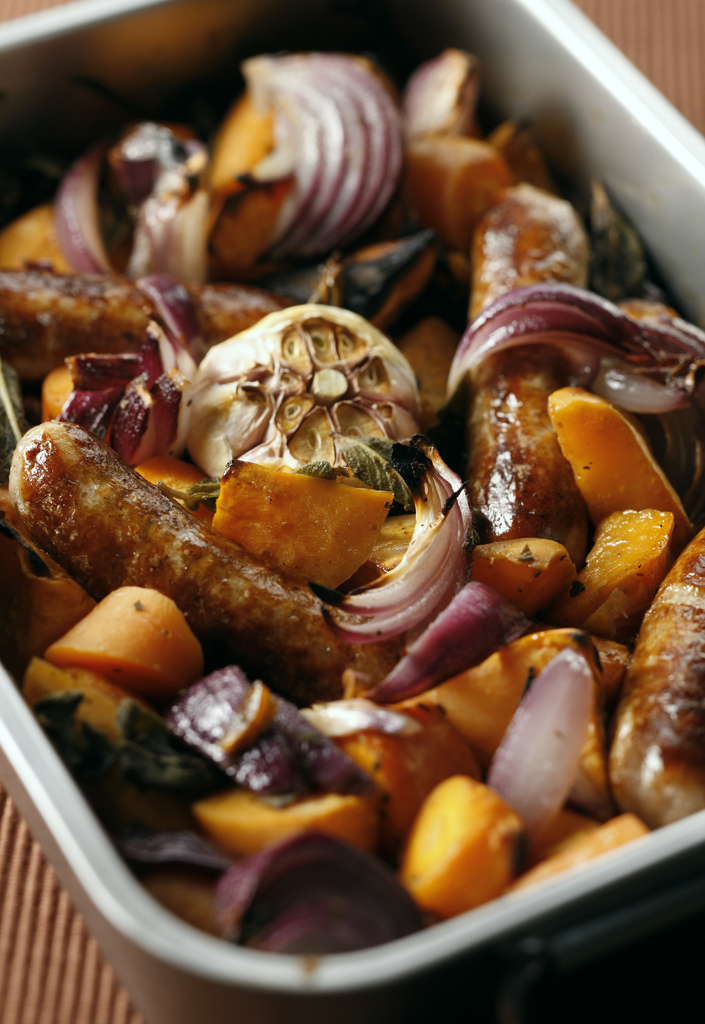
Oven-roasted Sausage and Sweet Potato
adapted from Good Mood Food by Donal Skehan*

Serves 4

Donal says this is a quick all-in-one dinner that can even be prepared ahead of time and then just banged into the oven, making it a perfect midweek supper. Donal’s original recipe calls for 3 fl oz (90 ml) red wine, but I used chicken stock simply because I tend not to have red wine in the house.

8 large, good-quality butcher sausages
4 sweet potatoes, chopped into chunks
2 large carrots, chopped into chunks
3 red onions, quartered
1 garlic bulb, top sliced off
1/2 cup (120 ml) chicken stock
1 tablespoon English mustard powder
1 tablespoon honey
2 teaspoons dried oregano
salt and freshly ground black pepper
a small handful of fresh sage leaves

Preheat the oven to 425°F (220°C). Arrange the sausages in a roasting tin or casserole dish with the sweet potatoes, carrots, red onions and garlic, making sure not to overload the tin. In a measuring jug or bowl, mix together the chicken stock, mustard powder, honey and oregano. Pour the stock mixture over the sausages and vegetables, tossing to make sure everything is coated with the stock. Season with salt (adjust according to how salty your stock is) and pepper and toss again. Scatter over the sage leaves. Roast in the oven for 45 to 55 minutes. Serve straight from the roasting tin, making sure to spoon over any remaining juices.

*Our thanks to Donal for permission to use his recipe and for his generous use of the photo from his cookbook.

Roast Loin of Pork with Fennel and Sauteed Cabbage

For someone who loves to cook, I know it’s surprising to admit that I only cooked a pork tenderloin for the first time this past winter. I put it down to the fact that growing up, our family only ever ate the most basic cuts of meat — lots of boneless, skinless chicken breasts and minced beef, with an occasional pork chop or rump roast. But ever since Kelly wrote about how pork tenderloin is one of her favorite meats to cook and makes for a quick weeknight dinner, I’ve had it in the back of my head to (finally) try it myself.

The first time I cooked a tenderloin, I wasn’t even sure my husband had got the right cut from the butcher when he came home with it, since it didn’t look like the photo in my cookbook (turns out the fat hadn’t been trimmed or the loin tied, like the recipe stated). The second time I cooked one I made this recipe, but even though I remembered to ask the butcher to tie the tenderloin, I forgot to ask him to trim the fat. And what a mistake that was, since it meant the garlicky mustard topping was slathered over the fat instead of directly on the meat, which was a terrible waste (though we still scraped as much as we could off the fat and ate it anyway). But third time’s the charm, and I finally got it right.

I can’t recommend the sauteed cabbage highly enough — I stood at the stove picking at the buttery, salty shreds of cabbage straight from the pan while the pork was resting — but if you want to skip it, then the pork with fennel is an easy roast version of a one-pot dinner. If you can’t find fennel or don’t care for its anise flavor, just leave it out; the dish will still be delicious with just the onions, carrots and potatoes.

Roast Loin of Pork with Fennel
adapted from Barefoot Contessa Parties! by Ina Garten

Serves 6

2 cloves garlic, minced
salt and freshly ground black pepper, plus 1 tablespoon kosher salt
1 tablespoon fresh thyme leaves (or 1 teaspoon dried thyme)
1/4 cup (60 ml) Dijon mustard
1 x 3 lb (1.4 kg) boneless pork loin, trimmed of fat and tied (ask your butcher to do this for you)
3 small fennel bulbs, tops removed
8 carrots, peeled and thickly sliced diagonally
12 baby potatoes, halved or quartered, depending on size
2 large yellow onions, thickly sliced
4 tablespoons olive oil

Preheat the oven to 425°F (220°C).

With a mortar and pestle, or in a food processor fitted with a steel blade, grind together the garlic, 1 tablespoon salt, and thyme leaves. Add the mustard. Spread the mixture over the pork and allow it to sit at room temperature for at least 30 minutes.

Meanwhile, cut the fennel bulbs in thick wedges, cutting through the core. Place the fennel, carrots, potatoes, and onions in a large roasting tin or casserole dish and toss evenly with the olive oil, salt and pepper to taste. Cook for 30 minutes. Add the pork loin to the tin and continue to cook for another 30 to 50 minutes, or until a meat thermometer inserted into the middle of the pork reads exactly 138°F (59°C). Remove the meat from the pan and return the vegetables to the oven to keep cooking, if necessary. Cover the meat with aluminum foil and allow it to rest for 15 minutes. Remove the strings from the meat and slice it thickly. Arrange the meat and vegetables on a platter. Sprinkle with salt and freshly ground pepper to taste. Serve warm.

***

Sauteed Cabbage
adapted from Barefoot Contessa Parties! by Ina Garten

Serves 6

1 small head white cabbage, including outer green leaves (about 2.5 lb/1.1 kg)
2 tablespoons unsalted butter
1 1/2 teaspoons kosher salt
1/2 teaspoon freshly ground black pepper

Cut the cabbage in half and, with the cut-side down, slice it as thinly as possible around the core, as though you were making coleslaw. (Or you could cut the cabbage with the slicing attachment of your food processor.) Discard the core.

Melt the butter in a large saute pan or heavy-bottomed pot over medium-high heat. Add the cabbage, salt, and pepper and saute for 10 to 15 minutes, stirring occasionally, until the cabbage is tender and begins to brown. Season to taste and serve warm.

Jambalaya with Shrimp and Ham with Toasted Garlic Kale

In celebration of Mardi Gras, Reuben cooked up a great pot of jambalaya. Out of the million and one versions of this classic Cajun cuisine, this one is my favorite. It’s low fat, cooks in one pot, and is a great way to use up leftover ham. The kale provides a burst of color and an extra serving of vegetables — very needed in my household as we struggle through the recent exchange of sicknesses between the kids. Much to our surprise, our 8‑month-old devoured her kale. Pretty impressive, Anabelle, but you’re still too young for beads.

Jambalaya with Shrimp and Ham
adapted from Ellie Krieger

Serves 4

1 tablespoon olive oil
1 large onion, diced
1 red bell pepper, diced
1 green bell pepper, diced
2 cloves garlic, minced
1/2 teaspoon salt, plus more, to taste
1/4 teaspoon freshly ground black pepper, plus more, to taste
1 teaspoon paprika
1/2 teaspoon dried oregano
1/2 teaspoon dried thyme
1 bay leaf
1/4 teaspoon cayenne pepper
1 tablespoon tomato paste
6 oz (170 g) diced, smoked ham
2 1/2 cups (600 ml) low sodium chicken broth
1 x 14-oz (400‑g) can diced tomatoes
1 cup (180 g) uncooked long-grain white rice
1 lb (450 g) peeled and deveined medium shrimp (tail-on preferred)
hot pepper sauce

Heat the oil in a large Dutch oven over a medium heat. Add the onion, peppers and garlic and saute until they begin to soften, about 10 minutes. Mix in the next 11 ingredients (salt through the diced tomatoes). Bring to a boil. Stir in the rice, cover, reduce heat and simmer for about 20 minutes, or until rice is done and most of the liquid is absorbed. Add the shrimp and cook, covered, for 5 minutes more, or until shrimp is cooked through. Season with salt and pepper, to taste. Serve with hot pepper sauce.

***

Toasted Garlic Kale

Serves 2 to 3

1 bunch kale, washed and roughly chopped
3 tablespoons olive oil
2 cloves garlic, minced

Bring a large pot of water to a boil. Salt the water as you would for cooking pasta. Add the chopped kale and simmer for 4 to 5 minutes, until the kale turns bright green. Immediately drain the kale and rinse with cold water.

In a large saute pan, heat the olive oil over a medium heat but do not let the oil smoke. Add the garlic and saute, stirring frequently, until the garlic just begins to turn golden. Add the drained kale to the oil and garlic, lower the heat, and saute until the kale is tender. Season to taste with salt and pepper.

Coca-Cola Ham, Parmesan Smashed Potatoes, and Roasted Beets with Greens and Goat Cheese

I’ve sworn off high fructose corn syrup (HFCS) for a few years now. My HFCS ban is one of the reasons I started cooking more of my own meals. At least in the United States, it’s pretty difficult to avoid HFCS in processed or convenience foods. Soda — or pop, depending on where you live — was one of the easier HFCS products to cut. I had already succumbed to the Diet Coke craze during college, like so many other calorie-conscious co-eds. Which is all a long way of saying that I’ve had a 2‑liter bottle of Coca-Cola perched on my fridge for a few months that I certainly wasn’t going to drink. I also have a freezer of pork, including several hams, begging to be eaten. It all came together to form a perfect “excuse” to make the ham in cola recipe that Kristin sheepishly sent me a few weeks ago. Despite my reservations, the ham turned out beautifully, just as Kristin promised it would.

Ham in Coca-Cola
adapted from Nigella Bites by Nigella Lawson

Serves 8

for the ham:
1 x 4 1/2‑lb (2‑kg) ham
1 onion, peeled and cut in half
1 x 2‑liter bottle cola (recommended: Coca-Cola)

for the glaze:
1 heaped tablespoon honey
2 teaspoons English mustard powder
2 tablespoons Demerara (raw cane sugar) or granulated brown sugar

For the ham: Place the ham and the onion into a large pot or Dutch oven and pour the cola on top. On a medium-high heat, allow the cola to come to a boil. Reduce the heat to medium-low and cover with a lid, though not tightly, and allow to cook for 2 1/2 hours (1 hour for every 2 lb/900 g).

Preheat the oven to 500°F (240°C).

For the glaze: Pull the ham from the pot and allow it to rest on a cutting board, reserving the cooking liquid if you want to make Nigella’s South Beach Black Bean Soup. Using a sharp knife, trim the skin, leaving a thin layer of fat on the ham. Using the knife, score the fat diagonally into large diamond cuts. Spread the honey over the meat. Gently pat the powdered mustard and sugar around the meat, so it sticks to the honey. Gently place the ham in a roasting pan (lined with aluminum foil for easier clean-up). Cook the ham for about 10 minutes, or until the glaze is burnished and bubbly.

To braise the ham in advance and then let it cool, take the ham from the refrigerator, glaze it according to the recipe, and allow it to sit at room temperature for 30 to 40 minutes. Place in a 350°F (180°C) oven for 30 to 40 minutes,  turning up the heat if you think it needs a more crispy exterior.

***

Parmesan Smashed Potatoes
adapted from the The Barefoot Contessa Cookbook by Ina Garten

Serves 8

4 lb (1.75 kg) red new potatoes, unpeeled
1 tablespoon kosher salt, plus 2 teaspoons
1 cup (240 ml) half-and-half (or half milk, half cream)
1/4 lb (110 g) unsalted butter
1/2 cup (50 g) freshly grated Parmesan
1/2 teaspoon ground black pepper

Place the potatoes and 1 tablespoon of salt in a 4‑quart saucepan and add cold water to cover. Bring to a boil, lower the heat and simmer covered for 25 to 35 minutes, until completely tender. Drain.

In a small saucepan, heat the half-and-half and butter. Put the potatoes into the bowl of an electric mixer fitted with a paddle attachment and mix the potatoes for a few seconds on low speed, to break them up. Slowly add the hot cream and butter to the potatoes, mixing on the lowest speed (the last quarter of the cream should be folded in by hand). Fold in the Parmesan cheese and the remaining salt and pepper; taste for seasoning and serve immediately. If the potatoes are too thick, add more hot cream and butter.

***

Roasted Beets with Greens and Goat Cheese

Serves 6

2 bunches beets with greens, washed well
8 tablespoons olive oil, divided
2 cloves garlic, minced
2 oz (60 g)  goat cheese, crumbled

Preheat the oven to 400°F (200°C). Remove the greens from the beets and set aside. Toss the beets in 5 tablespoons of olive oil, then wrap in aluminum foil. (I usually place 2 to 3 beets in each foil packet.) Roast until tender, 60 to 90 minutes, depending on the size of the beets. Remove from the oven and allow to cool for 15 to 20 minutes before peeling and quartering the beets. If the beets are very large, cut into 1‑inch pieces instead of quartering them.

While the beets cool, roughly chop the beet greens. Heat the remaining 3 tablespoons of olive oil in a large skillet over a medium heat. Add the garlic and cook for about 1 minute, until fragrant but not browned. Stir in the beet greens and saute, stirring frequently, for about 10 minutes, until they’re wilted and tender. If the greens begin to scorch, add a tablespoon or so of water or cover with a lid. Season the greens to taste with salt and pepper.

To serve, spoon the greens onto a plate, top with roasted beets and then crumbled goat cheese.

Green Chile Pork Tacos and Devil’s Food Cupcakes with Vanilla Buttercream Frosting

“I have a great idea, Mom.”

“What’s that, Sam?”

“I know, let’s make chocolate muffins. With whipped cream. And sprinkles.”

Some days, folks, that all the encouragement I need to grab the sugar from the cupboard and butter from the fridge. It didn’t hurt that our main course required little more than a few minutes of prep and the able assistance of my (er, Reuben’s) new slow cooker.

Green Chile Pork Tacos

Serves 6

3 lb (1.4 kg) pork shoulder, cut into 2‑inch cubes
2 tablespoons olive oil
1 large onion, chopped
1 teaspoon ground cumin
1 teaspoon dried oregano
1 cup (240 ml) chicken stock
1 x 4‑oz (110‑g) can diced green chilies
1 x 10-oz (280‑g) can Rotel tomatoes (or other diced tomatoes with green chilies)
3 cloves garlic, minced
1 teaspoon salt
1/2 teaspoon pepper
corn or flour tortillas
toppings: avocado, salsa, cheese, green onion, cilantro, pickled jalapenos, lime wedges

In a large frying pan, brown the pork cubes in the oil until they just begin to brown. Drain the meat and place into a slow cooker. Add the remaining ingredients through salt and pepper and cook on low until the pork is tender, about 8 hours. Gently shred the pork with a fork.

Warm the tortillas and serve the pork, taco-style, with desired toppings.

***

Devil’s Food Cupcakes
adapted from Alpineberry

Makes 1 dozen

1 1/2 cups (180 g) all-purpose flour
1 cup (200 g) granulated sugar
1/4 cup (30 g) unsweetened natural cocoa powder (don’t use Dutch-processed cocoa)
1 teaspoon baking soda
1/2 teaspoon salt
1 cup (240 ml) water
1/3 cup (80 ml) unflavored oil (canola, grapeseed, etc.)
1 tablespoon white or apple cider vinegar
1 teaspoon vanilla extract

Preheat the oven to 350°F (180°C). Line the wells of a standard muffin pan with paper liners.

Sift the flour, sugar, cocoa, baking soda and salt into a large mixing bowl. In another bowl, mix together the water, oil, vinegar and vanilla. Add the wet to the dry ingredients and mix until just combined and the batter is smooth. Be careful not to overmix.

Divide the cupcake batter evenly among the wells of your muffin pan. Bake for about 20 to 25 minutes, or until the cupcakes feel springy when gently pressed. Cool in the pan for 5 minutes, then gently remove the cupcakes from the pan and allow to cool fully on a wire rack.

Vanilla Buttercream Frosting
adapted from Magnolia Bakery

Makes enough for one 2‑layer 9‑inch cake or 2 dozen cupcakes [Note: I halved recipe for 1 dozen cupcakes]

1 cup (225 g) unsalted butter, softened
6 to 8 cups (720 g to 960 g) confectioners’ sugar (a.k.a. icing sugar)
1/2 cup (120 ml) milk
2 teaspoons vanilla extract

Place the butter in a large mixing bowl. Add 4 cups (480 g) of the sugar and then the milk and vanilla. On the medium speed of an electric mixer, beat until smooth and creamy, about 3 to 5 minutes. Gradually add the remaining sugar, 1 cup (120 g) at a time, beating well after each addition (about 2 minutes), until the icing is thick enough to be of good spreading consistency. You may not need to add all of the sugar. If desired, add a few drops of food coloring and mix thoroughly. Use and store the icing at room temperature because icing will set if chilled. Icing can be stored in an airtight container for up to 3 days.

Pork Chops and Roasted Potatoes with Blue Cheese Dressing

Last week I admitted to getting cable just so I could watch the Barefoot Contessa’s shows, but an unexpected bonus has been discovering Tyler Florence on the Food Network. He’s a real meat-and-potatoes kind of guy, but all taken to the next level. This dish is a case in point — what would otherwise be a forgettable pork chop and roasted potato is transformed into something tantalizing simply by adding a blue cheese dressing. So far I’ve wanted to make just about everything I’ve seen on his show, and invariably my husband comments that he wouldn’t complain if I made whatever Tyler’s cooking on TV. This is an easy weeknight dinner, requiring only a bit of chopping for the potatoes and any vegetable you want to serve, a quick stir to make the dressing and 10 minutes spent at the stove to fry the pork chops.

Since you’ll already have the oven on at a high heat for roasting the potatoes, a roasted vegetable would be a good choice to serve alongside the pork and potatoes. Roasted beets would complement the flavors in the blue cheese well, or you could try roasted winter vegetables, roasted parsnips and carrots, roasted squash, roasted broccoli or roasted Brussels sprouts.

Pork Chops and Roasted Potatoes with Blue Cheese Dressing
adapted from Tyler Florence

Serves 4

2 lb (900 g) baby potatoes, cut in half through the equator
extra virgin olive oil
salt and freshly ground black pepper
4 thick pork chops (about 3 lb/1.4 kg) total
1 bunch fresh mint, leaves only

for the blue cheese dressing:
1/2 cup (100 g) crumbled blue cheese
1/2 cup (120 ml) buttermilk
2 tablespoons olive oil
2 tablespoons fresh lemon juice
salt and freshly ground black pepper
1 bunch fresh chives, minced

Preheat the oven to 400°F (200°C). Pour enough olive oil in a roasting tin, baking sheet or casserole dish to coat the bottom, then place the tin in the oven to heat the oil.

Bring a pot of salted water to boil. Add the potatoes to the boiling water and boil for 5 minutes, then drain. Add the parboiled potatoes to the hot oil in the roasting tin, stirring well to ensure all the potatoes are coated with oil. Season well with salt and pepper, then roast in the oven for 30 minutes.

To make the dressing, put the cheese, buttermilk and olive oil in a small bowl and stir together with a fork, mashing a little to break up the cheese. Season with the lemon juice, salt, pepper, and chives.

When the potatoes have cooked for 20 minutes, season the chops with salt and pepper. Put a large saute pan over medium heat, add a splash of olive oil, and heat until it begins to smoke. Add the pork chops and saute until golden brown on the outside and just barely pink inside, 4 to 6 minutes on each side.

To serve, put a chop on each of 4 plates. Put the potatoes in a bowl and drizzle with the dressing. Add the mint and toss. Set one portion of the potatoes on top of each chop and serve.