Tag Archives: Pork

Oven-roasted Ratatouille with (or without) Sausages

I saw recipes for ratatouille for years and always flipped right by them in my cookbooks. A stew of nothing but vegetables sounded bland and boring to me — and this from someone who was a vegetarian for a time. It was only when I came across this recipe for Italian sausages and ratatouille that I was tempted to finally give it a try. I couldn’t believe how good it was, and kicked myself for not making it sooner. It’s the kind of dish that’s definitely more than the sum of its parts. While the sausages do impart an extra depth of flavor to it — especially if you get high-quality butcher sausages like pepper and herb, or my favorite, the Guinness sausages my local butcher makes — I’ve since made this just as often without them, and it’s equally as good. It’s the perfect dinner for late summer, when all these vegetables are readily available. I always make this on the day I get my delivery of organic fruit and veg, when everything is fresh and perfect.

There are so many versions of this classic dish out there. Most call for fresh tomatoes, as does this one, but to be honest, I just use canned tomatoes 99% of the time. Some use fennel, green peppers, wine or balsamic vinegar. Some use basil, marjoram, parsley or herbes de Provence. Almost all of them sauté the vegetables in batches in separate pans (I roast them because it’s easier). In other words, pretty much anything goes — use what you have or what you like and you can’t go too far wrong.
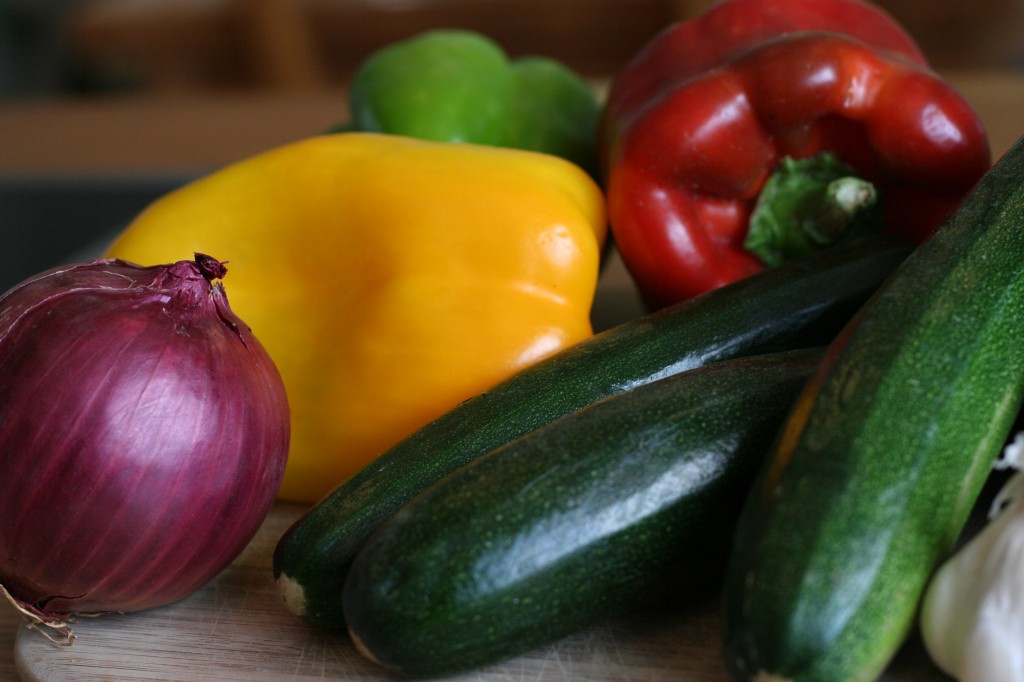
vegetables destined for ratatouille

Still looking for more ways to use up tomatoes? Try Chicken Cacciatore, Tomato and Goat’s Cheese Tart, Ravioli and Tomato Salad, Spaghetti with Fresh Tomato Sauce or Spaghetti with Roast Cherry Tomatoes, Chili and Basil.

Oven-roasted Ratatouille with (or without) Sausages

Serves 6

4 medium zucchini, chopped into bite-sized pieces
3 small eggplants, chopped into bite-sized pieces
3 red or white onions, chopped into bite-sized pieces
2 red peppers, deseeded and chopped into bite-sized pieces
2 yellow peppers, deseeded and chopped into bite-sized pieces
olive oil
salt and freshly ground black pepper
3 cloves garlic, chopped
2 x 14 oz (400 g) cans of chopped tomatoes
a few sprigs of fresh thyme (if you have it), chopped
2 sprigs of fresh rosemary, chopped
12 good-quality butcher sausages (allow 2 sausages per person)

Preheat the oven to 400°F (200°C).

Place the chopped zucchini, eggplants, onions and peppers on 2 baking sheets. Drizzle with olive oil and season well with salt and freshly ground black pepper. Toss the vegetables with your hands to ensure they’re all coated with the oil. Roast the vegetables in the oven for about 30 minutes, until they have blackened slightly, taking care not to let anything burn.

About 10 minutes before the vegetables are done roasting, heat 1 tablespoon of olive oil in a large pot (big enough to eventually hold all the vegetables, tomatoes and sausages, if you’re using them) over a medium heat. Add the garlic and cook for 1 minute, taking care not to let it burn. Add the tomatoes, chopped herbs and salt and freshly ground pepper and ring to the boil. Reduce the heat and simmer, uncovered, while the vegetables finish roasting.

Once the vegetables are done, add them to the pot with the tomatoes and stir to combine. Nestle the sausages into the vegetables and sauce, making sure they are immersed in the sauce as much as possible. Cover the pot halfway and continue to simmer on a medium-low, stirring occasionally so that nothing burns on the bottom, for about 30 minutes, until the sausages are cooked through and the flavours have blended together. Season to taste. Serve with crusty bread, or spooned on top of pasta as a sauce.
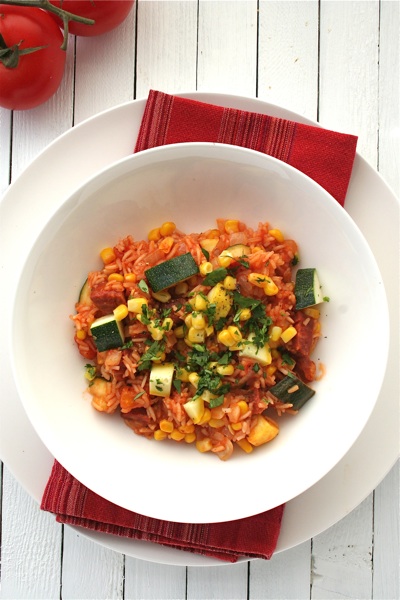
Mexican Rice Supper with Chorizo, Zucchini and Corn

You can learn a lot from reading cookbooks. By that I don’t mean just reading the recipes, but the surrounding text as well, where some good tips can be hidden. It was from Nigella Lawson’s How to Eat that I learned the great trick of substituting vermouth when a recipe calls for white wine, for the simple reason that if I open a bottle of wine to add some to whatever I’m cooking, the rest of it is going to be drunk that night. That’s not necessarily a problem, except that I like to cook with wine and that can get expensive, whereas you just need a splash of vermouth for the same effect and one bottle will last for a couple months.

Another invaluable trick is one I learned from Rick Balyess’s Mexican Kitchen: deflaming onions. I’ve never been a fan of raw onions, finding them to be too overpowering in most dishes, but deflaming them takes a lot of the bite out of them. All you do is prepare the onion as your recipe says to, then toss the cut-up onion into a strainer and rinse well under cold water. I do this all the time now.

This is a great one-dish dinner on its own, though Rick Bayless suggests pairing it with some dressed greens (try the Tangy Avocado Dressing) or a spinach salad, warm tortillas, and perhaps a small bowl of beans for, as he says, “a supper to savor.” If you’re really in the spirit of the summer season, use the kernels from 1 ear of fresh corn here.

Mexican Rice Supper with Chorizo, Zucchini and Corn
adapted from Rick Bayless’s Mexican Kitchen by Rick Bayless

Serves 4

If you have your own favorite salsa recipe, then by all means use that instead here. If you don’t want to bother making your own salsa, just substitute 2 cups (480 ml) of a good store-bought one. This dish can be made a day ahead, though the zucchini will suffer a bit in the reheating.

for the salsa:
2 medium round tomatoes or 4 to 6 plum tomatoes, chopped into 1/4‑inch dice
1 or 2 red chilies (or 3 to 5 fresh Serrano chilies), deseeded and finely chopped
1 large garlic clove, finely chopped
3 tablespoons chopped cilantro, plus extra to garnish
1 small onion, finely chopped

for the rice:
1 cup (225 g) chorizo sausage, casing removed
1 cup (180 g) rice, preferably medium grain
3/4 cup (175 ml) chicken, beef or vegetable stock (or water)
salt and freshly ground black pepper
2 small zucchini, cut into 1/2‑inch dice
1 cup (200 g) corn

To make the salsa, mix together the tomatoes, chillies, garlic and cilantro. Place the chopped onion into a strainer, rinse under cold water, shake off the excess and add to the mixture.

To make the rice, break up the chorizo into a medium heavy-bottomed saucepan (it will need to be big enough to accommodate all the ingredients) and set over a medium heat. Stir regularly, breaking up any lumps, until the chorizo is thoroughly cooked, about 10 minutes. Remove it with a slotted spoon, then pour off all but 1 tablespoon or so of the fat. Add the rice to the pan, return to the heat and stir regularly until the rice is lightly browned, about 7 minutes. Add the salsa, raise the heat to medium-high and cook, stirring every once in a while, until very thick and reduced, about 7 minutes.

While the mixture cooks, bring the stock (or water) to a boil in a small saucepan. Add to the rice mixture, stir once, scrape down any rice kernels clinging to the side of the pan, cover and cook over a medium-low heat for 10 minutes.

Add the cooked chorizo, zucchini and corn, re-cover and cook 5 minutes longer. Uncover and bite into a grain of rice: it should be nearly cooked through. If the rice is ready, turn off the heat, cover, and let stand for 5 to 10 minutes longer to complete the cooking. If the rice seems far from done, continue cooking for 5 minutes or so, retest, then turn off the heat and let stand for a few more minutes.

Divide into 4 warmed bowls, sprinkle with the extra cilantro, and serve.

Stuffed Pork Tenderloin on Grape Tomatoes, Middle Eastern Couscous with Saffron, Green Beans, and Lemon Bars

Regretfully, I forgot to take a picture of this dish. Trust me, it looks as good as it tastes. The colors are amazing. Frankly, it smelled too good for me to wait even 5 minutes to snap a blog-suitable photo of it. So you get a picture of dessert instead, taken at leisure after dinner was finished.

Pork tenderloin is one of my favorite meats to cook. It cooks quickly, stays tender, and can be used in a variety of dishes. Though I try to keep a tenderloin in my freezer for quick weeknight dinners, this stuffed preparation would make an impressive dinner party offering. No one will guess how easy it is to make. For the green beans, simply boil or steam them for a few minutes until they are tender.

Stuffed Pork Tenderloin on Grape Tomatoes

adapted from More Fast Food My Way by Jacques Pepin

Serves 4

4 tablespoons good olive oil
1 small onion, chopped
1 bunch (about 12 oz/340 g) fresh spinach, washed, dried and stems removed
3/4 teaspoon salt
3/4 teaspoon freshly ground black pepper
1 large pork tenderloin (about 1 1/2 lb/680 g)
about 3/4 cup (90 g) grated cheddar cheese
1 box grape tomatoes (about 12 oz/340 g)

Heat 2 tablespoons of the olive oil in a large skillet over a high heat. Add the onion and cook for 2 minutes. Add the spinach, pushing it down into the skillet, and 1/4 teaspoon each of the salt and pepper. Cover and cook over a medium heat for about 1 1/2 minutes, until the spinach is wilted. Remove the lid and cook, uncovered, until the liquid from the spinach has evaporated. Transfer to a plate and allow to cool.

Trim the tenderloin of any fat and silver skin. To butterfly the tenderloin for stuffing, lay it flat on the cutting board so one end is close to you and the other end is near the top of the board. Holding your knife so the blade is parallel to the board, cut through the long side of the tenderloin, stopping when you are about 1/2 inch from the other side. Turn the tenderloin so the uncut side is closest to you and make another parallel cut below the first one, again stopping about 1/2 inch before you reach the other side. Open up the butterflied tenderloin and pound it a little to extend it to about 12 inches long by 7 inches wide.

Preheat the oven to 350°F (180°C). Arrange half the spinach mixture down the center of the butterflied tenderloin and top with the cheese. Add the rest of the spinach, fold in the sides, and roll the tenderloin back and forth to evenly distribute and encase the filling. Wrap 4 pieces of kitchen twine, each 6 to 7 inches long, around the tenderloin to secure the stuffing inside.

Heat the remaining 2 tablespoons oil in a large ovenproof nonstick skillet. Sprinkle the outside of the tenderloin with 1/4 teaspoon each of the salt and pepper. Place the tenderloin carefully in the skillet and brown it, turning occasionally, for about 5 minutes. Bake the tenderloin in the oven for 10 to 12 minutes, when it will be slightly pink in the center. Carefully remove the kitchen twine from the tenderloin. Transfer the tenderloin to a plate, cover, and keep warm in the oven while you prepare the tomatoes (the pork will continue to cook as it sits).

Add the tomatoes and the remaining 1/4 teaspoon each salt and pepper to the skillet in which you browned the tenderloin and sauté over high heat for 2 minutes, until just softened. Divide among 4 warm plates. Slice the tenderloin crosswise into 8 medallions and arrange 2 slices in the middle of the tomatoes on each plate. Serve.

***

Middle Eastern Couscous with Saffron
adapted from More Fast Food My Way by Jacques Pepin

Serves 4

2 tablespoons good olive oil
1 small onion, finely chopped
1/4 cup (about 20 g) pine nuts
1/2 teaspoon crushed saffron pistils
1 1/2 cups (225 g) Israeli couscous
1 3/4 cups (415 ml) chicken broth
1/4 teaspoon salt
1/4 teaspoon pepper

Heat the oil in a medium saucepan over high heat and add the onion, pine nuts, and saffron. Cook for 1 to 2 minutes, then add the couscous and mix well. Add the stock, salt, and pepper, mix well, and bring to a boil. Reduce the heat to very low, cover, and cook for 10 minutes. Uncover and cook over a medium heat, stirring occasionally, for 1 to 2 minutes longer to dry the grains and make them fluffy.

***

Lemon bar

Lemon Bars
from Gourmet, March 1999

makes 24 bars

These bar cookies will keep, covered and chilled, for 3 days.

1 1/2 sticks (3/4 cup/170 g) unsalted butter
2 cups (220 g) all-purpose flour
1/2 cup (100 g) packed light brown sugar
1/2 teaspoon salt
4 large eggs
1 1/2 cups (340 g) granulated sugar
3/4 cup (175 ml) fresh lemon juice (I used the juice from 2 lemons and 2 limes)
1/3 cup (40 g) all-purpose flour
3 tablespoons confectioners’ sugar

Preheat the oven to 350°F (180°C).

Cut the butter into 1/2‑inch pieces. In a food processor, process all ingredients until the mixture begins to form small lumps. Sprinkle the mixture into a 13 x 9 x 2‑inch baking pan and with a metal spatula press evenly onto the bottom. Bake the shortbread in the middle of the oven until golden, about 20 minutes. Set aside.

While the shortbread is baking, prepare the topping. In a bowl, whisk together the eggs and granulated sugar until combined well, then stir in the lemon juice and flour. Pour the lemon mixture over the hot shortbread. Reduce the oven temperature to 300°F (150°C) and bake in the middle of the oven until set, about 30 minutes. Cool completely in the pan and cut into 24 bars. Sift confectioners’ sugar over the bars before serving.