Category Archives: Poultry

Collard Greens with Smoked Turkey and Sweet Potato Hash with Bacon

I grew up in Texas and, despite my Illinois born and bred Yankee parents, I developed a true love for Southern soul food. I crave okra, gumbo, hush puppies, and barbecue all the more because it’s hard to find these culinary gems here in Milwaukee. Of all the things I crave, however, collard greens are the dish I cook the most. Not having grown up in a household where greens were ever eaten, much less cooked, it took many years of experimentation before I found a tried and true method for cooking them. Years ago, an elderly gentleman in our local supermarket stopped me as I was examining a bunch of collard greens to ask if I was buying the greens for myself. I told him they were for me and he promptly asked if I knew how to make them. I told him my back story (Texas transplant) and admitted that I had yet to master this seemingly simple dish. He made me promise to try simmering my greens with smoked turkey and, voilà!, I finally had a collard greens recipe worth sharing.

Collard Greens with Smoked Turkey

Serves 8 as side dish, 4 as main course

1 smoked turkey leg
6 cups (1.5 liters) water
1 onion, diced
2 bunches collard greens
1/2 teaspoon red chili flakes
1 clove garlic, minced
salt and freshly ground black pepper, to taste
vinegar and hot sauce, to serve

Combine the turkey, water and onion in a large stock pot set over a medium-high heat. Bring the water to a boil, then reduce the heat and simmer for 30 to 60 minutes.

While the turkey “broth” simmers, wash the collard greens. Remove the large stems from the greens and slice each leaf crosswise into 1/2‑inch strips. To speed up this process, I stack 2 to 3 destemmed leaves together, roll them up crosswise into “cigars”, then slice each “cigar” into strips. Rewash the greens again to remove any remaining grit.

Add the greens to the turkey “broth”, pushing them down until they are completely submerged. Stir in the red chili flakes and garlic. Simmer the greens until they’re very tender, about 2 hours. Add salt and pepper to taste. I usually add about 1 teaspoon of salt. Please note that you’ll need to taste the “broth” before adding the salt. Some smoked turkey is very salty and won’t need much, if any, salt.

Before serving, remove the meat from the turkey leg and pull into bite-sized pieces. Serve the greens in bowls, topped with the turkey pieces, a splash of vinegar, and hot sauce.

***

Sweet Potato Hash with Bacon
adapted from Gourmet, October 2007

Serves 6 as side dish

1/2 lb (225 g) sliced bacon, cut into 1/4‑inch strips
2 medium onions, chopped
1 large red bell pepper, cut into thin strips
salt and freshly ground black pepper
2 lb (900 g) sweet potatoes, peeled and cut into 1/2‑inch cubes
1 teaspoon chopped fresh thyme

Cook the bacon in a 12-inch nonstick skillet over a medium heat until crisp. Transfer to paper towels to drain, reserving the fat in skillet.

Add the onions, bell pepper, 1/2 teaspoon salt, and 1/2 teaspoon pepper to the skillet and cook, stirring occasionally, until the vegetables are softened. Stir in the potatoes and another 1/2 teaspoon of salt and cook, covered, stirring occasionally, until the potatoes are tender and starting to brown, 10 to 14 minutes. Stir in the thyme, bacon, and more salt and pepper to taste.

Herb-roasted Turkey with Shallot Pan Gravy, Thanksgiving Stuffing, Buttermilk Mashed Potatoes, and Honeyed Pecan Pie

This year is my first time to host Thanksgiving. In fact, except for the Christmas when I was 9+ months pregnant and didn’t dare venture away from my doctor, I’ve never hosted a major holiday, so I was really excited to spend some time researching recipes and planning our menu. Luckily, my sister-in-law and mother-in-law are also cooking dishes  so I won’t be overwhelmed with cooking. Unlike Kristin, except for the pecan pie, I haven’t made any of my Thanksgiving recipes but they sound good to me and, almost as important, they don’t seem too time consuming. Speaking of time, for those of you who are also planning your menus right now, I’ll lay out my game plan. Sunday, shop for all beverages and groceries. Monday, wash table linens and polish candlesticks. Tuesday, make herb butter (for turkey), clean house. Wednesday, bake pie and cornbread, cube cornbread and French bread (for stuffing). Thursday, put turkey in the oven, set table, prepare remaining dishes, pour glass of wine and enjoy!

Herb-roasted Turkey with Shallot Pan Gravy
from Bon Appétit, November 2000

Serves 10

3/4 cup (180 g) butter, room temperature
3 tablespoons chopped fresh parsley plus 3 whole sprigs
2 tablespoons chopped fresh sage plus 3 whole sprigs
2 tablespoons chopped fresh thyme plus 3 whole sprigs
3/4 teaspoon salt
1/2 teaspoon coarsely ground black pepper
1 x 15- to 16-lb (7‑kg) turkey, rinsed and patted dry
1 1/2 lb (680 g) shallots, peeled and halved lengthwise through root end
3 cups (720 ml) (or more) low-sodium chicken broth
1 cup (240 ml) dry white wine
2 tablespoons all-purpose flour

Mix the butter, chopped parsley, chopped sage, chopped thyme, 3/4 teaspoon salt and 1/2 teaspoon pepper in a medium bowl to blend. (This can be prepared 3 days ahead. Transfer the herb butter to a small bowl; cover and refrigerate. Bring the butter to room temperature before using.) Position a rack in the bottom third of the oven and preheat to 350°F (180°C). Sprinkle the main cavity of the turkey with salt and pepper. Place the whole parsley, sage and thyme sprigs and 4 shallot halves in the cavity. Starting at the neck end, carefully slide your hand between the skin and breast meat to loosen the skin. Spread 3 tablespoons herb butter over the breast meat under the skin. Tuck the wing tips under, then tie the legs together to hold their shape. Place the turkey on a rack set in a large roasting pan. Rub 4 tablespoons of the herb butter over the turkey. Cover only the breast area of the turkey with a sheet of heavy-duty foil. Scatter the remaining shallots in the pan around the turkey.

Roast the turkey for 30 minutes, then baste with 1/2 cup (120 ml) broth. Continue roasting the turkey for 1 1/2 hours, basting with 1/2 cup (120 ml) broth every 30 minutes. Remove the foil from over the turkey breast. Continue to roast the turkey until golden brown and a thermometer inserted into the thickest part of the thigh registers 180°F (80°C), basting with pan juices every 20 minutes, for about 1 hour longer. Transfer the turkey to a platter. Brush with 1 tablespoon of herb butter. Tent loosely with foil and let stand 20 minutes.

Using a slotted spoon, transfer the shallots from the roasting pan to a plate. Pour the pan juices into a medium bowl; spoon off the fat and discard. Add the wine and 1 cup (240 ml) of chicken broth to the roasting pan. Set the pan directly over 2 burners and bring the broth mixture to a boil, scraping up any browned bits. Continue to boil until reduced by half, about 3 minutes; pour into a large glass measuring cup. Add the degreased pan juices. Add enough broth, if necessary, to equal 3 cups (720 ml) liquid.

Blend the flour into the remaining herb butter. Pour the broth mixture into a heavy medium saucepan and bring to a boil. Gradually whisk in the herb butter mixture. Add any accumulated juices from the turkey platter. Boil until the gravy thickens enough to coat a spoon lightly, whisking occasionally, about 6 minutes. Add the shallots to the gravy and simmer for 1 minute. Season the gravy with salt and pepper. Serve the turkey with the gravy.

***

Thanksgiving Stuffing
from The Pioneer Woman 

Serves 10

1 pan of cornbread
1 loaf French bread, somewhat crusty
1 stick (110 g) butter
1 whole medium onion, diced
2 cups (250 g) celery, chopped
4 cups (1 liter) low-sodium chicken broth
1/4 cup (10 g) chopped fresh parsley
2 to 3 teaspoons fresh chopped rosemary
1/2 teaspoon dried basil
1/2 teaspoon dried thyme
salt to taste

Chop the cornbread and loaf of French bread into 1‑inch cubes. Spread them out on two baking sheets and let them dry for approximately 24 hours.

Heat a large skillet over medium heat and add the butter. When it’s melted, add the onion and celery and cook for a few minutes, until the onions are almost translucent. While the onion and celery are cooking, chop up any fresh herbs you will be using.

Add 4 cups of chicken broth and bring to a boil. Add the parsley, rosemary, basil and thyme. Stir until combined.

Place all of your dried bread cubes into a large bowl and mix them up a bit. Gradually ladle the broth mixture into the bread, tossing lightly as you go. Keep gradually adding the broth mixture, tasting as you go and adding more seasoning and herbs if needed. Add salt carefully. You don’t want to over-salt your stuffing. If the mixture isn’t quite moist enough, add a bit more chicken broth and stir.

Either stuff the bird and cook according to directions or place in a baking dish and bake at 350°F (180°C) for 20 to 25 minutes or until golden brown on top.

***

Buttermilk Mashed Potatoes 
from A New Way to Cook by Sally Schneider

Serves 4 [Note: I plan to double this recipe]

You can make the potatoes up to 3 hours ahead. About 20 minutes before serving, warm them in a double boiler, stirring frequently, until hot.

1 1/4 lb (570 g) thin-skinned potatoes, such as Yellow Finns or Yukon Golds, peeled and cut into 2‑inch chunks if large
1 1/2 teaspoons kosher salt
3/4 cup (180 ml) buttermilk, warmed (not hot)
1 tablespoon unsalted butter
freshly ground black pepper

Place the potatoes and 1 teaspoon of the salt in a medium saucepan, add enough water to cover, and bring to a boil over a high heat. Reduce the heat to moderate and simmer until the potatoes are tender when pierced with a fork, about 45 minutes. Drain, reserving 1/4 cup of the cooking water.

Return the potatoes to the pan and set over a low heat, uncovered, for about 5 minutes, stirring occasionally, to let the potatoes dry out a little (too much moisture will dilute their flavor). For the smoothest potatoes, pass them through a food mill or potato ricer. For a slightly coarser puree, mash them with a potato masher or fork or use a hand mixer. Beat the buttermilk into the potatoes with a wooden spoon until thoroughly incorporated. If you prefer even creamier potatoes, add a little of the reserved cooking liquid. Beat in the butter, the remaining 1/2 teaspoon salt, and plenty of pepper. Serve at once, or keep the potatoes warm, covered, in a double boiler over hot water for up to 1 hour.

***

Honeyed Pecan Pie

Serves 8

1 cup (170 g) brown sugar (lightly packed)
1 cup (200 g) (or a bit less) light corn syrup (or golden syrup)
1/4 cup (60 ml) honey
1/2 teaspoon salt
1/3 cup (80 g) butter, melted
3 eggs, lightly beaten
1 1/2 cups (150 g) roasted, chopped pecans
1 x 9‑inch pie crust
whipped cream (optional)

Preheat the oven to 350°F (180°C).

Combine the brown sugar, corn syrup, honey, salt, and melted butter in a large bowl. Stir in the beaten eggs and mix well. Stir in the pecans. Pour the pecan mixture into the prepared pie crust and bake at 350°F (180°C) for 1 hour. Serve the pie warm or at room temperature with a dollop of freshly whipped cream, if desired.

Chicken with Creamy Dijon Mustard Sauce, French String Beans and Mashed Potatoes

Did you know that America has a National Mustard Museum? If I wasn’t painting the town red over in New Glarus in my college years, you might find me over in Mt. Horeb, put on the map not only for its museum, but for its Trollway too. The museum, which opened in 1992 and just moved from Mt. Horeb to Middleton, now has 5,2oo jars of mustard, 1,500 mustard pots and hundreds of items of mustard memorabilia. If you’re ever in southern Wisconsin, it’s worth checking out. 

This is all by way of saying that if you like mustard, then you’re going to love this Dijon mustard sauce. Amanda Hesser and Merrill Stubbs at Food52 weren’t kidding when they said, “You will sop up every last bit of sauce with bread because it is so delicious.” I’m not ashamed to admit that I scooped up the last few spoonfuls of sauce straight from the frying pan.

Chicken with Creamy Dijon Mustard Sauce
adapted from Maria Teresa Jorge at Food52.com

Serves 6

2 tablespoons butter
3 tablespoons extra virgin olive oil
10 sage leaves
12 garlic cloves, skin left on
8 chicken thighs
1 cup (240 ml) chicken stock (or water if you don’t have stock), heated
1/2 cup (120 ml) white wine
1/3 cup (80 ml) cognac
2 tablespoons Dijon mustard
1 tablespoon all-purpose flour
1/2 cup (120 ml) cream
salt and freshly ground black pepper

In a large pan, add the butter and the olive oil, the sage leaves and the garlic cloves with the skin on them. When the butter starts to sizzle, add the chicken thighs, skin side down, and let them get golden brown over a medium-low heat. Turn them with a spatula without damaging the chicken and brown the other side. They will be cooking more later, so you just want to get the nice golden brown color now.

Remove the chicken from the pan, add the white wine and the cognac and deglaze the pan, scraping up any crispy bits stuck on the bottom. Let the alcohol evaporate completely, then add the mustard and dissolve in the sauce with a whisk.

Add the chicken thighs back to the pan. Add enough hot chicken stock so that it comes up two-thirds of the height of the chicken thighs. Season with salt and freshly ground black pepper and simmer over a low heat, covered, for 20 minutes.

Remove the cooked chicken thighs and keep warm. Let the sauce simmer over a low heat to reduce to as much as you will need for the 8 thighs. Squeeze the garlic cloves and sage in the pan with the back of a wooden spoon or spatula to release more flavor, then discard them.

In a bowl, sift the flour and dissolve it in 3 tablespoons of cream using a whisk. Add the remaining cream and whisk. Now add a bit of hot sauce, whisk together very well and slowly pour the cream mixture into the pan, whisking well with all the sauce, over a very low heat. Keep whisking so the sauce doesn’t stick to the bottom.

Let the sauce reduce again to the amount you need, always stirring. You will need about 1 cup (240 ml) of sauce to serve with the 8 chicken thighs. Pour the hot sauce over the chicken thighs and serve immediately with some mashed potatoes.

***

French String Beans
from Barefoot in Paris by Ina Garten

Serves 6

1 lb (450 g) French string beans, both ends removed
kosher salt
1 red onion, large-diced
1/2 red pepper, large-diced
1/2 yellow pepper, large-diced
good olive oil
freshly ground black pepper

Preheat the oven to 425°F (220°C).

Blanch the string beans in a large pot of boiling salted water for just 4 minutes. Drain immediately and immerse in a large bowl of ice water to stop the cooking. When they are cool, drain and set aside.

Meanwhile, in a large bowl toss the onion and bell peppers together with 2 tablespoons of olive oil and sprinkle generously with salt and pepper. Place in a single layer on a baking sheet and roast for about 15 minutes, tossing with a spatula from time to time to be sure the vegetables roast evenly.

Just before serving, reheat the string beans in a large saute pan drizzled with a little olive oil. Sprinkle with salt and pepper and arrange on a platter. Spoon the roasted vegetables over the string beans and serve hot or at room temperature.

Chicken, Sausage and Apple Casserole and Berries with Maple Cream

Earlier this year, I was working on a cookbook and came to realize that there are just some things that I’m probably never going to cook — things like wood pigeon, pheasant, partridge or oxtail. I completely skip over the chapters on feathered game and furred game in the Jamie at Home cookbook. And even though I’ll now eat both white and black pudding (aka blood sausage), I won’t touch things like tripe or kidneys and I couldn’t bring myself to try haggis when I was in Edinburgh several years ago. For this Yank, raised on peanut butter and jelly sandwiches, I’m not terribly adventurous when it comes to food; pâté is the closet I get to eating offal. I’m just glad I didn’t dismiss this recipe out of hand when I first came across it last year, seeing as how it calls for rabbit. Lucky for me, Nigel Slater also explicitly said you could substitute chicken, otherwise I would never have tried what is now my favorite autumn casserole. But if you want to make it with rabbit, go right ahead. Just don’t ask me over to dinner.

Chicken, Sausage and Apple Casserole
adapted from Nigel Slater in The Observer

Serves 6

3 tablespoons olive oil
6 boneless chicken breasts (though you could use other bone-in chicken pieces if you prefer)
6 to 8 good-quality sausages
2 large onions, roughly chopped
4 dessert apples (such as Granny Smith, McIntosh, Cox’s Orange Pippin or Braeburn), peeled, cored and chopped
3 sprigs rosemary, chopped
2 tablespoons flour
2 bay leaves
salt and freshly ground black pepper
2 1/4 cups (540 ml) apple cider or juice, chicken stock or, at a push, water
1/4 cup (60 ml) brandy (optional)
2 x 14-oz (400‑g) cans of cannellini, flageolet or haricot beans
3 tablespoons double cream (optional)
1 tablespoon cider vinegar (or more to taste)
crusty bread, to serve

Heat the olive oil in a large stockpot. Add the chicken breasts and sausages and let them brown nicely on all sides.

Remove the meat to a plate and add the onions to the pan. Let them soften without coloring, about 10 minutes. Add the apple, allowing it to color on all sides, adding more oil if necessary. Stir in the chopped rosemary, flour, bay leaves, salt and pepper, then the cider/juice or stock and brandy, if using. Let the liquid bubble for a couple of minutes, stirring to dissolve any crusty bits from the bottom of the pot. Stir in the drained, cooked beans. Add the chicken and sausage back to the pot, nestling them down into the liquid as much as possible.

Bring to the boil, then reduce the heat and simmer for 45 minutes to 1 hour, covered. Check the meat is tender, then stir in the cream if you are using it and the cider vinegar. The sauce should be quite sweet, but if it’s too much so, reduce it by stirring in more cider vinegar. Check the seasoning, adding more salt, pepper, and cider vinegar as necessary. Serve in shallow bowls, with plenty of good crusty bread to mop up the sauce.

***

Berries with Maple Cream
adapted from Every Day with Rachel Ray

Serves 8

Bon Appétit has a similar version of this, using frozen maple cream. I’d still like to try the Bon Appétit recipe someday, since it doesn’t require an ice cream maker, but this version is much faster and easier if you want a quick treat.

1 cup (240 ml) heavy cream
4 tablespoons maple syrup
3 cups (1 lb) assorted fresh or frozen berries (blueberries, raspberries, blackberries)
zest of 1 lemon or orange

In a large bowl, beat the cream until soft peaks form. Add the maple syrup and beat until the cream holds stiff peaks. Set aside. In another bowl, toss the berries with the lemon zest. Divide among 8 bowls and top with the maple cream.

Cider-brined Turkey with Maple Chili Glaze, Homemade Stuffing, Bourbon Sweet Potato Puree, Roasted Winter Vegetables, and Nutmeg Maple Cream Pie

I know what you’re thinking — it’s only November 9th and she already has her entire Thanksgiving menu planned? I could try to blame it on the blog and say that I just wanted to get these recipes out there so that anyone who wanted to make any of them would have them well ahead of time so they can plan accordingly themselves … and that’s partly true. It’s also true that I’ve been making most of these recipes for years now, so I’m more or less just sticking to my tried-and-tested menu. But it’s also true that I had my children’s big Christmas presents ordered in July. I can’t help it — as a third-generation Virgo, planning ahead is just in my blood.

I should point out that this turkey recipe only uses the crown, which means you won’t get that Norman Rockwell moment of bringing a whole gloriously roasted turkey to the table. But honestly, don’t most people prefer the breast meat anyway? I find that using only the crown makes it easier and less time consuming to cook, not to mention that it takes up a lot less space in my fridge. Having said that, though, you could easily play around with this recipe to adjust it for a whole turkey. For anyone curious about the method behind the madness of brining a turkey, there are some interesting articles about it here and here. As for me, I’ve been brining turkey for years and think it’s the only way to go.

Poinsettia Cocktail
from Nigella Christmas by Nigella Lawson

Makes 8 to 9 glasses

1 x 75cl bottle of Prosecco or other fizzy dry wine, chilled
120 ml Cointreau, Grand Marnier or Triple Sec, chilled
500 ml cranberry juice, chilled

Mix all the ingredients in a large pitcher. Pour into wine glasses or champagne flutes and serve.

***

Cider-brined Turkey with Maple Chili Glaze 
adapted from A Kitchen Year by Paula McIntyre

Serves 8

1 x 11-lb (5‑kg) turkey crown
4 oz (110 g) butter, softened
salt and freshly ground black pepper

for the brine solution:
9 oz (250 g) sea salt
3 cups (510 g) Demerara sugar or light brown sugar
8 cups (2 litres) cider
8 cups (2 litres) water
2 cinnamon sticks
juice and zest of 2 oranges
1 onion, chopped
handful fresh chopped sage, rosemary and thyme

for the maple chili glaze:
1 red chili
1 tablespoon vegetable oil
1 onion, finely chopped
4 tablespoons maple syrup
2 tablespoons apple cider vinegar
3/4 cup (180 ml) cider
salt

To make the brine, bring all the brine ingredients to the boil and simmer for 10 minutes. Cool completely and add the turkey. Refrigerate for at least 24 hours. Remove from the brine and pat dry with paper towels.

To make the glaze, soak the chili in boiling water for 20 minutes. When cool enough to handle, remove the seeds and chop roughly. Heat the oil in a saucepan over a medium heat and add the onion. Cook until the onion is soft and golden, about 10 minutes. Add the chopped chili, maple syrup, vinegar and cider and simmer until the liquid has reduced by half. Blend to a smooth puree in a blender or food processor and pass through a fine-meshed sieve (if you have one; don’t worry about it if you don’t). Return to the pan and simmer until it has reached a syrupy consistency, about 10 minutes. Check the seasoning.

To cook the turkey, preheat the oven to 350°F (180°C). Place the turkey on a roasting rack and rub all over with the softened butter. Season well with salt and pepper. Cover with tin foil and place in the oven. Cook for 1 hour. Remove the foil and brush the glaze all over. Return to the oven and baste every 10 minutes. A good rule of thumb for cooking turkey is to allow 30 minutes per 2 1/4 lb (1 kg) plus an extra 15 minutes’ cooking time. A 11-lb (5‑kg) turkey breast will take just over 3 hours to cook and the internal temperature should register at least 160°F (70°C). Allow to rest at least 20 minutes before carving.

***

Homemade Stuffing
adapted from The New Vegetarian Epicure by Anna Thomas

Serves 10 (or enough for a 16 to 20-lb (7 to 9‑kg) turkey or 2 medium casseroles)

Homemade stuffing isn’t nearly as hard to make as you might think, and it tastes so much better than Stovetop. This is the recipe I use for every Thanksgiving and Christmas dinner at our house now. It’s not as fancy or elaborate as a lot of stuffing recipes, but I like it for its unfussy simplicity. If you want to make this ahead (though not more than 1 day), make it up to the point where you spoon it into the casserole, then cook it in the oven when you want to serve it (though it might need longer in the oven than the 45 minutes given here).

3/4 cup (170 g) butter
2 cups chopped onions (2 or 3 onions)
2 cups sliced or chopped celery (3 or 4 stalks of celery)
1 to 2 teaspoons salt
freshly ground black pepper, to taste
3 teaspoons dried sage
3 teaspoons poultry seasoning
1/2 cup (10 g) chopped fresh parsley
2 to 3 tablespoons apple cider vinegar
4 quarts (about 4 liters) of 1/2‑inch bread cubes
2 cups (480 ml) vegetable or chicken broth, or both

Preheat the oven to 350°F (180°C).

Melt the butter in a large pot and saute the chopped onion and celery in it until they are soft and just starting to color. Add about a teaspoon of salt, pepper to your taste, the herbs and the cider vinegar. Stir well and remove from the heat.

Put the bread cubes into the pot with the sauteed vegetables and herbs with all their butter, tossing everything together until it’s thoroughly combined. Drizzle on half the broth, toss again, and test. You’re aiming for a mixture that’s soft and moist throughout, but not soggy or soupy. Keep adding broth, a little at a time, mixing everything up well after each addition, until you have the consistency you like. The amount of broth used will vary quite a bit, depending on what kind of bread you use and how dry it is. If you’re roasting a turkey and plan to bake the stuffing separately but want the flavor of the turkey in it, you could add some drippings in place of part of the broth. In that case, however, cut down a little on the butter. If, on the other hand, you plan to stuff a turkey, leave the stuffing just a little on the dry side. When the texture feels right, taste and correct the seasoning with more salt or pepper if needed.

Spoon the stuffing into two buttered casserole dishes, or one very large one, cover well, and bake for about 45 minutes. Alternatively, spoon it into a turkey that’s been prepared for roasting.

***

Cranberry Sauce
adapted from The New Vegetarian Epicure by Anna Thomas

Serves 6 to 8

This keeps in the fridge for about 1 week, so is an ideal dish to make ahead.

12 oz (340 g) fresh cranberries
zest of 1 large orange
1 cup (240 ml) freshly squeezed orange juice
3/4 cup (150 g) sugar
1 teaspoon cinnamon
pinch of ground cloves

Wash the cranberries and discard any that are soft or spoiled. Combine the orange zest and juice in a heavy-bottomed saucepan with the sugar, cinnamon and cloves and bring to a boil, stirring to dissolve the sugar. Add the cranberries, return to a boil, and stir over a medium heat for 8 to 10 minutes. Use a long-handled wooden spoon, as the cranberries can really spit at you as they cook and pop. When most of the cranberries have popped and the liquid is somewhat thickened, the sauce is done. Pour it into a serving dish and allow it to cool, then chill.

***

Bourbon Sweet Potato Puree with Mascarpone and Caramelized Maple Pecans

Serves 6 to 8

These caramelized pecans (or you could use walnuts) would also make a wonderful accompaniment to an after-dinner cheese plate. They can also be made up to a few days in advance to save time on the day. If you like this puree, you’ll also like these bourbon-mashed sweet potatoes.

for the sweet potato puree:
3 lb (1.4 kg) sweet potatoes (2 or 3 large potatoes)
3 tablespoons bourbon
1/2 cup (120 ml) mascarpone

for the caramelized maple pecans:
1/3 cup (75 g) sugar
2 tablespoons maple syrup
1 cup (100 g) pecans

Preheat the oven to 400°F (200°C).

Line a baking sheet with aluminum foil. Prick the potatoes with a fork and place them on the baking sheet. Bake for about 1 to 1 1/2 hours, until the potatoes are tender. (If using very large potatoes, make sure they are cooked all the way through.)

Meanwhile, to make the caramelized maple pecans, place the sugar, maple syrup and pecans in a small saucepan on a medium heat. Allow the sugar and syrup to caramelize slightly, without stirring, which will take about 15 minutes. Gently swirl the pan to spread the sugar evenly, then replace the pan on the heat to allow the sugar to caramelize completely. Once all the sugar has melted and has nicely browned and caramelized, carefully pour the pecans onto parchment paper or a silicone baking mat. Allow the pecans to cool and harden, then break up the mixture to separate the nuts. Set aside.

When the potatoes are cool enough to handle, peel them and transfer to a food processor. Add the bourbon and mascarpone and process until the mixture is smooth.

Transfer the potato puree to a large gratin dish or casserole dish and smooth the top. Bake in the oven for 10 to 15 minutes, until heated through. Sprinkle the caramelized pecans evenly over the top and serve.

***

Roasted Winter Vegetables
adapted from Barefoot Contessa Family Style by Ina Garten

1 lb (450 g) carrots, peeled
1 lb (450 g) parsnips, peeled
1 large sweet potato, peeled
1 small butternut squash, peeled and seeded (about 2 lb/900 g)
3 tablespoons good-quality olive oil
1 1/2 teaspoons kosher salt
1/2 teaspoon freshly ground black pepper
2 tablespoons chopped flat-leaf parsley

Preheat the oven to 425°F (220°C).

Cut the carrots, parsnips, sweet potato, and butternut squash into 1‑inch cubes. All the vegetables will shrink while baking, so don’t cut them too small. Place all the cut vegetables in a single layer on 2 baking sheets. Drizzle them with olive oil, salt, and pepper and toss well. Bake for 25 to 35 minutes, until all the vegetables are tender, turning once with a metal spatula. Sprinkle with parsley, season to taste, and serve hot.

***

Nutmeg-maple Cream Pie
pie is adapted from The New York Times and the crust from Orangette

Serves 8

Pastry is not my forte, but I’ve had good results with this crust from Orangette. If you have your own favorite pie crust recipe, by all means use that instead, or use a store-bought pie shell. Smitten Kitchen has two helpful pie crust tutorials here and here.

for the nutmeg-maple cream pie filling:
3/4 cup (180 ml) maple syrup
2 1/4 cups (540 ml) heavy cream
4 egg yolks
1 whole egg
1/4 teaspoon salt
1 teaspoon freshly grated nutmeg
1 teaspoon vanilla extract

for the crust:
4 tablespoons ice water, plus more as needed
3/4 teaspoon apple cider vinegar
1 1/2 cups (180 g) unbleached all-purpose flour
1 tablespoon sugar
3/4 teaspoon salt
9 tablespoons (4 1/2 oz/130 g) cold unsalted butter, cut into cubes

To make the crust, combine the 4 tablespoons of  ice water and the cider vinegar in a small bowl or measuring cup.

In the bowl of a food processor, combine the flour, sugar, and salt. Pulse to blend. Add the butter, and pulse until the mixture resembles a coarse meal; there should be no pieces of butter bigger than a large pea. With the motor running, slowly add the water-vinegar mixture, processing just until moist clumps form. If you pick up a handful of the dough and squeeze it in your fist, it should hold together. If the dough seems a bit dry, add more ice water by the teaspoon, pulsing to incorporate. (Molly at Orangette sometimes finds that 1 additional teaspoon is perfect.)

Turn the dough out onto a wooden board or clean countertop, and gather it, massaging and pressing, until it just holds together. Shape it into a ball, and press it into a disk about 1 1/2 inches thick. If the disk cracks a bit at the edges, don’t worry; just pinch the cracks together as well as you can. Wrap the dough in plastic wrap and then press it a bit more, massaging away any cracks around the edges, allowing the constraint of the plastic wrap to help you form it into a smooth disk. Refrigerate the wrapped dough for at least 2 hours. (Dough can be kept in the refrigerator for up to 4 days or frozen for up to 1 month. Thaw it in the refrigerator overnight before using.) Before rolling it out, allow the dough to soften slightly at room temperature.

On a lightly floured surface, roll the dough into a circle wide enough to fit a 9‑inch removable-bottom pie dish. Transfer the dough gently into the dish and ease it into the corners and up the sides. Trim the edges to extend about 1/2 inch beyond the dish, then fold the overhang inward and press it against the side of the pan to reinforce the edge.

To par-bake the pie crust, preheat the oven to 350°F (180°C). Line the pie shell with foil or parchment paper and fill with pie weights or dried beans. Bake for 10 to 12 minutes or until it’s beginning to set. Remove the foil with weights and bake for 15 to 18 minutes longer, or until golden. If the shell puffs during baking, press it down with the back of spoon. Cool on a wire rack.

To make the pie filling, lower the oven to 300°F (150°C). In a medium saucepan over a medium-high heat, reduce the maple syrup by a quarter, 5 to 7 minutes. Stir in the cream and bring to a simmer. Remove from the heat.

In a medium bowl, whisk together the egg yolks and egg. Whisking constantly, slowly add the cream mixture to the eggs. Strain the mixture through a fine-mesh sieve into a cup or bowl with a pouring spout. Stir in the salt, nutmeg and vanilla.

To assemble, pour the filling into the crust and transfer to a rimmed baking sheet. Bake until the pie is firm to the touch but jiggles slightly when moved, about 1 hour. Let cool to room temperature before serving.

Maple Chicken and Ribs with Bourbon-Mashed Sweet Potatoes and Roasted Parsnips and Carrots

I love Nigella Lawson and have all her cookbooks. When Nigella Express was published two years ago, I even went to the bookstore on the day it was released to get my hands on a copy hot off the presses. The first thing I made was the instant chocolate mousse, which was perfectly fine (though actually a little too sweet for my taste). The second thing I made from the book was lamb shanks and beans. I’m not a big fan of lamb at the best of times, but when I made this I was in my first trimester of pregnancy, with the usual ailments — sensitive to smell and with occasional morning sickness. I could barely stand the smell of the lamb as it was cooking, and after just one bite, I gave one of the shanks to the dog and threw the rest straight into the wheelie bin outside so I wouldn’t be able to smell it anymore. After that, I didn’t really use that cookbook for the next two years.
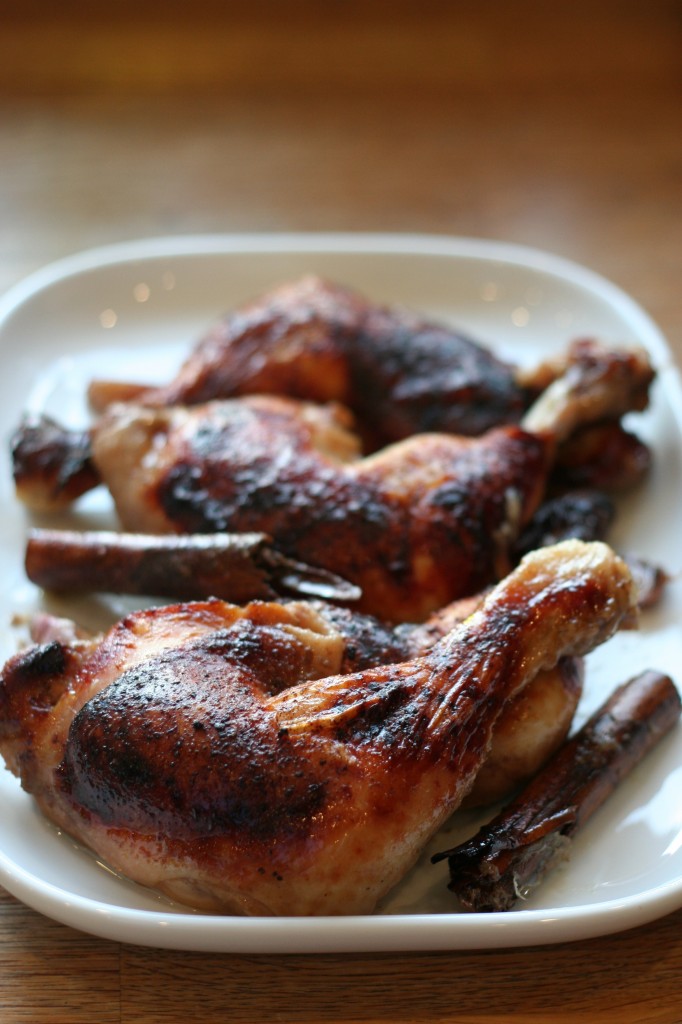
But seeing as how the whole premise of the Nigella Express cookbook is fast, easy meals, which I’m in need of lately, and because I still love Nigella as much as ever, lamb shanks notwithstanding, I pulled the book back off the shelf again last week to give it another chance. And to think that I had this maple chicken and ribs recipe all that time and never made it! It’s the easiest, tastiest chicken I’ve made in months, and the maple flavor really comes through, unlike in a lot of dishes that use maple syrup. I’ve included a recipe for bourbon-mashed sweet potatoes as part of the dinner, but if you want to keep things as simple as possible, then just use plain mashed sweet potatoes that have been boiled on the stove top.

As always, Nigella says it best when describing this dish: “Your input is minimal, but what you get out is a big feast that feels homey and welcoming and makes everyone happy, you included.”

maple chicken

Maple Chicken ‘n’ Ribs
adapted from Nigella Express by Nigella Lawson

Serves 6 to 8

You can easily decrease the quantities here if you don’t want to make 6 to 8 servings, or make this only using ribs or chicken instead of both (I just made chicken).

12 pork spareribs
12 chicken thighs, skin and bone still on
1 cup (240 ml) apple juice, as sharp as possible
4 tablespoons maple syrup
2 tablespoons vegetable oil
2 tablespoons soy sauce
2 star anise (optional; by all means use them if you have them, but I wouldn’t get them just for this recipe)
1 cinnamon stick, halved
6 cloves garlic, unpeeled

Put the ribs and chicken pieces in a couple of large freezer bags or into a dish. Add the remaining ingredients, squelching everything together well, before sealing the bag or covering the dish. Leave to marinate in the fridge overnight or up to 2 days.

Preheat the oven to 400°F (200°C).

Pour the contents of the bag into one or two large roasting tins (making sure the chicken is skin-side up), place in the oven and cook for about 1 1/4 hours, by which time everything should be sticky and glossed chestnut brown.

***

Bourbon-Mashed Sweet Potatoes
adapted from Emeril Legasse’s recipe in Food Network Favorites

Serves 4 to 6

1 3/4 to 2 lb (800 to 900 g) sweet potatoes
1/2 cup (120 ml) heavy cream
1/4 cup (60 ml) bourbon whiskey
3 tablespoons light brown sugar
2 tablespoons molasses or black treacle
1/8 teaspoon salt

Preheat the oven to 350°F (180°C).

Place the potatoes on a foil-lined baking sheet and prick each potato once or twice with a fork. Bake until they are tender and starting to ooze sugary syrup, about 1 hour and 15 minutes, depending on their size. Remove from the oven and let them sit until they’re cool enough to handle.

Cut a slit down each potato and scoop the flesh into a large bowl. Discard the skins. Add the cream, bourbon, brown sugar, molasses, and salt and beat on high speed with an electric mixer until smooth. Cover to keep warm, or gently reheat before serving.

***

Roasted Parsnips and Carrots
adapted from Barefoot Contessa Back to Basics by Ina Garten

Serves 4

The original recipe calls for the vegetables to be roasted at 425°F (220°C), but I’ve adapted it here to be 400°F (200°C), which is the temperature that the chicken and ribs are cooked at, meaning you can easily prepare both dishes in the same oven.

2 lb (900 g) parsnips, peeled
1 lb (450 g) carrots, unpeeled
3 tablespoon good olive oil
1 tablespoon kosher salt
1 1/2 teaspoons freshly ground black pepper
2 tablespoons chopped fresh dill or parsley

Preheat the oven to 400°F (200°C).

If the parsnips and carrots are very thick, cut them in half lengthwise. Slice each one diagonally into 1‑inch-thick slices. The vegetables will shrink while cooking, so don’t make the pieces too small. Place the cut vegetables on a baking tray. Add the olive oil, salt and pepper and toss well. Roast for 20 to 40 minutes, depending on the size of the vegetables, tossing occasionally, until the parsnips and carrots are just tender. Sprinkle with dill or parsley and serve hot.

Chicken a la Veracruzana and Barm Brack

I have a friend who used to work in the famous Bewley’s Cafe on Grafton Street in Dublin. She told me once about about the letters they got around this time of year, usually from tourists who had bought a loaf of barm brack in the store to take back home with them. The people writing the letters were concerned that they’d found a ring in their bread, with one person saying they’d had it appraised, and another one joking that they were relieved they hadn’t also found the finger that came with the ring. Most people sent the ring back.

They obviously didn’t know just what they’d bought. Barm brack (or báirín breac in Irish, from báirín, a loaf, and breac, speckled, due to the raisins in it) is a traditional Halloween treat, falling somewhere in between regular bread and cake. What makes it special is the ring and coin that are usually baked into the bread, turning it into a bit of a fortune-telling game: whoever gets the coin will be rich, and whoever gets the ring will be married within the year. Who knows what chances for love those well-meaning tourists sent back?

barm brack ring

This is the ring that came in the store-bought barm brack I bought last year (oh, those chubby, dimpled little toddler hands get me every time). But after making my own this year and seeing how quick and easy it is, we’ll only be having homemade brack from now on.

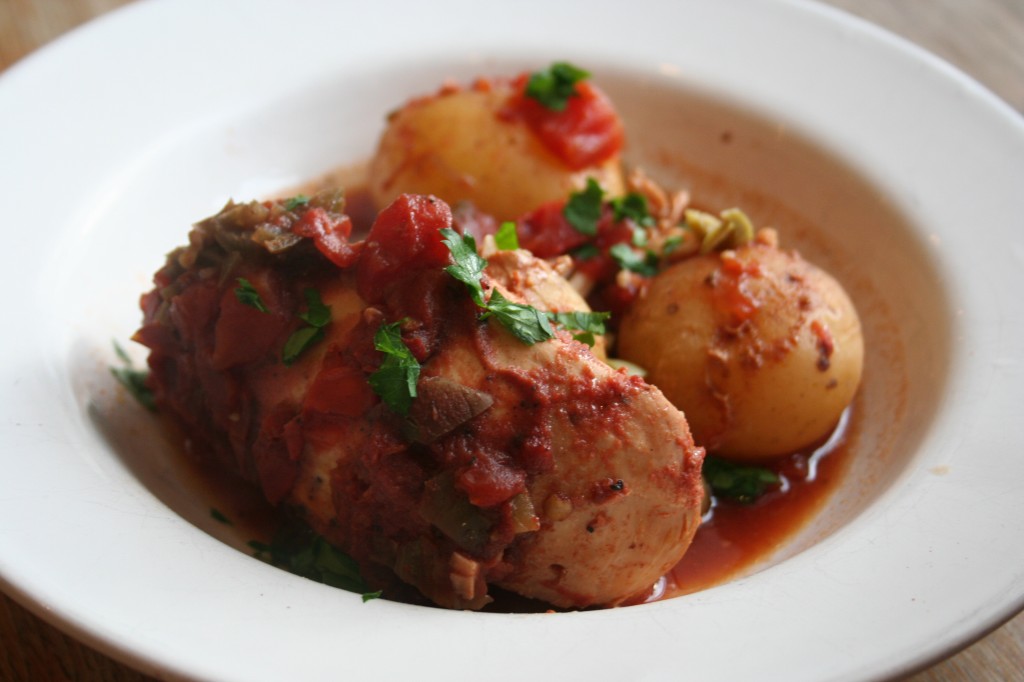
Chicken a la Veracruzana
adapted from Mexican Everyday by Rick Bayless

Serves 6

Rick Bayless suggests using 2 lb (900 g) of pork shoulder or beef chuck, cut into 1‑inch cubes, in place of the chicken. If using pork, he recommends replacing the potatoes with sweet potatoes cut into 1/2‑inch cubes. If using beef, try quartered sweet turnips, cubed carrots or peeled, cubed yuca. Chicken a la Veracruzana can also be used as a soft taco filling — just shred the chicken and stir it into the sauce with the olive and parsley and smash the potatoes into smaller pieces (this is how I served this meal to my kids, with a little grated Cheddar cheese too).

1 lb (450 g) new potatoes (or you could cut 4 medium potatoes into wedges)
6 boneless, skinless chicken breasts
1 x 28-oz (or 2 x 14-oz/400‑g) can diced tomatoes (preferably fire roasted), drained
4 to 6 canned pickled jalapeños, stemmed, deseeded and cut into strips
3 cloves garlic, finely chopped
2 tablespoons Worcestershire sauce
1/8 teaspoon dried thyme
1/8 teaspoon ground cloves
1/4 teaspoon ground cinnamon
1 teaspoon salt
1/2 cup (100 g) coarsely chopped green olives
1/4 cup (loosely packed) (10 g) roughly chopped flat-leaf parsley

Place the potatoes over the bottom of a slow cooker and put the chicken breasts over the potatoes. In a medium bowl, mix together the drained tomatoes, jalapenos, garlic, Worcestershire, thyme, cloves, cinnamon and salt. Pour the sauce evenly over the chicken. Set the lid in place and cook on high for 6 hours (the dish can hold on the slow cooker’s “keep warm” function for 4 more hours or so).

Carefully transfer a chicken breast and a portion of potatoes to each of 6 dinner plates, leaving as much sauce behind as possible. Mix the olives and parsley into the sauce, then taste and season with more salt if it needs it. Spoon the sauce over the chicken and potatoes and serve.

No slow cooker?
Put the chicken in a medium-large heavy pot, preferably a Dutch oven, and top with the potatoes. Cover with the sauce, set the lid in place and braise at 300°F (150°C) for 2 to 2 1/2 hours, until the chicken is completely tender. Complete the dish as described above.

chicken a la veracruzana

***

Barm Brack
adapted from Good Food Channel

Makes 1 loaf

If you want to include the traditional coin and/or ring, wrap them up well in greaseproof paper before adding them to the batter. You’d probably better wash the coin beforehand too. You can also make a yeasted version of barm brack, but you can’t beat this recipe if you want something quick and easy — it takes 10 minutes to make. If you want to elevate brack into a dessert, try this recipe for toffee apples on sugar-glazed barm brack.

3/4 cup (120 g) dark brown sugar
1 1/4 cups (300 ml) strong black tea
2 cups (320 g) raisins
2 tablespoons mixed candied peel
1 egg, beaten
2 cups (240 g) flour
1 heaped teaspoon baking powder
1/2 teaspoon cinnamon
1/4 teaspoon ground nutmeg

Dissolve the sugar in the tea. Add the raisins and candied peel and leave to soak overnight.

The next day, preheat the oven to 325°F (160°C). Grease an 8‑inch loaf tin or small round cake tin. Add the beaten egg to the raisins and peel as well as their soaking liquid. Sift in the flour, baking powder, cinnamon and nutmeg and stir well. Spoon the batter into the tin (add the charms now if you’re using them) and bake for 50 to 60 minutes, until a tester comes out clean. This is traditionally served toasted and buttered with a cup of tea.

Blue Cheese-stuffed Mushrooms, Sage Roasted Chicken, and Quinoa with Beets and Goat’s Cheese

Poor Reuben and Sam had to test out three of my concoctions tonight. I picked out some “real” recipes earlier in the week but decided to use up as much wilting produce in my fridge as possible instead. I don’t normally make an appetizer for a weeknight dinner, but what else can you do with a small wedge of very ripe blue cheese except stuff it in some mushrooms? I won’t say these are the finest recipes I ever created, but together they made for a satisfying dinner.

Blue Cheese-stuffed Mushrooms

Makes about 14 to 16 mushrooms

1 lb (450 g) white mushrooms
1/2 cup (25 g) fresh breadcrumbs
1/2 teaspoon garlic powder
1/4 teaspoon onion powder
1 1/2 oz (45 g) blue cheese
4 tablespoons olive oil or melted butter
salt and freshly ground black pepper, to taste

Preheat the oven to 375°F (190°C). Wash the mushrooms quickly under running water and dry them. Remove the stems from the mushroom caps. Using your hands, gently combine the remaining ingredients in a medium bowl. Stuff each mushroom cap with the filling. Bake for about 15 minutes, until mushrooms are tender and the breadcrumbs are golden. Serve hot.

***

Sage Roasted Chicken

Serves 4 to 6

1 x 3–4 lb (1.4 to 1.8 kg) whole chicken
olive oil or melted butter
salt and freshly ground black pepper
1 small bunch fresh sage

Preheat the oven to 400°F (200°C). Wash the chicken inside and out, then dry well. Rub the skin with olive oil or melted butter. Season generously, inside and out, with salt and pepper. Place 10 to 12 sage leaves under the skin of the chicken. Stuff the remaining sage inside the chicken cavity.

Place the chicken, breast down, on a roasting rack and set in a baking dish. Roast at 400°F (200°C) for about 20 minutes. Flip the chicken breast side up and continue roasting for another 20 minutes, until the skin takes on some color. Turn the oven down to 350°F (180°C) and continue roasting for another 20 to 40 minutes, depending on the size of the chicken. When done, the leg will move easily away from the body of the chicken and juices will run clear when the thigh is pierced. Let the chicken rest for 5 to 10 minutes before carving.

***

Quinoa with Beets and Goat’s Cheese

Serves 6

1 lb (450 g) beets, trimmed
8 tablespoons olive oil, divided
1 cup (170 g) quinoa
4 cups (1 liter) water
2 teaspoons salt, divided
2 oz (60 g) goat’s cheese, crumbled
1 shallot, minced
3 tablespoons sherry vinegar
1 teaspoon Dijon mustard
freshly ground black pepper, to taste

Preheat the oven to 400°F (200°C). Toss the beets in 3 tablespoons of olive oil, then wrap in aluminum foil. (I usually place 2 to 3 beets in each foil packet.) Roast until tender, 60 to 90 minutes, depending on the size of the beets. Remove from the oven and allow to cool for 15 to 20 minutes before peeling and quartering the beets. If the beets are very large, cut into 1‑inch pieces instead of quartering them.

Bring 4 cups (1 liter) of water to boil. Stir in the quinoa and salt to the boiling water. Cook the quinoa until tender, about 20 minutes. Drain and rinse under cold water. Place in a serving bowl.

In small bowl, whisk together the shallot, vinegar, mustard, remaining salt and freshly ground black pepper. Whisk in the remaining 5 tablespoons of olive oil. Stir the vinaigrette and quinoa together. Fold in the beets and crumbled goat’s cheese. Serve warm or at room temperature.