Category Archives: Potatoes

Easy Sole Meunière with Parmesan Roasted Asparagus and Herbed New Potatoes

Sole meunière had its five minutes of fame last year when the movie Julie and Julia was released, which renewed interest in Julia Child. The story did the rounds of how it was Julia’s first (and ultimately life-changing) meal in France, which she described as “a morsel of perfection.” Who am I to disagree? It’s simple and delicious, a true classic.

This is an all-Ina menu from three different cookbooks, and everything comes together to make an elegant and easy springtime dinner that’s ready in half an hour. In the “Easy French” episode of her TV show, Ina Garten suggests serving the sole with a French apple tart, which would elevate this menu into something nice enough for company.

Note that this sole recipe serves 2 while the asparagus and potatoes serve 6, so adjust the recipes according to how many people you’re serving. You could also try green beans dressed with lemon and olive oil or lemon roast potatoes instead of the roasted asparagus and herbed new potatoes.

Easy Sole Meunière
adapted from Barefoot Contessa Back to Basics by Ina Garten

Serves 2

When I make this recipe, I add a little olive oil along with the butter to stop it from burning.

1/2 cup (60 g) all-purpose flour
salt and freshly ground black pepper
4 x 4 oz (110 g) fresh sole fillets
6 tablespoons (90 g) unsalted butter
1 teaspoon grated lemon zest
6 tablespoons freshly squeezed lemon juice (3 lemons)
1 tablespoon minced fresh parsley

Preheat the oven to 200°F (100ºC). Have 2 heat-proof dinner plates ready.

Combine the flour, 2 teaspoons salt, and 1 teaspoon pepper in a large shallow plate. Pat the sole fillets dry with paper towels and sprinkle one side with salt.

Heat 3 tablespoons (45 g) of butter in a large (12-inch) saute pan over medium heat until it starts to brown (add a little olive oil as well if you’re worried about the butter burning). Dredge 2 sole fillets in the seasoned flour on both sides and place them in the hot butter. Lower the heat to medium-low and cook for 2 minutes. Turn carefully with a metal spatula and cook for 2 minutes on the other side. While the second side cooks, add 1/2 teaspoon of lemon zest and 3 tablespoons of lemon juice to the pan. Carefully put the fish fillets on the ovenproof plates and pour the sauce over them. Keep the cooked fillets warm in the oven while you repeat the process with the remaining 2 fillets. When they’re done, add the cooked fillets to the plates in the oven. Sprinkle with the parsley, salt, and pepper and serve immediately.

***

Parmesan Roasted Asparagus
adapted from Barefoot Contessa Family Style by Ina Garten

Serves 6

2 1/2 lb (1.1 kg) fresh asparagus (about 30 large spears)
2 tablespoons good-quality olive oil
1/2 teaspoon kosher salt
1/4 teaspoon freshly ground black pepper
1/2 cup (50 g) freshly grated Parmesan
2 lemons cut into wedges, for serving

Preheat the oven to 400°F (200°C).

Snap off the woody ends of the asparagus stalks and discard. Lay the stalks in a single layer on a sheet pan and drizzle with olive oil. Sprinkle with salt and pepper. Roast for 15 to 20 minutes, until tender. Sprinkle with the Parmesan and return to the oven for 1 minute more. Serve with lemon wedges.

***

Herbed New Potatoes
adapted from Barefoot in Paris by Ina Garten

Serves 6

4 tablespoons (60 g) unsalted butter
2 1/2 lb (1.1 kg) baby or new potatoes, scrubbed but not peeled
2 teaspoons kosher salt
1/2 teaspoon freshly ground black pepper
3 tablespoons chopped mixed fresh green herbs, such as parsley, chives, and dill

Melt the butter in a Dutch oven or large heavy-bottomed pot. Add the whole potatoes, salt and pepper and toss well. Cover the pot tightly and cook over a low heat for 15 to 30 minutes, until the potatoes are just tender when tested with a small knife. From time to time, shake the pot without removing the lid to prevent the bottom potatoes from burning. Turn off the heat and allow the potatoes to steam for another 5 minutes. Don’t overcook! Toss with the herbs and serve hot.

Hearty Moussaka with Low-fat White Sauce

Every time I eat Greek food I think about Kristin’s mom and stepdad taking us to Chicago to eat at Greek Islands. As a sixteen-year-old, any trip to the big city was amazing, but my first trip to Chicago’s Greektown was especially memorable. Friday night traffic was terrible (and a little exciting), the restaurant was packed, the menu was filled with dishes I had never heard of, much less eaten, and we started the meal with flaming cheese. How could that not leave an impression?

After moving to Chicago after college, I ate in Greektown frequently, usually with a big group of friends. Greek food is perfect for groups. Everyone can find a dish they like, yet few people cook Greek food at home. I’ve been experimenting over the past couple years with some of my Greek restaurant favorites. This recipe was my first try at moussaka. Although I managed to forget to add the cinnamon to the sauce, it still turned out great. I paired it with fresh green beans, but a tossed salad with feta and olives would have been even better. After this success, I may even be up for setting a plate of saganaki aflame. Opa!

Hearty Moussaka with Low-fat White Sauce
adapted from Bon Appétit, February 1998

Serves 8

olive oil spray (or olive oil)
1 or 2 eggplants (1 1/2 lb/680 g total), peeled, cut in half lengthwise, then crosswise into 1/2‑inch slices
1 1/2 lb (680 g) zucchini, trimmed and cut into 1/4‑inch-thick rounds
1 lb (450 g) red-skinned potatoes, cut into 1/4‑inch-thick rounds
1 teaspoon olive oil
1 large onion, chopped
1 tablespoon minced garlic
2 teaspoons dried oregano
1 lb (450 g) lean ground beef (sirloin or ground round)
1 x 28 oz (800 g) can whole tomatoes in juice
3 tablespoons tomato paste
1/4 cup (25 g) plain dry white breadcrumbs
1/4 teaspoon ground cinnamon
3 cups (700 ml) low-fat white sauce (see below)
2 tablespoons freshly grated Parmesan cheese

Preheat the oven to 425°F (220°C). Spray 2 large baking sheets with olive oil spray or brush with olive oil. Arrange the eggplant slices and half of the zucchini rounds, overlapping slightly, on 1 baking sheet. Arrange the potato rounds and remaining zucchini, overlapping slightly, on the second baking sheet. Spray the vegetables generously with olive oil spray or brush with olive oil. Sprinkle the vegetables with salt and pepper. Bake the vegetables until tender and beginning to brown, about 40 minutes. Remove from the oven and cool. Reduce the oven temperature to 375°F (190°C).

Heat 1 teaspoon of oil in a large nonstick skillet over medium heat. Add the onion and garlic and saute until the onion for about 7 minutes, until tender, adding 1 to 2 tablespoons of water if the mixture seems dry. Stir in the oregano. Add the beef and saute until brown, breaking it up with back of spoon. Add the tomatoes with their juices and the tomato paste, breaking up tomatoes with the back of the spoon. Simmer for about 15 minutes, until the mixture thickens slightly. Season to taste with salt and pepper. Remove from the heat and mix in the cinnamon.

Spray or brush a 13 x 9 x 2‑inch glass baking dish with olive oil spray. Sprinkle the breadcrumbs over the bottom of the dish. Arrange the potatoes in the prepared dish. Spoon half of the beef mixture over. Arrange the eggplant slices over. Spoon the remaining beef mixture over. Top with all of the zucchini, overlapping slightly if necessary.

Pour warm low-fat white sauce over the moussaka. Sprinkle 2 tablespoons of cheese on top. Bake until the top is golden brown, about 55 minutes. Let stand for 15 minutes. Cut into squares and serve.

Low-fat White Sauce

Makes 3 cups (720 ml)

6 tablespoons all purpose flour
3 cups (720 ml) low-fat milk
1/4 teaspoon ground nutmeg
1/3 cup (30 g) grated Parmesan cheese
1 large egg, beaten
1 teaspoon butter
salt and freshly ground black pepper

Whisk the flour in a heavy medium saucepan to remove any lumps. Gradually add 1 cup (240 ml) of milk, whisking until smooth. Add the remaining 2 cups (480 ml) of milk and nutmeg. Whisk over a medium heat for about 10 minutes, until the mixture thickens and boils. Remove from the heat. Whisk in the Parmesan, egg and butter. Season with salt and pepper. (Can be made 1 day ahead. Cover and refrigerate. Rewarm over low heat until heated through before using; do not boil.)

Marinated Lamb Fillets with Chive Mash and Buttered Leeks

About six years ago, my husband and I treated ourselves to a weekend away in Temple House, a fabulous Georgian mansion on a 1,000-acre estate in County Sligo on the site of a 13th-century Knights Templar castle. Dinner is served at one huge mahogany dining table, where everyone sits together. Ingredients are grown on the estate, sourced locally or from specialist producers, and where possible are organic. We had meant to leave on Sunday, but the meal we had there on the Saturday night was so good that we decided to stay an extra night and leave at the crack of dawn on Monday to make the three-hour drive back east in time for work just so we could have another dinner there.

At one of the dinners, they served a side dish of delicate, delicious leeks that I’ve been trying to recreate ever since. I’ve tried roasting them and braising them, but it was never the dish I remembered. But when I came across this recipe for buttered leeks, I had a feeling I might be on to something. Much like this sauteed cabbage or these sauteed carrots, the secret is in the recipe’s simplicity — just leeks, butter, salt and pepper and a touch of cream at the end for a little luxury. I’m kicking myself for not thinking of it sooner.

This menu is uncomplicated enough to make on a weekday — the lamb cooks in less than 10 minutes, you can saute the leeks while the lamb is resting, and mashed potatoes are never difficult — but is also impressive enough for company. These lemon roast potatoes would be perfect to serve with the lamb instead of the chive mash.

Marinated Lamb Fillets
adapted from Real Food by Nigel Slater

Serves 4

Nigel Slater’s recipe calls for lamb fillets, but the marinade works well with just about any cut, even an entire leg of lamb. The original recipe calls for 2 teaspoons dried herbes de Provence, but I like the combination of fennel and rosemary, inspired by Catherine Fulvio.

4 large cloves garlic, peeled and crushed
2 tablespoons lemon juice
4 tablespoons extra virgin olive oil
1 teaspoon fennel seeds
freshly ground black pepper
2 x 9 oz (250 g) lamb fillets
3 rosemary sprigs

Put the garlic, lemon juice, olive oil, fennel seeds and some freshly ground black pepper in a large measuring jug and whisk together well, until thick (or shake to combine in a screw-top jar). Place the lamb fillets in a casserole dish and tuck the rosemary sprigs around the lamb. Pour the marinade over the lamb, over with cling film and leave in a cool place for at least 1 hour, but preferably overnight.

To cook the lamb, get a ridged grill pan really hot (or if you don’t have one, use the oven broiler) and open the windows or turn your extractor fan on, as this will smoke a lot. Also, you might have to cook the lamb in 2 batches, depending on the size of your pan. Place the lamb on the grill pan and press it down onto the pan with a palette knife or the back of a spatula. Leave for 3 or 4 minutes, until the underneath is golden and crusted. Turn the lamb over and continue cooking for a further 3 to 4 minutes. The inside should still be pink. Remove to a plate or chopping board, cover with foil and allow to rest for 10 minutes, then cut into slices and serve.

***

Chive Mash

2 lb (900 g) floury potatoes, such as Kerr’s Pink, Maris Piper or Yukon Gold
1/2 cup (120 ml) milk
4 oz (110 g) butter
1/2 bunch chives, finely chopped
salt and freshly ground black pepper

Peel the potatoes and slice them 1/4 inch thick. Put them in a large pot of generously salted water and bring to the boil. Simmer just until the potatoes are tender, then drain. Return the potatoes to the pot off the heat, cover with a clean tea towel and allow to sit for 5 minutes (this helps to dry out the potatoes, resulting in a fluffier mash). Meanwhile, while the potatoes are cooking, place the milk and butter in a saucepan over a medium heat, until the butter has melted. Mash the potatoes, then pour in the hot milk and butter mixture and the chopped chives and beat with a wooden spoon until the mash is fluffy and light. Taste for seasoning and serve piping hot.

***

Buttered Leeks
adapted from Greatfood.ie

Serves 4 to 6

4 tablespoons (60 g) butter
5 large leeks, white and pale green parts only, washed very well and sliced thinly on the diagonal
salt and freshly ground black pepper
2 tablespoons cream

Melt the butter in a large pan. Add the leeks, stir and season generously. Cover and cook over a gentle heat for about 15 minutes, stirring once or twice, until the leeks are tender. Add the cream just before serving.

Oven-roasted Sausage and Sweet Potato

If you live in Ireland and are at all interested in food, chances are you’ve heard of Donal Skehan, a rising star on the food scene. At only 23 years old, he’s already been blogging for three years at The Good Mood Food Blog and has published a cookbook. Television appearances include Ireland AM, the RTÉ Afternoon Show and Nationwide in Ireland and Market Kitchen in the UK, where he cooked his mojito chicken. In addition to his blog, he’s also a talented food photographer (he took many of the photos for his book) and writes for Irish Tatler magazine and The Cork News newspaper. Last month, he was in Paris cooking for 700 people at Veilleé Foodstock and returned to Ireland in time to scoop the Best Food/Drink Blog award at the Irish Blog Awards. But there’s more! Donal also sings in the pop band Industry, which has had two number-one singles since their debut in 2009, and was a finalist in the Eurovision song contest in 2008. The quote on the cover of Donal’s book from RTÉ says he’s Ireland’s answer to Jamie Oliver, but at the rate Donal’s going, Jamie Oliver should watch out — there’s some stiff competition snapping at his heels across the Irish Sea.

Photo credit: Jocasta Clarke, courtesy of Donal Skehan

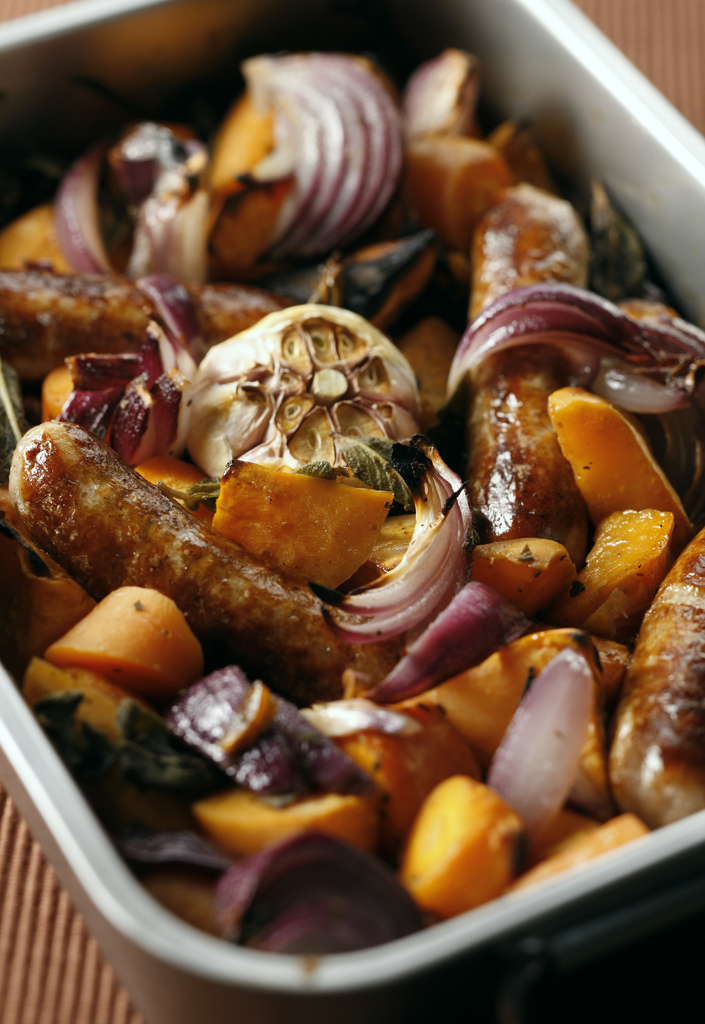
Oven-roasted Sausage and Sweet Potato
adapted from Good Mood Food by Donal Skehan*

Serves 4

Donal says this is a quick all-in-one dinner that can even be prepared ahead of time and then just banged into the oven, making it a perfect midweek supper. Donal’s original recipe calls for 3 fl oz (90 ml) red wine, but I used chicken stock simply because I tend not to have red wine in the house.

8 large, good-quality butcher sausages
4 sweet potatoes, chopped into chunks
2 large carrots, chopped into chunks
3 red onions, quartered
1 garlic bulb, top sliced off
1/2 cup (120 ml) chicken stock
1 tablespoon English mustard powder
1 tablespoon honey
2 teaspoons dried oregano
salt and freshly ground black pepper
a small handful of fresh sage leaves

Preheat the oven to 425°F (220°C). Arrange the sausages in a roasting tin or casserole dish with the sweet potatoes, carrots, red onions and garlic, making sure not to overload the tin. In a measuring jug or bowl, mix together the chicken stock, mustard powder, honey and oregano. Pour the stock mixture over the sausages and vegetables, tossing to make sure everything is coated with the stock. Season with salt (adjust according to how salty your stock is) and pepper and toss again. Scatter over the sage leaves. Roast in the oven for 45 to 55 minutes. Serve straight from the roasting tin, making sure to spoon over any remaining juices.

*Our thanks to Donal for permission to use his recipe and for his generous use of the photo from his cookbook.

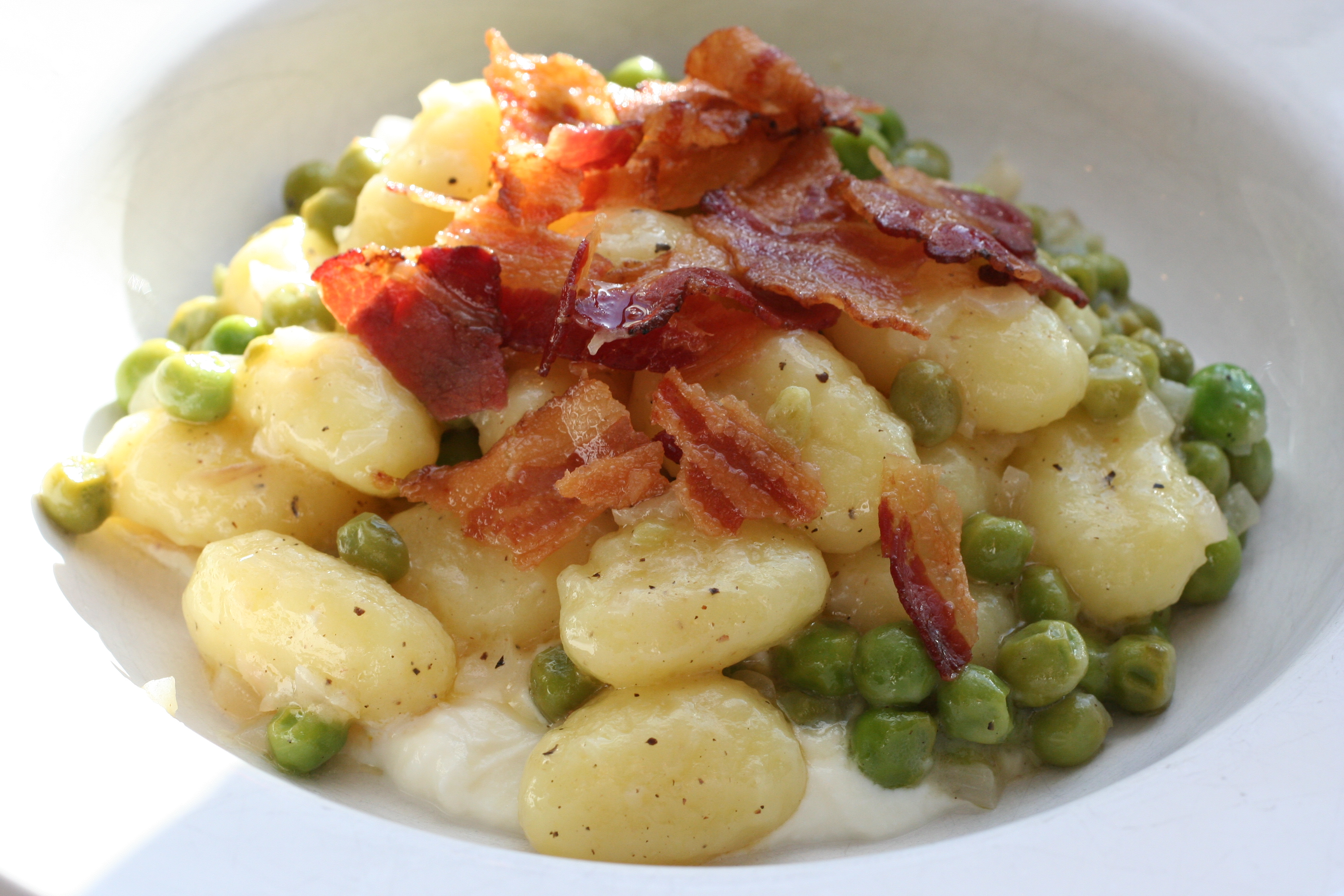
Gnocchi with Peas, Pancetta and Lemon Ricotta

I’ve been wanting to try my hand at making gnocchi for awhile now, but there’s only so far I’m only willing to go for a weeknight supper. I recently watched Tyler Florence making gnocchi on TV, and while it does look straightforward enough (not to mention something the kids would love to help with, since it looked like potato play dough), I cheated with a package of store-bought gnocchi but made the rest of his recipe, which comes together in less than half an hour.

This is an ideal dinner for this time of year. The potato gnocchi are still substantial and filling enough for spring evenings with a chill in the air, but the lemon brightens up the dish. Or if you’re having the kind of day where the last thing you want to face is cooking dinner, this requires minimal effort — the most taxing steps are chopping a shallot and zesting and juicing a lemon.

This was lovely just as it is, but I can see it being a springboard for other variations, perhaps with a cream and lemon sauce like the one in this lemon fusilli instead of the ricotta and pan sauce, with broad beans instead of the peas or with some finely chopped fresh basil or mint added in. A peppery arugula salad on the side would be perfect.

Gnocchi with Peas, Pancetta and Lemon Ricotta
adapted from Tyler Florence

Serves 4

If you quickly blanch the peas first it will help retain their green color, but honestly, could you be bothered? I’ll happily settle for dull green peas here if it makes for an easier life.

for the gnocchi:
1 lb 2 oz (500 g) store-bought gnocchi
4 oz (110 g) pancetta or prosciutto (or 6 slices bacon)
1 1/2 cups (200 g) frozen peas, thawed
1 large shallot, finely diced
2 tablespoons extra virgin olive oil
salt and freshly ground black pepper
2 tablespoons (30 g) butter
1/4 cup (25 g) freshly grated Parmesan

for the lemon ricotta:
2 cups (about 500 g, or 2 tubs) ricotta cheese
zest and juice of 1 lemon
salt

Preheat the oven to 350°F (180°C). (If using bacon instead of pancetta, preheat the oven to 400°F/200°C instead.) Bring a large pot of salted water to boil and cook the gnocchi according to the packet instructions (gnocchi usually only takes about 3 minutes to cook). Make sure you reserve about 1/2 cup (120 ml) of the cooking water for the sauce.

While the water is coming to a boil, place the strips of pancetta or bacon in 1 layer on a baking rack placed on top of a sheet pan. Cook for 8 to 10 minutes, until the pancetta is crispy. (If using bacon, this could take up to 15 or 20 minutes at the higher temperature, depending on how thick it is; cook until browned.) Drain on paper towels, then roughly chop into bite-sized pieces. Set aside.

Meanwhile, to make the lemon ricotta, place the ricotta in a mixing bowl and add the lemon zest and juice. Season with salt and set aside. (This could be done in advance and kept refrigerated.)

Heat the olive oil in a pan over a medium heat. Add the chopped shallots and gently saute for about 5 minutes, until fragrant and translucent. Add in the peas and toss gently to coat and heat through. Season with a little salt and pepper. Add the cooked gnocchi to the pan and gently toss. Add the reserved gnocchi water to the pan, then add the butter, sprinkle with the Parmesan and season again with salt and pepper.

To serve, spread a generous scoop of the lemon ricotta on the bottom of each plate. Ladle the gnocchi, peas and the pan sauce on top of the ricotta, then top with the crispy pancetta.

Tandoori Chicken with Bombay Potatoes

I’ve hated ghost stories, horror movies and all things even remotely scary since I was nine years old and read a book of ghost stories from my school library, so I’m at a loss to explain why I thought it was a good idea to start swapping first- and second-hand ghost stories when I was having lunch with a friend a week ago. That was all fine and good on a sunny Saturday afternoon, sitting in her bright, cozy kitchen in the County Kildare countryside with a glass of wine, but a few nights later, up in the middle of the night with my little boy, all our stories were running through my head and I was scaring myself silly.

But I’d do it all over again just to have this lunch that she made (not to mention her warm Bakewell tart with fresh raspberries, but that’s a recipe for another day). The fact that I made it myself for my family just one week after having it for our girls’ lunch will also tell you something about how good it is. My four-year-old daughter liked it so much on Saturday that she was disappointed when I served up something else on Sunday and said she wanted this again. Lucky for her, there were leftovers that I’d been planning on having for lunch yesterday, but I let her have them for dinner last night instead. Such are the sacrifices we make for our children — including getting up in the dark to soothe them back to sleep when you’ve turned into a scaredy cat again and just want to pull the covers over your head.

Don’t let the long list of ingredients put you off, it’s just a bunch of spices, and the marinade takes all of 5 minutes to put together. As an alternative to the raita, you could make a mango salsa by combining 1 large mango, peeled and chopped, 1 red chili, deseeded and chopped, the juice of 1 lime and 1 tablespoon chopped mint.

This tandoori chicken is very similar to Kelly’s chicken tikka masala, the main difference being that this version has more spices and doesn’t have a sauce, which makes it even faster and easier to cook as a weeknight dinner. I served it with the pan-roasted curried cauliflower and peas from that menu, as well as Kelly’s cucumber raita, which I added a large handful of chopped fresh mint to. I cooked the curried cauliflower in a separate pan, but next time I’ll try increasing the amount of spices for the Bombay potatoes and just cooking all the vegetables together in one pot instead.

Tandoori Chicken with Bombay Potatoes
adapted from The Eden Cookbook by Eleanor Walsh and Michael Durkin

Serves 6

for the tandoori chicken:
1 tablespoon paprika
1/2 teaspoon garam masala
1/2 teaspoon chili powder
1/2 teaspoon ground cumin
1/2 teaspoon salt
1/2 teaspoon turmeric
2 tablespoons lemon juice
2 tablespoons sunflower oil
2 tablespoons natural yogurt
2 tablespoons cream
1 tablespoon tomato puree
3 cloves garlic, crushed
1 teaspoon fresh ginger, peeled and grated
6 boneless, skinless chicken breasts

for the Bombay potatoes:
2 1/4 lb (1 kg) potatoes, peeled and cubed
1 tablespoon sunflower oil
2 onions, finely chopped
1 tablespoon tomato puree
1 tablespoon curry powder
salt and freshly ground black pepper
3/4 cup (180 ml) vegetable or chicken stock
a few handfuls of baby spinach (about 4 oz/110 g)

cucumber raita or mango salsa (see above), to serve

Combine all the marinade ingredients (except the chicken) in a medium-sized bowl. Add in the chicken, making sure all the pieces are coated with the marinade. Cover the bowl with cling film and marinate the chicken breasts overnight in the fridge.

To cook, preheat the oven to 400°F (200°C).

Place the potatoes in a saucepan with cold water, bring to the boil and drain immediately.

Meanwhile, heat a frying pan with 2 tablespoons sunflower oil. Seal the chicken breasts for 2 or 3 minutes per side, then transfer to a baking tray or casserole dish and cook in the preheated oven for 25 minutes.

In another saucepan, heat 1 tablespoon sunflower oil over a medium heat and fry the onions for 10 minutes, until translucent. Add the tomato puree, curry powder and salt and pepper. Cook for 1 minute, stirring with a wooden spoon. Add the parboiled potatoes and stock. Cover and cook for 10 minutes, until the potatoes are tender. Add the baby spinach just before serving, stirring until the spinach just wilts.

Serve the chicken on top of the potatoes and spinach, garnished with a dollop of cucumber raita.

Beef and Guinness Stew with Champ

In Ireland, it’s easy to take the top-quality food for granted. We have butter that’s a creamy yellow, the way it should be; bread that’s baked fresh every day and delivered to the stores first thing in the morning; brown eggs that are so fresh they’re often not even refrigerated in the grocery store; lamb that’s world famous; and grass-fed beef.

I didn’t appreciate how special the beef in particular is until I read Michael Pollan’s In Defense of Food recently, in which he says that 100% grass-fed beef commands premium prices in America (and indeed, a recent article in The Village Voice said a 1‑lb grass-fed, local steak set them back $26 compared to $9.99 for a typical feedlot steak of the same weight). Yet in Ireland, famous for the lush green grass (it’s not called the Emerald Isle for nothing), it’s just the way beef is. As I type this, I can look out my window and see my neighbor’s cattle grazing in the field just across the road. When I cook in my kitchen, I look west over a patchwork quilt of fields of potatoes, wheat, more cows and sheep too. When I take a walk with my son in my rural neighborhood, we pass another neighbor’s dairy farm, and if I walk further still, we pass the lambs that eventually wind up in the local butcher. If I walk east, I can stand at the top of our hill and see the Irish Sea about ten miles away, where small, colorful fishing boats trawl the waters. Compared to the US, where the average food item in a typical meal travels 1,500 miles to reach your plate, I feel very lucky indeed to be able to stand on my front step and practically be able to see where my milk, beef, lamb and fish come from, not to mention potatoes and various grains as well.

If you want to cook something special to celebrate St. Patrick’s Day on Wednesday, this beef and Guinness stew with a traditional Irish champ (brúitín) is just the thing. The stew is robust and full of flavor, given the pint of plain that’s in it. The bite of the spring onions in the champ is the perfect accompaniment to the rich stew, but feel free to serve it with plain mashed potatoes instead. If you want to round this off with an Irish dessert, try these easy Baileys cream pots. But don’t limit yourself to only serving this stew on Paddy’s Day. It’s actually the best beef stew I’ve ever made.

Beef and Guinness Stew
adapted from Gourmet, October 2004

Serves 4

To make this into a one-pot meal, add some baby potatoes right into the stew along with the beef stock, Guinness and herbs instead of serving with the champ. And don’t be tempted to skip tossing the beef in the flour — the flour helps give the sauce its gorgeous, thick consistency later on. Like most stews, this one actually improves in flavor after a day, so the leftovers are even better.

2 lb (900 g) boneless beef chuck (stewing beef), cut into 1‑inch pieces
1/4 cup (30 g) flour
1 teaspoon salt
1/2 teaspoon black pepper
1/4 cup (60 ml) olive oil
2 onions, roughly chopped
4 to 6 carrots, cut into 1‑inch pieces on the diagonal
3 large cloves garlic, finely chopped
2 tablespoons tomato paste
4 cups (960 ml) beef stock or broth
approx. 2 cups (500 ml) Guinness (or another stout)
1 tablespoon Worcestershire sauce
1 tablespoon dried thyme
2 bay leaves
chopped fresh parsley, to garnish

Pat the beef dry. Stir together the flour, salt and pepper in a bowl. Add the beef, turning to coat all the pieces, then shake off the excess flour and transfer to a plate.

Heat the oil in a pot over a moderately high heat, until just smoking, then brown the beef in 3 batches, turning occasionally, about 5 minutes per batch (don’t crowd the pot, otherwise the beef will steam, not brown). Transfer to a bowl and set aside.

Reduce the heat to medium. Add the onions and carrots to the pot and saute for 10 minutes, scraping up any brown bits from the bottom of the pan and stirring frequently. Add the garlic and cook for 1 minute. Add the tomato paste, stir to coat the vegetables, and cook for 1 minute more. Stir in the beef along with any juices accumulated in the bowl. Add in the beef stock, Guinness, Worcestershire sauce, thyme and bay leaves. Stir to combine. Bring the stew to a boil, then reduce the heat to medium-low. Simmer, uncovered, for 1 to 1 1/2 hours, stirring occasionally, until the beef is fork-tender and the sauce has reduced and thickened.

To serve, spoon off any fat that may have risen to the top of the stew. Taste for seasoning. Spoon some champ into individual shallow bowls or plates, making a well in the center. Ladle the stew on top of the champ, garnish with the chopped parsley and serve.

***

Champ

Serves 4

If you have your own favorite recipe for mashed potatoes, just follow that and add the scallions at the end, and voilà! Now you have champ. Or you could try making colcannon, another traditional Irish potato dish and first cousin to champ.

2 lb (900 g) floury potatoes, such as Kerr’s Pink, Maris Piper or Yukon Gold
1/2 cup (120 ml) milk
4 oz (110 g) butter
6 spring onions (scallions), white and green parts finely sliced
salt and freshly ground black pepper

Peel the potatoes and slice them 1/4 inch thick. Put them in a large pot of generously salted water and bring to the boil. Simmer until the potatoes are tender, then drain. Return the potatoes to the pot off the heat, cover with a clean tea towel and allow to sit for 5 minutes (this helps to dry out the potatoes, resulting in a fluffier mash). Meanwhile, while the potatoes are cooking, place the milk, butter and spring onions in a saucepan over a medium heat, until the butter has melted. Mash the potatoes, then pour in the hot milk and spring onion mixture and beat with a wooden spoon until the mash is fluffy and light. Taste for seasoning and serve piping hot.

Filipino-style London Broil, Oven-roasted Potatoes, and Winter Greens with Shaved Parmesan

My book club’s most recent pick, Animal, Vegetable, Miracle: A Year of Food Life by Barbara Kingsolver, provided the perfect inspiration for our meeting’s dinner menu. The book centers around the author’s year of eating only local foods, including produce and animals that she raised herself. After getting past the initial defensiveness of my own food choices, I came to love the book and have been truly inspired by it. It also provided a ready theme for our book club dinner — local. Luckily, by living in Wisconsin, I have easy access to farms that offer direct-to-seller meat and produce. I had a freezer full of beef from Sulzer Beef at my disposal. I also rediscovered Outpost Natural Foods, which in recent years has made a concerted effort to carry more local products.

My friend Alex brought a wonderful rhubarb strawberry crisp made with strawberries she picked from a nearby farm and rhubarb from her garden. For the salad, I used a winter salad mix from Milwaukee’s own urban, award-winning farm, Growing Power. To serve, I splashed some balsamic vinegar and olive oil over the greens (not local, I’m afraid), then used a vegetable peeler to grate long strips of Wisconsin Parmesan over the top. We rounded out the meal with an assortment of other Wisconsin cheeses (lemon chevre, cranberry cheddar, and Gorgonzola) and a fresh baguette from our local Breadsmith bakery.  A feast that doesn’t require gallons of petroleum to transport it to the table tastes even better than one that does.

Filipino-style London Broil
adapted from Indoor! Grilling by Steven Raichlen

Serves 4 to 6

2 medium lemons
1 cup (240 ml) soy sauce [Kikkoman brand is made in Walworth, Wisconsin]
1/2 cup (120 ml) distilled white vinegar
1/2 cup (120 ml) vegetable oil
1 medium onion, finely chopped
3 cloves garlic, finely chopped
3 bay leaves, crumbled
1 tablespoon coriander seed
1 teaspoon black pepper
1 sirloin or top or bottom round steak (1 1/2 to 2 lb/680 to 900 g)

Rinse the lemons. Cut each in half and squeeze out the juice with a citrus press. Place the lemon juice in a large nonreactive mixing bowl. Cut the rind of 1 lemon into 1/4‑inch dice and add it to the juice. Add the soy sauce, vinegar, oil, onion, garlic, bay leaves, coriander seed, and pepper and whisk to mix. Set aside half of the lemon juice mixture to use as a sauce.

Spread half of the remaining lemon juice mixture in the bottom of a nonreactive baking dish just large enough to hold the meat. Place the meat on top and spread the other half of the lemon juice mixture over it. Let the steak marinate for at least 6 hours, or ideally overnight. The beef can also be marinated in a resealable plastic bag.

Place a grill pan on the stove and preheat it to medium-high over a medium heat. When the grill pan is hot, a drop of water will skitter in the pan. When ready to cook, lightly oil the ridges of the grill pan. Drain the meat, scraping off most of the marinade with a rubber spatula. Place the beef in the hot grill pan. Sirloin or round steak will be cooked to medium-rare after 5 to 8 minutes per side. To test for doneness, use the poke method: when cooked to medium-rare the meat should be gently yielding.

Transfer the meat to a cutting board and let it sit for 5 minutes. Cut the meat into broad thin slices, holding a sharp knife blade at a 45-degree angle to the top of the meat. Spoon the reserved sauce over the slices and serve at once.

***

Oven-roasted Potatoes

Serves 6

3 large baking potatoes, cut into 1‑inch cubes
1/4 cup (60 ml) olive oil
handful of flat-leaf parsley, minced [I love parsley and use about a half bunch in this recipe]
3 cloves garlic, minced
1/2 teaspoon dried basil
1 teaspoon dried oregano
1 teaspoon paprika
salt and freshly ground black pepper

Preheat the oven to 375°F (190°C).

Toss the cubed potatoes with the olive oil, parsley, garlic, basil, oregano and paprika. Spread in a single layer on a large baking sheet (or 2 smaller baking sheets). Bake for 30 to 40 minutes, turning the potatoes halfway through cooking, until golden brown and tender. Immediately season with salt and pepper to taste.