Tag Archives: 30-minute meals

Fusilli with Zucchini, Tomatoes and Bacon and Oatmeal Chocolate Chip Cookies

When I would come home from school growing up, the first thing that would greet me as I walked in the door was the smell of something good cooking. My own daughter starts school today, and I couldn’t let the day pass without a homemade treat. What could be better for her first day of school than milk and cookies? And a big, warm, fresh-from-the-oven oatmeal chocolate chip cookie at that. This is my absolute, hands down, all-time favorite cookie recipe. Using a 1/4 cup measuring cup to scoop out the dough is key, though — their generous size is part of what makes them so perfect. I love having one with a cup of tea or coffee, or even for breakfast (it has oatmeal in it, so it’s practically granola, right?), and I make a version of these for Christmas with white chocolate, pecans and dried cranberries too. And now I will love them even more, as I’ll always think of this now as the treat I made on such a special day for my not-so-little girl.
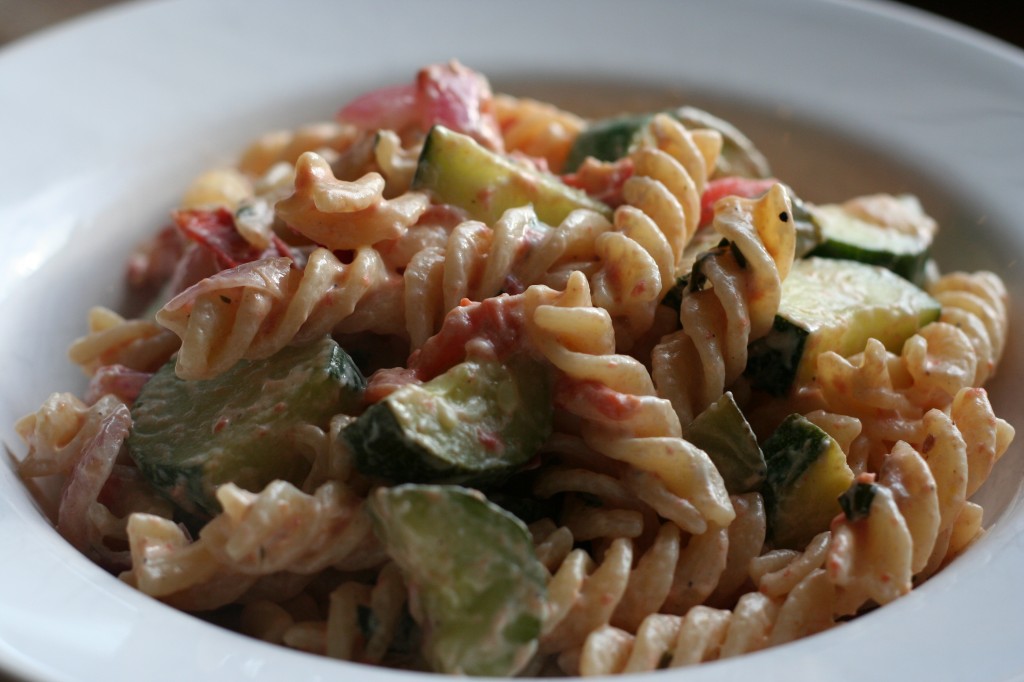
fusilli with zucchini, tomatoes and bacon

Fusilli with Zucchini, Tomatoes and Bacon 
adapted from Bon Appétit, September 2004

Serves 6

12 bacon slices, cut crosswise into 1‑inch pieces
1 large red onion, chopped
1 1/2 cups dry white wine
3 medium zucchini, halved lengthwise and sliced crosswise into 1/2‑inch-wide pieces
1 lb (450 g) fusilli (or gemelli or penne)
6 large ripe tomatoes, deseeded and coarsely chopped
1/2 cup (15 g) chopped fresh basil
1 cup (150 g) crumbled soft fresh goat’s cheese

Put a large pot of salted water on to boil. Cook the bacon in a heavy large skillet over a medium-high heat until brown and crisp. Using a slotted spoon, transfer to paper towels to drain. Pour off all but 1 tablespoon of the drippings from the skillet.

Add the onion and saute until soft, about 3 minutes. Add the wine and boil until it has reduced by one-third, about 3 minutes. Add the zucchini and saute until it’s crisp-tender, stirring occasionally, about 5 to 7 minutes.

Meanwhile, cook the pasta until al dente. Drain.

Add the chopped tomatoes and basil to the zucchini and onions and continue to saute on a medium heat while the pasta cooks, about 10 to 15 minutes.

Add the drained pasta to the zucchini and tomato mixture in the skillet (or if your skillet isn’t big enough to hold everything, put the drained pasta back in the pot you cooked it in and pour the vegetable mixture from the skillet into the larger pot). Toss over a medium-high heat until the sauce coats the pasta, about 3 minutes. Add the goat’s cheese and stir until it starts to melt, about 2 minutes more. Season to taste with salt and pepper and serve.

***
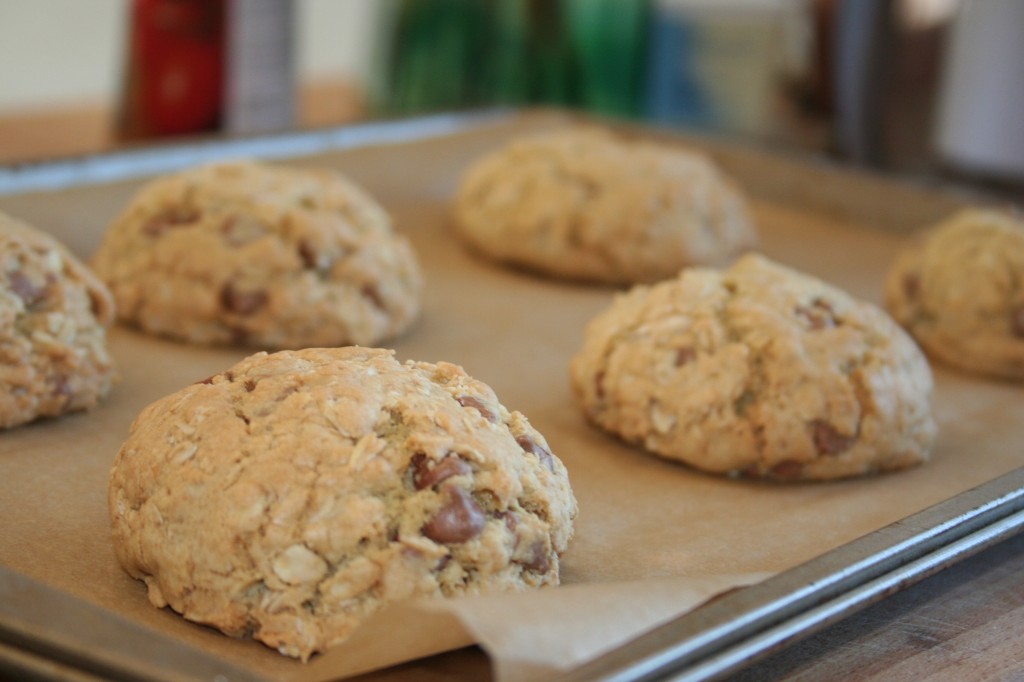
oatmeal chocolate chip cookies

Oatmeal Chocolate Chip Cookies
adapted from Orangette

Makes about 14 cookies

2 cups (240 g) unbleached all-purpose flour
1/2 teaspoon baking soda
1/2 teaspoon salt
3/4 cup (170 g) unsalted butter, melted and slightly cooled
1 cup (170 g) packed brown sugar
1/4 cup (50 g) granulated sugar
1 tablespoon vanilla extract
1 egg
1 egg yolk
1 1/2 cups (300 g) semi-sweet chocolate chips
1 1/2 cups (120 g) quick-cook oats or rolled oats

Preheat the oven to 325°F (160°C). Grease cookie sheets or line them with parchment paper or silicone baking mats.

Sift together the flour, baking soda, and salt and set aside. In a medium bowl, cream together the melted butter and brown and granulated sugars until well blended. Beat in the vanilla, egg, and egg yolk, mixing until light and creamy. Mix in the sifted ingredients, working until just blended. Stir in the chocolate chips and oats by hand, using a wooden spoon. Chill the dough in the refrigerator for 30 minutes to 1 hour. Use a table knife to scoop and press the dough into 1/4‑cup measuring scoops (0r roll 90 g of dough into a ball for one cookie), and plunk the mounds onto the prepared cookie sheets. Cookies should be 3 inches apart.

Bake the cookies for 15 to 20 minutes, or until the edges are lightly browned. Cool on baking sheets for a few minutes before transferring to wire racks to cool completely.

Drunken Stir-fried Beef with Green Beans, Cucumber Salad, and Chocolate-covered Coconut Macaroons

I subscribed to Cooking Light for years after I graduated college. Looking back, I’m not exactly sure why I continued my subscription. I rarely remade any recipes that I tried with a couple of exceptions, one being this Drunken Stir-fried Beef with Green Beans. I make this dish often, though it’s best in August, when the green beans, tomatoes, and basil are in abundance. Besides being tasty, this dish also reminds me of my son’s first real meal. When he was about 10 months old, after months of trying to get him to eat baby food, I decided to give him a bite of the flank steak in this dish. He devoured it and from then on we stopped trying to convince him to eat baby food and served him whatever we were eating.

Enough about the stir-fried beef. The real highlight of this meal was dessert. I’ve been craving these chocolate-covered coconut macaroons all summer and finally had a chance to make them. “Wow” is all I can say. Truly, truly, a fantastic cookie. And you can freeze them, too, for future decadent nibbles.

Drunken Stir-fried Beef with Green Beans

adapted from Cooking Light

1/2 teaspoon kosher salt
5 garlic cloves, minced
1 minced Serrano chili (or 1 teaspoon sambal)
2 teaspoons grated fresh ginger
zest and juice of 1 lime
1 tablespoon canola or peanut oil
1 lb (450 g)  flank steak, trimmed and cut into 1/4‑inch strips
1 lb (450 g) 1‑inch diagonally cut green beans
1 carton halved cherry tomatoes
1 tablespoon sugar
3 tablespoons Thai fish sauce
1 teaspoon cider vinegar
1 cup Thai basil leaves

Combine the salt and minced garlic in a mortar and pestle, and pound to form a paste. Add the chili, ginger, and lime zest, one at a time, until each ingredient is incorporated into the paste.

To prepare the stir-fry, heat the oil in a wok or large nonstick skillet over a medium-high heat. Add the paste, and stir-fry for 30 seconds (fumes may cause eyes and throat to burn slightly). Add the beef and stir-fry for 2 minutes. Add the beans and stir-fry for 4 to 5 minutes, until the beans are almost tender. Add the tomatoes, sugar, fish sauce, vinegar and lime juice. Stir-fry for 1 minute or until the beef reaches your desired degree of doneness. Stir in the basil. Serve with rice.

***

Simple Cucumber Salad

Serves 4

2 tablespoons soy sauce
2 tablespoons rice wine vinegar
2 teaspoons sesame oil
pinch of sugar
pinch of red pepper flakes
2 cucumbers, peeled and thinly sliced (1/8 inch thick)

Mix the first 5 ingredients until the sugar is dissolved. Toss with the cucumber slices. Chill for up to 2 hours, mixing occasionally.

***

Macaroon II

Chocolate-covered Coconut Macaroons
from Orangette

Makes 12 to 15 cookies

3 cups (250 g) lightly packed sweetened shredded coconut
3/4 cup (150 g) granulated sugar
3/4 cup (150 ml) egg whites (about 5 large)
1 1/2 teaspoon pure vanilla extract
1/4 teaspoon almond extract
8 oz (225 g) bittersweet or semisweet chocolate, finely chopped
3/4 cup (150 ml) heavy cream

Place the coconut, sugar and egg whites in a large, heavy saucepan, and stir to combine well. Cook over a medium-low heat, stirring regularly, for about 10 to 12 minutes, until the mixture is pasty but not dry. (The uncooked mixture will look sort of granular at first, then creamy as it heats, and then it will slowly get drier and drier. You want to stop cooking when it no longer looks creamy but is still quite gluey and sticky, not dry.) Remove from the heat. Mix in the vanilla and almond extracts. Spread out the coconut mixture on a large baking sheet. Refrigerate until cold, about 30 minutes.

Preheat the oven to 300°F (150°C). Line another baking sheet with parchment paper or a Silpat baking mat. Using a ¼‑cup measuring scoop, scoop and pack the coconut mixture into domes, and place them on the baking sheet. You should wind up with about a dozen. Bake the macaroons until golden, about 30 minutes. Transfer to a rack and cool.

Set the cookies on a rack over a rimmed baking sheet. Place the chopped chocolate in a medium bowl. Heat the heavy cream in a small saucepan until it is very hot and steamy (not boiling), remove from the heat, and pour it over the chocolate. Whisk until the mixture is smooth and the chocolate is thoroughly melted. Spoon the glaze over the macaroons, covering them almost completely and allowing the chocolate to drip down the sides. (You will have leftover glaze, which can be refrigerated or frozen.) Refrigerate the macaroons until the glaze sets, at least 2 hours. Transfer the macaroons to an airtight container, and refrigerate or freeze.

Spicy Peanut Soba with Tofu and Vegetables and Tossed Salad with Sesame Vinaigrette

I am not a vegetarian. I am not a college student. I am not a hippie. I am not Chinese, Japanese, or Korean. I don’t even live in California. Despite this, I am a proud and frequent eater of tofu. If you think you hate tofu, you probably haven’t had it prepared correctly. Tofu itself is bland and, how shall we say, texturally challenged. But if prepared well, tofu can be delicious. And, of course, it’s good for you. Tofu is low in calories, high in protein, and costs less than ground beef at your local supermarket.

The peanut sauce paired with the tofu in this menu is bold, flavorful, and spicy. Try it. I think you’ll like the combination. And if for some reason you can’t bring yourself to eat tofu, feel free to substitute chicken, pork, or shrimp in the recipe.

Spicy Soba II

Spicy Peanut Soba with Tofu and Vegetables

Serves 6

1/4 cup (60 ml) soy sauce
1/2 cup (120 ml) peanut butter
1/2 cup (15 g) chopped cilantro, plus extra for garnish
1 clove garlic, minced
1/4 cup (60 ml) hot water
1 tablespoon sambal (or 2 tablespoons chili oil or 1/2 teaspoon cayenne pepper)
2 teaspoons sherry
2 teaspoons sugar
1 package extra-firm tofu, cut into 1‑inch cubes
1 cup (240 ml) peanut or canola oil
1 x 12-oz (300‑g) buckwheat soba noodles
1 red or orange bell pepper, sliced thin
12 oz (340 g) sliced mushrooms
12 oz (340 g) snow pea pods, trimmed
1 bunch green onions, bias cut, white parts separated from green parts
1/2 lb (225 g) fresh bean sprouts

Combine the first 8 ingredients (through sugar) in a blender. Blend until smooth. The sauce should be about the consistency of ketchup.

Cook the soba noodles according to the package directions. Drain and set aside.

Heat the oil in a wok until it’s smoking. Add half the tofu to the oil, stirring constantly to prevent sticking. Continue frying for 3 to 4 minutes, until the tofu is golden. Remove the tofu with a slotted spoon and drain on a paper towel-covered paper grocery bag. Repeat with the remaining tofu until it’s all cooked and drained.

Remove all but 1 tablespoon of the oil from the wok or large frying pan. On a high heat, stir-fry the bell pepper for 2 minutes. Add the mushrooms and stir-fry for 1 minute. Add the pea pods and white parts of the green onions. Stir-fry for another 2 to 3 minutes, until all the vegetables are tender, but still crisp. Stir in the green onions (green parts) and bean sprouts. Remove the wok from the heat.

Toss the tofu in about 1/2 cup (120 ml) of the peanut sauce. In a large serving bowl, mix the cooked soba noodles, vegetables and half the peanut sauce. Add more sauce as needed to coat all the noodles and vegetables. I usually end up using all but a couple tablespoons of sauce. Garnish with cilantro.

***

Sesame Vinaigrette

Makes about 1/2 cup (120 ml)

1 teaspoon mirin
1 teaspoon soy sauce
2 tablespoons olive oil
1 tablespoon sesame oil
2 tablespoons rice wine vinegar
dash of red pepper flakes

Whisk together all the ingredients until slightly emulsified (or shake to combine in a screw-top jar). Cover and refrigerate if not using immediately.

Zucchini Carbonara and Peach and Blueberry Sour Cream Cobbler

It turns out I’m not the only one around these parts with a weakness for American bacon. We’re having our house repainted at the moment, and today the painter was working inside to do the window frames. He spent 15 years living in America and only moved back about five years ago, and was chatting with us in the kitchen as I started to fry up the pancetta for this dish. “That’s not streaky bacon, is it?” he asked, streaky bacon being somewhat closer to American bacon than rashers, but still too thick cut to get as crispy as I like it to be. So he got the whole story of how much I’d missed bacon and then finding the pancetta at the grocery store. He told me how his oldest daughter prefers American bacon too, and how he’d have to get her some now that he knew about it. He was also eying up this cobbler as I made it and dropping hints about how good it looked, so he was pretty pleased when he was still around when it came out of the oven and I gave him some to have with his coffee.

It’s true that carbonara isn’t for the calorie-conscious, but even so, once you break it down per serving, there’s “only” one or two tablespoons of cream, one egg yolk, a couple tablespoons of cheese and a few slices of pancetta per serving, so for being a decadent dish, it’s not all that bad, though certainly not something you’d want to have every day. But as for the cobbler, there’s only two tablespoons of sugar in the entire dessert, making it the kind of treat I don’t at all mind giving my kids.

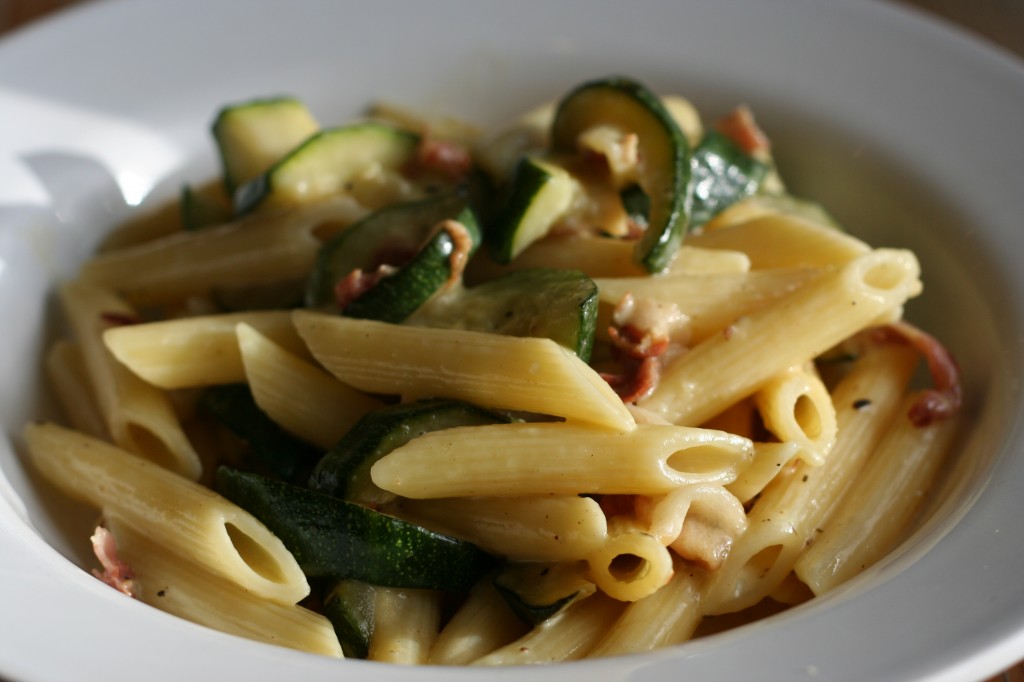
zucchini carbonara

Zucchini Carbonara
adapted from Jamie at Home by Jamie Oliver

Serves 4

6 medium green and yellow courgettes
1 lb (450 g) penne
4 large free-range or organic egg yolks
1/2 cup (120 ml) heavy cream
2 good handfuls of freshly grated Parmesan cheese
salt and freshly ground black pepper
olive oil
12 thick slices of pancetta or smoked streaky bacon, cut into chunky lardoons
a small bunch of fresh thyme, leaves picked and chopped (or 1/2 teaspoon dried)

Put a large pan of salted water on to boil. Halve and then quarter any larger courgettes lengthways. Cut out and discard any fluffy middle bits, and slice the courgettes at an angle into pieces roughly the same size and shape as the penne. Smaller courgettes can simply be sliced finely. When the water boils, add the penne to the pan and cook according to the packet instructions.

To make the carbonara sauce, put the egg yolks into a bowl, add the cream and half the Parmesan, and mix together with a fork. Season lightly and put to one side.

Heat a very large frying pan (one that will be able to hold all the sauce plus the pasta later on), add a good splash of olive oil and fry the pancetta or bacon until dark brown and crisp. Remove with a slotted spoon and to a plate lined with a paper towel to drain. Drain off all but 1 tablespoon or so of the bacon fat.

Add the courgette slices and 2 big pinches of black pepper, not just to season but to give it a bit of a kick. Sprinkle in the thyme leaves, give everything a stir, so the courgettes become coated with all the lovely bacon-flavoured oil, and fry until they start to turn lightly golden and have softened slightly. Crumble or chop the bacon and add it back to the pan.

It’s very important to get this next bit right or your carbonara could end up ruined. You need to work quickly. When the pasta is cooked, drain it, reserving a ladleful or two of the cooking water. Immediately toss the pasta in the pan with the courgettes and bacon, then remove from the heat and add a ladleful of the reserved cooking water and your creamy sauce. Stir together quickly. (No more cooking now, otherwise you’ll scramble the eggs.)

While you’re tossing the pasta and sauce, sprinkle in the rest of the Parmesan and a little more of the cooking water if needed, to give you a silky, shiny sauce. Taste quickly for seasoning. Serve and eat immediately, as the sauce can become thick and stodgy if left too long.

***

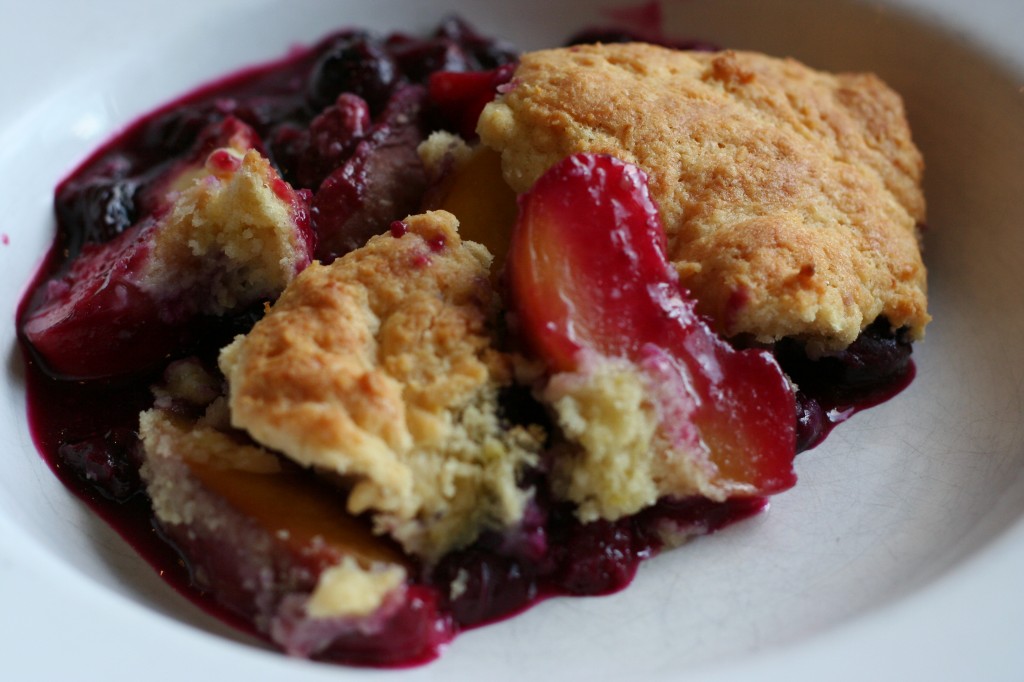
peach and blueberry sour cream cobbler

Peach and Blueberry Sour Cream Cobbler
adapted from The Kitchen Diaries by Nigel Slater

Serves 4

4 ripe peaches, sliced
about 3 cups (400 g) blueberries
juice of 1 lemon
1 tablespoon sugar
1 tablespoon flour

for the crust:
1 1/3 cups (150 g) flour
pinch of salt
2 teaspoons baking powder
1 heaped tablespoon sugar, plus extra for sprinkling
zest of 1 lemon
6 tablespoons (90 g) butter
1/2 cup (140 ml) sour cream
ice cream, cream or custard, to serve

Preheat the oven to 400°F (200°C).

For the cobbler crust, put the flour, salt, baking powder, sugar, lemon zest and butter in a food processor and blitz for a few seconds, until the mixture resembles breadcrumbs. Tip into a bowl and set aside.

Put the sliced peaches and blueberries into an ovenproof dish. Toss them with the lemon juice, sugar and flour.

Mix the sour cream into the crumb mixture to make a soft dough. Break off walnut-sized pieces and flatten them lightly. Lay them on top of the fruit. Sprinkle the rounds of dough with sugar, then bake for 25 minutes, till the cobbler is golden and the fruit is bubbling. Serve with ice cream, a drizzle of cream or some warm custard.

Salmon in Luxurious Green Sesame Pipian, Brown Rice, and Kale

When I want salmon with a bit of a kick, this is the dish I cook. The salmon is poached in an easy-to-make tomatillo and sesame sauce. The sauce is especially wonderful over brown rice, which accents the nuttiness of the sesame paste. If you aren’t a fan of brown rice, try it again with this sauce. I also recommend investing in a good rice cooker. I scoffed at my husband’s Christmas request for the Zojirushi Neuro Fuzzy rice cooker, but it has turned out to be one our most-used small appliances — second only to our espresso machine. The cooker has a timer so your rice can be perfectly cooked and waiting for you when you arrive home in the evening. This is especially useful when cooking brown rice, which can take an hour or more to cook on the stove top.

Salmon, rice, kale

Salmon in Luxurious Green Sesame Pipian
adapted from Mexican Everyday by Rick Bayless

2 cups (480 ml) store-bought or homemade tomatillo salsa (Xochitol brand recommended)
1 1/2 tablespoons vegetable or olive oil
1 cup (240 ml) chicken broth
3 tablespoons tahini (sesame paste)
salt
1/4 to 1/2 teaspoon sugar
1  heaping cup (150 g) peas (fresh or frozen)
4 boneless, skinless salmon, halibut, walleye, snapper or striped bass fillets, 4 to 5 oz each, about 1/2 inch thick
1 tablespoon sesame seeds, for garnish
chopped cilantro, for garnish

In a blender or food processor, process the salsa to a smooth purée. Heat the oil in a very large (12-inch) skillet over a medium-high heat. When quite hot, add the salsa all at once. Stir until the salsa reduces to the consistency of tomato paste, about 5 minutes. Stir in the broth and tahini. Return to a boil, then reduce the heat to medium-low and simmer for 10 minutes. Taste and season with salt (if needed) and sugar to balance the tartness of the salsa.

While the sauce is simmering, steam the peas until just hot and tender. When the sauce has cooked for 10 minutes, nestle the fish fillets in it, completely submerging them. Continue simmering gently until the fish flakes when pressed firmly, usually 5 to 6 minutes. Check by lifting a fillet from the sauce on a metal spatula and pressing with your finger or the back of a spoon.

Transfer a fish fillet to each dinner plate and spoon a portion of the sauce over top. Strew with peas, sesame seeds and cilantro.

***

Boiled Kale

There are two basic ways to cook kale: sauteed or boiled. I used boiled kale for this menu, mixing it with a bit of the sesame pipian as I ate. To prepare the kale, rinse the leaves well under warm water and drain in a colander, discarding any discolored leaves. Trim away and discard any tough stem ends, making a V‑shaped cut at the stem end. Slice leaves cross-wise into 1‑inch strips. Place into a large pot filled with well-salted boiling water. Boil for 5 to 10 minutes, until the kale is tender. Drain the kale, then serve with the topping of your choice (butter, sesame seeds, soy sauce, etc.). For this menu, I kept the kale in the cooking water (off the heat) until I was ready to plate it, ensuring that it was piping hot and tender when served.

Spaghetti with Pinot Grigio and Seafood and Roasted Broccoli

Pasta with clam sauce is one of my favorite Italian dishes. Unfortunately, I find that most restaurants fail miserably at the dish, making it too heavy or, worse yet, tasteless. I have yet to find anything close to the spaghetti alle vongole I ate while studying in Rome. The recipe below incorporates shrimp, arugula and sun-dried tomatoes for plenty of flavor. The large amount of wine cuts out any greasiness that the oil might lend.

spaghetti with pinot grigio and seafood

Spaghetti with Pinot Grigio and Seafood
from Everyday Italian by Giada De Laurentiis

Serves 4 to 6

1 lb (450 g) spaghetti pasta
1/4 cup (60 ml) olive oil
3 shallots, chopped
3 cloves garlic, minced
3/4 cup (175 ml) chopped sun-dried tomatoes
1 1/2 cups (360 ml) Pinot Grigio (or other white wine)
1 lb (450 g) shrimp, peeled and deveined
2 lb (900 g) small clams, washed
1 teaspoon kosher salt
1 teaspoon freshly ground black pepper
2 cups (50 g) arugula

Bring a large pot of salted water to a boil over a high heat. Add the pasta and cook until al dente, stirring occasionally, about 8 to 10 minutes. Drain.

Meanwhile, heat the olive oil in a large, heavy skillet over a medium heat. Add the shallots and the garlic and cook for 3 minutes, until tender but not brown. Add the sun-dried tomatoes and cook for another minute. Add the wine, shrimp, and clams. Bring the liquid to a boil. Reduce the heat and simmer, covered, until the shrimp are pink and the clams have opened, about 7 minutes.

Add the spaghetti to the seafood mixture. Add the salt and pepper and stir to combine. Add the arugula. Stir gently and transfer to a serving platter. Serve immediately.

***

Roasted Broccoli

Serves 4

1 large head broccoli, broken into florets
olive oil
sea salt and freshly ground black pepper
freshly grated Parmesan
juice of 1/2 lemon

Preheat the oven to 400°F (200°C). Arrange the broccoli on a baking sheet, drizzle with some olive oil (a couple tablespoons or so) and season with salt and pepper to taste. Toss to coat evenly, making sure oil coats each floret. Transfer to the oven and roast for 10 to 12 minutes, until browned and just tender. Place the broccoli in a serving bowl, top with grated Parmesan and drizzle with fresh lemon juice.

Chicken Saltimbocca, Farfalle with Pesto, and Sauteed Spinach

This menu is quicker and easier to prepare than you might think. The whole dinner took about half an hour to make, start to finish. Plain pasta could certainly be served in lieu of the pesto since the chicken has a nice sauce to it. But if you are trying to use up a pound of fresh basil, pesto is a nice compliment to the buttery, salty chicken. The pesto recipe below makes a large amount of pesto; you will need less than half of the batch for a pound of pasta. I spoon my extra pesto into ice cube trays, then store them in plastic bags in the freezer. For instant pesto year round, take a few cubes out while the pasta of your choice is cooking, then toss the cubes with the hot pasta and a splash or two of the pasta water. Top with freshly grated Parmesan.

Chicken Saltimbocca

Serves 4

1/2 cup (60 g) all-purpose flour
1 teaspoon black pepper
1 1/2 lb (680 g) chicken tenders (or chicken cutlets)
1 tablespoon minced fresh sage
3 oz (90 g) thin slices of prosciutto, cut into pieces to match the chicken
2 tablespoons olive oil
1 1/2 cups (360 ml) white wine
juice of 1/2 lemon (about 1 tablespoon)
4 tablespoons (60 g) butter, cut into 4 pieces and chilled
1 tablespoon minced fresh parsley leaves

Preheat the oven to 200°F (100°C).

Combine the flour and pepper in a shallow dish. Pat the tenders dry with paper towels. Dredge the chicken in the seasoned flour, shaking off any excess. Sprinkle the tenders evenly with minced sage. Place 1 prosciutto slice on top of each cutlet, pressing lightly to adhere.

Heat the oil in a large skillet over a medium-high heat until it begins to shimmer. Add the tenders to the pan, prosciutto side down, and cook until light golden brown, 3 to 4 minutes. The prosciutto will adhere to the chicken. Flip and cook on the other side until light golden brown, about 3 minutes more. Transfer to a wire rack set on a rimmed baking sheet and keep warm in the oven. (Note: If the skillet is not large enough to hold all the tenders, cook only half of the tenders, remove from pan, then add 1 tablespoon oil and cook the other tenders as directed.) Transfer the tenders to the oven to keep warm while preparing the sauce.

Deglaze the pan with the wine, scraping up any browned bits, and simmer until reduced to about 1/2 cup, about 5 minutes. Stir in the lemon juice. Turn the heat to low and whisk in the butter, 1 tablespoon at a time. Off the heat, stir in the parsley and season to taste with salt and pepper. Remove the chicken from the oven and spoon the sauce over the tenders before serving.

***

Pesto

4 cups fresh basil
1 cup fresh parsley
2 cloves garlic, chopped
about 1 cup olive oil
3/4 cup walnuts and/or toasted pine nuts
1/2 cup freshly grated Parmesan

Pulse the basil, parsley, and garlic in a food processor until finely minced. Add the nuts and cheese. While the processor is running, pour in olive oil until the desired thickness is reached. Season with salt and pepper to taste. For use as a pasta sauce, add about 1/2 cup pesto to 12 oz (340 g) cooked pasta and garnish with freshly grated Parmesan.

***

Sauteed Spinach

Serves 4

2 tablespoons olive oil
1 to 2 garlic cloves, thinly sliced
1 lb (450 g) fresh spinach, washed and thoroughly dried
sea salt and freshly ground black pepper

To a cold skillet, add the olive oil and garlic. Sauté over a medium-low heat until the garlic just turns golden, about 5 minutes. Add the spinach and sauté over a medium-high heat, stirring frequently, until the spinach just wilts. Season to taste and serve. Optional add-ins (after cooking): splash of balsamic vinegar, grated Parmesan, lemon zest, or toasted sesame seeds.

Orange and Soy Salmon with Soba Noodles and Roasted Broccoli

On my way home from picking the kids up at day care yesterday, I realized that I’d forgotten to buy green beans, which I’d planned to make for dinner that night. What I did have, though, was a head of broccoli, so I went online to search for a roasted broccoli recipe and found this one with soy sauce and sesame seeds, a perfect complement to the salmon I’d started marinating earlier that afternoon. I’d never roasted broccoli before, but when the first search result that came up was “the best broccoli of your life”, I had to try it. My 15-month-old baby certainly seemed to think so — he couldn’t get enough of it, as well as the salmon.

The best thing about this dinner is that broccoli and salmon are two of the top 10 super foods, so it packs a real punch for one plate. It also doesn’t hurt that aside from marinating the salmon (which takes 5 minutes to pull together earlier in the day), the whole dinner takes less than half an hour to make from start to finish, helped by the fact that the salmon and broccoli cook at the same temperature and for the same amount of time.

You could serve this dinner either by combining the roasted broccoli and soba noodles and then serving the salmon fillet on top, or by keeping the three dishes separate.

Roasted Orange and Soy Salmon
from Bon Appétit, April 2003

Serves 4

1/4 cup (60 ml) dry white wine
1/4 cup (60 ml) orange juice
1/4 cup (60 ml) soy sauce
4 x 6 oz (170 g) salmon fillets, with skin

Mix the wine, orange juice and soy sauce in a glass baking dish large enough to hold all the salmon. Place the salmon, skin side up, in the dish. Cover with plastic wrap and refrigerate for 2 hours, turning occasionally.

Preheat the oven to 450°F (230°C). Line a baking sheet with foil. Shake any excess marinade off the salmon. Transfer the salmon to the baking sheet, skin side down. Roast until the fish is opaque in the center, about 14 minutes. Sprinkle the salmon with salt and transfer to plates.

***

Roasted Broccoli with Soy Sauce and Sesame Seeds
adapted from VeggieGardener.com

Serves 4

2 tablespoons olive oil
1 tablespoon soy sauce
1 teaspoon sesame oil
1 lb (450 g) fresh broccoli (1 large or 2 small heads), broken into florets
1 tablespoon sesame seeds, toasted

Preheat oven to 450°F (230°C).

In a small bowl, whisk together the olive oil, soy sauce and sesame oil (or shake to combine in a screw-top jar).

Place the broccoli florets in a bowl and toss well with the soy dressing. Arrange the florets in a single layer on a baking sheet and roast for 10 minutes. After 10 minutes, stir and continue roasting for 5 minutes more, or until the broccoli is tender-crisp and slightly browned on the edges.

While the broccoli roasts, toast the sesame seeds in a dry pan over a very high heat for 30 to 60 seconds, taking care that they don’t burn. When the broccoli is done, put it back into the bowl, add in the sesame seeds, and toss again. Serve hot.

***

Soba Noodles
from Bobby Flay

Serves 4

1 lb (450 g) soba noodles, cooked al dente
1/2 cup (120 ml) soy sauce
2 tablespoons fresh lime juice
2 cloves garlic, finely chopped
1 tablespoon minced fresh ginger
1 tablespoon olive oil
2 teaspoons sesame oil
1/4 cup (5 g) chopped fresh cilantro
salt and freshly ground black pepper
3 scallions, finely chopped

Place the noodles in a large bowl. Whisk together the soy sauce, lime juice, garlic, ginger, olive oil and sesame oil. Pour over the noodles, add the cilantro and toss to combine. Season to taste with salt and pepper. Garnish with scallion.